French Horn
ProductOverview
The French horn (in orchestral usage simply "horn") is a brass instrument of unusually long, narrow, and mostly conical tubing wound into a circular coil. The standard modern instrument is the double horn devised by Eduard Kruspe and Fritz Kruspe around 1897: two horns sharing one bell and mouthpipe, a 3.7 m horn in F and a 2.7 m horn in B-flat, selected instantly by a thumb-operated change valve. The long tube and the deep funnel Mouthpiece give the horn its dark, blended tone and also its notorious difficulty, since players work high in the harmonic series where adjacent playable notes are close together.
Uniquely among brass instruments, the horn is played with the left hand on the Rotary Valve Cluster and the right hand inside the bell, a holdover from the 18th-century natural horn, where hand position in the bell was the only way to alter pitch.
How it works
The player's lips, buzzing against the mouthpiece rim, act as the pressure-controlled valve that sustains a standing wave in the tube. The horn's air column supports a harmonic series whose spacing depends on tube length; valves splice in extra tubing to lower the series. Each of the three finger valves is a rotary valve: a tapered brass Valve Rotor with two internal passages turning inside a lapped Valve Casing. The fit is the seal; clearances of a few microns, maintained by oil, let the rotor spin freely without leaking. Pressing a Valve Lever pulls the Valve Linkage, traditionally a cord wrapped around the rotor spindle, turning the rotor exactly 90 degrees between cork Valve Bumper stops on the Stop Arm. A Coil Spring returns the lever. Valves 1, 2, and 3 lower pitch by a tone, a semitone, and a tone and a half respectively.
The fourth valve, on the Thumb Lever, does something different: it switches the air path between two complete sets of valve tubing, the F side and the B-flat side. Players use the F side for the low and middle range and the B-flat side above about written G4, where its shorter tube spaces the harmonics more safely.
The right hand in the bell is part of the acoustic system, not just a support. Cupping the hand lowers and steadies pitch and darkens the tone; closing the bell fully ("stopping") raises the effective pitch roughly a semitone and produces a metallic, buzzing timbre that composers score explicitly. Condensation is drained through the Water Key.
Construction
The tubing is drawn yellow or gold brass, bent into Coiled Branch coils around mandrels, joined by Knuckles, and stiffened by soldered Braces. The taper matters everywhere: only the valve section is cylindrical (bore 11.9–12.1 mm), while the Leadpipe and the bell side expand continuously. The Bell Flare opens to about 310 mm, formed from a gusseted sheet-brass blank, hammered and spun, with a Bell Rim Wire rolled into the edge. Many professional horns use a Bell Screw Joint so the flare unscrews, halving case size. Tuning is set at the Main Tuning Slide, the B-flat Tuning Slide for the short side, and six Valve Slides that trim each valve loop on each side.
Bell material and wall thickness audibly change the sound: yellow brass is bright, gold brass (higher copper) warmer, nickel silver more projecting, and thin hand-hammered bells "bloom" at high dynamics. Total weight is 2.2–2.7 kg, carried partly on the Finger Hook.
Variants
Single horns in F or B-flat are lighter and cheaper, used by students and some professionals. Triple horns add a third, high-F side an octave above the low F horn for security in the extreme high register, at a cost of weight and complexity. Vienna horns retain a single F tube and double- piston Pumpenvalves, preserving the 19th-century sound of the Vienna Philharmonic. The Wagner tuba, despite its name a horn-family instrument played by hornists with horn mouthpieces, covers the gap between horn and trombone in Wagner, Bruckner, and Strauss.
French Horn parts and their functions
6 top-level parts · 67 parts in total · full bill of materials below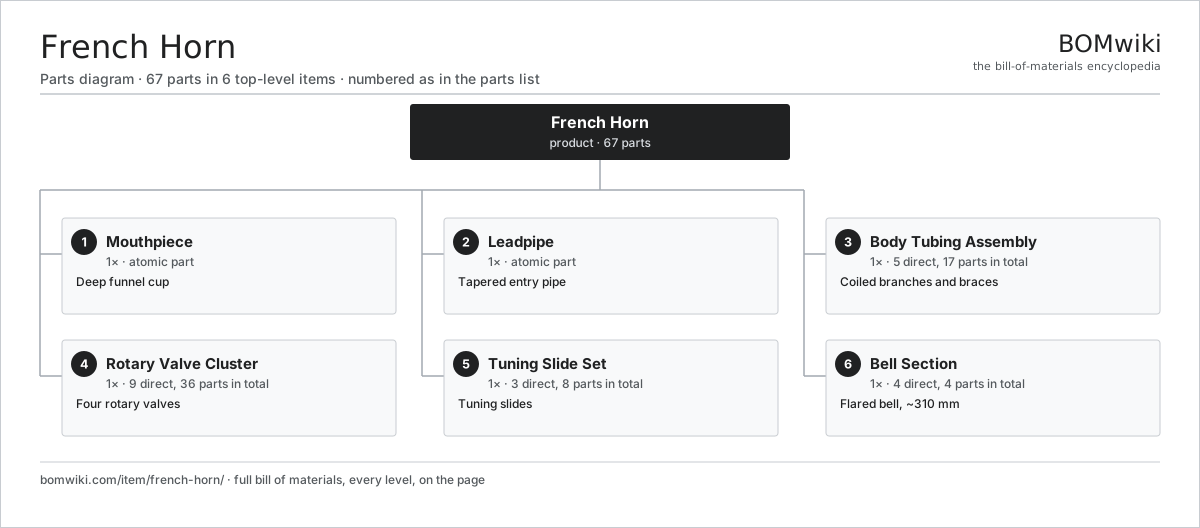
| # | Part | Qty | What it does |
|---|---|---|---|
| 1 | Mouthpiece | 1× | Deep funnel cup |
| 2 | Leadpipe | 1× | Tapered entry pipe |
| 3 | Body Tubing Assembly 5 parts | 1× | Coiled branches and braces |
| 4 | Rotary Valve Cluster 9 parts | 1× | Four rotary valves |
| 5 | Tuning Slide Set 3 parts | 1× | Tuning slides |
| 6 | Bell Section 4 parts | 1× | Flared bell, ~310 mm |
3D model
No 3D model yet. Have a CAD file of this? Add a 3D model. STL renders right on this page; STEP, FreeCAD, and OpenSCAD sources are welcome too (openly licensed, like all 3D models on BOMwiki).
Build & assembly graph
expand / collapse · shared sub-assemblies converge · links to related products · est. labourTap an assembly to expand/collapse · tap a part to open it · use “Open page” for any node · drag to pan, scroll to zoom.
Bill of materials for French Horn
6 top-level lines · 27 rows shown · 67 parts total · indented to 3 levels| # | Item / sub-assembly | Part no. | Qty/assy | Ext. qty | Parts | Type |
|---|---|---|---|---|---|---|
| 1 | Mouthpiece | french-horn-mouthpiece | 1× | 1 | · | part |
| 2 | Leadpipe | french-horn-leadpipe | 1× | 1 | · | part |
| 3 | Body Tubing Assembly 5 parts | french-horn-body-tubing | 1× | 1 | 17 | assembly |
| 3.1 | Coiled Branch | french-horn-branch | 4× | 4 | · | part |
| 3.2 | Knuckle | french-horn-knuckle | 6× | 6 | · | part |
| 3.3 | Brace | french-horn-brace | 5× | 5 | · | part |
| 3.4 | Water Key | french-horn-water-key | 1× | 1 | · | part |
| 3.5 | Finger Hook | french-horn-finger-hook | 1× | 1 | · | part |
| 4 | Rotary Valve Cluster 9 parts | french-horn-valve-cluster | 1× | 1 | 36 | assembly |
| 4.1 | Valve Rotor | french-horn-rotor | 4× | 4 | · | part |
| 4.2 | Valve Casing | french-horn-valve-casing | 4× | 4 | · | part |
| 4.3 | Valve Lever | french-horn-valve-lever | 3× | 3 | · | part |
| 4.4 | Thumb Lever | french-horn-thumb-lever | 1× | 1 | · | part |
| 4.5 | Stop Arm | french-horn-stop-arm | 4× | 4 | · | part |
| 4.6 | Valve Linkage | french-horn-valve-linkage | 4× | 4 | · | part |
| 4.7 | Coil Spring | coil-spring | 4× | 4 | · | part |
| 4.8 | Valve Cap | french-horn-valve-cap | 4× | 4 | · | part |
| 4.9 | Valve Bumper | french-horn-bumper | 8× | 8 | · | part |
| 5 | Tuning Slide Set 3 parts | french-horn-slide-set | 1× | 1 | 8 | assembly |
| 5.1 | Main Tuning Slide | french-horn-main-slide | 1× | 1 | · | part |
| 5.2 | Valve Slide | french-horn-valve-slide | 6× | 6 | · | part |
| 5.3 | B-flat Tuning Slide | french-horn-bflat-slide | 1× | 1 | · | part |
| 6 | Bell Section 4 parts | french-horn-bell-section | 1× | 1 | 4 | assembly |
| 6.1 | Bell Flare | french-horn-bell-flare | 1× | 1 | · | part |
| 6.2 | Bell Tail | french-horn-bell-tail | 1× | 1 | · | part |
| 6.3 | Bell Rim Wire | french-horn-bell-rim-wire | 1× | 1 | · | part |
| 6.4 | Bell Screw Joint | french-horn-bell-ring-joint | 1× | 1 | · | part |
Something wrong in this list? Report a problem with this BOM.
Related products
same domain, ranked by shared parts Bb Trumpet
74 parts · shares 1 with this page
Bb Trumpet
74 parts · shares 1 with this page
 Concert Pedal Harp
554 parts · shares 1 with this page
Concert Pedal Harp
554 parts · shares 1 with this page
 Digital Piano
689 parts · shares 1 with this page
Digital Piano
689 parts · shares 1 with this page
 Drum Kit
226 parts · shares 1 with this page
Drum Kit
226 parts · shares 1 with this page
 Electric Guitar
133 parts · shares 1 with this page
Electric Guitar
133 parts · shares 1 with this page
 Electronic Drum Kit
336 parts · shares 1 with this page
Electronic Drum Kit
336 parts · shares 1 with this page
Sourcing: possible vendors
Browse the supplier directory → Prices, MOQ, and lead times are algorithmic estimates, not quotes, and not claims about these companies. Company mappings are curated by keyword; est. price band $50–$5k. How estimates work| Vendor | HQ | Specialty | MOQ | Lead time |
|---|---|---|---|---|
| yamaha.com ↗ | Hamamatsu, JP | Audio & instruments | 200 units | 8–14 wks |
|
🇺🇸Fender
fender.com ↗
|
Los Angeles, US | Guitars & amps | 200 units | 8–14 wks |
|
🇺🇸Gibson
gibson.com ↗
|
Nashville, US | Guitars | 200 units | 8–14 wks |
|
🇯🇵Roland
roland.com ↗
|
Hamamatsu, JP | Electronic instruments | 200 units | 8–14 wks |
| steinway.com ↗ | New York, US | Pianos | 200 units | 8–14 wks |
718-word article