Friction Welding Machine
ProductOverview
Friction welding joins two solid cylindrical parts (rods, pipes, tubes) end-to-end by rotating one part at high speed and forging it against the other stationary part. Frictional heating at the interface (typically reaching 1000–1200 °C, near melting but not liquid) creates plastic deformation zones. When the forge cylinder applies axial pressure, the plastic material at the interface consolidates, expelling impurities and oxide layers. Result: a metallurgical bond as strong as the base material.
No filler metal, no heat-affected zone softening, and no distortion make friction welding ideal for high-strength, corrosion-resistant welds in aerospace, automotive, and tools. Weld cycles are fast (5–30 seconds total), and weld quality is consistent part-to-part.
The typical machine consists of a variable-speed spindle holding and rotating the first part, a precision carriage supporting the second part, and a hydraulic forge cylinder applying compressive force.
How it works
Part Loading and Alignment: The operator inserts the first part (rotating) into the rotating collet on the spindle, and the second part (stationary) into the stationary collet on the carriage. Both parts are aligned coaxially and are touching or nearly touching (gap < 1 mm). The safety guard is closed.
Spindle Ramp: The operator presses "Start" or "Cycle" on the control panel. The PLC controller energizes the spindle VFD, ramping the spindle speed smoothly from 0 to target RPM (typically 500–2000 rpm for rod welds, up to 3000 rpm for thin tubular). The ramp time is adjustable (typically 2–5 seconds) to avoid shock loading.
As the spindle reaches full speed, friction between the rotating part end and the stationary part end generates heat. Temperature builds up in the interface zone. A thin layer of material (0.5–2 mm) reaches plastic deformation temperature.
Contact and Forge Phase: Once the spindle reaches target speed, the timer circuit signals the hydraulic proportional solenoid valve. The forge cylinder extends, pushing the carriage toward the spindle. The stationary part forges against the rotating part.
Pressure Application and Friction Time: The pressure gauge climbs to the set pressure (typically 50–200 bar, equivalent to 10–100 kN force). The operator maintains this pressure for a set contact time (5–20 seconds, depending on part diameter and material). During this "upset phase," the rotating part and forging force generate intense localized heating and plastic flow at the interface.
The material at the interface reaches plastic deformation temperature (1000–1200 °C, still below melting point ~1450 °C for steel). The forging action extrudes (upsets) impurities and oxide layers outward, producing a solid-state weld with grain structure refined by the severe plastic deformation.
Spindle Brake and Cool-Down: When the contact timer expires, the PLC de-energizes the forge cylinder solenoid (carriage retracts under spring or counter-pressure), and simultaneously applies the electromagnetic brake to the spindle. The spindle decelerates from full speed to zero within 1 second.
The forced-air cooling blower directs cold air at the weld zone, rapidly cooling the interface. The parts remain in the collets under residual forge pressure for another 2–3 seconds, consolidating the weld as it cools.
Weld Inspection and Unload: The operator removes the welded assembly. If properly executed, the weld has minimal upset (typically 1–3 mm of axial shortening), no heat-affected zone softening, and full penetration across the entire cross-section.
Friction vs. Fusion Welding
Advantages of friction:
- Solid-state (no melting): Avoids segregation and porosity common in arc-welded joints.
- Fast: Total cycle 10–30 seconds vs. 5–10 minutes for multi-pass arc welds.
- Repeatable: No weld pool dynamics or arc instability; process is deterministic.
- Clean: No sparks, smoke, or slag; part is ready for immediate use or further machining.
- Grain refinement: Severe plastic deformation produces fine, equiaxed grains, excellent fatigue and impact strength.
Disadvantages:
- Limited to cylindrical shapes: Difficult to friction-weld complex geometries (flanges, offsets).
- Part diameter range: Typically 5–100 mm (limited by spindle power and carriage stroke).
- Capital cost: Equipment is expensive ($200,000–$500,000 for production systems).
- Material-dependent: Some materials (titanium, copper) require special speeds and pressures.
Spindle Speed and Contact Pressure Selection
Weld quality depends on finding the right combination of speed and pressure. Too slow or too low pressure: insufficient heat, cold weld (weak or brittle). Too fast or too high pressure: excessive heat, melting at the interface, or base metal strength loss.
| Material | Diameter | Speed | Pressure | Time |
|---|---|---|---|---|
| Mild steel | 10 mm | 1500 rpm | 50 bar | 10 s |
| Stainless 304 | 10 mm | 2000 rpm | 80 bar | 12 s |
| Aluminum 6061 | 8 mm | 2500 rpm | 40 bar | 8 s |
| Titanium | 6 mm | 500 rpm | 100 bar | 15 s |
| Copper | 12 mm | 1200 rpm | 60 bar | 12 s |
These are starting points; each shop tests to find the exact parameters that produce repeatable, defect-free welds.
Heat Generation and Temperature Control
Heat is generated by friction:
$$Q = mu imes P imes A imes v$$
Where:
- μ = coefficient of friction (~0.3–0.5 for steel on steel)
- P = normal pressure (N/mm²)
- A = contact area (mm²)
- v = relative velocity (m/s)
A 10 mm diameter rod rotating at 1500 rpm generates ~5–10 kW of frictional power. With a contact area of ~80 mm², and forging pressure of 50 bar, the interface temperature quickly reaches 1000 °C.
Cooling: The blower system cools the weld zone after spindle braking. The large mass of the two parts also acts as a heat sink, conducting internal heat away from the interface. Typical weld zone temperature drops from 1000 °C to room temperature within 5–10 seconds after braking.
No post-weld stress relief required (unlike arc welds) because there is no large heat-affected zone. The weld itself is stronger than the base metal due to fine grain structure.
Upset and Burn-Off
During welding, plastic material is expelled radially, creating an "upset collar" around the weld. This is normal and expected. Upset amount (axial shortening of the assembly) is typically 1–5 mm, depending on part length and pressure. After welding, the upset collar may be machined off or left as-is, depending on functional requirements.
"Burn-off" is the amount of material expelled and oxidized. For a 10 mm diameter rod welded for 10 seconds, burn-off is typically 0.5–1 mm of length per part. This is accounted for when designing part length.
Inertia and Friction Welding vs. Continuous-Drive
Inertia friction welding (IFW): A large flywheel is spun up to high speed, then suddenly engaged to the weld spindle. The flywheel's kinetic energy drives the friction weld as it decelerates. This is faster (3–8 second total cycle) but requires a larger, more expensive machine.
Continuous-drive (shown here): The spindle motor continuously supplies power. Cycle times are longer (10–30 seconds), but equipment is simpler and more flexible for varying materials and part sizes. Most small job shops use continuous-drive.
Part Design and Fit-Up Requirements
Friction-weldable parts must be:
- Cylindrical: Any circular cross-section (solid rod, hollow tube).
- Coaxial: The two parts must be aligned within 0.5–1 mm runout.
- Clean surfaces: Oxide scale and oil must be removed (wire-brush or grind).
- Similar or compatible materials: Dissimilar metals (aluminum to steel) are very difficult and require special procedures.
Parts with flanges, shoulders, or step changes can be friction-welded, but additional collet fixtures and setup time are needed.
Maintenance
Spindle bearings: Annual inspection and re-greasing (if not sealed). High-speed spindles generate centrifugal forces; bearings must be preloaded properly to prevent cage distortion.
Collets: Visual inspection before each part; replace if collet jaws show visible wear or cracks. Worn collets slip during forge phase, producing weak welds.
Hydraulic system: Check pump pressure (should hold setpoint ±5 bar), inspect hoses for leaks or abrasion, and change hydraulic fluid every 2 years or 2000 operating hours.
VFD: Monitor cooling fan operation (should run whenever VFD is powered). Keep ambient temperature below 50 °C. If VFD trips on over-temperature, allow 30 min cool-down before restart.
Guard and safety interlocks: Test guard position switch monthly (spindle should not start if guard open). Clean sensor faces of dust. Replace switch contacts every 5 years or if chattering occurs.
Weld Defects and Troubleshooting
Cold weld (weak, brittle): Insufficient speed (increase RPM 200–300), low pressure (increase by 10–20 bar), or too short contact time (extend 2–3 seconds). Test by bending the welded rod; a cold weld bends or fractures at the interface.
Melting/burn-through (visible liquid at interface): Over-speed (reduce RPM 200–300), excessive pressure (reduce by 20–30 bar), or too long contact time (reduce by 3–5 seconds). Result is a brittle intermetallic zone and loss of ductility.
Eccentricity (off-axis weld, visible offset): Collet misalignment (re-seat parts in collets and check runout with dial indicator), or spindle bearing wear (spindle runout > 0.2 mm indicates bearing replacement needed).
Upset collar uneven: Part diameter variation or collet jaw wear (replace collet jaws if wear grooves visible). Uneven upset suggests non-coaxial parts; re-align carefully.
Spindle won't reach full speed: Motor overloaded (reduce pressure or contact time), VFD fault (check error code, reset), or spindle bearing friction too high (bearing replacement).
Guard switch prevents cycle: Guard position sensor misaligned (re-aim sensor or clean lens), or guard physically stuck (lubricate hinge). Safety interlocks must pass for any cycle start.
Production and Cost
A friction welder produces one weld every 15–30 seconds (depending on material and part geometry). That is 120–240 welds per hour. At USD 10–20 labor per weld, total production cost is USD 120–240/hour, or 0.5–1 USD per weld. Compare this to arc welding (USD 5–10 per pass, multi-pass welds USD 20–50 total), and friction wins on speed for high-volume cylindrical assemblies.
Equipment cost (USD 250,000–500,000) is recovered at high production volumes. For low-volume or custom work (< 100 welds/month), friction welding may not be economical.
Friction Welding Machine parts and their functions
8 top-level parts · 48 parts in total · full bill of materials below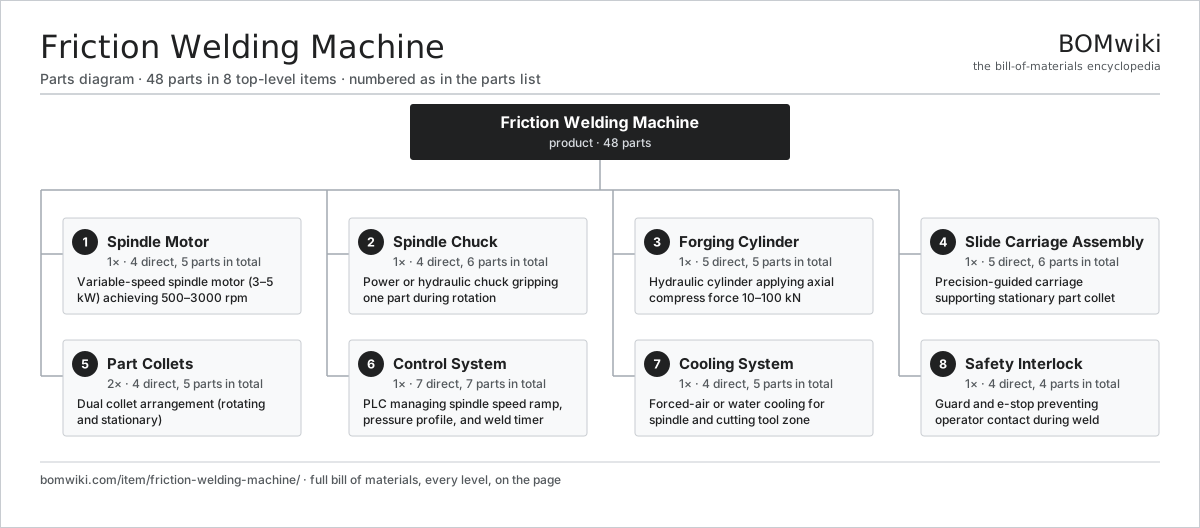
| # | Part | Qty | What it does |
|---|---|---|---|
| 1 | Spindle Motor 4 parts | 1× | Variable-speed spindle motor (3–5 kW) achieving 500–3000 rpm |
| 2 | Spindle Chuck 4 parts | 1× | Power or hydraulic chuck gripping one part during rotation |
| 3 | Forging Cylinder 5 parts | 1× | Hydraulic cylinder applying axial compress force 10–100 kN |
| 4 | Slide Carriage Assembly 5 parts | 1× | Precision-guided carriage supporting stationary part collet |
| 5 | Part Collets 4 parts | 2× | Dual collet arrangement (rotating and stationary) |
| 6 | Control System 7 parts | 1× | PLC managing spindle speed ramp, pressure profile, and weld timer |
| 7 | Cooling System 4 parts | 1× | Forced-air or water cooling for spindle and cutting tool zone |
| 8 | Safety Interlock 4 parts | 1× | Guard and e-stop preventing operator contact during weld |
3D model
No 3D model yet. Have a CAD file of this? Add a 3D model. STL renders right on this page; STEP, FreeCAD, and OpenSCAD sources are welcome too (openly licensed, like all 3D models on BOMwiki).
Build & assembly graph
expand / collapse · shared sub-assemblies converge · links to related products · est. labourTap an assembly to expand/collapse · tap a part to open it · use “Open page” for any node · drag to pan, scroll to zoom.
Bill of materials for Friction Welding Machine
8 top-level lines · 45 rows shown · 48 parts total · indented to 3 levels| # | Item / sub-assembly | Part no. | Qty/assy | Ext. qty | Parts | Type |
|---|---|---|---|---|---|---|
| 1 | Spindle Motor 4 parts | friction-welding-machine-spindle-motor | 1× | 1 | 5 | assembly |
| 1.1 | Spindle VFD | friction-welding-machine-spindle-vfd | 1× | 1 | · | part |
| 1.2 | Spindle Bearings | friction-welding-machine-spindle-bearings | 2× | 2 | · | part |
| 1.3 | Spindle Housing | friction-welding-machine-spindle-housing | 1× | 1 | · | part |
| 1.4 | Spindle Brake | friction-welding-machine-spindle-brake | 1× | 1 | · | part |
| 2 | Spindle Chuck 4 parts | friction-welding-machine-spindle-chuck | 1× | 1 | 6 | assembly |
| 2.1 | Chuck Jaw | friction-welding-machine-chuck-jaw | 3× | 3 | · | part |
| 2.2 | Chuck Actuator | friction-welding-machine-chuck-actuator | 1× | 1 | · | part |
| 2.3 | Chuck Body | friction-welding-machine-chuck-body | 1× | 1 | · | part |
| 2.4 | Chuck Quick-Change | friction-welding-machine-chuck-key | 1× | 1 | · | part |
| 3 | Forging Cylinder 5 parts | friction-welding-machine-forging-cylinder | 1× | 1 | 5 | assembly |
| 3.1 | Forge Cylinder Body | friction-welding-machine-forge-cylinder-body | 1× | 1 | · | part |
| 3.2 | Forge Piston | friction-welding-machine-forge-piston | 1× | 1 | · | part |
| 3.3 | Forge Seals | friction-welding-machine-forge-seals | 1× | 1 | · | part |
| 3.4 | Forge Relief Valve | friction-welding-machine-forge-pressure-relief | 1× | 1 | · | part |
| 3.5 | Forge Pressure Gauge | friction-welding-machine-forge-gauge | 1× | 1 | · | part |
| 4 | Slide Carriage Assembly 5 parts | friction-welding-machine-slide-carriage | 1× | 1 | 6 | assembly |
| 4.1 | Carriage Base | friction-welding-machine-carriage-base | 1× | 1 | · | part |
| 4.2 | Linear Guide | friction-welding-machine-linear-guide | 1× | 1 | · | part |
| 4.3 | Carriage Block | friction-welding-machine-carriage-block | 1× | 1 | · | part |
| 4.4 | Backing Plate | friction-welding-machine-backing-plate | 1× | 1 | · | part |
| 4.5 | Ball Bearing | ball-bearing | 2× | 2 | · | part |
| 5 | Part Collets 4 parts | friction-welding-machine-part-collets | 2× | 2 | 5 | assembly |
| 5.1 | Rotating Collet | friction-welding-machine-rotating-collet | 1× | 2 | · | part |
| 5.2 | Stationary Collet | friction-welding-machine-stationary-collet | 1× | 2 | · | part |
| 5.3 | Collet Socket | friction-welding-machine-collet-socket | 2× | 4 | · | part |
| 5.4 | Collet Puller | friction-welding-machine-collet-puller | 1× | 2 | · | part |
| 6 | Control System 7 parts | friction-welding-machine-control-system | 1× | 1 | 7 | assembly |
| 6.1 | PLC Controller | friction-welding-machine-plc | 1× | 1 | · | part |
| 6.2 | Speed Control | friction-welding-machine-spindle-speed-knob | 1× | 1 | · | part |
| 6.3 | Weld Timer | friction-welding-machine-forge-time-dial | 1× | 1 | · | part |
| 6.4 | Ramp Timer | friction-welding-machine-spindle-ramp-dial | 1× | 1 | · | part |
| 6.5 | Pressure Feedback | friction-welding-machine-pressure-feedback | 1× | 1 | · | part |
| 6.6 | Speed Sensor | friction-welding-machine-spindle-speed-sensor | 1× | 1 | · | part |
| 6.7 | Power Supply | power-supply | 1× | 1 | · | part |
| 7 | Cooling System 4 parts | friction-welding-machine-cooling-system | 1× | 1 | 5 | assembly |
| 7.1 | Cooling Blower | friction-welding-machine-cooling-blower | 1× | 1 | · | part |
| 7.2 | Cooling Duct | friction-welding-machine-cooling-duct | 1× | 1 | · | part |
| 7.3 | Cooling Nozzle | friction-welding-machine-cooling-nozzle | 2× | 2 | · | part |
| 7.4 | Cooling Filter | friction-welding-machine-cooling-filter | 1× | 1 | · | part |
| 8 | Safety Interlock 4 parts | friction-welding-machine-safety-interlock | 1× | 1 | 4 | assembly |
| 8.1 | Guard Cover | friction-welding-machine-guard-cover | 1× | 1 | · | part |
| 8.2 | Guard Switch | friction-welding-machine-guard-switch | 1× | 1 | · | part |
| 8.3 | E-Stop Button | friction-welding-machine-e-stop-button | 1× | 1 | · | part |
| 8.4 | Warning Beacon | friction-welding-machine-warning-light | 1× | 1 | · | part |
Something wrong in this list? Report a problem with this BOM.
Sourcing: possible vendors
Browse the supplier directory → Prices, MOQ, and lead times are algorithmic estimates, not quotes, and not claims about these companies. Company mappings are curated by keyword; est. price band $10k–$1M. How estimates work| Vendor | HQ | Specialty | MOQ | Lead time |
|---|---|---|---|---|
|
🇩🇪DMG MORI
dmgmori.com ↗
|
Bielefeld, DE | Machine tools | 5 units | 12–20 wks |
|
🇯🇵Mazak
mazak.com ↗
|
Oguchi, JP | Machine tools | 5 units | 12–20 wks |
| haascnc.com ↗ | Oxnard, US | CNC machine tools | 5 units | 12–20 wks |
|
🇯🇵Okuma
okuma.com ↗
|
Niwa, JP | Machine tools | 5 units | 12–20 wks |
|
🇩🇪Trumpf
trumpf.com ↗
|
Ditzingen, DE | Laser & sheet-metal machines | 5 units | 12–20 wks |
1,765-word article