Optical Fruit Sorter
ProductOverview
An optical fruit sorter uses machine vision and near-infrared spectroscopy to grade fruit by appearance and internal quality (ripeness, sugar content, defects) at line speed. The Input Hopper feeds fruit into a Single-File Conveyor conveyor that orients them in single lane. The Optical Inspection Head scans each fruit, and the Air Ejection System pneumatically deflects substandard fruit into reject lanes while premium fruit continues forward.
Exporters, packers, and juice producers use optical sorters to achieve consistent quality, reduce labor (vision replaces human graders), and minimize waste. A well-tuned sorter can process 200–500 fruit per minute and detect subtle defects invisible to human inspectors.
Single-file conveyor and fruit orientation
The Single-File Conveyor is a gentle belt moving at 1–3 m/min (adjustable). The Edge Guide Rails keep fruit in a centered lane, preventing overlap or contact with the inspection head.
Fruit orientation is critical: a sorter must see the fruit from a consistent angle. Some machines use a curved diverter or orienting wheel to ensure fruit pass the camera in a standardized position. Unoriented fruit can lead to misclassification (a defect on the unseen side goes to premium lane).
Optical inspection system
The Optical Inspection Head is a compact assembly containing:
Color Camera: The Color Camera Module captures full-color (RGB) images in bright white light. The camera resolution is 5–12 megapixels; higher resolution allows finer defect detection (small dark specks, cracks, color blemishes). The Camera Lens is a fixed-focus industrial lens (typically 25 mm), and the Camera Processor converts raw sensor data to images at 100–1000 frames per second depending on fruit speed.
Color analysis identifies:
- Skin color and maturity (darker = riper for many fruits).
- Surface defects: scars, bruises, mold, insect damage.
- Size (pixel count in the image, compared to calibration).
NIR Spectrometer: The NIR Spectrometer Module measures reflected light in the near-infrared spectrum (700–2500 nm). Different wavelengths penetrate the fruit skin to varying depths, revealing internal properties:
- Sugar content (high sugar absorbs 940 nm more than 1100 nm).
- Ripeness (related to pigment composition).
- Blemishes inside the fruit (internal browning, rot, hollow spots).
The NIR Sensor Array is typically 8–16 discrete wavelength channels, each with its own detector. The fruit-sorted-nir-processor calculates a ripeness index or sugar content estimate for each fruit.
Lighting: The Illumination System provides uniform illumination. The RGB LED Ring produces bright white light for color imaging; the NIR LED Ring provides infrared illumination for spectral measurement. Both rings fire in sync with camera exposure.
Machine vision and classification
Raw images (RGB pixels, 16 NIR spectral values) are fed to an AI model running on the Industrial PC industrial PC. The model is typically a deep convolutional neural network trained on thousands of labeled fruit images. It outputs a class (grade A, B, C, reject) and a confidence score for each fruit.
Grading rules are customizable:
- Premium: Color in range X–Y, no visible defects, sugar content >11 Brix.
- Grade 1: Minor color deviation, small surface mark (<5 mm), sugar >10 Brix.
- Grade 2: Moderate color shift, defect up to 10 mm, sugar >8 Brix.
- Reject: Severe color, large defects, rot, sugar <8 Brix.
The model processes one fruit per 200–500 ms, depending on camera frame rate and model complexity.
Ejection and lane diversion
The Air Ejection System delivers pneumatic rejection at 100+ ms latency from detection. The Control & Vision Processor PLC triggers the appropriate Solenoid Valve as each fruit approaches an fruit-sorting-ejector-nozzle. A short high-pressure air pulse (100–200 ms) ejects the fruit sideways into a reject lane.
Timing precision is critical: if the solenoid fires early, the wrong fruit is rejected; if late, the fruit misses the deflection zone. The PLC uses the rotary encoder on the Belt Drive Motor to predict fruit position and trigger ejection with millisecond precision.
The Discharge Conveyor Lanes are typically 3–5 small belt conveyors or chutes, each handling one grade. Rejected fruit (bruised, small, unripe) falls into a lower-value lane; premium fruit continues to the top lane. Some sorters include a final lane diverter gate (pneumatic actuator) to redirect fruit between lanes based on real-time demand.
Air supply
The Air Compressor is a rotary screw or piston unit (0.75–1.5 kW) delivering 4–6 bar air to the ejector solenoid valves. The Air Storage Tank (30–50 L) smooths pressure ripples and provides surge capacity for rapid nozzle pulses.
Compressed air must be clean and dry: an aftercooler and water separator (auto drain) remove moisture and oil carryover, preventing solenoid stiction and nozzle clogging.
Sorting accuracy and false rejects
Optimal performance is 95–99% accuracy, but this depends on:
- Training data quality: models trained on thousands of labeled examples of your specific fruit variety will outperform generic models.
- Defect visibility: large bruises or mold are easy to detect; internal voids are harder.
- Lighting: inconsistent illumination causes misclassification.
- Fruit speed: faster speeds reduce inspection time and increase false rejects.
An operator typically tunes the sensitivity dial: sliding toward "permissive" reduces false rejects (less premium fruit sent to reject lane) but increases false accepts (some defects pass); sliding toward "strict" catches more defects but wastes premium fruit.
Calibration and maintenance
Daily: Nozzles are blown clear with compressed air to remove sugar residue or dust. The camera lens is wiped with a clean cloth.
Weekly: A calibration fruit (standard color, known ripeness) is run through the sorter to verify model accuracy. If accuracy drops >2%, the model may need retraining or the camera lens may need cleaning.
Monthly: The NIR LED Ring and RGB LED Ring are checked for brightness (LEDs dim over time); if measured LED current drops >10%, bulbs are replaced. The Camera Lens is cleaned with lens paper and isopropyl alcohol.
Quarterly: The Air Storage Tank drain valve is opened to remove collected water. The fruit-sorting-ejector-nozzles are removed and flushed with warm water (sugar deposits can clog jets).
Annually: The air compressor oil is changed. The PLC memory is backed up. Model performance is reviewed; if new fruit varieties or seasonal variations appear, the model is retrained with recent data.
Sorting speed and throughput
Sorting speed is limited by inspection time and ejection reaction time. A fruit takes ~200 ms to pass the inspection head at typical speed; adding 100 ms for detection and ejection lag, the machine can classify one fruit every 300 ms = 12 fruit/min per lane. With multiple lanes, throughput scales.
Higher speeds (up to 500 fruit/min for small fruit like berries) require faster cameras (1000+ fps), more processing power, and faster solenoid valves. For large fruit (apples, oranges), 100–200 fruit/min is typical.
Quality consistency
An optical sorter removes human subjectivity. Three human graders might rate the same apple differently; the sorter is consistent (though it can be fooled by unusual defects not in its training set). Weekly audits (manually inspecting a sample of rejected fruit) ensure the sorter's logic aligns with business requirements.
Data logging and traceability
Modern sorters log which fruit went to which lane, with timestamps. Some systems include a simple barcode or QR label applied to each fruit before sorting; rejected fruit are then tracked to their source (orchard, harvest date) for quality feedback. This data is valuable for orchard management and variety improvement.
Optical Fruit Sorter parts and their functions
7 top-level parts · 200 parts in total · full bill of materials below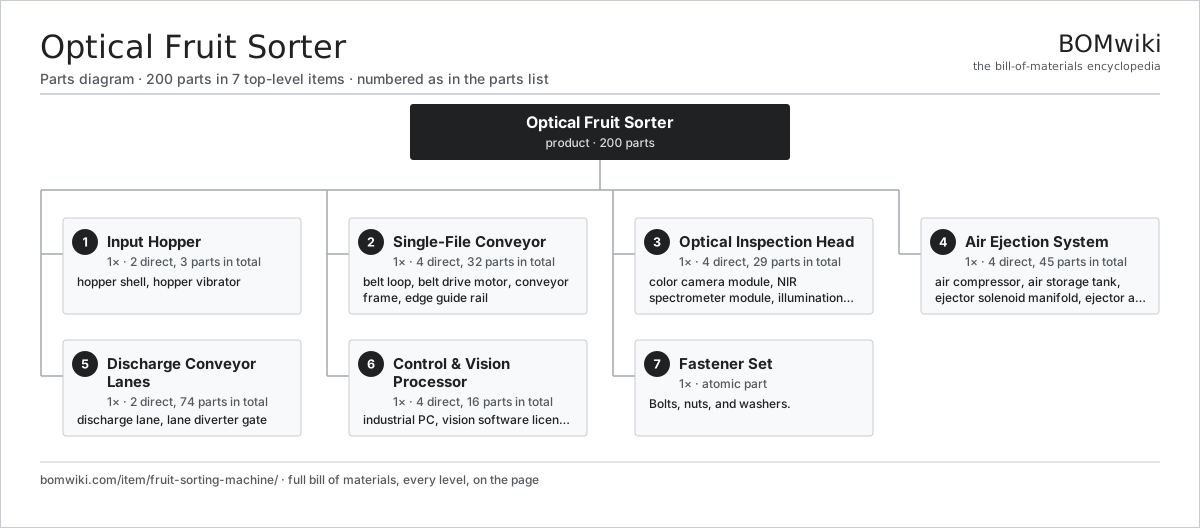
| # | Part | Qty | What it does |
|---|---|---|---|
| 1 | Input Hopper 2 parts | 1× | Stainless funnel feeding fruit to single-file conveyor. |
| 2 | Single-File Conveyor 4 parts | 1× | Gentle belt conveyor orienting fruit in single lane. |
| 3 | Optical Inspection Head 4 parts | 1× | Camera and NIR imaging array analyzing fruit quality and color. |
| 4 | Air Ejection System 4 parts | 1× | Solenoid valves and air jets rapidly deflecting defective fruit. |
| 5 | Discharge Conveyor Lanes 2 parts | 1× | Multiple small conveyors collecting sorted grades. |
| 6 | Control & Vision Processor 4 parts | 1× | Industrial PC running sorting algorithm and solenoid drivers. |
| 7 | Fastener Set | 1× | Bolts, nuts, and washers. |
3D model
No 3D model yet. Have a CAD file of this? Add a 3D model. STL renders right on this page; STEP, FreeCAD, and OpenSCAD sources are welcome too (openly licensed, like all 3D models on BOMwiki).
Build & assembly graph
expand / collapse · shared sub-assemblies converge · links to related products · est. labourTap an assembly to expand/collapse · tap a part to open it · use “Open page” for any node · drag to pan, scroll to zoom.
Bill of materials for Optical Fruit Sorter
7 top-level lines · 68 rows shown · 200 parts total · indented to 3 levels| # | Item / sub-assembly | Part no. | Qty/assy | Ext. qty | Parts | Type |
|---|---|---|---|---|---|---|
| 1 | Input Hopper 2 parts | fruit-sorting-hopper | 1× | 1 | 3 | assembly |
| 1.1 | Hopper Shell | fruit-sorting-hopper-shell | 1× | 1 | · | part |
| 1.2 | Hopper Vibrator 2 parts | fruit-sorting-hopper-vibrator | 1× | 1 | 2 | assembly |
| 1.2.1 | Vibrator Coil | fruit-sorting-vibrator-coil | 1× | 1 | · | part |
| 1.2.2 | Armature Plate | fruit-sorting-vibrator-armature | 1× | 1 | · | part |
| 2 | Single-File Conveyor 4 parts | fruit-sorting-single-file | 1× | 1 | 32 | assembly |
| 2.1 | Belt Loop 3 parts | fruit-sorting-single-file-belt | 1× | 1 | 3 | assembly |
| 2.1.1 | Belt Fabric | fruit-sorting-belt-fabric | 1× | 1 | · | part |
| 2.1.2 | Drive Pulley | fruit-sorting-belt-drive-pulley | 1× | 1 | · | part |
| 2.1.3 | Idler Pulley | fruit-sorting-belt-idler-pulley | 1× | 1 | · | part |
| 2.2 | Belt Drive Motor 4 parts | fruit-sorting-single-file-motor | 1× | 1 | 25 | assembly |
| 2.2.1 | Stator Assembly 3 parts + deeper › | stator-assembly | 1× | 1 | 3 | assembly |
| 2.2.2 | Rotor Assembly 4 parts + deeper › | rotor-assembly | 1× | 1 | 19 | assembly |
| 2.2.3 | Motor Housing | motor-housing | 1× | 1 | · | part |
| 2.2.4 | Ball Bearing | ball-bearing | 2× | 2 | · | part |
| 2.3 | Conveyor Frame 2 parts | fruit-sorting-single-file-frame | 1× | 1 | 2 | assembly |
| 2.3.1 | Main Beam | fruit-sorting-frame-beam | 1× | 1 | · | part |
| 2.3.2 | Frame Rail | fruit-sorting-frame-rail | 1× | 1 | · | part |
| 2.4 | Edge Guide Rail | fruit-sorting-edge-guide | 2× | 2 | · | part |
| 3 | Optical Inspection Head 4 parts | fruit-sorting-inspection-head | 1× | 1 | 29 | assembly |
| 3.1 | Color Camera Module 4 parts | fruit-sorting-camera-module | 1× | 1 | 5 | assembly |
| 3.1.1 | CMOS Image Sensor | image-sensor | 1× | 1 | · | part |
| 3.1.2 | Camera Lens | fruit-sorting-camera-lens | 1× | 1 | · | part |
| 3.1.3 | Camera Housing | fruit-sorting-camera-housing | 1× | 1 | · | part |
| 3.1.4 | Camera Processor 2 parts + deeper › | fruit-sorting-camera-processor | 1× | 1 | 2 | assembly |
| 3.2 | NIR Spectrometer Module 2 parts | fruit-sorting-nir-module | 1× | 1 | 3 | assembly |
| 3.2.1 | NIR Sensor Array | fruit-sorting-nir-array | 1× | 1 | · | part |
| 3.2.2 | NIR Processor 2 parts + deeper › | fruit-sorting-nir-processor | 1× | 1 | 2 | assembly |
| 3.3 | Illumination System 3 parts | fruit-sorting-lighting-system | 1× | 1 | 20 | assembly |
| 3.3.1 | RGB LED Ring 2 parts + deeper › | fruit-sorting-rgb-led-ring | 1× | 1 | 9 | assembly |
| 3.3.2 | NIR LED Ring 2 parts + deeper › | fruit-sorting-nir-led-ring | 1× | 1 | 9 | assembly |
| 3.3.3 | LED Driver Module 2 parts + deeper › | fruit-sorting-led-driver | 1× | 1 | 2 | assembly |
| 3.4 | Lens Holder | fruit-sorting-lens-assembly | 1× | 1 | · | part |
| 4 | Air Ejection System 4 parts | fruit-sorting-ejection-system | 1× | 1 | 45 | assembly |
| 4.1 | Air Compressor 2 parts | fruit-sorting-air-compressor | 1× | 1 | 24 | assembly |
| 4.1.1 | Compressor Motor 3 parts + deeper › | fruit-sorting-compressor-motor | 1× | 1 | 23 | assembly |
| 4.1.2 | Pump Head | fruit-sorting-compressor-pump-head | 1× | 1 | · | part |
| 4.2 | Air Storage Tank 3 parts | fruit-sorting-air-tank | 1× | 1 | 3 | assembly |
| 4.2.1 | Tank Shell | fruit-sorting-tank-shell | 1× | 1 | · | part |
| 4.2.2 | Pressure Relief Valve | fruit-sorting-tank-pressure-valve | 1× | 1 | · | part |
| 4.2.3 | Tank Drain Valve | fruit-sorting-tank-drain | 1× | 1 | · | part |
| 4.3 | Ejector Solenoid Manifold 2 parts | fruit-sorting-ejector-manifold | 1× | 1 | 9 | assembly |
| 4.3.1 | Manifold Block | fruit-sorting-manifold-block | 1× | 1 | · | part |
| 4.3.2 | Solenoid Valve | fruit-sorting-solenoid-valve | 8× | 8 | · | part |
| 4.4 | Ejector Air Nozzle Array 2 parts | fruit-sorting-ejector-nozzles | 1× | 1 | 9 | assembly |
| 4.4.1 | Air Nozzle | fruit-sorting-nozzle | 8× | 8 | · | part |
| 4.4.2 | Nozzle Mounting Rail | fruit-sorting-nozzle-manifold | 1× | 1 | · | part |
| 5 | Discharge Conveyor Lanes 2 parts | fruit-sorting-discharge-lanes | 1× | 1 | 74 | assembly |
| 5.1 | Discharge Lane 2 parts | fruit-sorting-discharge-lane | 3× | 3 | 24 | assembly |
| 5.1.1 | Lane Belt | fruit-sorting-lane-belt | 1× | 3 | · | part |
| 5.1.2 | Lane Motor 3 parts + deeper › | fruit-sorting-lane-motor | 1× | 3 | 23 | assembly |
| 5.2 | Lane Diverter Gate 2 parts | fruit-sorting-lane-diverter | 1× | 1 | 2 | assembly |
| 5.2.1 | Diverter Blade | fruit-sorting-diverter-blade | 1× | 1 | · | part |
| 5.2.2 | Diverter Actuator 1 parts + deeper › | fruit-sorting-diverter-actuator | 1× | 1 | 1 | assembly |
| 6 | Control & Vision Processor 4 parts | fruit-sorting-control-system | 1× | 1 | 16 | assembly |
| 6.1 | Industrial PC 4 parts | fruit-sorting-pc | 1× | 1 | 4 | assembly |
| 6.1.1 | CPU Board | fruit-sorting-cpu-board | 1× | 1 | · | part |
| 6.1.2 | GPU Accelerator | fruit-sorting-gpu-module | 1× | 1 | · | part |
| 6.1.3 | Storage Module | fruit-sorting-memory | 1× | 1 | · | part |
| 6.1.4 | Bare PCB | pcb-bare | 1× | 1 | · | part |
| 6.2 | Vision Software License | fruit-sorting-vision-software | 1× | 1 | · | part |
| 6.3 | Solenoid Driver Board 2 parts | fruit-sorting-solenoid-driver-board | 1× | 1 | 9 | assembly |
| 6.3.1 | Driver Relay | fruit-sorting-driver-relay | 8× | 8 | · | part |
| 6.3.2 | Driver PCB | fruit-sorting-driver-pcb | 1× | 1 | · | part |
| 6.4 | HMI Touchscreen 2 parts | fruit-sorting-hmi | 1× | 1 | 2 | assembly |
| 6.4.1 | LCD Panel | lcd-panel | 1× | 1 | · | part |
| 6.4.2 | Touch Digitizer | touch-digitizer | 1× | 1 | · | part |
| 7 | Fastener Set | fastener-set | 1× | 1 | · | part |
Something wrong in this list? Report a problem with this BOM.
Related products
same domain, ranked by shared parts Grain Color Sorter
3,056 parts · shares 14 with this page
Automatic Filleting Machine
73 parts · shares 2 with this page
Grain Color Sorter
3,056 parts · shares 14 with this page
Automatic Filleting Machine
73 parts · shares 2 with this page
 Chocolate Enrober
470 parts · shares 13 with this page
Chocolate Moulding Line
223 parts · shares 13 with this page
Chocolate Enrober
470 parts · shares 13 with this page
Chocolate Moulding Line
223 parts · shares 13 with this page
 Chocolate Tempering Machine
141 parts · shares 13 with this page
Chocolate Tempering Machine
141 parts · shares 13 with this page
Sourcing: possible vendors
Browse the supplier directory → Prices, MOQ, and lead times are algorithmic estimates, not quotes, and not claims about these companies. Company mappings are curated by keyword; est. price band $1k–$500k. How estimates work| Vendor | HQ | Specialty | MOQ | Lead time |
|---|---|---|---|---|
| gea.com ↗ | Düsseldorf, DE | Process technology | 20 units | 12–20 wks |
| buhlergroup.com ↗ | Uzwil, CH | Food & materials processing | 20 units | 12–20 wks |
| tetrapak.com ↗ | Pully, CH | Food packaging & processing | 20 units | 12–20 wks |
| jbtc.com ↗ | Chicago, US | Food processing equipment | 20 units | 12–20 wks |
| alfalaval.com ↗ | Lund, SE | Heat transfer & separation | 20 units | 12–20 wks |
1,266-word article