FTIR Spectrometer
ProductOverview
Fourier-transform infrared (FTIR) spectroscopy identifies chemical bonds and functional groups by measuring molecular absorption of infrared radiation. Unlike classical dispersive spectrometers that scan one wavelength at a time, FTIR instruments capture broadband IR simultaneously using an optical interferometer, then convert the resulting interferogram into a frequency spectrum via mathematical Fourier transform. This approach yields superior signal-to-noise ratio (~100×), faster acquisition, and superior spectral resolution compared to older technologies.
FTIR dominates materials characterization in pharmaceutical R&D, polymer science, coatings, catalysis, and forensics. A single spectrum takes 1–10 seconds and requires <1 mg solid sample or <1 mL liquid.
How it works
The Interferometer (Michelson): The optical engine is a Michelson interferometer. Broadband IR from a heated ceramic source passes through a beamsplitter, which acts as a 50/50 reflector/transmitter at all IR frequencies. Half the light reflects to a fixed mirror, half transmits to a moving mirror on a motorized linear stage. The two beams recombine at the beamsplitter. As the moving mirror sweeps ±0.5–5 cm, the optical path difference (OPD) between the two arms increases, causing constructive and destructive interference. If a particular frequency has wavelength λ, it constructively interferes when OPD = n × λ (n = integer) and destructively interferes at half-wavelengths.
The detector continuously measures total intensity as the mirror moves, recording an interference pattern called an interferogram. The intensity oscillates as each frequency component alternately reinforces and cancels. A laser encoder (typically HeNe at 632.8 nm) tracks the exact mirror position with <100 nm precision.
Fourier Transform: The raw interferogram is a superposition of cosine waves, one for each frequency in the sample. Mathematically, inverting this relationship via Fourier transform extracts the amplitude and phase of each frequency, yielding a spectrum of absorbance vs. wavenumber (measured in cm⁻¹, which is 1/wavelength). Modern instruments perform this FFT digitally at >100,000 samples per second, storing the result as a 4000-point array from 400–4000 cm⁻¹.
Signal Acquisition: The interferogram is sampled at each mirror position using a laser trigger; for 4000 cm⁻¹ range and 2 cm⁻¹ resolution, ~4000 samples per scan are collected over ~40 ms. The detector's transimpedance preamp converts minute currents (picoamps for thermal detectors) into millivolts, then an anti-alias filter and analog-to-digital converter digitize at 16–24 bits.
Sample Measurement: The sample sits between the interferometer output and detector. In transmission mode (solids pressed into KBr or NaCl windows, or liquids in sealed cells), IR light passes through the sample, and portions of specific frequencies are absorbed. The detector records reduced intensity at those wavenumbers, revealing the sample's absorbance spectrum. In attenuated total reflection (ATR) mode, light undergoes evanescent-wave interaction at a ZnSe crystal surface, allowing analysis of opaque solids and aqueous solutions without dissolution.
Spectral Quality: To minimize water vapor (strong 3300–3000 cm⁻¹ and 1600 cm⁻¹ absorptions) and atmospheric CO₂ (1200–1300 cm⁻¹), many systems include optional purge with dry nitrogen or CO₂-free air flowing through the sample compartment. This typically improves baseline noise by 50% below 1500 cm⁻¹.
Interpretation
Infrared spectra are dominated by functional group vibrations: C–H stretches (2900–3000 cm⁻¹), C=O (1600–1750 cm⁻¹), O–H (3200–3600 cm⁻¹), N–H (3300–3500 cm⁻¹), and aromatic C=C (1400–1600 cm⁻¹). Fingerprint region (400–1500 cm⁻¹) is molecule-specific and used for identity matching against spectral libraries (>100,000 reference compounds available). Quantitative analysis is feasible using Beer-Lambert law if extinction coefficients and path lengths are known.
Advantages over Dispersive IR
- Throughput: All frequencies captured simultaneously (Fellgett advantage) vs. single-wavelength scanning.
- Resolution: Laser-encoder precision yields sub-wavenumber resolution.
- Speed: Full spectrum in 1–5 seconds; classical scanning needed minutes.
- Aperture: Smaller apertures usable (Jacquinot advantage) without intensity loss, improving spatial resolution for microscopy.
Applications
- Pharmaceutical: Polymorphism detection (different crystal forms of APIs), stability testing under heat/humidity, and impurity profiling.
- Polymers & Coatings: Curing kinetics, cross-link density, and composition (filled resins, blends).
- Catalysis: Identification of functional groups on catalyst surfaces; CO and pyridine adsorption studies.
- Forensics: Fiber identification, paint analysis, and drug screening.
- Environmental: Contamination analysis in soil, sediment, and wastewater sludge.
Maintenance
- Beamsplitter wear: Metallic coating degrades after 500–1000 operating hours; substrate remains usable if re-coated.
- Source aging: Nichrome coils weaken; replacement every 1–2 years typical.
- Detector care: DTGS elements age gracefully (~10-year lifespan); MCT detectors require periodic liquid-N₂ refill (weekly) and eventual replacement (~5 years).
- Optical alignment: Annual check-up; gold mirrors and optics require only dry-cloth cleaning.
FTIR Spectrometer parts and their functions
7 top-level parts · 32 parts in total · full bill of materials below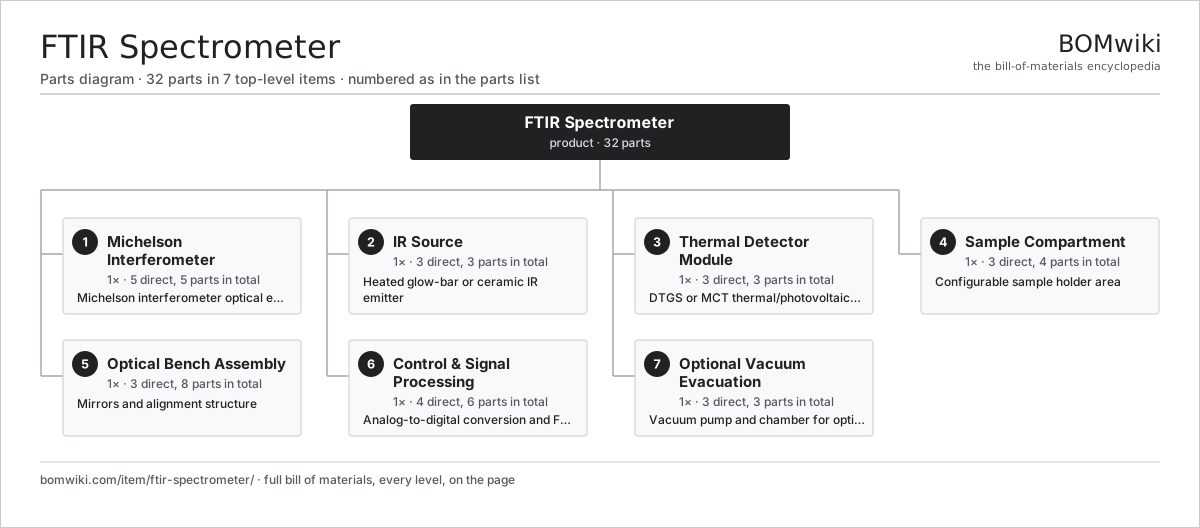
| # | Part | Qty | What it does |
|---|---|---|---|
| 1 | Michelson Interferometer 5 parts | 1× | Michelson interferometer optical engine |
| 2 | IR Source 3 parts | 1× | Heated glow-bar or ceramic IR emitter |
| 3 | Thermal Detector Module 3 parts | 1× | DTGS or MCT thermal/photovoltaic detector |
| 4 | Sample Compartment 3 parts | 1× | Configurable sample holder area |
| 5 | Optical Bench Assembly 3 parts | 1× | Mirrors and alignment structure |
| 6 | Control & Signal Processing 4 parts | 1× | Analog-to-digital conversion and FFT processor |
| 7 | Optional Vacuum Evacuation 3 parts | 1× | Vacuum pump and chamber for optional evacuation |
3D model
No 3D model yet. Have a CAD file of this? Add a 3D model. STL renders right on this page; STEP, FreeCAD, and OpenSCAD sources are welcome too (openly licensed, like all 3D models on BOMwiki).
Build & assembly graph
expand / collapse · shared sub-assemblies converge · links to related products · est. labourTap an assembly to expand/collapse · tap a part to open it · use “Open page” for any node · drag to pan, scroll to zoom.
Bill of materials for FTIR Spectrometer
7 top-level lines · 31 rows shown · 32 parts total · indented to 3 levels| # | Item / sub-assembly | Part no. | Qty/assy | Ext. qty | Parts | Type |
|---|---|---|---|---|---|---|
| 1 | Michelson Interferometer 5 parts | ftir-spectrometer-interferometer | 1× | 1 | 5 | assembly |
| 1.1 | Beamsplitter | ftir-spectrometer-beamsplitter | 1× | 1 | · | part |
| 1.2 | Fixed Mirror | ftir-spectrometer-fixed-mirror | 1× | 1 | · | part |
| 1.3 | Moving Mirror | ftir-spectrometer-moving-mirror | 1× | 1 | · | part |
| 1.4 | Mirror Actuator | ftir-spectrometer-actuator | 1× | 1 | · | part |
| 1.5 | Encoder | encoder | 1× | 1 | · | part |
| 2 | IR Source 3 parts | ftir-spectrometer-ir-source | 1× | 1 | 3 | assembly |
| 2.1 | Source Element | ftir-spectrometer-source-element | 1× | 1 | · | part |
| 2.2 | Source Housing | ftir-spectrometer-source-housing | 1× | 1 | · | part |
| 2.3 | Heating Element | heating-element | 1× | 1 | · | part |
| 3 | Thermal Detector Module 3 parts | ftir-spectrometer-detector | 1× | 1 | 3 | assembly |
| 3.1 | Detector Crystal | ftir-spectrometer-detector-element | 1× | 1 | · | part |
| 3.2 | Detector Window | ftir-spectrometer-detector-window | 1× | 1 | · | part |
| 3.3 | Preamp Stage | ftir-spectrometer-preamp | 1× | 1 | · | part |
| 4 | Sample Compartment 3 parts | ftir-spectrometer-sample-compartment | 1× | 1 | 4 | assembly |
| 4.1 | Compartment Frame | ftir-spectrometer-compartment-frame | 1× | 1 | · | part |
| 4.2 | Transmission Cell | ftir-spectrometer-transmission-cell | 1× | 1 | · | part |
| 4.3 | Sample Optics Mirror | ftir-spectrometer-mirrors-sample | 2× | 2 | · | part |
| 5 | Optical Bench Assembly 3 parts | ftir-spectrometer-optical-bench | 1× | 1 | 8 | assembly |
| 5.1 | Optical Base Plate | ftir-spectrometer-base-plate | 1× | 1 | · | part |
| 5.2 | Kinematic Mirror Mount | ftir-spectrometer-kinematic-mounts | 5× | 5 | · | part |
| 5.3 | Fastener Set | fastener-set | 2× | 2 | · | part |
| 6 | Control & Signal Processing 4 parts | ftir-spectrometer-electronics | 1× | 1 | 6 | assembly |
| 6.1 | Bare PCB | pcb-bare | 2× | 2 | · | part |
| 6.2 | Microcontroller | mcu | 1× | 1 | · | part |
| 6.3 | SMD Passive (R/C/L) | smd-passives | 1× | 1 | · | part |
| 6.4 | Connector | connector | 2× | 2 | · | part |
| 7 | Optional Vacuum Evacuation 3 parts | ftir-spectrometer-vacuum-system | 1× | 1 | 3 | assembly |
| 7.1 | Blower Motor | blower-motor | 1× | 1 | · | part |
| 7.2 | Vacuum Solenoid Valve | ftir-spectrometer-vacuum-valve | 1× | 1 | · | part |
| 7.3 | Bare PCB | pcb-bare | 1× | 1 | · | part |
Something wrong in this list? Report a problem with this BOM.
Related products
same domain, ranked by shared parts X-Ray Diffractometer
705 parts · shares 2 with this page
X-Ray Diffractometer
705 parts · shares 2 with this page
 Atomic Absorption Spectrometer
648 parts · shares 2 with this page
Atomic Absorption Spectrometer
648 parts · shares 2 with this page
 Climate Test Chamber
64 parts · shares 2 with this page
Freeze Dryer
317 parts · shares 2 with this page
Climate Test Chamber
64 parts · shares 2 with this page
Freeze Dryer
317 parts · shares 2 with this page
 Gas Chromatograph
450 parts · shares 2 with this page
Gas Chromatograph
450 parts · shares 2 with this page
Sourcing: possible vendors
Browse the supplier directory → Prices, MOQ, and lead times are algorithmic estimates, not quotes, and not claims about these companies. Company mappings are curated by keyword; est. price band $1k–$500k. How estimates work| Vendor | HQ | Specialty | MOQ | Lead time |
|---|---|---|---|---|
| thermofisher.com ↗ | Waltham, US | Lab instruments | 100 units | 10–18 wks |
|
🇺🇸Agilent
agilent.com ↗
|
Santa Clara, US | Analytical instruments | 100 units | 10–18 wks |
|
🇺🇸Bruker
bruker.com ↗
|
Billerica, US | Scientific instruments | 100 units | 10–18 wks |
|
🇯🇵Shimadzu
shimadzu.com ↗
|
Kyoto, JP | Analytical instruments | 100 units | 10–18 wks |
|
🇺🇸Waters
waters.com ↗
|
Milford, US | Chromatography & MS | 100 units | 10–18 wks |
757-word article