Common Rail Injection Pump
ProductOverview
A common rail fuel injection pump is a precision positive-displacement pump that builds and maintains high-pressure fuel (typically 2500 bar) in a pressurized reservoir called the "common rail," supplying multiple solenoid injectors on demand. Unlike older port-injection systems where a camshaft-driven pump fired each injector synchronously, the common rail decouples pump pressure from injection event timing, enabling multiple injections per cycle (split injection, post-injection), precise injection timing independent of engine speed, and flexible pressure control for emissions and efficiency optimization.
The pump is mechanically driven by the engine (via gear, chain, or direct coupling to crankshaft or camshaft), rotating at engine speed. It uses reciprocating plungers pushed by a rotating lobed cam to draw fuel from a low-pressure supply (3–7 bar from the main electric fuel pump) and force it into the common rail at 2500 bar. An electronic metering valve controlled by the engine control unit (ECU) varies pump displacement, modulating rail pressure in closed-loop fashion to match load and injection demand.
How It Works
The pump's core is a set of reciprocating plunger elements, typically two to four, each operating in a precision-bored cylinder (5–7 mm bore, concentricity tolerance ±0.005 mm). The Pump Drive Cam rotates at engine speed (or half-speed on some designs), its lobed profile oscillating each plunger at the same frequency.
As the cam lobe moves down, a Cam Follower Roller (hardened steel or roller bearing) tracking the cam releases the plunger. The plunger retracts into its bore, increasing chamber volume. Low-pressure fuel (3–7 bar) from the electric fuel pump enters through the Inlet Metering Valve, a solenoid-controlled proportional valve. Fuel fills the plunger chamber, and a check valve at the plunger inlet opens, allowing flow.
As the cam lobe rotates and rises, it pushes the follower upward, forcing the plunger inward. The plunger chamber volume shrinks, and pressure inside rises rapidly. At approximately 50–100 bar, the inlet check valve closes, trapping the fuel. Further plunger motion pressurizes this trapped fuel to 2500 bar (the relief setting), at which point the outlet check valve cracks open and fuel is forced into the Outlet Check Valve, a check valve assembly that feeds the common rail.
The Inlet Metering Valve (a solenoid-controlled spool) modulates the duty cycle of fuel delivery. When the solenoid is de-energized, the metering spool blocks inlet flow, and plungers simply oscillate without displacing fuel, the pump idles, producing zero delivery. When the solenoid is energized (by ECU PWM command), the spool opens, allowing fuel inflow proportional to spool position. This varies pump displacement and, consequently, the amount of fuel discharged to the rail per pump cycle.
The Pressure Relief Valve is a calibrated spring-loaded poppet (hardened steel cone or ceramic ball) biased to open at 2500 bar. If rail pressure rises above this setpoint (due to low demand or injector blockage), the relief poppet cracks open and vents excess pressure back to the low-pressure fuel tank circuit, limiting maximum pressure and protecting components.
Pressure Control and Feedback
Real-time pressure feedback is critical. A pressure sensor in the common rail (0–3000 bar range, 0–5V output) feeds back actual rail pressure to the ECU. The ECU closes the loop: if pressure is below target, it increases solenoid duty cycle (more metering valve opening, more pump displacement, higher rail pressure). If pressure exceeds target, it reduces duty cycle. Response time is typically <50 milliseconds, holding rail pressure within ±20 bar of target across the entire engine load and speed range.
This closed-loop control enables remarkable precision: cold-start conditions (high viscosity, low demand) operate at reduced pressure (800–1200 bar), minimizing pump parasitic load and heat. Idle and light cruise run at 600–1000 bar. Full-load high-speed operation maintains 2200–2500 bar. Post-injection events (injecting a small amount of fuel late in the cycle to reburn unburned hydrocarbons in the catalytic converter) can request precisely controlled lower pressures.
Mechanical Durability
Pump plungers operate in an extremely harsh environment: pressure spikes from 0.1 bar (atmospheric during intake) to 2500 bar (discharge) 1000–8000 times per minute. The plunger-to-bore clearance is extraordinarily tight: 0.005–0.01 mm. At this clearance, internal leakage is minimal (<2% of displaced volume), but any particulate (sand, corrosion) instantly causes scoring and catastrophic failure.
The Fuel Filter (integral 10–40 micron mesh) removes particles before fuel enters the pump chamber. A clogged filter starves the pump, causing pressure loss and misfire; a torn or absent filter leads to rapid plunger seizure.
The cam-driven follower roller experiences Hertzian contact stresses >1000 MPa, requiring hardening to 58–62 HRC (Rockwell hardness). Any wear groove in the cam lobe causes oscillation (flat-spotting), loss of displacement, and pressure ripple, audible as metallic chattering or knocking.
Check valve balls or poppets must seal perfectly to prevent backflow (fuel flowing from high pressure back into the plunger chamber during intake stroke), which would starve the discharge and collapse rail pressure. Seat lapping is to <1 micron flatness; any speck of contamination prevents sealing.
Failure Modes
Water contamination (moisture in fuel) causes rust inside plunger bores, scoring the rod surface and destroying the pump. Most fuel systems include a water-trap in the main electric fuel pump or a captive desiccant filter cartridge.
Fuel injector blockage causes back-pressure feedback: the solenoid tries to maintain rail pressure, but injectors can't deliver fuel, so the pump continuously pressurizes against a closed system. If the relief valve sticks or malfunctions, pressure may spike to 3500+ bar, rupturing the rail or hoses.
Metering solenoid electrical failure (open coil, shorts) causes pump runaway (full displacement) or complete shutdown (no displacement). Modern systems use redundant electrical sensing to detect faults and trigger limp-home mode.
Wear of plunger rods and cam followers causes displacement loss and unstable pressure over time. Commercial diesel engines typically need pump refurbishment at 200,000–300,000 km if water contamination or inadequate fuel filtering has occurred.
Modern Variants
Variable-displacement pump designs use a mechanical linkage (not solenoid metering) sensitive to rail pressure, providing open-loop regulation. These are simpler but less precise and less responsive to transient load changes.
High-pressure common rail pumps pushing 3000+ bar (for emissions compliance) require exotic materials: ceramic plungers, tungsten-carbide-coated bores, and synthetic engine oil with extreme-pressure additives for lubrication.
Electronically controlled unit pump (EUP) designs place the pump and injector together in a single cartridge screwed into the cylinder head, eliminating the common rail and high-pressure hose runs. This enables ultra-high-pressure operation (2500+ bar) and rapid pressure modulation but loses the advantage of decoupled pump timing.
Modular pump assemblies integrate metering solenoid, check valves, relief valve, and pressure sensor into a single compact cartridge, simplifying engine integration and reducing weight.
Common Rail Injection Pump parts and their functions
8 top-level parts · 25 parts in total · full bill of materials below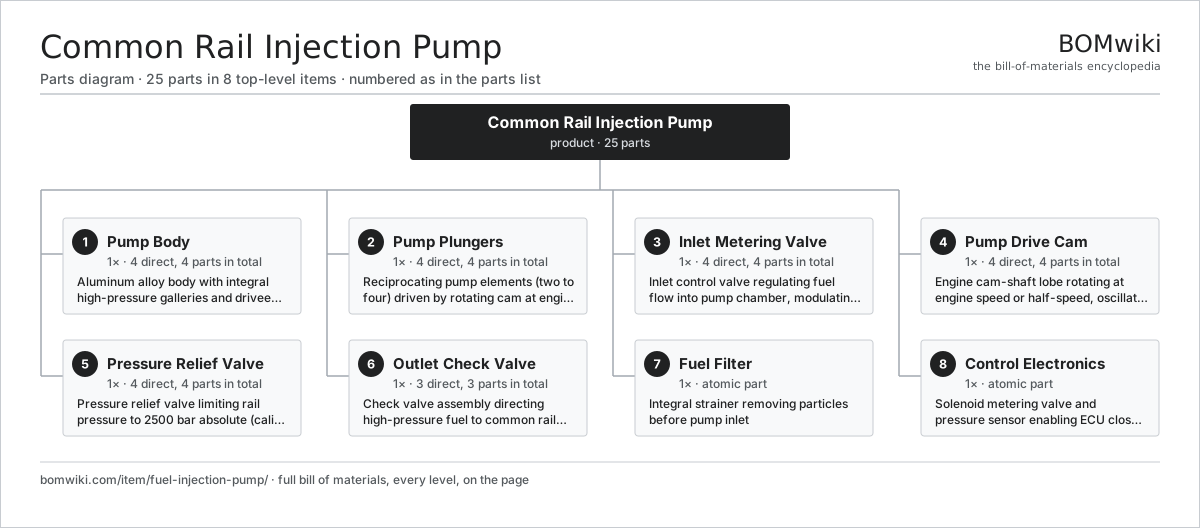
| # | Part | Qty | What it does |
|---|---|---|---|
| 1 | Pump Body 4 parts | 1× | Aluminum alloy body with integral high-pressure galleries and driveend bore |
| 2 | Pump Plungers 4 parts | 1× | Reciprocating pump elements (two to four) driven by rotating cam at engine speed |
| 3 | Inlet Metering Valve 4 parts | 1× | Inlet control valve regulating fuel flow into pump chamber, modulating delivery pressure |
| 4 | Pump Drive Cam 4 parts | 1× | Engine cam-shaft lobe rotating at engine speed or half-speed, oscillating pump plungers |
| 5 | Pressure Relief Valve 4 parts | 1× | Pressure relief valve limiting rail pressure to 2500 bar absolute (calibrated spring) |
| 6 | Outlet Check Valve 3 parts | 1× | Check valve assembly directing high-pressure fuel to common rail only |
| 7 | Fuel Filter | 1× | Integral strainer removing particles before pump inlet |
| 8 | Control Electronics | 1× | Solenoid metering valve and pressure sensor enabling ECU closed-loop control |
3D model
No 3D model yet. Have a CAD file of this? Add a 3D model. STL renders right on this page; STEP, FreeCAD, and OpenSCAD sources are welcome too (openly licensed, like all 3D models on BOMwiki).
Build & assembly graph
expand / collapse · shared sub-assemblies converge · links to related products · est. labourTap an assembly to expand/collapse · tap a part to open it · use “Open page” for any node · drag to pan, scroll to zoom.
Bill of materials for Common Rail Injection Pump
8 top-level lines · 31 rows shown · 25 parts total · indented to 3 levels| # | Item / sub-assembly | Part no. | Qty/assy | Ext. qty | Parts | Type |
|---|---|---|---|---|---|---|
| 1 | Pump Body 4 parts | fuel-injection-pump-housing | 1× | 1 | 4 | assembly |
| 1.1 | Main Pump Casting | fuel-injection-pump-main-casting | 1× | 1 | · | part |
| 1.2 | Top Cover Plate | fuel-injection-pump-cover-plate | 1× | 1 | · | part |
| 1.3 | Drain Passage | fuel-injection-pump-drain-gallery | 1× | 1 | · | part |
| 1.4 | Engine Mount Flange | fuel-injection-pump-mounting-flange | 1× | 1 | · | part |
| 2 | Pump Plungers 4 parts | fuel-injection-pump-plunger-set | 1× | 1 | 4 | assembly |
| 2.1 | Plunger Bore | fuel-injection-pump-plunger-barrel | 1× | 1 | · | part |
| 2.2 | Plunger Rod | fuel-injection-pump-plunger-rod | 1× | 1 | · | part |
| 2.3 | Inlet Check Valve | fuel-injection-pump-inlet-valve | 1× | 1 | · | part |
| 2.4 | Plunger Outlet Valve | fuel-injection-pump-outlet-valve | 1× | 1 | · | part |
| 3 | Inlet Metering Valve 4 parts | fuel-injection-pump-metering-valve | 1× | 1 | 4 | assembly |
| 3.1 | Metering Solenoid Coil | fuel-injection-pump-metering-solenoid | 1× | 1 | · | part |
| 3.2 | Metering Valve Spool | fuel-injection-pump-metering-spool | 1× | 1 | · | part |
| 3.3 | Metering Spring | fuel-injection-pump-metering-spring | 1× | 1 | · | part |
| 3.4 | Metering Inlet Port | fuel-injection-pump-metering-inlet | 1× | 1 | · | part |
| 4 | Pump Drive Cam 4 parts | fuel-injection-pump-drive-cam | 1× | 1 | 4 | assembly |
| 4.1 | Pump Cam Lobe | fuel-injection-pump-cam-lobe | 1× | 1 | · | part |
| 4.2 | Pump Drive Shaft | fuel-injection-pump-cam-shaft | 1× | 1 | · | part |
| 4.3 | Cam Follower Roller | fuel-injection-pump-follower-roller | 1× | 1 | · | part |
| 4.4 | Drive Coupling | fuel-injection-pump-drive-coupling | 1× | 1 | · | part |
| 5 | Pressure Relief Valve 4 parts | fuel-injection-pump-high-pressure-relief | 1× | 1 | 4 | assembly |
| 5.1 | Relief Poppet | fuel-injection-pump-relief-poppet | 1× | 1 | · | part |
| 5.2 | Relief Spring | fuel-injection-pump-relief-spring | 1× | 1 | · | part |
| 5.3 | Relief Inlet Port | fuel-injection-pump-relief-inlet | 1× | 1 | · | part |
| 5.4 | Relief Outlet Port | fuel-injection-pump-relief-outlet | 1× | 1 | · | part |
| 6 | Outlet Check Valve 3 parts | fuel-injection-pump-outlet-stage | 1× | 1 | 3 | assembly |
| 6.1 | Outlet Poppet | fuel-injection-pump-outlet-poppet | 1× | 1 | · | part |
| 6.2 | Outlet Spring | fuel-injection-pump-outlet-spring | 1× | 1 | · | part |
| 6.3 | Outlet Seat | fuel-injection-pump-outlet-seat | 1× | 1 | · | part |
| 7 | Fuel Filter | fuel-injection-pump-fuel-filter | 1× | 1 | · | part |
| 8 | Control Electronics | fuel-injection-pump-electrical-control | 1× | 1 | · | part |
Something wrong in this list? Report a problem with this BOM.
Sourcing: possible vendors
Browse the supplier directory → Prices, MOQ, and lead times are algorithmic estimates, not quotes, and not claims about these companies. Company mappings are curated by keyword; est. price band $8k–$90k. How estimates work| Vendor | HQ | Specialty | MOQ | Lead time |
|---|---|---|---|---|
|
🇯🇵Toyota
global.toyota ↗
|
Toyota City, JP | Automaker | made to order | 16–28 wks |
| volkswagen-group.com ↗ | Wolfsburg, DE | Automaker | made to order | 16–28 wks |
| gm.com ↗ | Detroit, US | Automaker | made to order | 16–28 wks |
| hyundai.com ↗ | Seoul, KR | Automaker | made to order | 16–28 wks |
|
🇨🇳BYD
byd.com ↗
|
Shenzhen, CN | EV & battery manufacturer | made to order | 16–28 wks |
1,167-word article