Gear Coupling
ProductOverview
Gear couplings are flexible torque transmitters using gear mesh between rotating hubs and a floating central sleeve. This design accommodates 0.5–2 mm parallel misalignment and 0.5–1.5° angular misalignment while transmitting torque with minimal backlash and excellent efficiency (>98%).
The floating sleeve design is elegant: both input and output hubs have external involute gears. The central sleeve has matching internal gears, meshing both hub gears simultaneously. Radial misalignment changes the contact angle slightly, allowing the teeth to mesh across a range of positions without losing engagement. This flexibility makes gear couplings ideal for machinery with variable loads, temperature swings, or mounting uncertainty.
They are widespread in pumps, fans, compressors, and paper mills where reliability and high-speed capability are critical. Sealed cartridge designs (grease-lubricated, maintenance-free) are increasingly popular, offsetting higher purchase cost through reduced operational overhead.
Gear mesh and misalignment accommodation
The input hub and output hub each carry external involute gears (typically 20–40 teeth). The floating sleeve has corresponding internal gears (same pitch diameter, opposite tooth orientation). As the input hub rotates, its external teeth mesh the sleeve's internal teeth, driving the sleeve. The sleeve's internal teeth simultaneously mesh the output hub's external teeth, delivering torque to the load.
If input and output shafts are parallel but offset (parallel misalignment), the meshing angle changes slightly across the contact zone. The involute tooth profile accommodates this without losing torque transmission. Typical allowance is 0.5–2 mm parallel offset without excessive edge loading.
Angular misalignment (shafts at an angle) is similarly accommodated: the teeth come into contact at an angle, distributing load across the tooth flank. Practical tolerance is 0.5–1.5° angular misalignment without accelerated wear.
Gear selection and loading
Tooth profile can be helical (more efficient, quieter) or spur (simpler, lower cost). Helical gears have a helix angle of 15–25°, enabling smoother engagement and load distribution along the tooth flank. Spur gears have 0° helix angle and exhibit higher noise and stress concentration at engagement.
Tooth size (pitch diameter, module) determines torque capacity. A coupling with 30-tooth hubs and 60-tooth sleeve (matched pitch diameters) might transmit 500 N·m at 1500 RPM with acceptable stress. Scaling up to 50-tooth hubs and 100-tooth sleeve increases capacity to 2000+ N·m at the same speed due to larger tooth volume.
Lubrication and cooling
Oil-lubricated couplings use a sump or reservoir holding ISO 46–68 mineral oil. Oil is drawn into the tooth mesh by centrifugal action, cooling and lubricating the contact zone. Splash lubrication (oil bath at bottom, splashed by rotation) is typical; high-speed or high-power couplings use forced circulation (small gear pump) or oil-cooled radiator.
Sealed grease-cartridge designs eliminate the need for oil level monitoring and sampling. Grease is pre-packed in the sleeve cavity; the coupling is sealed for life (or until 10,000+ operating hours). This simplifies maintenance for food, pharmaceutical, and cleanroom applications where contamination is a risk.
Oil temperature should remain 40–80 °C; continuous operation above 80 °C degrades viscosity and accelerates oxidation. In tropical climates or continuous-duty factories, oil coolers are standard: radiators with thermostat control maintain 50–70 °C setpoint.
Bearing and support
The floating sleeve carries radial load from tooth mesh misalignment and is supported by a single angular-contact bearing pair. This bearing is preloaded (typically 500–2000 N) to minimize internal clearance and reduce noise. High-speed couplings benefit from preload; lower speeds can tolerate loose fit.
Bearing life is typically 5000–10,000 operating hours under nominal duty; worn bearings manifest as noise, increased radial play, and eventual seal failure.
Damping and torsional stiffness
The tooth mesh provides torsional stiffness (typically 100–500 N·m/° depending on tooth engagement). This is higher than mechanical vibration isolators but lower than rigid shafts, making gear couplings suitable for applications requiring some compliance without excessive softness.
Damping (energy dissipation) is low (<1% per cycle), derived from micro-slip at tooth flanks and bearing friction. For shock-load applications, elastomer or friction-pad dampers can be added to the hubs, increasing damping to 5–10% at the cost of complexity.
Failure modes and diagnostics
Tooth pitting: Early-stage fatigue appears as small pits on tooth flanks. Root cause is typically inadequate lubrication, contamination (water, abrasive particles), or shock overload. Oil analysis (ASTM D4378) trending ferrous debris and acid number predicts progression.
Tooth spalling: Macroscopic fracture of tooth material, usually following untreated pitting. Leads to increased noise, vibration, and eventual coupling failure. Remedy is prompt tooth or coupling replacement.
Bearing spalling: Angular-contact bearings exposed to high radial load (severe misalignment) or contaminated oil fail first. Symptoms include grinding noise at the bearing zone and increased temperature.
Seal leakage: Oil weeping indicates worn lip seals or gasket failure. Replace seals during annual maintenance to prevent water ingress and contamination.
Corrosion: Water-contaminated oil causes rust on internal teeth and bearing races, reducing torque capacity and causing noise. Breather replacement every 6–12 months prevents moisture accumulation.
Installation and alignment
Gear coupling installation is straightforward:
- Mount hubs to motor and load shafts (keyed or tapered bore).
- Slide floating sleeve onto both hubs, meshing external teeth with internal teeth.
- Bolt end covers (if present) and tighten in a cross pattern.
- Rotate by hand to confirm smooth engagement.
- Add oil through fill plug to the operating level (typically mid-range of sight glass).
- Bleed trapped air by rotating at low speed; oil should reach steady level within 1 minute.
Initial startup should be at low speed for 5–10 minutes to allow proper oil circulation and bed-in of tooth surfaces. Typical installation time is 1–2 hours.
Performance and reliability
Well-designed and properly lubricated gear couplings offer exceptional reliability. Operating life exceeds 20,000 hours in most industrial settings. They are favored in critical applications (large blower drives, compressor couplings) because they offer high efficiency, low maintenance, and graceful degradation (wear is gradual, not catastrophic).
Modern sealed-cartridge variants reduce operational complexity to zero; inspections are visual (listening for noise, checking for leakage) only. This makes them an excellent choice for remote or unmanned installations.
Gear Coupling parts and their functions
6 top-level parts · 19 parts in total · full bill of materials below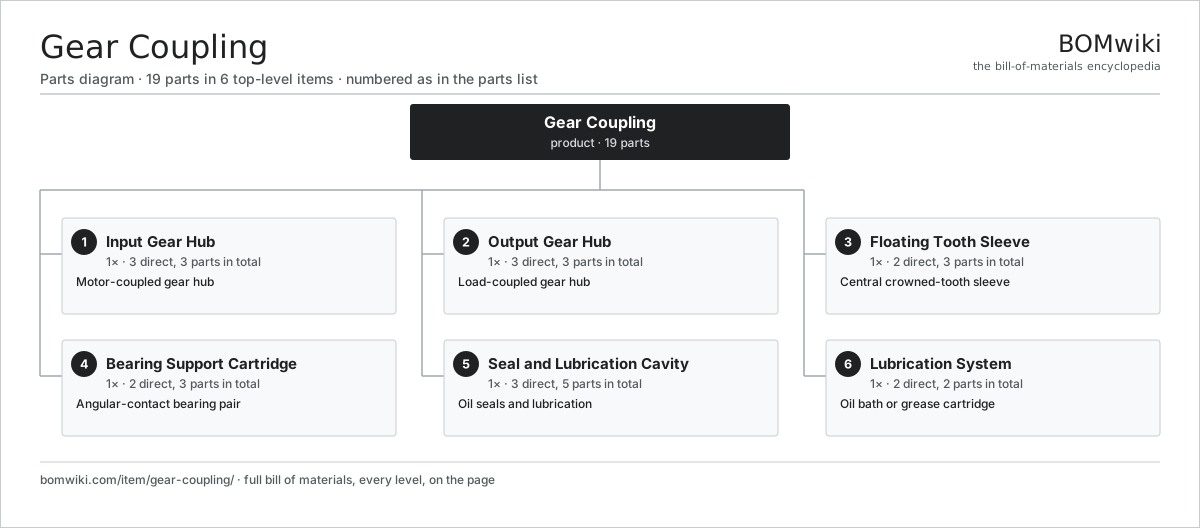
| # | Part | Qty | What it does |
|---|---|---|---|
| 1 | Input Gear Hub 3 parts | 1× | Motor-coupled gear hub |
| 2 | Output Gear Hub 3 parts | 1× | Load-coupled gear hub |
| 3 | Floating Tooth Sleeve 2 parts | 1× | Central crowned-tooth sleeve |
| 4 | Bearing Support Cartridge 2 parts | 1× | Angular-contact bearing pair |
| 5 | Seal and Lubrication Cavity 3 parts | 1× | Oil seals and lubrication |
| 6 | Lubrication System 2 parts | 1× | Oil bath or grease cartridge |
3D model
No 3D model yet. Have a CAD file of this? Add a 3D model. STL renders right on this page; STEP, FreeCAD, and OpenSCAD sources are welcome too (openly licensed, like all 3D models on BOMwiki).
Build & assembly graph
expand / collapse · shared sub-assemblies converge · links to related products · est. labourTap an assembly to expand/collapse · tap a part to open it · use “Open page” for any node · drag to pan, scroll to zoom.
Bill of materials for Gear Coupling
6 top-level lines · 21 rows shown · 19 parts total · indented to 3 levels| # | Item / sub-assembly | Part no. | Qty/assy | Ext. qty | Parts | Type |
|---|---|---|---|---|---|---|
| 1 | Input Gear Hub 3 parts | gear-coupling-input-hub | 1× | 1 | 3 | assembly |
| 1.1 | Hub Body | gear-coupling-hub-body | 1× | 1 | · | part |
| 1.2 | External Gear Ring | gear-coupling-gear-tooth-set | 1× | 1 | · | part |
| 1.3 | Hub Coupling Key | gear-coupling-hub-key | 1× | 1 | · | part |
| 2 | Output Gear Hub 3 parts | gear-coupling-output-hub | 1× | 1 | 3 | assembly |
| 2.1 | Hub Body | gear-coupling-hub-body | 1× | 1 | · | part |
| 2.2 | External Gear Ring | gear-coupling-gear-tooth-set | 1× | 1 | · | part |
| 2.3 | Output Coupling Interface | gear-coupling-output-coupling | 1× | 1 | · | part |
| 3 | Floating Tooth Sleeve 2 parts | gear-coupling-floating-sleeve | 1× | 1 | 3 | assembly |
| 3.1 | Sleeve Body | gear-coupling-sleeve-body | 1× | 1 | · | part |
| 3.2 | Sleeve End Seal | gear-coupling-sleeve-seals | 2× | 2 | · | part |
| 4 | Bearing Support Cartridge 2 parts | gear-coupling-bearing-set | 1× | 1 | 3 | assembly |
| 4.1 | Ball Bearing | ball-bearing | 2× | 2 | · | part |
| 4.2 | Bearing Preload Spring | gear-coupling-bearing-preload | 1× | 1 | · | part |
| 5 | Seal and Lubrication Cavity 3 parts | gear-coupling-seal-system | 1× | 1 | 5 | assembly |
| 5.1 | Oil Seal | oil-seal | 2× | 2 | · | part |
| 5.2 | End Cap Gasket | gear-coupling-gasket | 2× | 2 | · | part |
| 5.3 | Breather Element | gear-coupling-breather | 1× | 1 | · | part |
| 6 | Lubrication System 2 parts | gear-coupling-lubrication | 1× | 1 | 2 | assembly |
| 6.1 | Fill and Drain Plug | gear-coupling-fill-drain-plug | 1× | 1 | · | part |
| 6.2 | Lubricant Reservoir | gear-coupling-lube-reserve | 1× | 1 | · | part |
Something wrong in this list? Report a problem with this BOM.
Related products
same domain, ranked by shared parts Blow Molding Machine
83 parts · shares 2 with this page
Blown Film Extrusion Line
436 parts · shares 2 with this page
Blow Molding Machine
83 parts · shares 2 with this page
Blown Film Extrusion Line
436 parts · shares 2 with this page
Sourcing: possible vendors
Browse the supplier directory → Prices, MOQ, and lead times are algorithmic estimates, not quotes, and not claims about these companies. Company mappings are curated by keyword; est. price band $5k–$2M. How estimates work| Vendor | HQ | Specialty | MOQ | Lead time |
|---|---|---|---|---|
| atlascopco.com ↗ | Stockholm, SE | Compressors & industrial | 10 units | 12–20 wks |
|
🇦🇹Andritz
andritz.com ↗
|
Graz, AT | Process plants & machinery | 10 units | 12–20 wks |
| buhlergroup.com ↗ | Uzwil, CH | Food & materials processing | 10 units | 12–20 wks |
| gea.com ↗ | Düsseldorf, DE | Process technology | 10 units | 12–20 wks |
| mhi.com ↗ | Tokyo, JP | Heavy machinery | 10 units | 12–20 wks |
1,093-word article