Gear Grinding Machine
ProductOverview
A gear grinding machine finishes hardened gear teeth to exacting tolerances after heat treatment. Unlike hobbing or shaping, which produce the gear tooth form in softer material before hardening, grinding works on the finished part, reaching DIN 3962 grades 5–6 (pitch error within 5 µm, single-flank profile tolerance ±2 µm) with surface finish under 0.4 µm Ra. This precision is essential for high-speed transmissions where even slight tooth deviations cause vibration, noise, and bearing misalignment. The machine pairs a motor-driven Grinding Wheel at 1500–3500 rpm with a slow-rotating Work Spindle that indexes the gear workpiece in discrete angular steps, allowing the grinding wheel to trace the involute profile flank-by-flank.
The grinding spindle and wheel
The Grinding Spindle Assembly is a precision spindle running at constant or variable frequency through the Spindle VFD. Its Spindle Bearing Housing mounts precision angular-contact Ball Bearing pairs that take both radial and thrust loads; most machines use ceramic hybrid bearings for lower friction and heat generation at speed. The Grinding Wheel, typically 12–25 mm in diameter and bonded with resinoid or vitrified abrasive (or increasingly CBN for alumina gears), is dressed to either a worm profile (for helical gears) or involute profile (for spur gears) by the Dressing Unit. Dressing happens every 10–50 workpieces, automatically triggered by the Dressing Solenoid, because the wheel glazes and loses sharpness, causing temperature rise and inaccuracy.
Work spindle indexing
The Work Spindle rotates the gear slowly, typically 10–200 rpm, often stepped discretely, so that each tooth flank aligns sequentially under the grinding wheel. A Work Spindle Motor (stepper or servo with Encoder feedback) drives the rotation; during grinding of one flank, the spindle is held stationary while the wheel and bed axes move. Multi-axis CNC interpolation during the grind cycle allows the CNC Servo Axes to follow an involute path, continuously infeed in Z, and adjust workpiece engagement angle without stopping, cutting cycle time dramatically. Workpiece location, usually by bore on a precision Work Spindle Chuck, must be repeatable to within 0.05 mm, achieved through tapered or collet clamping onto the spindle shaft.
Coordinate system and infeed
The Machine Bed is the reference datum, ground flat within 0.02 mm over its length. The Coordinate Table moves along precision hardened ways under ball-screw drive via X and Y servos; Z infeed (wheel-to-workpiece distance, typically 0–80 mm per cycle) is controlled by the Z-Axis Servo Motor, allowing feed rates from 0.1 to 5 mm/min depending on wheel condition and metal hardness. Machine geometry is set so that wheel center, workpiece center, and infeed axis are all coplanar; deviations here ripple directly into gear pitch errors. Some machines use a secondary C-axis rotary table instead of a work spindle, especially for large or complex geometries.
Coolant, flushing, and chip removal
The Coolant & Flushing System is critical. Coolant removes heat from the grinding zone, the friction between wheel and hardened steel generates far more energy than cutting, and flushes away the fine metallic dust and glazed abrasive particles. A Coolant Pump circulates oil-in-water emulsion (5–10% active concentrate, usually 1–2 µm viscosity) through articulated Coolant Nozzles directed at the wheel-workpiece engagement point. The coolant must evaporate or drain quickly from tooth cavities, so a high-speed flushing jet often follows the primary coolant. The Coolant Filter, both magnetic (catching ferrous fines) and mechanical (10–20 µm cartridge), keeps the tank Coolant Tank clean; without it, abrasive contamination clogs the wheel and raises workpiece temperature. Settled Drain Tray fines are disposed as industrial waste.
Dressing and wheel management
The Dressing Unit employs a single-point or clustered Diamond Dresser that removes the outermost layer of abrasive grains, restoring sharpness. Dressing is fast (2–5 seconds) but consumes the diamond, so single-point dressers last roughly 30–100 dressings before replacement. Some high-volume shops install a Dressing Arm Linkage linkage with a solenoid that engages automatically on a timer or cycle count. Manual dressing (operator notices temperature rise or rough finish) is also common on older machines.
Motion control and CNC
Modern gear grinders use three to five axes of motion, all coordinated by the CNC Control Cabinet. The Microcontroller (PLC or industrial PC) reads the Encoder feedback from the work spindle and the ball-screw-driven axes, running G-code-like gear-grinding cycles. The four X-Axis Servo Motor, Y, Z, and C motors are amplified by the Servo Amplifier Module, a multi-channel servo amplifier. The Spindle VFD keeps the grinding spindle at setpoint despite load and temperature drift. All motion is soft-stopped to prevent wheel chatter; servo tuning and damping are adjusted per gear size and material.
Machine frame and electrical
The Bed Casting is typically ductile or nodular iron, precision-ground and stress-relieved to minimize thermal growth. Smaller machines (50–100 mm gears) weigh 1500–2000 kg; large production machines for automotive gears can exceed 5000 kg. The Electrical System cabinet houses the Main Contactor, Relay circuits for solenoids and coolant pump, and the servo drive and VFD units. A three-phase supply of 6–12 kW is typical; some machines use single-phase 2–3 kW motors for the coolant and dressing systems. Safety interlocks ensure the spindle stops and enclosure lights activate when the access guard opens.
Typical grinding cycle
Load the gear onto the Work Spindle Chuck, close the enclosure, and press Cycle Start. The Coordinate Table positions the workpiece, the Work Spindle indexes to the first tooth, and Z rapids toward the wheel. Infeed begins at 0.5–1 mm/min (slow) as the wheel engages; once contact is detected (by spindle motor current or acoustic signal), feed slows to 0.1–0.3 mm/min for finishing. The wheel path traces an involute arc, and the workpiece rotates one tooth at a time. After all teeth are ground, the spindle rapids away, the workpiece indexes home, and the cycle repeats. A typical batch of 20–50 gears runs unattended once setup is complete. Dressing occurs automatically mid-batch or on manual command.
Gear Grinding Machine parts and their functions
9 top-level parts · 83 parts in total · full bill of materials below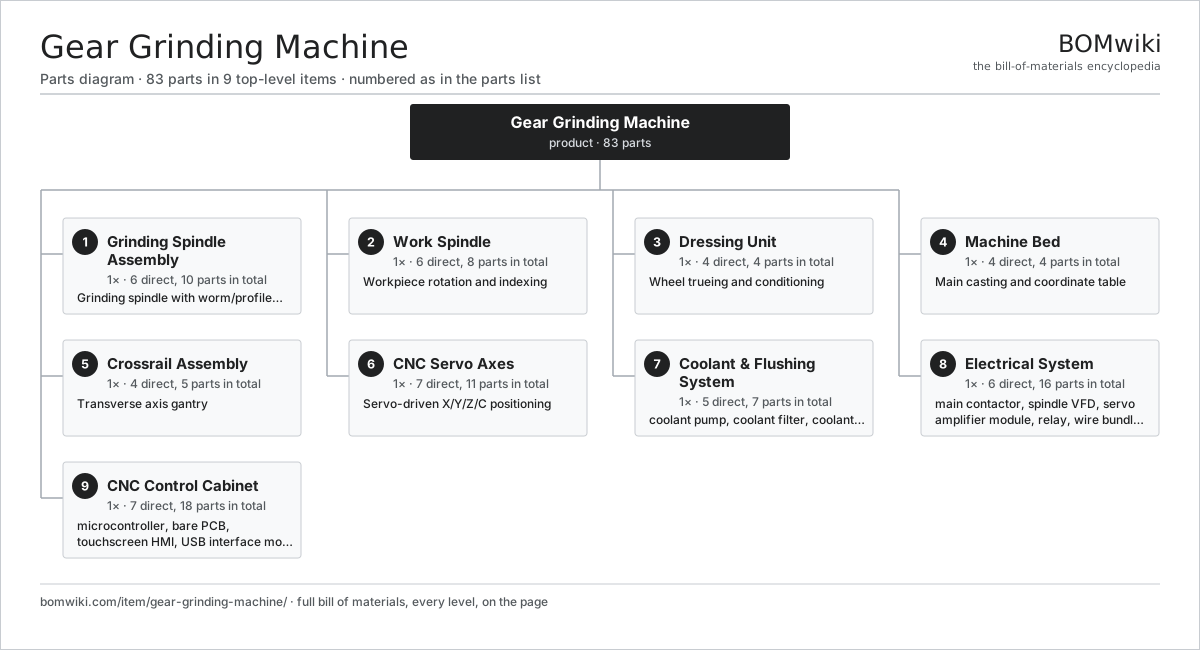
| # | Part | Qty | What it does |
|---|---|---|---|
| 1 | Grinding Spindle Assembly 6 parts | 1× | Grinding spindle with worm/profile wheel |
| 2 | Work Spindle 6 parts | 1× | Workpiece rotation and indexing |
| 3 | Dressing Unit 4 parts | 1× | Wheel trueing and conditioning |
| 4 | Machine Bed 4 parts | 1× | Main casting and coordinate table |
| 5 | Crossrail Assembly 4 parts | 1× | Transverse axis gantry |
| 6 | CNC Servo Axes 7 parts | 1× | Servo-driven X/Y/Z/C positioning |
| 7 | Coolant & Flushing System 5 parts | 1× | Supplies coolant to the grinding zone and removes chips and metallic fines. |
| 8 | Electrical System 6 parts | 1× | Three-phase power distribution, motor starters, and safety interlocks. |
| 9 | CNC Control Cabinet 7 parts | 1× | Enclosed industrial PC and PLC running the grinding cycle and coordinating axes. |
3D model
No 3D model yet. Have a CAD file of this? Add a 3D model. STL renders right on this page; STEP, FreeCAD, and OpenSCAD sources are welcome too (openly licensed, like all 3D models on BOMwiki).
Build & assembly graph
expand / collapse · shared sub-assemblies converge · links to related products · est. labourTap an assembly to expand/collapse · tap a part to open it · use “Open page” for any node · drag to pan, scroll to zoom.
Bill of materials for Gear Grinding Machine
9 top-level lines · 58 rows shown · 83 parts total · indented to 3 levels| # | Item / sub-assembly | Part no. | Qty/assy | Ext. qty | Parts | Type |
|---|---|---|---|---|---|---|
| 1 | Grinding Spindle Assembly 6 parts | gear-grinding-machine-spindle-assembly | 1× | 1 | 10 | assembly |
| 1.1 | Spindle Bearing Housing | gear-grinding-machine-spindle-bearing-housing | 1× | 1 | · | part |
| 1.2 | Ball Bearing | ball-bearing | 4× | 4 | · | part |
| 1.3 | Spindle Shaft | gear-grinding-machine-spindle-shaft | 1× | 1 | · | part |
| 1.4 | Grinding Wheel | gear-grinding-machine-grinding-wheel | 1× | 1 | · | part |
| 1.5 | Spindle Motor | gear-grinding-machine-spindle-motor | 1× | 1 | · | part |
| 1.6 | Oil Seal | oil-seal | 2× | 2 | · | part |
| 2 | Work Spindle 6 parts | gear-grinding-machine-work-spindle | 1× | 1 | 8 | assembly |
| 2.1 | Work Spindle Housing | gear-grinding-machine-work-spindle-housing | 1× | 1 | · | part |
| 2.2 | Ball Bearing | ball-bearing | 3× | 3 | · | part |
| 2.3 | Work Spindle Shaft | gear-grinding-machine-work-spindle-shaft | 1× | 1 | · | part |
| 2.4 | Work Spindle Chuck | gear-grinding-machine-work-spindle-chuck | 1× | 1 | · | part |
| 2.5 | Work Spindle Motor | gear-grinding-machine-work-spindle-motor | 1× | 1 | · | part |
| 2.6 | Encoder | encoder | 1× | 1 | · | part |
| 3 | Dressing Unit 4 parts | gear-grinding-machine-dressing-unit | 1× | 1 | 4 | assembly |
| 3.1 | Dressing Head | gear-grinding-machine-dressing-head | 1× | 1 | · | part |
| 3.2 | Diamond Dresser | gear-grinding-machine-diamond-dresser | 1× | 1 | · | part |
| 3.3 | Dressing Arm Linkage | gear-grinding-machine-dressing-arm | 1× | 1 | · | part |
| 3.4 | Dressing Solenoid | gear-grinding-machine-dressing-solenoid | 1× | 1 | · | part |
| 4 | Machine Bed 4 parts | gear-grinding-machine-bed | 1× | 1 | 4 | assembly |
| 4.1 | Bed Casting | gear-grinding-machine-bed-casting | 1× | 1 | · | part |
| 4.2 | Coordinate Table | gear-grinding-machine-coordinate-table | 1× | 1 | · | part |
| 4.3 | Way Covers & Bellows | gear-grinding-machine-way-covers | 1× | 1 | · | part |
| 4.4 | Fastener Set | fastener-set | 1× | 1 | · | part |
| 5 | Crossrail Assembly 4 parts | gear-grinding-machine-crossrail | 1× | 1 | 5 | assembly |
| 5.1 | Crossrail Beam | gear-grinding-machine-crossrail-beam | 1× | 1 | · | part |
| 5.2 | Spindle Head Carriage | gear-grinding-machine-spindle-head-carriage | 1× | 1 | · | part |
| 5.3 | Linear Bearing Blocks | gear-grinding-machine-linear-bearing-blocks | 2× | 2 | · | part |
| 5.4 | Ball Screw | ball-screw | 1× | 1 | · | part |
| 6 | CNC Servo Axes 7 parts | gear-grinding-machine-cnc-axes | 1× | 1 | 11 | assembly |
| 6.1 | X-Axis Servo Motor | gear-grinding-machine-servo-motor-x | 1× | 1 | · | part |
| 6.2 | Y-Axis Servo Motor | gear-grinding-machine-servo-motor-y | 1× | 1 | · | part |
| 6.3 | Z-Axis Servo Motor | gear-grinding-machine-servo-motor-z | 1× | 1 | · | part |
| 6.4 | C-Axis Servo Motor | gear-grinding-machine-servo-motor-c | 1× | 1 | · | part |
| 6.5 | Servo Drive Unit | gear-grinding-machine-servo-drive-unit | 1× | 1 | · | part |
| 6.6 | Encoder | encoder | 2× | 2 | · | part |
| 6.7 | Hall Sensor | hall-sensor | 4× | 4 | · | part |
| 7 | Coolant & Flushing System 5 parts | gear-grinding-machine-coolant-system | 1× | 1 | 7 | assembly |
| 7.1 | Coolant Pump | gear-grinding-machine-coolant-pump | 1× | 1 | · | part |
| 7.2 | Coolant Filter | gear-grinding-machine-coolant-filter | 1× | 1 | · | part |
| 7.3 | Coolant Nozzles | gear-grinding-machine-coolant-nozzles | 3× | 3 | · | part |
| 7.4 | Coolant Tank | gear-grinding-machine-coolant-tank | 1× | 1 | · | part |
| 7.5 | Drain Tray | gear-grinding-machine-drain-tray | 1× | 1 | · | part |
| 8 | Electrical System 6 parts | gear-grinding-machine-electrical | 1× | 1 | 16 | assembly |
| 8.1 | Main Contactor | gear-grinding-machine-main-contactor | 1× | 1 | · | part |
| 8.2 | Spindle VFD | gear-grinding-machine-spindle-vfd | 1× | 1 | · | part |
| 8.3 | Servo Amplifier Module | gear-grinding-machine-axis-drives | 1× | 1 | · | part |
| 8.4 | Relay | relay | 2× | 2 | · | part |
| 8.5 | Wire Bundle | wire-bundle | 1× | 1 | · | part |
| 8.6 | Connector | connector | 10× | 10 | · | part |
| 9 | CNC Control Cabinet 7 parts | gear-grinding-machine-control-cabinet | 1× | 1 | 18 | assembly |
| 9.1 | Microcontroller | mcu | 1× | 1 | · | part |
| 9.2 | Bare PCB | pcb-bare | 2× | 2 | · | part |
| 9.3 | Touchscreen HMI | gear-grinding-machine-touchscreen-hmi | 1× | 1 | · | part |
| 9.4 | USB Interface Module | gear-grinding-machine-usb-interface | 1× | 1 | · | part |
| 9.5 | Power Supply | power-supply | 1× | 1 | · | part |
| 9.6 | Relay | relay | 4× | 4 | · | part |
| 9.7 | Connector | connector | 8× | 8 | · | part |
Something wrong in this list? Report a problem with this BOM.
Related products
same domain, ranked by shared parts Bed-Type Milling Machine
151 parts · shares 1 with this page
Bed-Type Milling Machine
151 parts · shares 1 with this page
 Bevel Gear Generator
201 parts · shares 1 with this page
Camshaft Grinder
489 parts · shares 1 with this page
Centering and Facing Machine
1,419 parts · shares 1 with this page
Bevel Gear Generator
201 parts · shares 1 with this page
Camshaft Grinder
489 parts · shares 1 with this page
Centering and Facing Machine
1,419 parts · shares 1 with this page
 Centerless Grinder
129 parts · shares 1 with this page
Centerless Grinder
129 parts · shares 1 with this page
Sourcing: possible vendors
Browse the supplier directory → Prices, MOQ, and lead times are algorithmic estimates, not quotes, and not claims about these companies. Company mappings are curated by keyword; est. price band $10k–$1M. How estimates work| Vendor | HQ | Specialty | MOQ | Lead time |
|---|---|---|---|---|
|
🇩🇪DMG MORI
dmgmori.com ↗
|
Bielefeld, DE | Machine tools | 5 units | 12–20 wks |
|
🇯🇵Mazak
mazak.com ↗
|
Oguchi, JP | Machine tools | 5 units | 12–20 wks |
| haascnc.com ↗ | Oxnard, US | CNC machine tools | 5 units | 12–20 wks |
|
🇯🇵Okuma
okuma.com ↗
|
Niwa, JP | Machine tools | 5 units | 12–20 wks |
|
🇩🇪Trumpf
trumpf.com ↗
|
Ditzingen, DE | Laser & sheet-metal machines | 5 units | 12–20 wks |
1,121-word article