Geared Foundry Ladle
ProductOverview
The geared foundry ladle is the standard vessel for transporting and pouring molten iron from the furnace into sand molds. It is a refractory-lined steel drum (10–50 tons capacity) suspended by trunnions from an overhead crane or monorail. A worm-gear drive operated by hand allows a single worker to tilt the ladle and pour metal smoothly and safely at controlled rates.
The ladle must maintain metal at 1400–1500 °C during transport from furnace to mold, resist the corrosive action of molten iron and slag, and provide precise pour control to fill cavities without sloshing or air entrainment. Modern foundries rely on large geared ladles (30–50 tons) to reduce pouring cycle time and keep molten metal temperature consistent across multiple mold fills.
How it works
A geared ladle begins its life empty and sits in the support stand positioned directly below the furnace tap hole. As molten iron flows from the furnace, it pours into the ladle through a channel or directly from the furnace spout. Once the ladle reaches the desired fill level (typically 80–90 % full to prevent overflow during tilt), it is suspended from the bail and trunnions by the overhead crane.
Before pouring, the operator removes floating slag from the metal surface using the slag skimming rod, pushing a ceramic plate across the metal surface to gather slag into a pile, which is then carefully ladled out. The operator then checks metal temperature by inserting the thermocouple probe through the thermowell in the ladle side, reading the temperature on a portable digital meter. If temperature is 1400 °C or above, pouring can begin.
The crane positions the ladle above the sand mold cavity. The operator grasps the handwheel and begins rotating it. The rotation drives the worm screw, which meshes with the worm wheel, converting the slow handwheel rotation into a slower tilting motion of the tilt arm. This 20:1 gear ratio ensures smooth, controllable tilt, no jerky motion or sudden metal flow.
As the ladle tilts (0–45 degrees), molten metal flows down toward the pouring spout, a teapot-shaped ceramic passage that directs the stream into the mold cavity. The operator observes the metal rising in the mold and adjusts handwheel rotation speed to control pour rate: faster rotation yields a thicker stream (10–30 kg/sec); slower rotation reduces flow (2–5 kg/sec) for thin-wall sections or overflow prevention.
Once the mold is full (metal reaches a riser or edge), the operator reverses handwheel rotation, tilting the ladle back to horizontal. The friction brake on the handwheel shaft prevents backslip if the operator releases the wheel, ensuring ladle remains tilted only as long as the operator is actively turning it.
Real-world operation and metallurgy
Metal temperature is critical: if the ladle cools below 1350 °C during transport or waiting, metal becomes too viscous to pour cleanly, creating casting defects (misruns, cold shuts). Foundries typically heat-soak the ladle (place it in a furnace or under radiant heaters for 2–4 hours) before filling to ensure the refractory lining is at 1000–1200 °C; this preheating slows metal cooling and allows the first pour to begin within 15–30 minutes of fill.
For large castings, the ladle may feed multiple molds in sequence, requiring transport time between fills. To maintain temperature, ladles are often fitted with spout covers (ceramic or steel caps) that can be manually lowered to reduce radiation heat loss during travel. Some modern foundries use ladle heaters, electric or immersion-gas-fired heaters placed inside the ladle or below it, to maintain 1450 °C for extended pours.
Slag (the byproduct of coke combustion and flux reaction in the furnace) floats on the metal surface. If not removed before pouring, slag enters the mold cavity, creating hard, non-metallic inclusions in the casting that reduce strength and machinability. The skimming operation is thus critical and often repeated multiple times during a day-long casting session.
Refractory lining and maintenance
The refractory lining experiences intense thermal cycling: each fill-and-pour cycle heats one side of the bowl to 1450 °C while the other side radiates heat. Over 200–400 heats, brick cracks develop, mortar joints fail, and metal begins leaking through the side (a process called "wash-out"). Modern ladles are equipped with thermowells and external thermocouples to detect sudden temperature drops that signal lining failure.
Advanced foundries use high-alumina linings (Al₂O₃ > 75 %) for longer life and better slag resistance, though initial cost is higher than silica-brick alternatives. Some facilities extend lining life by applying a thin slag-coating (a mixture of lime, silica, and metal powder) to the hot bowl after each heat, which fuses and seals micro-cracks.
Integration and automation
In modern foundries, geared ladles are often part of an integrated pouring system: a conveyor or push-cart moves filled molds under a stationary ladle, allowing rapid sequential pouring without moving the ladle position. Some advanced facilities use automated tilt systems, a hydraulic or gear motor replacing the handwheel, enabling programmable tilt curves that optimize pour rate based on mold cavity geometry.
The support stand is frequently equipped with wheels for manual positioning but may be mounted on a motorized cart for larger installations. Multi-ladle systems (two or more ladles rotating in sequence) allow continuous casting: while one ladle is being filled from the furnace, another is pouring, and a third is cooling, maximizing production throughput.
Related equipment
Metal arrives in the ladle from the cupola furnace or an induction melting furnace. After pouring into sand molds, the metal solidifies; the ladle is then cleaned (slag and adhering metal removed manually or with compressed air) and returned to the furnace for refilling. Scrap castings and gates are often recirculated back to the furnace for remelting.
Geared Foundry Ladle parts and their functions
8 top-level parts · 43 parts in total · full bill of materials below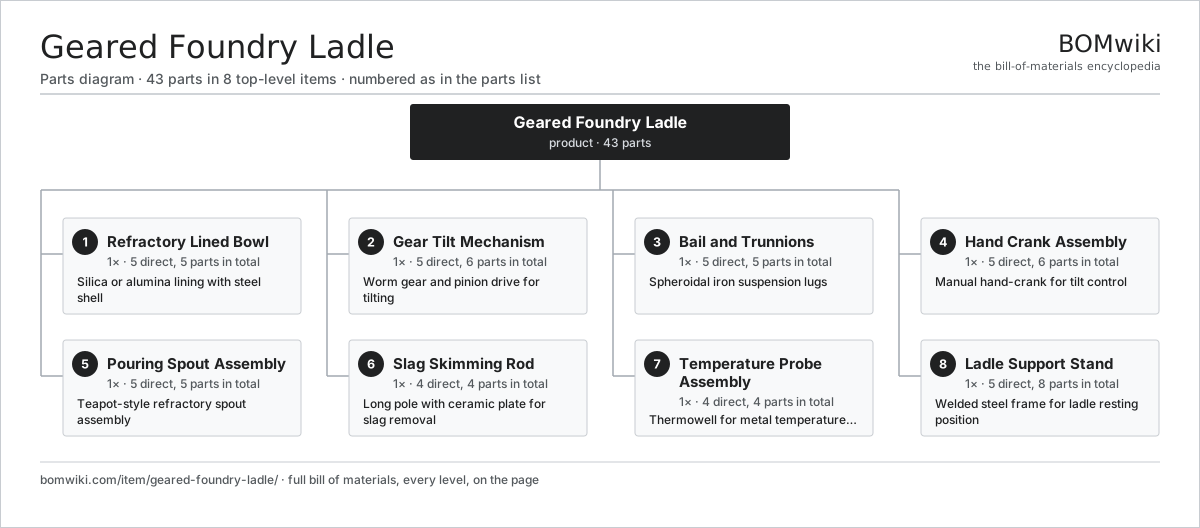
| # | Part | Qty | What it does |
|---|---|---|---|
| 1 | Refractory Lined Bowl 5 parts | 1× | Silica or alumina lining with steel shell |
| 2 | Gear Tilt Mechanism 5 parts | 1× | Worm gear and pinion drive for tilting |
| 3 | Bail and Trunnions 5 parts | 1× | Spheroidal iron suspension lugs |
| 4 | Hand Crank Assembly 5 parts | 1× | Manual hand-crank for tilt control |
| 5 | Pouring Spout Assembly 5 parts | 1× | Teapot-style refractory spout assembly |
| 6 | Slag Skimming Rod 4 parts | 1× | Long pole with ceramic plate for slag removal |
| 7 | Temperature Probe Assembly 4 parts | 1× | Thermowell for metal temperature monitoring |
| 8 | Ladle Support Stand 5 parts | 1× | Welded steel frame for ladle resting position |
3D model
No 3D model yet. Have a CAD file of this? Add a 3D model. STL renders right on this page; STEP, FreeCAD, and OpenSCAD sources are welcome too (openly licensed, like all 3D models on BOMwiki).
Build & assembly graph
expand / collapse · shared sub-assemblies converge · links to related products · est. labourTap an assembly to expand/collapse · tap a part to open it · use “Open page” for any node · drag to pan, scroll to zoom.
Bill of materials for Geared Foundry Ladle
8 top-level lines · 46 rows shown · 43 parts total · indented to 3 levels| # | Item / sub-assembly | Part no. | Qty/assy | Ext. qty | Parts | Type |
|---|---|---|---|---|---|---|
| 1 | Refractory Lined Bowl 5 parts | geared-foundry-ladle-refractory-bowl | 1× | 1 | 5 | assembly |
| 1.1 | Ladle Steel Shell | geared-foundry-ladle-steel-shell | 1× | 1 | · | part |
| 1.2 | Hearth Lining Brick | geared-foundry-ladle-hearth-brick | 1× | 1 | · | part |
| 1.3 | Sidewall Lining | geared-foundry-ladle-sidewall-brick | 1× | 1 | · | part |
| 1.4 | Dome Roof Segment | geared-foundry-ladle-roof-segment | 1× | 1 | · | part |
| 1.5 | Refractory Lining Cement | geared-foundry-ladle-lining-cement | 1× | 1 | · | part |
| 2 | Gear Tilt Mechanism 5 parts | geared-foundry-ladle-gear-tilt-mechanism | 1× | 1 | 6 | assembly |
| 2.1 | Worm Screw | geared-foundry-ladle-worm-screw | 1× | 1 | · | part |
| 2.2 | Worm Gear Wheel | geared-foundry-ladle-worm-wheel | 1× | 1 | · | part |
| 2.3 | Tilt Output Shaft | geared-foundry-ladle-output-shaft | 1× | 1 | · | part |
| 2.4 | Tilt Arm Lever | geared-foundry-ladle-tilt-arm | 1× | 1 | · | part |
| 2.5 | Tilt Pivot Bearing Block | geared-foundry-ladle-bearing-block | 2× | 2 | · | part |
| 3 | Bail and Trunnions 5 parts | geared-foundry-ladle-bail-and-trunnions | 1× | 1 | 5 | assembly |
| 3.1 | Front Trunnion | geared-foundry-ladle-front-trunnion | 1× | 1 | · | part |
| 3.2 | Rear Trunnion | geared-foundry-ladle-rear-trunnion | 1× | 1 | · | part |
| 3.3 | Bail Bar | geared-foundry-ladle-bail-bar | 1× | 1 | · | part |
| 3.4 | Bail Lock Pin | geared-foundry-ladle-bail-lock-pin | 1× | 1 | · | part |
| 3.5 | Fastener Set | fastener-set | 1× | 1 | · | part |
| 4 | Hand Crank Assembly 5 parts | geared-foundry-ladle-handwheel | 1× | 1 | 6 | assembly |
| 4.1 | Hand Wheel Disc | geared-foundry-ladle-handwheel-disc | 1× | 1 | · | part |
| 4.2 | Crank Shaft | geared-foundry-ladle-crank-shaft | 1× | 1 | · | part |
| 4.3 | Shaft Support Bearing | geared-foundry-ladle-shaft-support-bearing | 2× | 2 | · | part |
| 4.4 | Handwheel Friction Brake | geared-foundry-ladle-handwheel-lock | 1× | 1 | · | part |
| 4.5 | Grip Handle | geared-foundry-ladle-operator-handle | 1× | 1 | · | part |
| 5 | Pouring Spout Assembly 5 parts | geared-foundry-ladle-pouring-spout | 1× | 1 | 5 | assembly |
| 5.1 | Spout Ceramic Core | geared-foundry-ladle-spout-core | 1× | 1 | · | part |
| 5.2 | Spout Steel Jacket | geared-foundry-ladle-spout-jacket | 1× | 1 | · | part |
| 5.3 | Spout Mounting Block | geared-foundry-ladle-spout-mounting-block | 1× | 1 | · | part |
| 5.4 | Spout Seal Ring | geared-foundry-ladle-spout-seal-ring | 1× | 1 | · | part |
| 5.5 | Fastener Set | fastener-set | 1× | 1 | · | part |
| 6 | Slag Skimming Rod 4 parts | geared-foundry-ladle-skimmer-rod | 1× | 1 | 4 | assembly |
| 6.1 | Skimmer Pole | geared-foundry-ladle-skimmer-pole | 1× | 1 | · | part |
| 6.2 | Skimming Plate | geared-foundry-ladle-skimmer-plate | 1× | 1 | · | part |
| 6.3 | Skimmer Plate Bracket | geared-foundry-ladle-skimmer-bracket | 1× | 1 | · | part |
| 6.4 | Insulation Wrap | geared-foundry-ladle-handle-wrap | 1× | 1 | · | part |
| 7 | Temperature Probe Assembly 4 parts | geared-foundry-ladle-temperature-probe | 1× | 1 | 4 | assembly |
| 7.1 | Thermowell Ceramic Tube | geared-foundry-ladle-thermowell | 1× | 1 | · | part |
| 7.2 | Type K Thermocouple | geared-foundry-ladle-thermocouple | 1× | 1 | · | part |
| 7.3 | Temperature Display Meter | geared-foundry-ladle-temp-display | 1× | 1 | · | part |
| 7.4 | Thermowell Plug | geared-foundry-ladle-protection-plug | 1× | 1 | · | part |
| 8 | Ladle Support Stand 5 parts | geared-foundry-ladle-support-stand | 1× | 1 | 8 | assembly |
| 8.1 | Stand Base Frame | geared-foundry-ladle-stand-base | 1× | 1 | · | part |
| 8.2 | Stand Center Pedestal | geared-foundry-ladle-stand-pedestal | 1× | 1 | · | part |
| 8.3 | Ladle Nest Ring | geared-foundry-ladle-nest-ring | 1× | 1 | · | part |
| 8.4 | Spout Support Bracket | geared-foundry-ladle-spout-support | 1× | 1 | · | part |
| 8.5 | Stand Caster Wheel | geared-foundry-ladle-stand-wheels | 4× | 4 | · | part |
Something wrong in this list? Report a problem with this BOM.
Sourcing: possible vendors
Browse the supplier directory → Prices, MOQ, and lead times are algorithmic estimates, not quotes, and not claims about these companies. Company mappings are curated by keyword; est. price band $5k–$2M. How estimates work| Vendor | HQ | Specialty | MOQ | Lead time |
|---|---|---|---|---|
| atlascopco.com ↗ | Stockholm, SE | Compressors & industrial | 10 units | 12–20 wks |
|
🇦🇹Andritz
andritz.com ↗
|
Graz, AT | Process plants & machinery | 10 units | 12–20 wks |
| buhlergroup.com ↗ | Uzwil, CH | Food & materials processing | 10 units | 12–20 wks |
| gea.com ↗ | Düsseldorf, DE | Process technology | 10 units | 12–20 wks |
| mhi.com ↗ | Tokyo, JP | Heavy machinery | 10 units | 12–20 wks |
1,102-word article