Gem Trim Saw
ProductOverview
A gem trim saw (also called a trim saw or slab saw in lapidary circles) is a precision circular-blade machine for cutting and trimming rough gemstones, mineral specimens, and jewelry blanks. Unlike a regular abrasive saw that wears away material slowly, a gem saw uses a diamond blade that cuts quickly and produces minimal loss of valuable stone.
The blade is a steel or bronze ring impregnated with industrial diamonds (typically 40–60 mesh), rotating at 2500–4500 rpm. The coolant (usually mineral oil) flows continuously to the blade, lubricating the cutting edge and carrying away stone dust and heat. The stone is held in a vise mounted on an adjustable table, and the operator manually advances it into the spinning blade.
Trim saws range from small tabletop units (4-inch blade) for hobbyists, to larger production machines (12-inch blade) in gem-cutting studios and lapidary operations. The key advantage over hand-sanding or bench grinders is speed and minimal kerf loss: a diamond blade cuts a 6-inch piece of quartz in seconds, versus hours with hand tools, and wastes only 0.02–0.05 inch of material in the kerf.
Blade Design and Materials
The blade is the specialized component that sets a gem saw apart. The core is a thin ring of steel or bronze (0.10–0.25 inch thick, depending on blade size) providing structural support. The rim is a sintered composite of industrial diamonds mixed with bronze or nickel binder, bonded to the core. The diamonds themselves are graded by mesh size (40, 60, 100 mesh are common), mesh referring to the number of particles per inch. Finer mesh (100) cuts slowly but with excellent surface finish; coarser mesh (40) cuts fast but leaves a rougher kerf.
The diamonds are electrically conductive metal-bonded: as the blade spins and the stone is pushed against it, diamonds continuously fracture and cleave naturally, keeping sharp cutting edges exposed. Unlike fixed abrasives, the diamonds essentially "self-sharpen" during cutting. A typical diamond blade lasts for 100–500 carats of cut stone before degradation (many diamonds have dulled and detached) requires blade replacement. Dressing, running the blade against a dressing stone, can restore a dull blade but eventually becomes uneconomical.
The Arbor Nut screws onto the tapered Arbor Nose of the Spindle Shaft, holding the blade in place. The flanges clamp the blade from both sides, distributing load evenly and preventing blade wobble. The arbor nut is always tightened by hand firmly but not with tools, over-tightening can crush the blade core.
Spindle and Drive System
The Spindle Assembly is the core of the machine. A precision Spindle Shaft with ball-bearing support rotates the blade at 2500–4500 rpm, depending on the blade diameter and material being cut. Larger blades (10–12 inch) run slower (2500–3000 rpm) to keep the cutting speed (blade edge velocity) in the optimal range. Smaller blades (4–6 inch) can run faster (4000–4500 rpm) without excessive cutting speed.
The Motor is typically a 0.5–1 hp AC induction motor running at 1800 rpm base. The belt drive steps up the speed by 1.5–3 times via the motor pulley and spindle pulley. A stepped-pulley system allows speed selection by moving the belt between different groove pairs: for example, a three-step pulley might provide 2500, 3500, and 4500 rpm.
Speed selection is critical: the optimal cutting speed for quartz is about 100 feet per second; for harder stones (diamond, corundum), 80–120 feet per second is typical. Cutting too slow grinds the blade, generating excessive heat and accelerating diamond dulling. Cutting too fast risks blade breakage from vibration and chatter.
Vise and Stone Holding
The vise secures the stone during the cut. A traditional vise body has two parallel jaws, one stationary and one movable, both lined with hardened steel or bronze. The handwheel-driven screw applies clamping force without requiring high pressure; typically 10–20 pounds is sufficient to hold a stone firmly. Over-tightening risks crushing the stone itself.
The dovetail slide allows the entire vise to shift position on the table, accommodating different stone sizes and positioning the cut line. The table adjusters (height and angle screws) ensure the stone is perfectly perpendicular to the blade, preventing binding.
For fine cuts, optional fence stops or guide blocks can be clamped to the table, allowing the stone to be advanced in a straight line without manual steering.
Coolant and Lubrication
The Coolant System is essential for both blade longevity and operator safety. Mineral oil or synthetic cutting fluid circulates via a small pump from the reservoir. The nozzle delivers coolant as a steady drip or mist directly onto the blade cutting line.
Coolant serves three purposes:
- Lubrication: Reduces friction between blade and stone, extending blade life 2–3 times.
- Chip clearance: Flushes away stone dust and diamond particles, preventing rebinding.
- Cooling: Dissipates frictional heat that could dull the diamonds or thermally shock the stone.
The Coolant Filter removes stone fines; old coolant becomes thick with grit and must be changed every 50–100 hours of cutting. Neglecting coolant maintenance degrades both blade and finish.
Water-based coolants are sometimes used for softer stones, but mineral oil is preferred for hard gems; water can cause thermal shock and microcracking in sensitive stones like turquoise or fluorite.
Cutting Technique and Workflow
The operator indexes the stone in the vise and positions the table so the cutting line is perpendicular to the blade. The blade is spun up to the selected speed (audible pitch rises as rpm increase). The stone is then advanced slowly into the blade by hand, applying gentle pressure, forcing the stone causes binding and chipping.
For a typical 2-inch quartz piece at 4000 rpm with a 8-inch blade, cutting takes 15–30 seconds. Harder stones (sapphire, diamond) are cut much more slowly (30 seconds to 2 minutes for the same size) and require frequent cooling breaks to avoid thermal stress.
Once one cut is complete, the stone is repositioned for the next cut. Complex cabochons or faceted blanks may require 5–10 cuts, taking 5–15 minutes total. A lapidary artist working alone might process 20–40 stones per day.
Safety and Operator Considerations
The spinning blade is dangerous: loose sleeves or hair can be caught. The hood guard with polycarbonate shield helps contain stone chips and provides a barrier to hands. Most modern saws require the hood to be closed before power is applied, via an interlock. The operator peeks through a small window or hinged opening to monitor cutting progress.
Stone chips travel at high speed; even a small fragment can embed in skin. The hood minimizes spray, but eye protection is essential. Hearing protection is recommended; a spinning blade with coolant spray produces 80–85 dB noise.
Stone Material Compatibility
Different stones require different blade speeds and coolants:
- Quartz (SiO₂): Cuts easily at 3500–4500 rpm, tolerates fast feed.
- Tourmaline and beryl: 3000–4000 rpm, moderate speed, must be cooled frequently to avoid cracking.
- Corundum (sapphire, ruby): 2500–3500 rpm, slow feed, very hard and wear diamonds quickly. High-quality diamond blade essential.
- Diamond: Only diamond blades cut diamond. Specialized electroplated or hybrid blades are used; very slow feed (30–60 seconds per 0.5 inch).
- Turquoise, opal: 2000–3000 rpm, frequent coolant breaks. These soft stones are porous and sensitive to heat.
Production and Maintenance
In a lapidary studio or cutting factory, a single trim saw operates many hours daily. The pump runs continuously when the blade is spinning. The blade dulls predictably; a busy shop might replace blades weekly. The spindle bearings are sealed and rarely serviced; they last years before requiring replacement.
The V-belt stretches over time and must be retensioned every 6–12 months or replaced annually if run daily. Spindle wobble (runout) should not exceed 0.005 inch; if runout increases beyond this, the bearing is likely worn.
A well-maintained trim saw is extremely reliable and can operate for decades. Vintage saws from the 1960s–1980s are still in use today in lapidary studios, often outlasting modern imports in durability if properly serviced.
Gem Trim Saw parts and their functions
8 top-level parts · 40 parts in total · full bill of materials below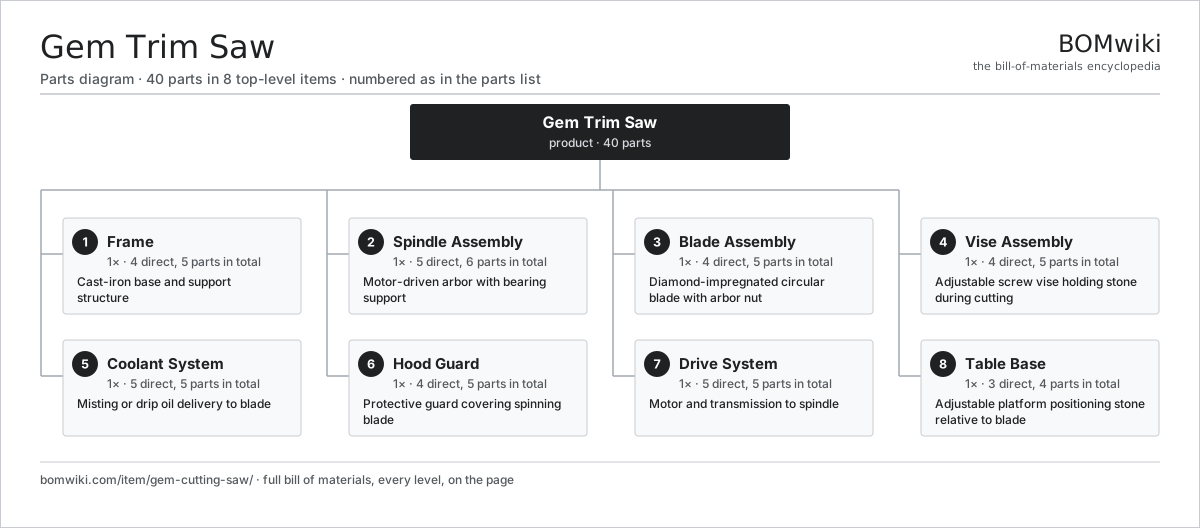
| # | Part | Qty | What it does |
|---|---|---|---|
| 1 | Frame 4 parts | 1× | Cast-iron base and support structure |
| 2 | Spindle Assembly 5 parts | 1× | Motor-driven arbor with bearing support |
| 3 | Blade Assembly 4 parts | 1× | Diamond-impregnated circular blade with arbor nut |
| 4 | Vise Assembly 4 parts | 1× | Adjustable screw vise holding stone during cutting |
| 5 | Coolant System 5 parts | 1× | Misting or drip oil delivery to blade |
| 6 | Hood Guard 4 parts | 1× | Protective guard covering spinning blade |
| 7 | Drive System 5 parts | 1× | Motor and transmission to spindle |
| 8 | Table Base 3 parts | 1× | Adjustable platform positioning stone relative to blade |
3D model
No 3D model yet. Have a CAD file of this? Add a 3D model. STL renders right on this page; STEP, FreeCAD, and OpenSCAD sources are welcome too (openly licensed, like all 3D models on BOMwiki).
Build & assembly graph
expand / collapse · shared sub-assemblies converge · links to related products · est. labourTap an assembly to expand/collapse · tap a part to open it · use “Open page” for any node · drag to pan, scroll to zoom.
Bill of materials for Gem Trim Saw
8 top-level lines · 42 rows shown · 40 parts total · indented to 3 levels| # | Item / sub-assembly | Part no. | Qty/assy | Ext. qty | Parts | Type |
|---|---|---|---|---|---|---|
| 1 | Frame 4 parts | gem-cutting-saw-frame | 1× | 1 | 5 | assembly |
| 1.1 | Base Plate | gem-cutting-saw-base-plate | 1× | 1 | · | part |
| 1.2 | Support Post | gem-cutting-saw-support-post | 2× | 2 | · | part |
| 1.3 | Arm Support | gem-cutting-saw-arm-support | 1× | 1 | · | part |
| 1.4 | Fastener Set | fastener-set | 1× | 1 | · | part |
| 2 | Spindle Assembly 5 parts | gem-cutting-saw-spindle-assembly | 1× | 1 | 6 | assembly |
| 2.1 | Spindle Shaft | gem-cutting-saw-spindle-shaft | 1× | 1 | · | part |
| 2.2 | Spindle Bearing | gem-cutting-saw-spindle-bearing | 2× | 2 | · | part |
| 2.3 | Arbor Nose | gem-cutting-saw-arbor-nose | 1× | 1 | · | part |
| 2.4 | Spindle Pulley | gem-cutting-saw-spindle-pulley | 1× | 1 | · | part |
| 2.5 | Motor Mount | gem-cutting-saw-motor-mount | 1× | 1 | · | part |
| 3 | Blade Assembly 4 parts | gem-cutting-saw-blade-assembly | 1× | 1 | 5 | assembly |
| 3.1 | Blade Core | gem-cutting-saw-blade-core | 1× | 1 | · | part |
| 3.2 | Diamond Segment | gem-cutting-saw-diamond-segment | 1× | 1 | · | part |
| 3.3 | Arbor Nut | gem-cutting-saw-arbor-nut | 1× | 1 | · | part |
| 3.4 | Blade Flange | gem-cutting-saw-blade-flange | 2× | 2 | · | part |
| 4 | Vise Assembly 4 parts | gem-cutting-saw-vise-assembly | 1× | 1 | 5 | assembly |
| 4.1 | Vise Body | gem-cutting-saw-vise-body | 1× | 1 | · | part |
| 4.2 | Vise Screw | gem-cutting-saw-vise-screw | 1× | 1 | · | part |
| 4.3 | Vise Jaw | gem-cutting-saw-vise-jaw | 2× | 2 | · | part |
| 4.4 | Vise Slide | gem-cutting-saw-vise-slide | 1× | 1 | · | part |
| 5 | Coolant System 5 parts | gem-cutting-saw-coolant-system | 1× | 1 | 5 | assembly |
| 5.1 | Coolant Reservoir | gem-cutting-saw-coolant-reservoir | 1× | 1 | · | part |
| 5.2 | Coolant Pump | gem-cutting-saw-coolant-pump | 1× | 1 | · | part |
| 5.3 | Coolant Line | gem-cutting-saw-coolant-line | 1× | 1 | · | part |
| 5.4 | Coolant Filter | gem-cutting-saw-coolant-filter | 1× | 1 | · | part |
| 5.5 | Coolant Nozzle | gem-cutting-saw-coolant-nozzle | 1× | 1 | · | part |
| 6 | Hood Guard 4 parts | gem-cutting-saw-hood-guard | 1× | 1 | 5 | assembly |
| 6.1 | Hood Frame | gem-cutting-saw-hood-frame | 1× | 1 | · | part |
| 6.2 | Hood Shield | gem-cutting-saw-hood-shield | 2× | 2 | · | part |
| 6.3 | Hood Hinge | gem-cutting-saw-hood-hinge | 1× | 1 | · | part |
| 6.4 | Hood Latch | gem-cutting-saw-hood-latch | 1× | 1 | · | part |
| 7 | Drive System 5 parts | gem-cutting-saw-drive-system | 1× | 1 | 5 | assembly |
| 7.1 | Motor | gem-cutting-saw-motor | 1× | 1 | · | part |
| 7.2 | Motor Pulley | gem-cutting-saw-motor-pulley | 1× | 1 | · | part |
| 7.3 | Spindle Pulley | gem-cutting-saw-spindle-pulley | 1× | 1 | · | part |
| 7.4 | Drive Belt | gem-cutting-saw-drive-belt | 1× | 1 | · | part |
| 7.5 | Tension Adjuster | gem-cutting-saw-tension-adjuster | 1× | 1 | · | part |
| 8 | Table Base 3 parts | gem-cutting-saw-table-base | 1× | 1 | 4 | assembly |
| 8.1 | Table Plate | gem-cutting-saw-table-plate | 1× | 1 | · | part |
| 8.2 | Table Adjuster | gem-cutting-saw-table-adjuster | 2× | 2 | · | part |
| 8.3 | Table Fence | gem-cutting-saw-table-fence | 1× | 1 | · | part |
Something wrong in this list? Report a problem with this BOM.
Sourcing: possible vendors
Browse the supplier directory → Prices, MOQ, and lead times are algorithmic estimates, not quotes, and not claims about these companies. Company mappings are curated by keyword; est. price band $5k–$2M. How estimates work| Vendor | HQ | Specialty | MOQ | Lead time |
|---|---|---|---|---|
| atlascopco.com ↗ | Stockholm, SE | Compressors & industrial | 10 units | 12–20 wks |
|
🇦🇹Andritz
andritz.com ↗
|
Graz, AT | Process plants & machinery | 10 units | 12–20 wks |
| buhlergroup.com ↗ | Uzwil, CH | Food & materials processing | 10 units | 12–20 wks |
| gea.com ↗ | Düsseldorf, DE | Process technology | 10 units | 12–20 wks |
| mhi.com ↗ | Tokyo, JP | Heavy machinery | 10 units | 12–20 wks |
1,542-word article