Gem Faceting Machine
ProductOverview
A gem faceting machine is a precision lapidary tool for cutting planar faces (facets) onto gemstones with exact angles and positions. By rotating a diamond-impregnated lap (abrasive disk) and maintaining a stone at a precisely controlled angle, the operator progressively grinds away material, creating a geometric pattern of facets that maximizes light refraction and brilliance. The process is essential for transforming rough gemstones into finished jewels, each facet must be ground to within ±0.5° of the design angle, or the finished stone will not exhibit proper optical performance.
Gem faceting machines range from manual benchtop units used by amateur lapidaries to precision CNC systems employed in commercial cutting houses. The fundamental design has remained largely unchanged since the 1960s: a rotating lap, a movable stone holder, and an index mechanism to set precise facet angles.
How it works
A gemstone (rough or partially finished) is mounted in a stone holder (chuck or dop stick) attached to the faceting head. The operator sets the index gears to the angle of the first facet (e.g., 41.8° for a brilliant-cut crown facet). This adjustment moves the mast carriage, tilting the stone holder to match that angle relative to the rotating lap disk.
The lap spins at 1200–2400 RPM (typical speed for faster cutting without heat buildup). The operator lowers the stone toward the lap using the vertical height screw, establishing light contact. Water from the circulation system flows over the lap, carrying away stone dust and heat.
The operator then grinds the facet by moving the stone in figure-eight or circular patterns across the rotating lap surface. The diamond particles on the lap abrade the stone; the exact angle is maintained by the locking index gears, so all facets at the same angle are cut to nearly identical geometry.
Grinding time per facet varies: a small (5–10 carat) stone might take 30 seconds to 2 minutes per facet; a large (20+ carat) stone may take 5–10 minutes. Once the first facet is established (visible by examining the cut surface), the operator resets the index to the next angle and repeats. A typical brilliant-cut diamond has 58 facets (33 on the crown, 24 on the pavilion, plus the table); cutting takes 1–3 hours per stone depending on size, clarity, and operator skill.
Lap Composition and Grit
The lap disk is a flat circular plate (3–6 inches diameter) made of copper, aluminum, or cast iron, with diamond particles embedded into the surface. Diamond grit is measured in microns: coarser grits (80–220) cut quickly but leave rough surfaces; medium grits (400–600) refine the surface; finer grits (1000+) polish and finish the facet.
Most machines use a single lap with one grit (typically 220–600 for general work). Production shops may have a set of laps with different grits: coarse (220) for roughing, medium (400) for refining, fine (1000) for polishing. A lap eventually wears and loses cutting efficiency; it is replaced every 1–3 years depending on usage.
Diamond-impregnated laps are far superior to older silicon carbide (SiC) laps because diamond is much harder and faster-cutting; a diamond lap cuts a gemstone 2–3× faster with less heat generation.
Index System and Angle Control
The index system consists of a precision worm and gear (typical ratio 40:1 or 100:1). One full turn of the handwheel rotates the mast carriage (and stone) by 360/N degrees, where N is the gear ratio. With a 40:1 system, one handwheel turn = 9° rotation. The dial is marked in 1° increments, allowing the operator to set any angle 0–90° by counting handwheel turns or reading the dial directly.
For higher precision, a vernier scale allows reading to 0.1° or better. The detent mechanism (spring-loaded ball bearing) locks the index wheel at each degree increment, preventing accidental drift during grinding.
Facet angle precision is critical: the "crown angle" of a brilliant-cut diamond should be 34.5±1°; if cut at 36°, light exits the side of the stone (leakage), reducing brilliance. If cut at 32°, light bounces internally (total internal reflection) and the stone appears dark. Precision ±0.5° is necessary for good optical performance.
Stone Holder and Pressure Control
The stone chuck grips the dop stick (a small shaft with the stone attached to one end). Dops are typically made of brass, with a wooden or leather-wrapped shaft for holding. The chuck must hold the stone rigidly without slipping.
The pressure screw is a hand-turned knob that lowers the stone incrementally toward the lap. Light pressure (2–5 pounds force) is typical for fine faceting; heavy pressure is avoided because it generates heat and dulls the lap. The operator adjusts pressure by feel and sound (a grinding sound indicates adequate contact; silence suggests too-light pressure).
Water Circulation and Cooling
The water system is essential. Water serves two purposes: cooling the stone and lap (preventing thermal shock or heat damage to the stone), and carrying away stone dust slurry. Without water circulation, friction heat can exceed 500°C locally; many gemstones (opal, emerald, tourmaline) will crack or burn at sustained temperatures >100°C.
Water is circulated by a small pump from a trough over the lap and stone. The slurry drains back to the trough, where a filter insert removes stone dust. The water should be changed weekly or when it becomes cloudy with slurry.
Cut Patterns and Optical Design
Different gemstones and styles require different facet patterns. The brilliant cut (standard for diamonds and many transparent stones) has:
- Crown: 1 table + 8 star facets + 8 upper-girdle facets = 17 facets
- Pavilion: 8 lower-girdle facets + 8 main facets = 16 facets
- Girdle: 8 facets
- Total: 58 facets
Each facet has a specific angle and size; the proportions determine the optical properties (brilliance, scintillation, fire). The faceting machine allows precise angle control, but achieving the exact facet size requires skill in stone positioning and consistent grinding motion.
Materials and Gemstone Properties
Diamond (hardness 10): Fastest to cut with a diamond lap, but requires precise angle control.
Corundum (sapphire, ruby, hardness 9): Slightly slower than diamond; requires finer-grit laps for finishing.
Beryl (emerald, aquamarine, hardness 7.5–8): Softer; requires lighter pressure and slower lap speed to avoid cracking along cleavage planes.
Quartz (amethyst, citrine, topaz, hardness 7–8): Cuts smoothly; moderate speed and pressure.
Opal (hardness 5.5–6.5): Delicate and hydrophilic (absorbs water, can crack if dried rapidly); requires constant water circulation and gentle pressure.
Workflow and Production Speed
A professional faceter can cut 5–8 gems per 8-hour shift, depending on stone size and complexity. Larger stones (>20 carats) take 2–3 hours each; smaller stones (<5 carats) may take 20–30 minutes. The skilled operator judges:
- When the facet is complete (facet should be flat and bright, with minimal texture).
- Whether angle and size match the design.
- Pressure and lap speed to maximize speed without damaging the stone.
Mistakes are costly: overcutting a facet (grinding too deep) removes excess material and ruins the stone's proportions. Undercutting wastes time; the operator must start over, increasing the facet size and shifting all subsequent facet positions. A single critical error on a large gemstone can result in loss of USD 1000+, making precision essential.
Gem Faceting Machine parts and their functions
7 top-level parts · 34 parts in total · full bill of materials below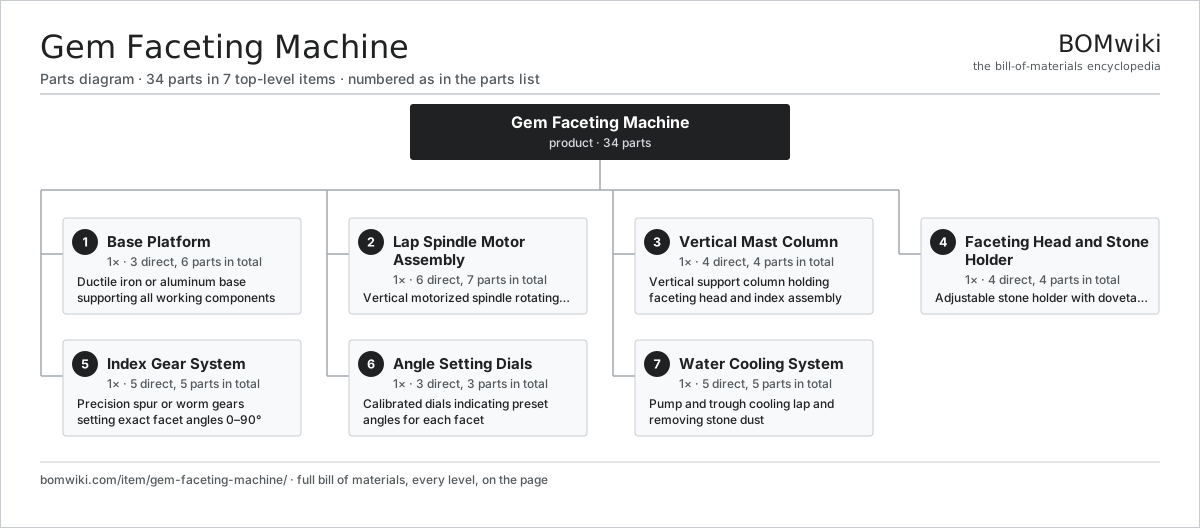
| # | Part | Qty | What it does |
|---|---|---|---|
| 1 | Base Platform 3 parts | 1× | Ductile iron or aluminum base supporting all working components |
| 2 | Lap Spindle Motor Assembly 6 parts | 1× | Vertical motorized spindle rotating diamond-charged lap at 600–3600 RPM |
| 3 | Vertical Mast Column 4 parts | 1× | Vertical support column holding faceting head and index assembly |
| 4 | Faceting Head and Stone Holder 4 parts | 1× | Adjustable stone holder with dovetail angle mechanism |
| 5 | Index Gear System 5 parts | 1× | Precision spur or worm gears setting exact facet angles 0–90° |
| 6 | Angle Setting Dials 3 parts | 1× | Calibrated dials indicating preset angles for each facet |
| 7 | Water Cooling System 5 parts | 1× | Pump and trough cooling lap and removing stone dust |
3D model
No 3D model yet. Have a CAD file of this? Add a 3D model. STL renders right on this page; STEP, FreeCAD, and OpenSCAD sources are welcome too (openly licensed, like all 3D models on BOMwiki).
Build & assembly graph
expand / collapse · shared sub-assemblies converge · links to related products · est. labourTap an assembly to expand/collapse · tap a part to open it · use “Open page” for any node · drag to pan, scroll to zoom.
Bill of materials for Gem Faceting Machine
7 top-level lines · 37 rows shown · 34 parts total · indented to 3 levels| # | Item / sub-assembly | Part no. | Qty/assy | Ext. qty | Parts | Type |
|---|---|---|---|---|---|---|
| 1 | Base Platform 3 parts | gem-faceting-machine-base-platform | 1× | 1 | 6 | assembly |
| 1.1 | Base Cast Plate | gem-faceting-machine-base-plate | 1× | 1 | · | part |
| 1.2 | Vibration Damping Feet | gem-faceting-machine-damping-feet | 4× | 4 | · | part |
| 1.3 | Spindle Mounting Bracket | gem-faceting-machine-spindle-mount | 1× | 1 | · | part |
| 2 | Lap Spindle Motor Assembly 6 parts | gem-faceting-machine-lap-spindle | 1× | 1 | 7 | assembly |
| 2.1 | Spindle Motor | gem-faceting-machine-spindle-motor | 1× | 1 | · | part |
| 2.2 | Spindle Shaft | gem-faceting-machine-spindle-shaft | 1× | 1 | · | part |
| 2.3 | Spindle Bearing | gem-faceting-machine-spindle-bearing | 2× | 2 | · | part |
| 2.4 | Lap Mounting Plate | gem-faceting-machine-lap-plate | 1× | 1 | · | part |
| 2.5 | Diamond-Impregnated Lap Disk | gem-faceting-machine-lap-disk | 1× | 1 | · | part |
| 2.6 | Spindle Drive Pulley | gem-faceting-machine-spindle-pulley | 1× | 1 | · | part |
| 3 | Vertical Mast Column 4 parts | gem-faceting-machine-mast-assembly | 1× | 1 | 4 | assembly |
| 3.1 | Mast Vertical Post | gem-faceting-machine-mast-post | 1× | 1 | · | part |
| 3.2 | Mast Dovetail Carriage | gem-faceting-machine-mast-carriage | 1× | 1 | · | part |
| 3.3 | Mast Carriage Lock Lever | gem-faceting-machine-mast-lock | 1× | 1 | · | part |
| 3.4 | Vertical Height Screw | gem-faceting-machine-vertical-adjuster | 1× | 1 | · | part |
| 4 | Faceting Head and Stone Holder 4 parts | gem-faceting-machine-faceting-head | 1× | 1 | 4 | assembly |
| 4.1 | Stone Holder Body | gem-faceting-machine-head-body | 1× | 1 | · | part |
| 4.2 | Stone Chuck or Dop Holder | gem-faceting-machine-stone-chuck | 1× | 1 | · | part |
| 4.3 | Angle Adjustment Mechanism | gem-faceting-machine-angle-adjustment | 1× | 1 | · | part |
| 4.4 | Pressure Control Screw | gem-faceting-machine-pressure-screw | 1× | 1 | · | part |
| 5 | Index Gear System 5 parts | gem-faceting-machine-index-gears | 1× | 1 | 5 | assembly |
| 5.1 | Precision Worm Shaft | gem-faceting-machine-index-worm | 1× | 1 | · | part |
| 5.2 | Index Spur Gear | gem-faceting-machine-index-wheel | 1× | 1 | · | part |
| 5.3 | Index Dial Plate | gem-faceting-machine-index-dial | 1× | 1 | · | part |
| 5.4 | Index Detent Mechanism | gem-faceting-machine-index-detent | 1× | 1 | · | part |
| 5.5 | Facet Reference Marks | gem-faceting-machine-facet-position-marks | 1× | 1 | · | part |
| 6 | Angle Setting Dials 3 parts | gem-faceting-machine-angle-dials | 1× | 1 | 3 | assembly |
| 6.1 | Main Angle Dial | gem-faceting-machine-main-dial | 1× | 1 | · | part |
| 6.2 | Vernier Fine-Adjustment Scale | gem-faceting-machine-vernier-scale | 1× | 1 | · | part |
| 6.3 | Index Pointer Needle | gem-faceting-machine-pointer-needle | 1× | 1 | · | part |
| 7 | Water Cooling System 5 parts | gem-faceting-machine-water-circulation | 1× | 1 | 5 | assembly |
| 7.1 | Water Circulation Pump | gem-faceting-machine-water-pump | 1× | 1 | · | part |
| 7.2 | Water Trough Basin | gem-faceting-machine-water-trough | 1× | 1 | · | part |
| 7.3 | Supply Hose | gem-faceting-machine-water-supply-hose | 1× | 1 | · | part |
| 7.4 | Drain Hose | gem-faceting-machine-drain-hose | 1× | 1 | · | part |
| 7.5 | Water Filter Insert | gem-faceting-machine-water-filter | 1× | 1 | · | part |
Something wrong in this list? Report a problem with this BOM.
Sourcing: possible vendors
Browse the supplier directory → Prices, MOQ, and lead times are algorithmic estimates, not quotes, and not claims about these companies. Company mappings are curated by keyword; est. price band $5k–$2M. How estimates work| Vendor | HQ | Specialty | MOQ | Lead time |
|---|---|---|---|---|
| atlascopco.com ↗ | Stockholm, SE | Compressors & industrial | 10 units | 12–20 wks |
|
🇦🇹Andritz
andritz.com ↗
|
Graz, AT | Process plants & machinery | 10 units | 12–20 wks |
| buhlergroup.com ↗ | Uzwil, CH | Food & materials processing | 10 units | 12–20 wks |
| gea.com ↗ | Düsseldorf, DE | Process technology | 10 units | 12–20 wks |
| mhi.com ↗ | Tokyo, JP | Heavy machinery | 10 units | 12–20 wks |
1,318-word article