Generator Paralleling Switchgear
ProductOverview
A generator paralleling switchgear system is an electrical infrastructure that synchronizes and controls multiple generators running in parallel on a common bus bar, sharing load automatically while preventing out-of-phase closure and islanding. The core subsystem is the Synchronization Module, which continuously measures voltage magnitude, frequency, and phase angle between the generator and the main bus, signaling the individual Generator Breakers to open or close only when synchronization conditions are met.
Paralleling systems are essential in data centers, hospitals, industrial plants, and military facilities where redundancy and load sharing are critical. Two or three generators running in parallel provide continuous operation if one fails. Load sharing equalizes fuel burn and wear across engines, extending service life.
How it works
Each generator connects to the main Main Bus Bars through a dedicated generator breaker. The Current Transformers on the bus and generator feeders provide 5 A secondary signals proportional to primary current. The Synchronization Module microcontroller continuously monitors:
- Bus voltage: Sampled via potential transformer (PT) stepped down from the main bus (e.g., 208 V to 120 V)
- Generator voltage: Sampled via PT from the generator output terminals
- Bus frequency: Zero-crossing detection of bus voltage sine wave
- Generator frequency: Zero-crossing detection of generator voltage sine wave
- Phase offset: Time measurement between corresponding zero-crossings
Before opening a generator breaker, the synchronizer confirms that:
- Generator frequency is within ±2 % of bus frequency
- Generator voltage is within ±5 % of bus voltage
- Phase angle offset is less than ±3° (approximately 5 ms at 60 Hz)
When all conditions are met, the synchronizer energizes the generator breaker solenoid, closing the breaker in <500 ms. Real power flows from the higher-frequency generator into the lower-frequency bus, achieving synchronism in 1–2 seconds.
Protection hierarchy
The Protection Relays provide multiple layers of defense:
- Overcurrent (50/51): Trips generator breaker if output current exceeds field rating plus margin, protecting against short-circuit or overload.
- Underfrequency (81): Detects grid failure by monitoring bus frequency drop. If frequency falls below 59.5 Hz (60 Hz system), the relay signals generator disconnection to prevent islanding.
- Overvoltage (59): Detects excitation runaway. If voltage rises above 132 % nominal, the relay trips the generator field exciter circuit.
- Reverse-power (32): Detects motoring condition (negative real power) if engine fails or load is removed. The relay disconnects the generator to prevent it acting as a motor and overheating.
- Out-of-sync (25): Prevents breaker closure if generators are >10° phase offset, avoiding inrush current that could damage equipment and trip protection.
Load sharing
Once paralleled, generators share load proportional to their governor speed droop curves. A generator with a 5 % droop (frequency drops 5 % when going from no-load to full-load) will carry approximately equal MW as another 5 % droop unit. If droop curves differ (one unit 3 %, another 5 %), the stiffer unit carries more load. Operators must tune governor droop curves during commissioning to balance load equally.
Reactive power sharing is controlled by excitation. Generators with higher AVR (automatic voltage regulator) setpoints will push reactive power into those with lower setpoints. Field current sharing can be verified by comparing phase angles; ideally, all generators should show identical voltage and phase at the bus.
Manual and automatic modes
In automatic mode, the synchronizer continuously monitors conditions and opens/closes generator breakers autonomously. An engine-start signal from the facility's load management system triggers the synchronizer to bring the generator online when load demand increases.
In manual mode, an operator uses the Local HMI Panel pushbuttons to START (crank and run engine) and SYNC (close breaker when ready). This mode is used during maintenance or troubleshooting.
The Audible Alarm and status LEDs on the Local HMI Panel alert operators to protection relay trips, synchronization failures, or out-of-service conditions.
Commissioning
Before first operation, the three current transformers must be tested for secondary current accuracy using a CT megger (insulation) and secondary load test. Potential transformer secondaries are verified to output 120 V when primary voltage is nominal (e.g., 208 V primary = 120 V secondary at 120/208 V systems).
The synchronizer software is configured with generator nameplate ratings, protection relay setpoints, and frequency droop curves. Each generator's no-load voltage is adjusted via AVR trim so that all generators present identical voltage at the bus.
A "soft-start" commissioning test involves starting each generator individually, loading to 50 %, then paralleling a second unit at reduced load. Phase angle is observed on the synchronizer display; closure should occur within ±3°. Real and reactive power are verified balanced on the Local HMI Panel.
Maintenance
The Circuit Breaker Contacts in molded-case breakers erode with each switching cycle. Every 1000 mechanical operations (approximately 5–10 years of normal load cycling), contacts should be inspected for pitting and wear. Severely eroded contacts reduce contact force, causing excessive heating; replacement is needed.
The Current Transformers core may saturate if secondary burden (relay and wiring) exceeds the CT's rated burden. Core saturation appears as nonlinear secondary current; relays may fail to trip on high currents. Annual CT saturation testing (secondary open-circuit voltage test) confirms good core condition.
The Synchronization Module microcontroller firmware is updated annually to patch any discovered synchronization algorithm issues. Potential transformer (PT) windings should be megger-tested (insulation resistance) every 3 years; moisture ingress can reduce insulation and cause core saturation.
Generator Paralleling Switchgear parts and their functions
8 top-level parts · 91 parts in total · full bill of materials below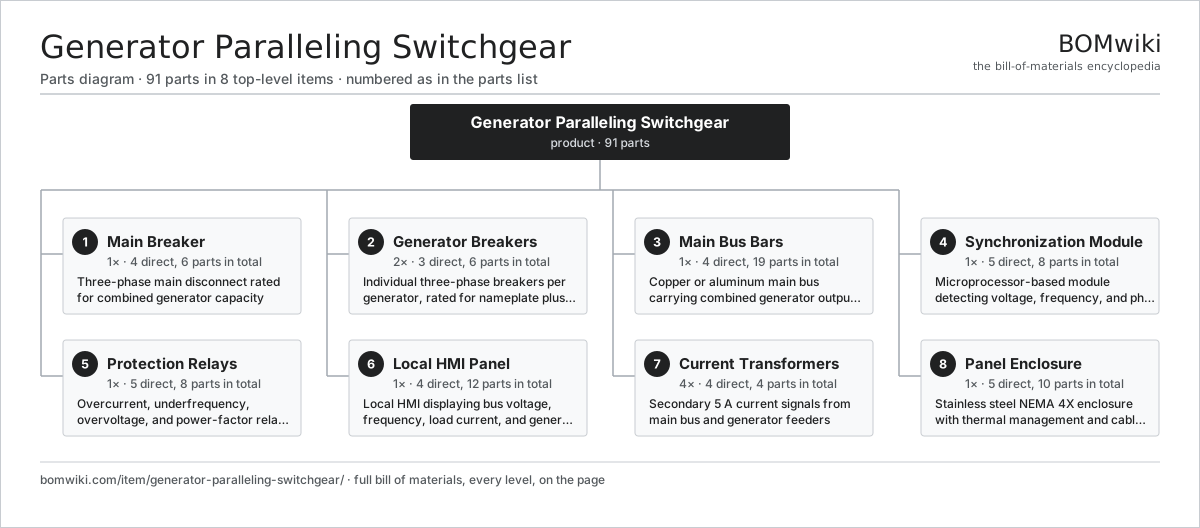
| # | Part | Qty | What it does |
|---|---|---|---|
| 1 | Main Breaker 4 parts | 1× | Three-phase main disconnect rated for combined generator capacity |
| 2 | Generator Breakers 3 parts | 2× | Individual three-phase breakers per generator, rated for nameplate plus margin |
| 3 | Main Bus Bars 4 parts | 1× | Copper or aluminum main bus carrying combined generator output to load |
| 4 | Synchronization Module 5 parts | 1× | Microprocessor-based module detecting voltage, frequency, and phase angle between generators |
| 5 | Protection Relays 5 parts | 1× | Overcurrent, underfrequency, overvoltage, and power-factor relays for each generator |
| 6 | Local HMI Panel 4 parts | 1× | Local HMI displaying bus voltage, frequency, load current, and generator status |
| 7 | Current Transformers 4 parts | 4× | Secondary 5 A current signals from main bus and generator feeders |
| 8 | Panel Enclosure 5 parts | 1× | Stainless steel NEMA 4X enclosure with thermal management and cable routing |
3D model
No 3D model yet. Have a CAD file of this? Add a 3D model. STL renders right on this page; STEP, FreeCAD, and OpenSCAD sources are welcome too (openly licensed, like all 3D models on BOMwiki).
Build & assembly graph
expand / collapse · shared sub-assemblies converge · links to related products · est. labourTap an assembly to expand/collapse · tap a part to open it · use “Open page” for any node · drag to pan, scroll to zoom.
Bill of materials for Generator Paralleling Switchgear
8 top-level lines · 42 rows shown · 91 parts total · indented to 3 levels| # | Item / sub-assembly | Part no. | Qty/assy | Ext. qty | Parts | Type |
|---|---|---|---|---|---|---|
| 1 | Main Breaker 4 parts | generator-paralleling-main-breaker | 1× | 1 | 6 | assembly |
| 1.1 | Circuit Breaker Contacts | generator-paralleling-breaker-contacts | 3× | 3 | · | part |
| 1.2 | Breaker Mechanism | generator-paralleling-breaker-mechanism | 1× | 1 | · | part |
| 1.3 | Breaker Frame | generator-paralleling-breaker-frame | 1× | 1 | · | part |
| 1.4 | Auxiliary Contacts | generator-paralleling-breaker-status-aux | 1× | 1 | · | part |
| 2 | Generator Breakers 3 parts | generator-paralleling-gen-breakers | 2× | 2 | 6 | assembly |
| 2.1 | Circuit Breaker Contacts | generator-paralleling-breaker-contacts | 2× | 4 | · | part |
| 2.2 | Breaker Mechanism | generator-paralleling-breaker-mechanism | 2× | 4 | · | part |
| 2.3 | Generator Paralleling Gen Ct Connection | generator-paralleling-switchgear-generator-paralleling-gen-ct-connection | 2× | 4 | · | part |
| 3 | Main Bus Bars 4 parts | generator-paralleling-bus | 1× | 1 | 19 | assembly |
| 3.1 | Bus Bars | generator-paralleling-bus-bars | 3× | 3 | · | part |
| 3.2 | Bus Insulators | generator-paralleling-bus-insulators | 6× | 6 | · | part |
| 3.3 | Compression Lugs | generator-paralleling-bus-connectors | 9× | 9 | · | part |
| 3.4 | Grounding Bus | generator-paralleling-bus-grounding | 1× | 1 | · | part |
| 4 | Synchronization Module 5 parts | generator-paralleling-synchronizer | 1× | 1 | 8 | assembly |
| 4.1 | Sync Microcontroller | generator-paralleling-sync-microcontroller | 1× | 1 | · | part |
| 4.2 | PT Secondary Network | generator-paralleling-voltage-input | 2× | 2 | · | part |
| 4.3 | Frequency Detector | generator-paralleling-frequency-detector | 1× | 1 | · | part |
| 4.4 | Phase Angle Detector | generator-paralleling-phase-detector | 1× | 1 | · | part |
| 4.5 | Solid-State Relay Output | generator-paralleling-relay-output | 3× | 3 | · | part |
| 5 | Protection Relays 5 parts | generator-paralleling-protection-relays | 1× | 1 | 8 | assembly |
| 5.1 | Relay | relay | 4× | 4 | · | part |
| 5.2 | Underfrequency Relay | generator-paralleling-underfreq-relay | 1× | 1 | · | part |
| 5.3 | Overvoltage Relay | generator-paralleling-overvoltage-relay | 1× | 1 | · | part |
| 5.4 | Reverse-Power Relay | generator-paralleling-reverse-power-relay | 1× | 1 | · | part |
| 5.5 | Synchronism Check Relay | generator-paralleling-sync-check-relay | 1× | 1 | · | part |
| 6 | Local HMI Panel 4 parts | generator-paralleling-hmi | 1× | 1 | 12 | assembly |
| 6.1 | HMI Display | generator-paralleling-display-screen | 1× | 1 | · | part |
| 6.2 | Control Buttons | generator-paralleling-push-buttons | 4× | 4 | · | part |
| 6.3 | Status LEDs | generator-paralleling-indicator-lights | 6× | 6 | · | part |
| 6.4 | Audible Alarm | generator-paralleling-audio-alarm | 1× | 1 | · | part |
| 7 | Current Transformers 4 parts | generator-paralleling-current-transformers | 4× | 4 | 4 | assembly |
| 7.1 | Main Bus CT | generator-paralleling-ct-main | 1× | 4 | · | part |
| 7.2 | Gen 1 Feeder CT | generator-paralleling-ct-gen1 | 1× | 4 | · | part |
| 7.3 | Gen 2 Feeder CT | generator-paralleling-ct-gen2 | 1× | 4 | · | part |
| 7.4 | CT Burden Resistor | generator-paralleling-ct-burden | 1× | 4 | · | part |
| 8 | Panel Enclosure 5 parts | generator-paralleling-panel-housing | 1× | 1 | 10 | assembly |
| 8.1 | Enclosure Frame | generator-paralleling-enclosure-frame | 1× | 1 | · | part |
| 8.2 | Enclosure Door | generator-paralleling-enclosure-door | 1× | 1 | · | part |
| 8.3 | Interior Heatsink | generator-paralleling-interior-heatsink | 1× | 1 | · | part |
| 8.4 | Terminal Blocks | generator-paralleling-terminal-blocks | 1× | 1 | · | part |
| 8.5 | Cable Glands | generator-paralleling-cable-glands | 6× | 6 | · | part |
Something wrong in this list? Report a problem with this BOM.
Sourcing: possible vendors
Browse the supplier directory → Prices, MOQ, and lead times are algorithmic estimates, not quotes, and not claims about these companies. Company mappings are curated by keyword; est. price band $5k–$50M. How estimates work| Vendor | HQ | Specialty | MOQ | Lead time |
|---|---|---|---|---|
| gevernova.com ↗ | Cambridge, US | Power generation | made to order | 20–40 wks |
| siemens-energy.com ↗ | Munich, DE | Power & grid | made to order | 20–40 wks |
| hitachienergy.com ↗ | Zurich, CH | Grid & transformers | made to order | 20–40 wks |
|
🇨🇭ABB
abb.com ↗
|
Zurich, CH | Electrification & automation | made to order | 20–40 wks |
| se.com ↗ | Rueil-Malmaison, FR | Electrical & automation | made to order | 20–40 wks |
916-word article