Glass Armonica
ProductOverview
The glass armonica is one of the most unusual instruments ever invented: rotating glass bowls played by touching their rims with moistened fingertips. When a wet finger presses lightly against the rim of a rotating glass hemisphere, friction between the finger and glass vibrates the entire bowl. This vibration excites the air inside and outside the bowl, producing a pure, ethereal tone often described as "otherworldly" or "angelic."
The instrument was invented by Benjamin Franklin in 1761 and named after the Italian word for "harmony" (harmonica). Franklin designed it to overcome the limitations of existing glass harmonica variants by nesting bowls of different sizes on a single spindle. The glass armonica achieved great popularity in 18th-century salons and concert halls, played by virtuosi who drew audiences with its mysterious, haunting tones.
The motor drive continuously rotates the spindle at adjustable speeds (60–150 RPM). The player sits to the side of the instrument, placing moistened fingers on the rotating bowl rims to produce gliding, vocalization-like tones. The instrument produces no percussive attack (unlike piano or harpsichord) and sustains smoothly as long as the player's finger remains in contact.
How it works
The fundamental mechanism is friction excitation of a vibrating glass shell. Each high bowl, mid bowl, and low bowl is precisely tuned by its mass, wall thickness, diameter, and glass composition. A glass hemisphere naturally resonates at specific frequencies determined by classical elasticity theory; the fundamental pitch is dominated by the lowest symmetric vibration mode.
When the spindle rotates at a steady speed (typically 80–120 RPM for mid-register bowls), a player places a moistened finger gently against the rim. The moisture (usually water mixed with glycerin or rosin powder) creates a viscous interface with minimal slip. As the rim rotates beneath the finger, friction forces impart energy to the glass. This energy excites the bowl's resonant vibration mode, causing the entire hemisphere to oscillate at its natural frequency. The oscillation radiates sound both inward (through the water-filled trough) and outward into the room.
The player's finger position and pressure control several parameters:
- Pitch bending: Light sideways movement of the finger shifts the contact point along the rim, allowing glissando slides and vibrato effects.
- Amplitude (dynamics): Pressing harder or lighter modulates the transfer of friction energy, controlling loudness.
- Timbre: Contact point position, finger shape, and moisture saturation all subtly alter the excitation distribution and thus the harmonic content.
The water trough beneath the bowls serves two purposes: it provides the moistening medium for the player's fingers, and it acts as an acoustic coupling, reflecting and reinforcing low-frequency vibrations from the larger bowls. Temperature and water salinity affect the viscosity and acoustic properties; many performers finely control water composition (distilled water, rose water, salt) to optimize tone.
Construction and tuning
Manufacturing glass armonicas requires precision glassblowing. Each bowl must be hemispherical (or nearly so) with uniform wall thickness and symmetrical geometry. Asymmetries or thick spots cause the bowl to vibrate in multiple modes, producing unwanted beating or false frequencies.
Bowls are tuned by selectively grinding interior or exterior surfaces to adjust mass distribution. A 300 mm bowl producing C1 (frequency 32.7 Hz) weighs approximately 800–1000 grams and requires many hours of careful tuning. Each instrument contains 23–37 bowls, so total tuning time can exceed 100 hours per instrument.
The spindle must be perfectly balanced and smooth: vibration or runout exceeding 0.2 mm causes audible wow and flutter. Historical armonicas used wooden spindles and manual hand-crank or foot-pump mechanisms. Modern instruments use steel spindles and electric motors with variable speed control via foot pedal, allowing players to maintain optimal rotational speed during performance.
Water quality affects tone: mineral content, temperature, and pH all influence evaporation rate and damping. Experienced players use distilled water mixed with glycerin (to reduce evaporation) or add rosin powder (to increase friction). Too much friction causes squealing and breaks the smooth oscillation; too little causes the tone to be weak or absent.
Repertoire and decline
The glass armonica was featured in major Baroque and Classical compositions:
- Mozart: Wrote an Adagio and Rondo (K. 617) for armonica with flute, oboe, viola, and cello, one of only a few major chamber works for the instrument.
- Beethoven, C. P. E. Bach, and Rossini: All wrote for glass armonica, establishing it as a concert instrument.
However, several factors led to its decline:
- Tuning instability: The instrument is extremely sensitive to temperature and humidity fluctuations, causing slow pitch drift during performances.
- Difficult learning curve: Producing a clear, steady tone requires months of practice; vibrato and dynamics are counterintuitive.
- Mysterious reputation: Urban legends claimed the armonica's "otherworldly" tones caused nervous disorders and psychological disturbances (unfounded, but powerful in the 19th century).
- Limited repertoire: Few composers wrote for it after 1900.
- Emergence of synthesizers: Electronic instruments offered more practical alternatives for producing sustained, otherworldly sounds.
The glass armonica nearly disappeared from concert halls by the 20th century. Revivals in the 1970s–2000s have brought renewed interest from classical specialists and new-music composers. Professional performers are extremely rare; perhaps 50–100 virtuoso players exist worldwide.
Modern glass armonicas are handcrafted by specialized makers (particularly in Germany, Italy, and the United States), costing $4,000–$15,000+ depending on bowl count and quality. Museum collections maintain historical examples from the 18th and 19th centuries.
Glass Armonica parts and their functions
6 top-level parts · 81 parts in total · full bill of materials below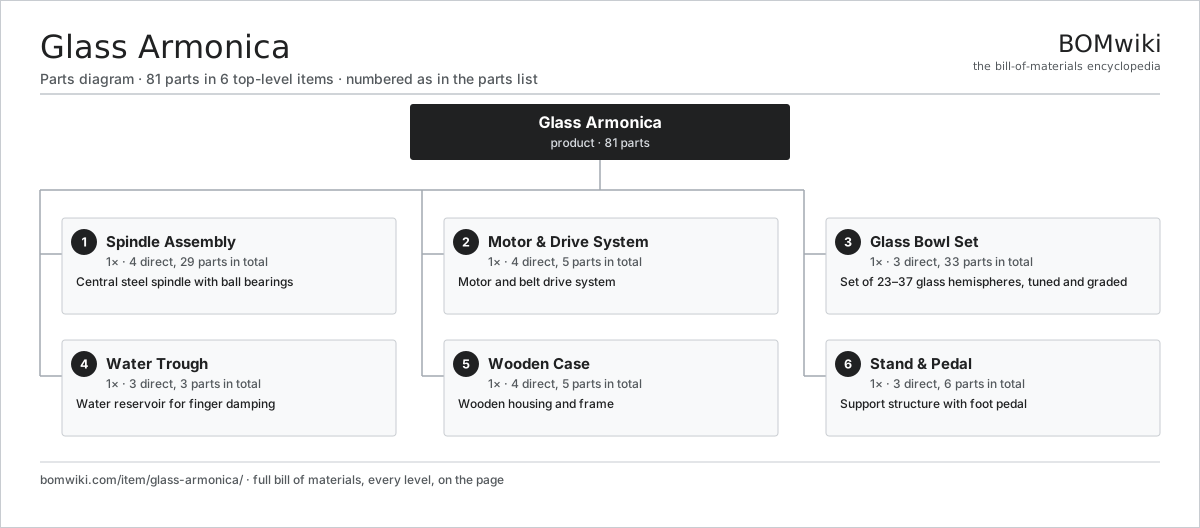
| # | Part | Qty | What it does |
|---|---|---|---|
| 1 | Spindle Assembly 4 parts | 1× | Central steel spindle with ball bearings |
| 2 | Motor & Drive System 4 parts | 1× | Motor and belt drive system |
| 3 | Glass Bowl Set 3 parts | 1× | Set of 23–37 glass hemispheres, tuned and graded |
| 4 | Water Trough 3 parts | 1× | Water reservoir for finger damping |
| 5 | Wooden Case 4 parts | 1× | Wooden housing and frame |
| 6 | Stand & Pedal 3 parts | 1× | Support structure with foot pedal |
3D model
No 3D model yet. Have a CAD file of this? Add a 3D model. STL renders right on this page; STEP, FreeCAD, and OpenSCAD sources are welcome too (openly licensed, like all 3D models on BOMwiki).
Build & assembly graph
expand / collapse · shared sub-assemblies converge · links to related products · est. labourTap an assembly to expand/collapse · tap a part to open it · use “Open page” for any node · drag to pan, scroll to zoom.
Bill of materials for Glass Armonica
6 top-level lines · 27 rows shown · 81 parts total · indented to 3 levels| # | Item / sub-assembly | Part no. | Qty/assy | Ext. qty | Parts | Type |
|---|---|---|---|---|---|---|
| 1 | Spindle Assembly 4 parts | glass-armonica-spindle | 1× | 1 | 29 | assembly |
| 1.1 | Spindle Shaft | glass-armonica-spindle-shaft | 1× | 1 | · | part |
| 1.2 | Ball Bearing | ball-bearing | 4× | 4 | · | part |
| 1.3 | Spindle Collar | glass-armonica-spindle-collar | 23× | 23 | · | part |
| 1.4 | Spindle Lock Nut | glass-armonica-spindle-nut | 1× | 1 | · | part |
| 2 | Motor & Drive System 4 parts | glass-armonica-motor-drive | 1× | 1 | 5 | assembly |
| 2.1 | AC Motor | glass-armonica-motor-ac | 1× | 1 | · | part |
| 2.2 | Belt Pulley | glass-armonica-pulley | 2× | 2 | · | part |
| 2.3 | Drive Belt | glass-armonica-belt | 1× | 1 | · | part |
| 2.4 | Speed Control Pedal | glass-armonica-speed-control | 1× | 1 | · | part |
| 3 | Glass Bowl Set 3 parts | glass-armonica-bowls | 1× | 1 | 33 | assembly |
| 3.1 | High Bowl | glass-armonica-bowl-high | 12× | 12 | · | part |
| 3.2 | Mid Bowl | glass-armonica-bowl-mid | 12× | 12 | · | part |
| 3.3 | Low Bowl | glass-armonica-bowl-low | 9× | 9 | · | part |
| 4 | Water Trough 3 parts | glass-armonica-trough | 1× | 1 | 3 | assembly |
| 4.1 | Trough Basin | glass-armonica-trough-basin | 1× | 1 | · | part |
| 4.2 | Trough Access Lip | glass-armonica-trough-rim | 1× | 1 | · | part |
| 4.3 | Fastener Set | fastener-set | 1× | 1 | · | part |
| 5 | Wooden Case 4 parts | glass-armonica-case | 1× | 1 | 5 | assembly |
| 5.1 | Case Base | glass-armonica-case-base | 1× | 1 | · | part |
| 5.2 | Case Side Panel | glass-armonica-case-side | 2× | 2 | · | part |
| 5.3 | Case Access Cover | glass-armonica-case-cover | 1× | 1 | · | part |
| 5.4 | Case Veneer | glass-armonica-case-veneer | 1× | 1 | · | part |
| 6 | Stand & Pedal 3 parts | glass-armonica-stand | 1× | 1 | 6 | assembly |
| 6.1 | Stand Leg | glass-armonica-stand-leg | 4× | 4 | · | part |
| 6.2 | Pedal Mechanism | glass-armonica-pedal-mechanism | 1× | 1 | · | part |
| 6.3 | Fastener Set | fastener-set | 1× | 1 | · | part |
Something wrong in this list? Report a problem with this BOM.
Related products
same domain, ranked by shared parts


Sourcing: possible vendors
Browse the supplier directory → Prices, MOQ, and lead times are algorithmic estimates, not quotes, and not claims about these companies. Company mappings are curated by keyword; est. price band $50–$5k. How estimates work| Vendor | HQ | Specialty | MOQ | Lead time |
|---|---|---|---|---|
| yamaha.com ↗ | Hamamatsu, JP | Audio & instruments | 200 units | 8–14 wks |
|
🇺🇸Fender
fender.com ↗
|
Los Angeles, US | Guitars & amps | 200 units | 8–14 wks |
|
🇺🇸Gibson
gibson.com ↗
|
Nashville, US | Guitars | 200 units | 8–14 wks |
|
🇯🇵Roland
roland.com ↗
|
Hamamatsu, JP | Electronic instruments | 200 units | 8–14 wks |
| steinway.com ↗ | New York, US | Pianos | 200 units | 8–14 wks |
948-word article