Glassblowing Furnace
ProductOverview
A glassblowing furnace is a high-temperature vessel designed to melt and hold molten glass at a constant working temperature, typically 2100–2300 °F (1150–1260 °C). The furnace comprises a heavily insulated Refractory Body lined with high-alumina ceramic brick, a sophisticated Burner System with a heat recuperator, and a large Melting Crucible holding 100–400 pounds of molten glass.
The recuperator, a Recuperator Core that exchanges heat between hot exhaust gases and incoming combustion air, is the key to energy efficiency. By preheating air before it enters the burner, the recuperator cuts fuel consumption by 30–50% compared to direct-fire furnaces, a critical advantage for studio and production facilities running 8–12 hours daily.
The Door Assembly provides access to the working glass, with a removable ceramic block plug that the artist or technician positions to open or close the gathering hole as needed. Heat loss through the door is minimized by careful design: the Door Plug fits tightly in a Door Frame sealed with ceramic fiber rope.
Furnaces are built for durability and continuous operation. A typical studio furnace runs 24/7 during active production seasons, with temperature held constant by adjusting burner output via a manual Damper Valve or an automatic Control Panel with thermostat feedback from a Pyrometer.
Refractory Construction and Thermal Management
The Refractory Body is built from high-alumina ceramic brick rated for 3000+ °F, even though the furnace operates below 2400 °F. This margin ensures that the inner surface of the Crown Arch and Sidewalls remains stable over years of thermal cycling.
The Floor Hearth bears the weight of the Crucible Vessel (often 300+ lbs when full), so it is laid with refractory tiles or brick set in high-temperature mortar. Beneath the hearth, a Grating Shelf allows hot combustion gases to circulate, promoting even heat distribution around the crucible. This circulation prevents cold spots where glass would cool and become immobile.
The entire outer envelope is wrapped with a Insulation Blanket, a ceramic fiber blanket 2–4 inches thick, and clad in sheet metal to retain loose fiber. Radiant heat loss through the walls accounts for only 5–10% of total energy consumption in a well-designed furnace, compared to 20–30% in poorly insulated units.
Burner and Recuperator Operation
The Burner System operates on a simple but elegant cycle. Natural gas or propane enters the Fuel Line, where a Gas Regulator steps the supply pressure from the tank (500+ psi) down to working pressure (2–5 psi). An electric Air Blower supplies forced combustion air at 10–20 psi.
At the Burner Head, fuel and preheated air mix and ignite from a Igniter (either a spark plug or a constant pilot flame). The flame enters the furnace chamber at high velocity, creating turbulence that ensures good heat transfer to the Crucible Vessel.
The hot exhaust gases exit through the Flue Duct into the Recuperator Core, where they pass around or through ceramic tubes carrying incoming combustion air. Heat transfers from the exhaust to the incoming air, raising its temperature to 800–1200 °F before it reaches the burner. This preheated air burns hotter and more efficiently than cold air, requiring less fuel to maintain furnace temperature.
Temperature Control and Instrumentation
Maintaining precise temperature is essential: glass at 2100 °F is perfect for gathering and blowing, but 100 °F too cool and it becomes viscous and cracks; 100 °F too hot and it becomes too fluid and drips. The Pyrometer provides a safe, non-contact measurement using optical or thermocouple technology, reading to within 20 °F.
Simple furnaces use manual damper control: the operator opens or closes the Damper Valve in the Flue System to reduce draft and increase furnace back-pressure, which slows heat loss and raises temperature. Closing the damper partially also reduces exhaust flow through the recuperator, decreasing air preheat and burner efficiency, a tradeoff the operator adjusts moment to moment.
Automated systems add a Solenoid Valve to the Fuel Line and a Control Panel with thermostat logic. The panel reads the pyrometer, compares actual temperature to a setpoint dial, and cycles the solenoid on and off. This keeps temperature within ±10 °F without operator intervention, a significant comfort improvement for long work sessions.
The Crucible and Glass Management
The Crucible Vessel is typically 18–24 inches in diameter and holds 100–400 pounds of molten glass depending on its depth and the artist's batch size. Crucibles are made from high-alumina clay or ceramic, chosen for thermal stability and resistance to corrosion from alkali in the glass batch.
The Crucible Lid caps the crucible, reducing surface heat loss and minimizing oxidation of the glass. It has a 2–3 inch opening, the gathering hole, through which the artist inserts a blowpipe to pull molten glass. A well-fitted lid keeps ambient heat low and ensures that new batches of cullet (recycled glass) added during the day melt quickly and evenly.
Every 3–5 years, even with care, crucibles develop small cracks from thermal fatigue. When a crack appears, it typically grows, and the crucible must be replaced. A complete change-out involves cooling the furnace to 800 °F, extracting the old crucible, sealing the opening temporarily, and installing a new one, a 4–6 hour job. Many studios keep a spare crucible on hand to minimize production downtime.
Safety and Maintenance
Gas-fired furnaces present hazards: carbon monoxide if combustion air is inadequate, fire risk from fuel leaks, and extreme radiant heat. Proper installation includes a dedicated gas supply with a main shutoff valve upstream of the furnace, a solenoid shutoff at the furnace, and a Igniter that lights reliably every startup. Many furnaces include a flame-monitoring sensor that cuts fuel automatically if ignition fails.
The Flue System must be sized correctly and vented safely outdoors; incomplete draft can flood the studio with combustion byproducts. The Damper Valve should never close completely, or CO will accumulate. A simple draft test, holding a lit match near the flue opening to see if the flame bends toward it, confirms adequate draw.
The Air Blower and Burner Head require seasonal cleaning: dust and combustion debris accumulate in the recuperator tubes, slowly reducing heat recovery. A once-yearly shut-down for internal inspection and cleaning ensures consistent performance.
Variations and Special Features
Some studios add a glory hole, a second, smaller chamber held at 2000–2200 °F, where finished or semi-finished pieces are reheated for additional working or annealing. The glory hole is fed by its own smaller burner and operates as a satellite to the main furnace.
Crucible furnaces (where the glass sits in a pot) are the most common for blown glass work. Pot furnaces (where the glass is melted in an open tank with side ports for gathering) are more expensive but allow larger batches and are favored by large production facilities.
Modern furnaces often include electronic controls and data logging, recording temperature trends and fuel consumption for process optimization. However, the fundamental design, burner, recuperator, refractory chamber, crucible, has remained unchanged since the early 20th century, a testament to the elegance of the engineering.
Glassblowing Furnace parts and their functions
7 top-level parts · 33 parts in total · full bill of materials below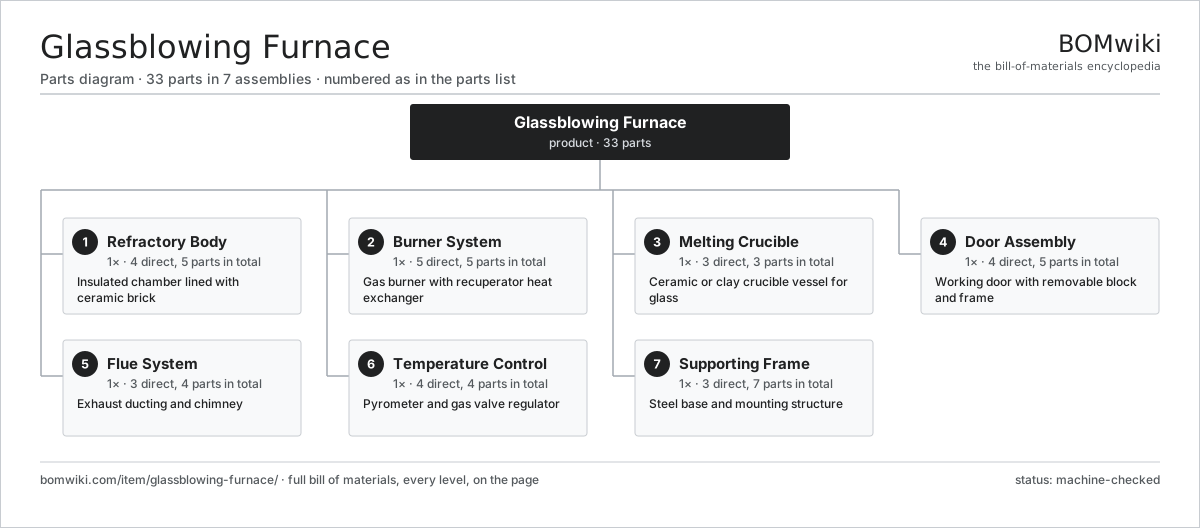
| # | Part | Qty | What it does |
|---|---|---|---|
| 1 | Refractory Body 4 parts | 1× | Insulated chamber lined with ceramic brick |
| 2 | Burner System 5 parts | 1× | Gas burner with recuperator heat exchanger |
| 3 | Melting Crucible 3 parts | 1× | Ceramic or clay crucible vessel for glass |
| 4 | Door Assembly 4 parts | 1× | Working door with removable block and frame |
| 5 | Flue System 3 parts | 1× | Exhaust ducting and chimney |
| 6 | Temperature Control 4 parts | 1× | Pyrometer and gas valve regulator |
| 7 | Supporting Frame 3 parts | 1× | Steel base and mounting structure |
3D model
No 3D model yet. Have a CAD file of this? Add a 3D model — STL renders right on this page; STEP, FreeCAD, and OpenSCAD sources are welcome too (openly licensed, like all 3D models on BOMwiki).
Build & assembly graph
expand / collapse · shared sub-assemblies converge · links to related products · est. labourTap an assembly to expand/collapse · tap a part to open it · use “Open page” for any node · drag to pan, scroll to zoom.
Bill of materials for Glassblowing Furnace
7 top-level lines · 33 rows shown · 33 parts total · indented to 3 levels| # | Item / sub-assembly | Part no. | Qty/assy | Ext. qty | Parts | Type |
|---|---|---|---|---|---|---|
| 1 | Refractory Body 4 parts | glassblowing-furnace-refractory-body | 1× | 1 | 5 | assembly |
| 1.1 | Crown Arch | glassblowing-furnace-crown-arch | 1× | 1 | · | part |
| 1.2 | Sidewalls | glassblowing-furnace-sidewalls | 2× | 2 | · | part |
| 1.3 | Floor Hearth | glassblowing-furnace-floor-hearth | 1× | 1 | · | part |
| 1.4 | Insulation Blanket | glassblowing-furnace-insulation-blanket | 1× | 1 | · | part |
| 2 | Burner System 5 parts | glassblowing-furnace-burner-system | 1× | 1 | 5 | assembly |
| 2.1 | Recuperator Core | glassblowing-furnace-recuperator-core | 1× | 1 | · | part |
| 2.2 | Burner Head | glassblowing-furnace-burner-head | 1× | 1 | · | part |
| 2.3 | Fuel Line | glassblowing-furnace-fuel-line | 1× | 1 | · | part |
| 2.4 | Air Blower | glassblowing-furnace-air-blower | 1× | 1 | · | part |
| 2.5 | Igniter | glassblowing-furnace-igniter | 1× | 1 | · | part |
| 3 | Melting Crucible 3 parts | glassblowing-furnace-melting-crucible | 1× | 1 | 3 | assembly |
| 3.1 | Crucible Vessel | glassblowing-furnace-crucible-vessel | 1× | 1 | · | part |
| 3.2 | Crucible Lid | glassblowing-furnace-crucible-lid | 1× | 1 | · | part |
| 3.3 | Grating Shelf | glassblowing-furnace-grating-shelf | 1× | 1 | · | part |
| 4 | Door Assembly 4 parts | glassblowing-furnace-door-assembly | 1× | 1 | 5 | assembly |
| 4.1 | Door Frame | glassblowing-furnace-door-frame | 1× | 1 | · | part |
| 4.2 | Door Plug | glassblowing-furnace-door-plug | 1× | 1 | · | part |
| 4.3 | Door Hinge | glassblowing-furnace-door-hinge | 2× | 2 | · | part |
| 4.4 | Door Seal | glassblowing-furnace-door-seal | 1× | 1 | · | part |
| 5 | Flue System 3 parts | glassblowing-furnace-flue-system | 1× | 1 | 4 | assembly |
| 5.1 | Flue Duct | glassblowing-furnace-flue-duct | 2× | 2 | · | part |
| 5.2 | Damper Valve | glassblowing-furnace-damper-valve | 1× | 1 | · | part |
| 5.3 | Chimney Stack | glassblowing-furnace-chimney-stack | 1× | 1 | · | part |
| 6 | Temperature Control 4 parts | glassblowing-furnace-temperature-control | 1× | 1 | 4 | assembly |
| 6.1 | Pyrometer | glassblowing-furnace-pyrometer | 1× | 1 | · | part |
| 6.2 | Gas Regulator | glassblowing-furnace-gas-regulator | 1× | 1 | · | part |
| 6.3 | Solenoid Valve | glassblowing-furnace-solenoid-valve | 1× | 1 | · | part |
| 6.4 | Control Panel | glassblowing-furnace-control-panel | 1× | 1 | · | part |
| 7 | Supporting Frame 3 parts | glassblowing-furnace-supporting-frame | 1× | 1 | 7 | assembly |
| 7.1 | Steel Base | glassblowing-furnace-steel-base | 1× | 1 | · | part |
| 7.2 | Vibration Mounts | glassblowing-furnace-vibration-mounts | 4× | 4 | · | part |
| 7.3 | Sheet Metal Panel | sheet-panel | 2× | 2 | · | part |
Related products
same domain, ranked by shared parts All-Electric Injection Molding Machine
851 parts · shares 1 with this page
Automated Paint Spray Line
2,003 parts · shares 1 with this page
Blown Film Extrusion Line
436 parts · shares 1 with this page
All-Electric Injection Molding Machine
851 parts · shares 1 with this page
Automated Paint Spray Line
2,003 parts · shares 1 with this page
Blown Film Extrusion Line
436 parts · shares 1 with this page
 Briquetting Press
92 parts · shares 1 with this page
Can Densifier
44 parts · shares 1 with this page
Briquetting Press
92 parts · shares 1 with this page
Can Densifier
44 parts · shares 1 with this page
Sourcing: possible vendors
Prices, MOQ, and lead times are algorithmic estimates, not quotes, and not claims about these companies. Company mappings are curated by keyword; est. price band $5k–$2M. How estimates work| Vendor | HQ | Specialty | MOQ | Lead time |
|---|---|---|---|---|
| atlascopco.com ↗ | Stockholm, SE | Compressors & industrial | 10 units | 12–20 wks |
|
🇦🇹Andritz
andritz.com ↗
|
Graz, AT | Process plants & machinery | 10 units | 12–20 wks |
| buhlergroup.com ↗ | Uzwil, CH | Food & materials processing | 10 units | 12–20 wks |
| gea.com ↗ | Düsseldorf, DE | Process technology | 10 units | 12–20 wks |
| mhi.com ↗ | Tokyo, JP | Heavy machinery | 10 units | 12–20 wks |
1,274-word article