Glockenspiel
ProductOverview
The glockenspiel (German: ''glockenspielbau'', bell-play) is a pitched percussion instrument made of hardened steel bars arranged like a piano keyboard. Each bar is tuned to a specific pitch, and below each bar hangs a Resonator Tube, a metal tube precisely tuned to that same pitch, acting as an acoustic amplifier. When a bar is struck, its vibration couples into the resonator cavity, which resonates at the bar's frequency, extending the sustain and enriching the tone.
The glockenspiel is a fixture of orchestras, concert bands, and educational programs worldwide. Its bright, bell-like tone cuts through ensemble textures, and its layout (essentially a pitched mallet percussion keyboard) makes it accessible to trained percussionists. The standard instrument spans two and a half octaves (30 bars, F5–F7), sufficient for most orchestral and solo repertoire.
Bar construction
The Bar Set consists of 30 hardened steel bars, each tuned to a chromatic semitone. The Steel Bar dimensions vary by pitch: lower bars (F5–G5) are roughly 6 cm long, 4–5 cm wide, and 6–7 mm thick; higher bars (E7–F7) are roughly 2.5 cm long, 3 cm wide, and 4–5 mm thick. The bars are made of high-carbon steel, hardened and tempered to ensure durability and stable tuning.
Each bar is suspended by two support rails (the Support Rails), typically made of wood or metal, that isolate the bars from direct contact with the frame and each other, preventing unwanted vibration coupling. The bars are held in place with felt or cork pads that damp transverse vibration while allowing vertical oscillation. The Bar Spacing (typically 1–2 cm between bars) allows the player to strike individual bars without interference.
Resonator design
Below each bar hangs a Resonator Tube, precisely tuned to that bar's pitch. These tubes are usually made of metal (aluminium for lighter weight, copper for richer tone, or steel), though wooden resonators are sometimes used for special effects or aesthetic reasons. Each tube is closed at one end and opens at the other, forming a quarter-wavelength resonator cavity.
The quarter-wavelength cavity (length = sound speed ÷ 4 × frequency) resonates at the bar's fundamental pitch. When the bar vibrates, sound radiates downward into the resonator, which then radiates that sound back out, amplifying and extending the sustain. The Resonator Length is adjusted in manufacture to match the bar pitch exactly: a bar tuned 1 Hz off results in a resonator that amplifies a slightly different frequency, reducing overall sustain and clarity.
The bottom opening of each resonator can be fitted with a Resonator Damper, a cork or felt plug that partially or completely blocks the opening. If the plug is removed (fully open), the resonator functions optimally, providing full sustain (typically 2–5 seconds per bar). If the plug is inserted, it reduces the acoustic efficiency, shortening sustain.
Frame and ergonomics
The Frame is a robust four-legged structure, typically wood or metal tubing, supporting the entire weight of the bars and resonators (roughly 15–25 kg depending on material choices). The Frame Rails run parallel along the length of the instrument, mounting the bar support rails. The Frame Stiffeners, cross-members and diagonal bracing, prevent rocking or flexing under the impact loads of mallet strikes.
The Height Adjustment allows the frame to be positioned at comfortable striking height (typically 60–75 cm above the floor for a standing player). Some professional instruments allow the frame to tilt slightly, accommodating player ergonomics.
The bar layout follows the standard chromatic order: C is typically at the left, with bars arranged ascending from left to right and back, like a piano keyboard. This layout is familiar to keyboard musicians and allows rapid scale and arpeggio passages.
Damping and sustain control
The Damping System allows the player to control sustain in real-time. Some instruments use a Damper Pedal, a foot lever similar to a piano pedal, that engages or disengages all dampers simultaneously. This is transmitted to the individual Damper Pads (felt or cork blocks) at each bar via mechanical Damper Linkage (rods or cables).
When the damper pedal is released (up position), all damper pads are lifted away from the bars, and bars vibrate freely at full sustain. When the pedal is pressed (down position), all damper pads contact the bars simultaneously, stopping their vibration. This allows the player to control whether successive struck bars sustain into each other (pedal up, creating legato) or decay immediately (pedal down, creating staccato or clarity).
Playing technique and mallets
The Mallets are typically a pair of mallets, one in each hand. Each mallet has a Mallet Handle (wooden shaft, ~25 cm long) topped with a Mallet Head (usually plastic, rubber, or wound yarn). The mallet head material significantly affects tone: plastic produces a bright, articulate sound; rubber produces a softer, warmer tone; wool wind produces sustained, singing tones.
The player strikes bars by rotating the wrist and arm, aiming for the dead centre of each bar's upper surface. A well-struck bar produces a clear, bell-like attack and a sustaining tone. A poorly struck bar (off-centre) produces a muffled, dull sound or undesired overtones.
Rapid passages are possible: a skilled player can execute 16th-note runs at moderate tempos, moving the mallets in rapid alternation across the keyboard. Double-mallets in one hand (one mallet per finger) allow more complex polyphonic playing, though this is technically demanding and not common in orchestral contexts.
Orchestral role
In orchestral contexts, the glockenspiel typically appears in short, articulate passages requiring high-register brilliance, ''sparkle'' sounds in Germanic music, staccato ostinatos in modern compositions, or silvery arpeggios in romantic works. Its sustain is too short and its dynamic range too limited to sustain long melodic lines, so it is usually accompanied by other instruments. In contemporary and experimental music, extended techniques (scraping, bowing, prepared bars) have expanded the glockenspiel's range of sounds.
The glockenspiel is a standard instrument in percussion ensembles, school orchestras, and concert bands, and virtually all trained percussionists learn to play it as part of their standard repertoire.
Glockenspiel parts and their functions
5 top-level parts · 142 parts in total · full bill of materials below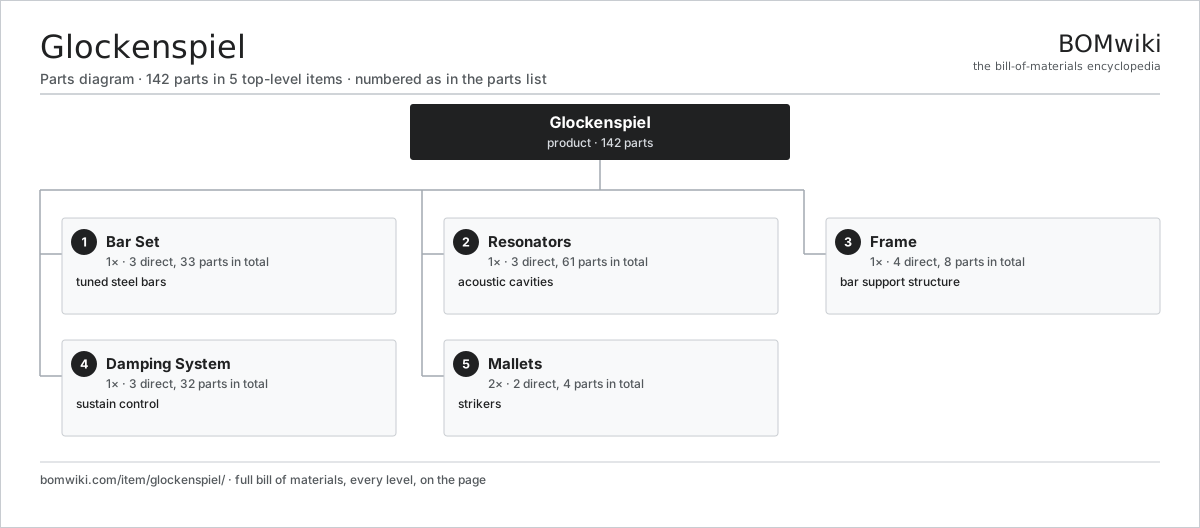
| # | Part | Qty | What it does |
|---|---|---|---|
| 1 | Bar Set 3 parts | 1× | tuned steel bars |
| 2 | Resonators 3 parts | 1× | acoustic cavities |
| 3 | Frame 4 parts | 1× | bar support structure |
| 4 | Damping System 3 parts | 1× | sustain control |
| 5 | Mallets 2 parts | 2× | strikers |
3D model
No 3D model yet. Have a CAD file of this? Add a 3D model. STL renders right on this page; STEP, FreeCAD, and OpenSCAD sources are welcome too (openly licensed, like all 3D models on BOMwiki).
Build & assembly graph
expand / collapse · shared sub-assemblies converge · links to related products · est. labourTap an assembly to expand/collapse · tap a part to open it · use “Open page” for any node · drag to pan, scroll to zoom.
Bill of materials for Glockenspiel
5 top-level lines · 20 rows shown · 142 parts total · indented to 3 levels| # | Item / sub-assembly | Part no. | Qty/assy | Ext. qty | Parts | Type |
|---|---|---|---|---|---|---|
| 1 | Bar Set 3 parts | glockenspiel-bar-set | 1× | 1 | 33 | assembly |
| 1.1 | Steel Bar | glockenspiel-steel-bar | 30× | 30 | · | part |
| 1.2 | Support Rails | glockenspiel-bar-support-rails | 2× | 2 | · | part |
| 1.3 | Bar Spacing | glockenspiel-bar-spacing | 1× | 1 | · | part |
| 2 | Resonators 3 parts | glockenspiel-resonators | 1× | 1 | 61 | assembly |
| 2.1 | Resonator Tube | glockenspiel-resonator-tube | 30× | 30 | · | part |
| 2.2 | Resonator Length | glockenspiel-resonator-length | 1× | 1 | · | part |
| 2.3 | Resonator Damper | glockenspiel-resonator-damper | 30× | 30 | · | part |
| 3 | Frame 4 parts | glockenspiel-frame | 1× | 1 | 8 | assembly |
| 3.1 | Frame Legs | glockenspiel-frame-legs | 4× | 4 | · | part |
| 3.2 | Frame Rails | glockenspiel-frame-rails | 2× | 2 | · | part |
| 3.3 | Frame Stiffeners | glockenspiel-frame-stiffeners | 1× | 1 | · | part |
| 3.4 | Height Adjustment | glockenspiel-height-adjustment | 1× | 1 | · | part |
| 4 | Damping System 3 parts | glockenspiel-damping-system | 1× | 1 | 32 | assembly |
| 4.1 | Damper Pedal | glockenspiel-damper-pedal | 1× | 1 | · | part |
| 4.2 | Damper Linkage | glockenspiel-damper-linkage | 1× | 1 | · | part |
| 4.3 | Damper Pads | glockenspiel-damper-pads | 30× | 30 | · | part |
| 5 | Mallets 2 parts | glockenspiel-mallets | 2× | 2 | 4 | assembly |
| 5.1 | Mallet Handle | glockenspiel-mallet-handle | 2× | 4 | · | part |
| 5.2 | Mallet Head | glockenspiel-mallet-head | 2× | 4 | · | part |
Something wrong in this list? Report a problem with this BOM.
Sourcing: possible vendors
Browse the supplier directory → Prices, MOQ, and lead times are algorithmic estimates, not quotes, and not claims about these companies. Company mappings are curated by keyword; est. price band $50–$5k. How estimates work| Vendor | HQ | Specialty | MOQ | Lead time |
|---|---|---|---|---|
| yamaha.com ↗ | Hamamatsu, JP | Audio & instruments | 200 units | 8–14 wks |
|
🇺🇸Fender
fender.com ↗
|
Los Angeles, US | Guitars & amps | 200 units | 8–14 wks |
|
🇺🇸Gibson
gibson.com ↗
|
Nashville, US | Guitars | 200 units | 8–14 wks |
|
🇯🇵Roland
roland.com ↗
|
Hamamatsu, JP | Electronic instruments | 200 units | 8–14 wks |
| steinway.com ↗ | New York, US | Pianos | 200 units | 8–14 wks |
1,034-word article