Glycol Dehydration Unit
ProductOverview
Natural gas leaves the wellhead saturated with water vapor, and that water is a pipeline's worst enemy: it condenses in cold spots, corrodes steel in the presence of CO₂ and H₂S, and combines with methane under pressure to form hydrates, ice-like solids that can plug a line completely. Pipeline specifications therefore limit water content to 4–7 lb per million standard cubic feet, against the 60–120 lb/MMscf the gas carries when it arrives. The glycol dehydration unit closes that gap. It is the most common gas-conditioning package in the world, with tens of thousands operating at wellsites, compressor stations, and gas plants.
The process is continuous absorption and regeneration. Triethylene glycol (TEG) has a strong affinity for water and a high boiling point (288 °C against water's 100 °C), so it can soak up water vapor from gas at high pressure and then give that water back when heated at atmospheric pressure, without boiling away itself.
How it works
Wet gas enters the bottom of the Contactor Tower, passing first through the Inlet Scrubber Section section, which knocks out free liquids and solids that would contaminate the glycol. The gas then rises through the contact zone, either a bed of Structured Packing or a stack of Bubble Cap Tray decks, while lean glycol introduced through the Glycol Distributor trickles down. Counter-current contact lets the driest glycol meet the driest gas at the top, achieving outlet dewpoints 30–60 °C below the inlet. A Mist Extractor pad recovers entrained glycol droplets before the dry gas exits; carryover above about 0.1 gal/MMscf is the unit's main operating cost.
The rich glycol, now carrying 3–7 wt % water, leaves the contactor bottom and begins the regeneration loop. It first picks up heat in the Surge Preheat Coil inside the surge tank, then drops to 350–500 kPa in the Flash Separator separator, where dissolved methane and entrained condensate break out, the flash gas typically fuels the reboiler burner. The Level Controller controller and Dump Valve pair keep the glycol and condensate phases separated and discharged.
Filtration follows: a Sock Filter Element removes solids to 5–10 microns and a Carbon Filter Element adsorbs dissolved hydrocarbons and the dark degradation products that foul fire tubes and cause foaming. The rich glycol then recovers most of its regeneration heat in the Lean/Rich Exchanger before entering the Still Column.
Regeneration
The Regeneration Reboiler is where the water leaves. A Natural-Draft Burner fires into the immersed Fire Tube, holding the glycol bath at 190–204 °C, hot enough to boil off the absorbed water, but kept under the 207 °C threshold where TEG itself begins to thermally decompose. The Reboiler Thermostat holds this band, and heat flux on the fire tube is limited to roughly 20 kW/m² of surface to prevent local hot spots from coking the glycol.
Steam rising off the bath passes up the packed Still Column, where a small reflux of condensed water washes glycol vapor back down; overhead losses run only a few gallons per week on a healthy unit. Boiling alone regenerates TEG to about 98.5–98.9 wt %. Where deeper drying is needed, the Stripping Gas Sparger sparger bubbles a little dry gas through the hot glycol, lowering the water partial pressure and pushing lean purity past 99.5 wt %, good for dewpoint depressions beyond 80 °C.
Hot lean glycol drains to the Surge Tank tank, gives up heat to the incoming rich stream, and returns to the contactor via the Glycol Circulation Pump. On unpowered wellsites this is usually an energy-exchange pump: returning high-pressure rich glycol drives the Pump Piston pair through D-Slide Valve porting, pumping lean glycol back up to contactor pressure with no electricity at all. The Gas/Glycol Cooler coil trims the lean glycol to within about 10 °C of the gas temperature, cooler glycol absorbs more water, but glycol colder than the gas condenses hydrocarbons into the loop.
Operating practice
Circulation rate is the main tuning knob: 2–5 gallons of TEG per pound of water removed covers most duties, with more circulation giving drier gas at the cost of more reboiler fuel. The Control System package supervises the burner through a Burner Management System with flame proving and a Flame Arrestor on the air intake, since the unit usually stands in a hazardous area fed by its own Fuel Gas Regulator.
Common ailments are well known: foaming from condensate contamination (cured by the carbon filter and inlet scrubbing), fire-tube scaling from glycol degradation, and BTEX emissions from the still vent, modern units route still vapors to a condenser or combustor to meet air-quality rules. Glycol pH is checked monthly; below 6, organic acids accelerate corrosion and the charge is neutralized or replaced.
Glycol Dehydration Unit parts and their functions
8 top-level parts · 68 parts in total · full bill of materials below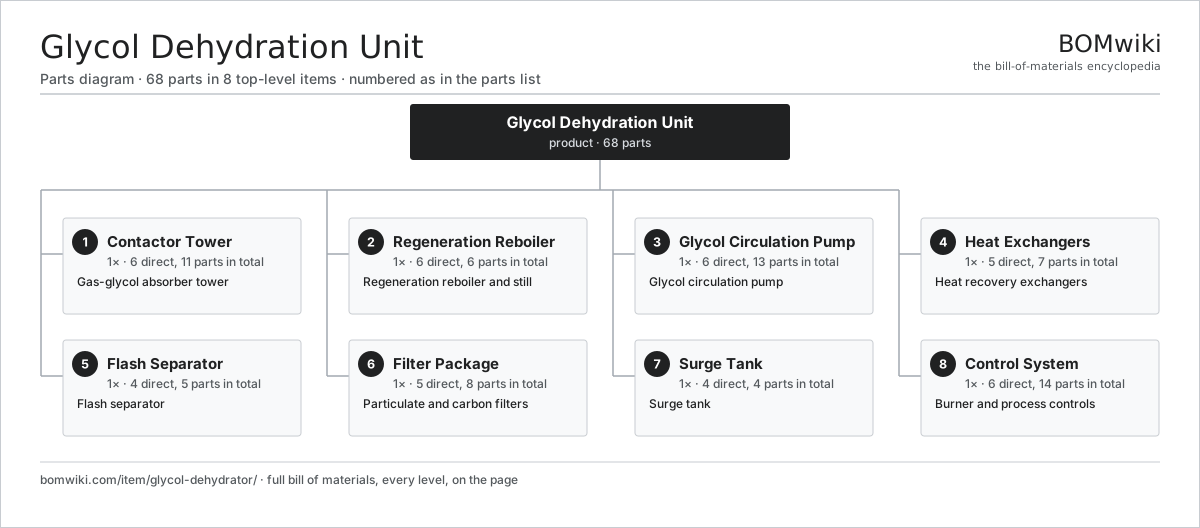
| # | Part | Qty | What it does |
|---|---|---|---|
| 1 | Contactor Tower 6 parts | 1× | Gas-glycol absorber tower |
| 2 | Regeneration Reboiler 6 parts | 1× | Regeneration reboiler and still |
| 3 | Glycol Circulation Pump 6 parts | 1× | Glycol circulation pump |
| 4 | Heat Exchangers 5 parts | 1× | Heat recovery exchangers |
| 5 | Flash Separator 4 parts | 1× | Flash separator |
| 6 | Filter Package 5 parts | 1× | Particulate and carbon filters |
| 7 | Surge Tank 4 parts | 1× | Surge tank |
| 8 | Control System 6 parts | 1× | Burner and process controls |
3D model
No 3D model yet. Have a CAD file of this? Add a 3D model. STL renders right on this page; STEP, FreeCAD, and OpenSCAD sources are welcome too (openly licensed, like all 3D models on BOMwiki).
Build & assembly graph
expand / collapse · shared sub-assemblies converge · links to related products · est. labourTap an assembly to expand/collapse · tap a part to open it · use “Open page” for any node · drag to pan, scroll to zoom.
Bill of materials for Glycol Dehydration Unit
8 top-level lines · 54 rows shown · 68 parts total · indented to 3 levels| # | Item / sub-assembly | Part no. | Qty/assy | Ext. qty | Parts | Type |
|---|---|---|---|---|---|---|
| 1 | Contactor Tower 6 parts | glycol-dehydrator-contactor | 1× | 1 | 11 | assembly |
| 1.1 | Contactor Shell | glycol-dehydrator-contactor-shell | 1× | 1 | · | part |
| 1.2 | Structured Packing | glycol-dehydrator-packing | 1× | 1 | · | part |
| 1.3 | Bubble Cap Tray | glycol-dehydrator-bubble-tray | 6× | 6 | · | part |
| 1.4 | Mist Extractor | glycol-dehydrator-mist-extractor | 1× | 1 | · | part |
| 1.5 | Inlet Scrubber Section | glycol-dehydrator-inlet-scrubber | 1× | 1 | · | part |
| 1.6 | Glycol Distributor | glycol-dehydrator-distributor | 1× | 1 | · | part |
| 2 | Regeneration Reboiler 6 parts | glycol-dehydrator-reboiler | 1× | 1 | 6 | assembly |
| 2.1 | Reboiler Shell | glycol-dehydrator-reboiler-shell | 1× | 1 | · | part |
| 2.2 | Fire Tube | glycol-dehydrator-fire-tube | 1× | 1 | · | part |
| 2.3 | Natural-Draft Burner | glycol-dehydrator-burner | 1× | 1 | · | part |
| 2.4 | Still Column | glycol-dehydrator-still-column | 1× | 1 | · | part |
| 2.5 | Stripping Gas Sparger | glycol-dehydrator-stripping-gas | 1× | 1 | · | part |
| 2.6 | Flame Arrestor | glycol-dehydrator-flame-arrestor | 1× | 1 | · | part |
| 3 | Glycol Circulation Pump 6 parts | glycol-dehydrator-pump | 1× | 1 | 13 | assembly |
| 3.1 | Pump Body | glycol-dehydrator-pump-body | 1× | 1 | · | part |
| 3.2 | Pump Piston | glycol-dehydrator-pump-piston | 2× | 2 | · | part |
| 3.3 | D-Slide Valve | glycol-dehydrator-pump-dvalve | 2× | 2 | · | part |
| 3.4 | Check Valve | glycol-dehydrator-check-valve | 4× | 4 | · | part |
| 3.5 | O-Ring Set | oring-set | 2× | 2 | · | part |
| 3.6 | Oil Seal | oil-seal | 2× | 2 | · | part |
| 4 | Heat Exchangers 5 parts | glycol-dehydrator-exchangers | 1× | 1 | 7 | assembly |
| 4.1 | Lean/Rich Exchanger | glycol-dehydrator-glycol-exchanger | 1× | 1 | · | part |
| 4.2 | Gas/Glycol Cooler | glycol-dehydrator-gas-cooler | 1× | 1 | · | part |
| 4.3 | Surge Preheat Coil | glycol-dehydrator-coil | 1× | 1 | · | part |
| 4.4 | O-Ring Set | oring-set | 2× | 2 | · | part |
| 4.5 | Fastener Set | fastener-set | 2× | 2 | · | part |
| 5 | Flash Separator 4 parts | glycol-dehydrator-flash | 1× | 1 | 5 | assembly |
| 5.1 | Flash Vessel | glycol-dehydrator-flash-vessel | 1× | 1 | · | part |
| 5.2 | Level Controller | glycol-dehydrator-flash-level | 1× | 1 | · | part |
| 5.3 | Dump Valve | glycol-dehydrator-dump-valve | 2× | 2 | · | part |
| 5.4 | Pressure Sensor | pressure-sensor | 1× | 1 | · | part |
| 6 | Filter Package 5 parts | glycol-dehydrator-filters | 1× | 1 | 8 | assembly |
| 6.1 | Sock Filter Element | glycol-dehydrator-sock-filter | 1× | 1 | · | part |
| 6.2 | Carbon Filter Element | glycol-dehydrator-carbon-filter | 1× | 1 | · | part |
| 6.3 | Filter Housing | glycol-dehydrator-filter-housing | 2× | 2 | · | part |
| 6.4 | O-Ring Set | oring-set | 2× | 2 | · | part |
| 6.5 | Pressure Sensor | pressure-sensor | 2× | 2 | · | part |
| 7 | Surge Tank 4 parts | glycol-dehydrator-surge | 1× | 1 | 4 | assembly |
| 7.1 | Surge Tank Shell | glycol-dehydrator-surge-shell | 1× | 1 | · | part |
| 7.2 | Level Gauge | glycol-dehydrator-level-gauge | 1× | 1 | · | part |
| 7.3 | Blanket Gas Valve | glycol-dehydrator-blanket-valve | 1× | 1 | · | part |
| 7.4 | O-Ring Set | oring-set | 1× | 1 | · | part |
| 8 | Control System 6 parts | glycol-dehydrator-controls | 1× | 1 | 14 | assembly |
| 8.1 | Reboiler Thermostat | glycol-dehydrator-thermostat | 1× | 1 | · | part |
| 8.2 | Burner Management System 4 parts | glycol-dehydrator-bms | 1× | 1 | 5 | assembly |
| 8.2.1 | Microcontroller | mcu | 1× | 1 | · | part |
| 8.2.2 | Bare PCB | pcb-bare | 1× | 1 | · | part |
| 8.2.3 | SMD Passive (R/C/L) | smd-passives | 1× | 1 | · | part |
| 8.2.4 | Relay | relay | 2× | 2 | · | part |
| 8.3 | Fuel Gas Regulator | glycol-dehydrator-fuel-regulator | 1× | 1 | · | part |
| 8.4 | Pressure Sensor | pressure-sensor | 2× | 2 | · | part |
| 8.5 | Relay | relay | 4× | 4 | · | part |
| 8.6 | Wire Bundle | wire-bundle | 1× | 1 | · | part |
Something wrong in this list? Report a problem with this BOM.
Related products
same domain, ranked by shared parts Centrifugal Gas Compressor
137 parts · shares 2 with this page
CO2 Injection Pump
463 parts · shares 2 with this page
Centrifugal Gas Compressor
137 parts · shares 2 with this page
CO2 Injection Pump
463 parts · shares 2 with this page
 Deepwater Drillship
891,301 parts · shares 2 with this page
Deepwater Drillship
891,301 parts · shares 2 with this page
 Drilling Mud Degasser
154 parts · shares 2 with this page
Electric Submersible Pump (ESP)
635 parts · shares 2 with this page
Drilling Mud Degasser
154 parts · shares 2 with this page
Electric Submersible Pump (ESP)
635 parts · shares 2 with this page
 Iron Roughneck
104 parts · shares 2 with this page
Iron Roughneck
104 parts · shares 2 with this page
Sourcing: possible vendors
Browse the supplier directory → Prices, MOQ, and lead times are algorithmic estimates, not quotes, and not claims about these companies. Company mappings are curated by keyword; est. price band $10k–$50M. How estimates work| Vendor | HQ | Specialty | MOQ | Lead time |
|---|---|---|---|---|
|
🇺🇸SLB
slb.com ↗
|
Houston, US | Oilfield services & equipment | made to order | 24–48 wks |
| halliburton.com ↗ | Houston, US | Oilfield services | made to order | 24–48 wks |
| bakerhughes.com ↗ | Houston, US | Energy technology | made to order | 24–48 wks |
|
🇺🇸NOV
nov.com ↗
|
Houston, US | Drilling equipment | made to order | 24–48 wks |
| technipfmc.com ↗ | London, GB | Subsea & surface systems | made to order | 24–48 wks |
841-word article