GPS NTP Time Server
ProductOverview
A GPS NTP time server is the device that gives a network its sense of time. It sits in a rack, listens to navigation satellites through a roof antenna, and answers Network Time Protocol queries as a stratum-1 source, one hop from the atomic clocks aboard the GNSS constellations. Trading floors timestamp orders against it, telecom networks frame against it, and ordinary enterprises use it so that log files from a thousand machines can be correlated to the millisecond.
Functionally it is three instruments in one box: the GNSS Receiver recovers UTC from the sky, the Disciplined Oscillator smooths and stores it, and the Network Board retails it over Ethernet. The Antenna Kit on the roof is as much a part of the product as the chassis.
Recovering time from satellites
Every GNSS satellite carries atomic clocks and broadcasts its time and orbit continuously; a receiver solving for position is really solving for position and time together. The GNSS Module is a timing-grade receiver that exploits a fixed installation: after a self-survey of several hours establishes the antenna position permanently, all satellite measurements collapse into a single unknown, time, and the module's pulse-per-second output aligns to UTC within roughly 5–15 ns. Signals arrive at about −130 dBm, below the thermal noise floor, so the LNA & Filter and the antenna's own 30–40 dB preamplifier do the heavy lifting, while a SAW filter keeps adjacent cellular bands out. Cable delay matters at this precision: the 30–60 m of Coax Cable from the Antenna Element adds about 4 ns per metre, entered as a calibration constant. The Surge Arrestor exists because that same cable is a lightning conductor terminating in the server room.
The disciplined oscillator
Raw GNSS pulses are accurate but not dependable, jamming, antenna faults, or simple roof work can interrupt them. The OCXO is the flywheel that rides through: a crystal oscillator inside a miniature oven held near 70 °C, stable to a part in 10^10 per day. The Phase Comparator continuously measures the OCXO against the GNSS pulse-per-second, and a slow control loop steers the oscillator through the Control DAC in steps of parts per trillion. While satellites are visible, the OCXO is a noise filter that removes the receiver's nanosecond-level jitter; when they vanish, the unit enters holdover and the OCXO carries the timescale alone, drifting less than ten microseconds per day. For most networks that means days of antenna outage before clients notice anything. Rubidium options stretch holdover into weeks at higher cost and power.
The oven is also why the Cooling Fan is positioned to ventilate the Rack Chassis without blowing on the oscillator: a draft modulates oven duty cycle, and that shows up as frequency wander.
Serving the network
The Compute SoC Module runs the NTP daemon, answering UDP port 123 queries at rates above ten thousand per second; an NTP response is small and stateless, so one 1U box covers a large enterprise. Precision clients use PTP instead, and that is where the Ethernet PHY earns its place: IEEE 1588 hardware timestamping stamps packets as they cross the wire, removing the operating system's scheduling jitter and bringing client sync from NTP's typical sub-millisecond down to sub-microsecond. The SFP Cage serves fiber-isolated segments, and the Memory Bank holds the OS, leap-second tables, and holdover logs. Management is web, SNMP, and syslog; the Front Panel with its LCD Panel, Status LEDs, and Keypad covers initial setup and the at-a-glance question every operator asks walking past: locked, or in holdover?
Infrastructure duties
Because everything downstream assumes the time server is up, the Power System is redundant: two hot-swap supplies behind an Inlet Filter, plus a telecom −48 V DC Input option, all inside a Fastener Set-assembled steel shell with Rack Ears. Total draw is 20–30 W, a third of it the oscillator oven.
Deployment practice repays attention. The antenna under its Antenna Radome needs an open horizon on its Mast Mount, multipath off rooftop structures is the dominant error source. Serious installations run two servers on opposite ends of the building with separate antennas, since NTP clients are designed to vote among sources. And operators increasingly enable multi-constellation reception not for accuracy but for integrity: GPS jamming incidents near ports and airports are now routine enough that a stratum-1 source watching four constellations, with an OCXO ready to coast through the gap, is the difference between an alarm and an outage.
GPS NTP Time Server parts and their functions
7 top-level parts · 37 parts in total · full bill of materials below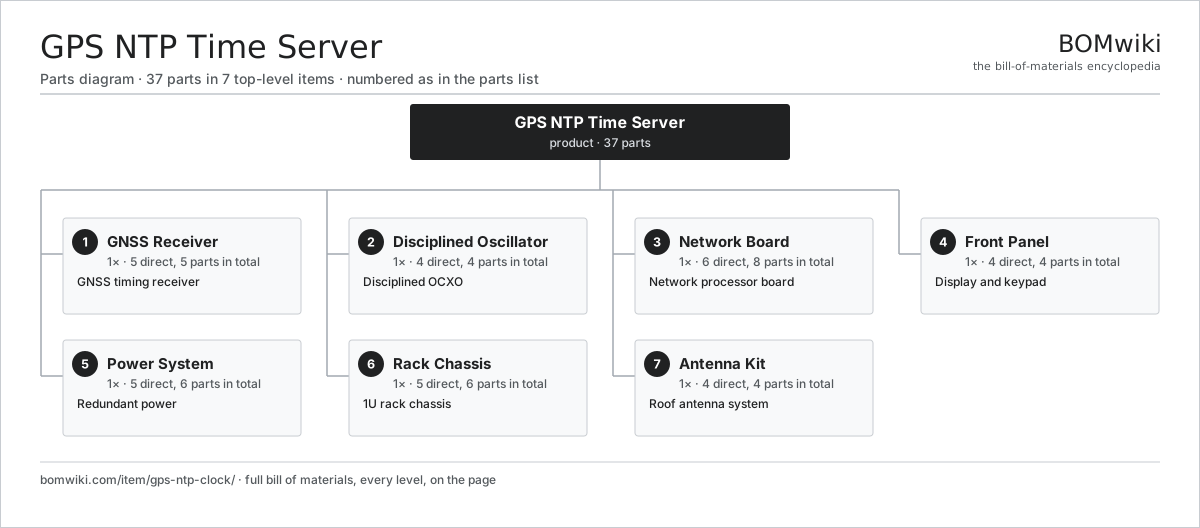
| # | Part | Qty | What it does |
|---|---|---|---|
| 1 | GNSS Receiver 5 parts | 1× | GNSS timing receiver |
| 2 | Disciplined Oscillator 4 parts | 1× | Disciplined OCXO |
| 3 | Network Board 6 parts | 1× | Network processor board |
| 4 | Front Panel 4 parts | 1× | Display and keypad |
| 5 | Power System 5 parts | 1× | Redundant power |
| 6 | Rack Chassis 5 parts | 1× | 1U rack chassis |
| 7 | Antenna Kit 4 parts | 1× | Roof antenna system |
3D model
No 3D model yet. Have a CAD file of this? Add a 3D model. STL renders right on this page; STEP, FreeCAD, and OpenSCAD sources are welcome too (openly licensed, like all 3D models on BOMwiki).
Build & assembly graph
expand / collapse · shared sub-assemblies converge · links to related products · est. labourTap an assembly to expand/collapse · tap a part to open it · use “Open page” for any node · drag to pan, scroll to zoom.
Bill of materials for GPS NTP Time Server
7 top-level lines · 40 rows shown · 37 parts total · indented to 3 levels| # | Item / sub-assembly | Part no. | Qty/assy | Ext. qty | Parts | Type |
|---|---|---|---|---|---|---|
| 1 | GNSS Receiver 5 parts | gps-ntp-clock-gnss-receiver | 1× | 1 | 5 | assembly |
| 1.1 | GNSS Module | gps-ntp-clock-gnss-module | 1× | 1 | · | part |
| 1.2 | LNA & Filter | gps-ntp-clock-lna-filter | 1× | 1 | · | part |
| 1.3 | Surge Arrestor | gps-ntp-clock-surge-arrestor | 1× | 1 | · | part |
| 1.4 | Connector | connector | 1× | 1 | · | part |
| 1.5 | SMD Passive (R/C/L) | smd-passives | 1× | 1 | · | part |
| 2 | Disciplined Oscillator 4 parts | gps-ntp-clock-disciplined-oscillator | 1× | 1 | 4 | assembly |
| 2.1 | OCXO | gps-ntp-clock-ocxo | 1× | 1 | · | part |
| 2.2 | Control DAC | gps-ntp-clock-control-dac | 1× | 1 | · | part |
| 2.3 | Phase Comparator | gps-ntp-clock-phase-comparator | 1× | 1 | · | part |
| 2.4 | SMD Passive (R/C/L) | smd-passives | 1× | 1 | · | part |
| 3 | Network Board 6 parts | gps-ntp-clock-network-board | 1× | 1 | 8 | assembly |
| 3.1 | Compute SoC Module | soc-module | 1× | 1 | · | part |
| 3.2 | Bare PCB | pcb-bare | 1× | 1 | · | part |
| 3.3 | Ethernet PHY | gps-ntp-clock-ethernet-phy | 2× | 2 | · | part |
| 3.4 | SFP Cage | gps-ntp-clock-sfp-cage | 1× | 1 | · | part |
| 3.5 | Memory Bank | gps-ntp-clock-memory-bank | 1× | 1 | · | part |
| 3.6 | Connector | connector | 2× | 2 | · | part |
| 4 | Front Panel 4 parts | gps-ntp-clock-front-panel | 1× | 1 | 4 | assembly |
| 4.1 | LCD Panel | lcd-panel | 1× | 1 | · | part |
| 4.2 | Status LEDs | gps-ntp-clock-status-leds | 1× | 1 | · | part |
| 4.3 | Keypad | gps-ntp-clock-keypad | 1× | 1 | · | part |
| 4.4 | Bare PCB | pcb-bare | 1× | 1 | · | part |
| 5 | Power System 5 parts | gps-ntp-clock-power-system | 1× | 1 | 6 | assembly |
| 5.1 | Power Supply | power-supply | 2× | 2 | · | part |
| 5.2 | Inlet Filter | gps-ntp-clock-inlet-filter | 1× | 1 | · | part |
| 5.3 | DC Input | gps-ntp-clock-dc-input | 1× | 1 | · | part |
| 5.4 | Thermal Fuse | thermal-fuse | 1× | 1 | · | part |
| 5.5 | Wire Bundle | wire-bundle | 1× | 1 | · | part |
| 6 | Rack Chassis 5 parts | gps-ntp-clock-chassis | 1× | 1 | 6 | assembly |
| 6.1 | Sheet Metal Panel | sheet-panel | 1× | 1 | · | part |
| 6.2 | Rack Ears | gps-ntp-clock-rack-ears | 2× | 2 | · | part |
| 6.3 | Cooling Fan | gps-ntp-clock-cooling-fan | 1× | 1 | · | part |
| 6.4 | Front Bezel | gps-ntp-clock-front-bezel | 1× | 1 | · | part |
| 6.5 | Fastener Set | fastener-set | 1× | 1 | · | part |
| 7 | Antenna Kit 4 parts | gps-ntp-clock-antenna-kit | 1× | 1 | 4 | assembly |
| 7.1 | Antenna Element | gps-ntp-clock-antenna-element | 1× | 1 | · | part |
| 7.2 | Antenna Radome | gps-ntp-clock-antenna-radome | 1× | 1 | · | part |
| 7.3 | Coax Cable | gps-ntp-clock-coax-cable | 1× | 1 | · | part |
| 7.4 | Mast Mount | gps-ntp-clock-mast-mount | 1× | 1 | · | part |
Something wrong in this list? Report a problem with this BOM.
Related products
same domain, ranked by shared parts Chess Clock
47 parts · shares 5 with this page
Chess Clock
47 parts · shares 5 with this page
 Radio-Controlled Atomic Clock
130 parts · shares 5 with this page
Digital Desk Clock
33 parts · shares 5 with this page
Radio-Controlled Atomic Clock
130 parts · shares 5 with this page
Digital Desk Clock
33 parts · shares 5 with this page
 Railway Station Clock
43 parts · shares 5 with this page
Railway Station Clock
43 parts · shares 5 with this page
 Watch Winder
39 parts · shares 5 with this page
Watch Winder
39 parts · shares 5 with this page
 Flip Clock
119 parts · shares 2 with this page
Flip Clock
119 parts · shares 2 with this page
Sourcing: possible vendors
Browse the supplier directory → Prices, MOQ, and lead times are algorithmic estimates, not quotes, and not claims about these companies. Company mappings are curated by keyword; est. price band $20–$50k. How estimates work| Vendor | HQ | Specialty | MOQ | Lead time |
|---|---|---|---|---|
|
🇯🇵Seiko
seikowatches.com ↗
|
Tokyo, JP | Watches | 500 units | 8–14 wks |
|
🇯🇵Citizen
citizenwatch-global.com ↗
|
Tokyo, JP | Watches | 500 units | 8–14 wks |
|
🇯🇵Casio
casio.com ↗
|
Tokyo, JP | Watches & electronics | 500 units | 8–14 wks |
| swatchgroup.com ↗ | Biel, CH | Watches (Omega, Tissot) | 500 units | 8–14 wks |
| titancompany.in ↗ | Bengaluru, IN | Watches & timepieces | 500 units | 8–14 wks |
839-word article