Grain Auger
ProductOverview
A grain auger is a portable or semi-stationary material handling machine that conveys grain, seed, flour, or similar bulk materials from a low point (such as a truck bed or floor) upward into a storage silo or bin via a rotating helical screw. The Auger Tube & Flighting contains a Auger Shaft with welded Auger Flighting Section (helical screw form) that rotates at 100–300 rpm. As the shaft turns, material is scooped up and pushed upward along the inner surface of the casing, discharging at the top through a Discharge Spout & Control.
Grain augers are essential infrastructure on farms, grain cooperatives, and milling operations, eliminating the manual labor of shovel-loading. The machine occupies minimal floor space and is portable on pneumatic wheels, allowing it to be moved between locations. Elevating to 8–10 m height at a rate of 10–30 tonnes per hour, a single auger can empty a truck in 10–15 minutes.
Auger mechanics
The Auger Flighting Section is the critical component. It is a helical blade welded continuously along the Auger Shaft, forming a screw shape with a pitch of 100–150 mm. The pitch determines how much material is pushed per revolution: tighter pitch (100 mm) for fine, cohesive flour; coarser pitch (150 mm) for free-flowing grain. As the shaft rotates, the screw flights continuously lift material from the bottom of the Auger Tube & Flighting upward. Gravity pulls material downward, but the upward motion of the flights dominates, creating net upward flow.
The Tube Sections are cylindrical casings that surround the flighting, typically 150–200 mm in diameter and 1 m long. Sections are bolted together end-to-end, with coupling nuts sealing the joints. The Tube Support Bearings (typically pillow-block units) are mounted every 1–2 m to support the shaft and prevent whipping.
For extra-long augers (>8 m), multiple bearings are essential. The Auger Shaft can flex, so bearing placement prevents resonance and binding as the shaft rotates.
Motor and gearbox
The Drive Motor is typically a 3-phase electric motor rated 2–5.5 kW, though PTO-driven variants exist for tractor coupling. The Gearbox & Transmission reduces motor speed (1400–1500 rpm) down to auger speed (100–300 rpm), a reduction ratio of 5:1 to 15:1. The Input Gear is a helical pinion on the motor shaft; the Output Gear is the large driven gear bolted to the Auger Shaft or coupled via a reducer.
The lower the auger speed, the higher the torque transmitted. For small augers (6 m), 250 rpm is typical. For tall augers (10 m) or heavy material (wet grain, seed-coated product), 150–200 rpm is chosen to build sufficient screw-flight torque to push material against gravity and friction.
The Gearbox Housing is a cast-iron enclosure filled with ISO VG 150 or 220 oil. The gearbox must be refilled after 500–1000 operating hours.
Hopper and feed
The Input Hopper is a conical or rectangular bin bolted to the top of the auger tube. Material is poured into the hopper and gravity-fed into the Auger Flighting Section. A typical hopper holds 80–120 liters, enough for a few buckets of grain before the truck bed or floor is exhausted. The Intake Ring seals the hopper to the top of the tube, preventing spillage around the junction.
As the auger runs, material is continuously drawn down into the hopper and pushed upward through the flights.
Elevation and angle
Most augers can be angled from vertical (0°) to 45° from horizontal. A shallow angle (20–30°) reduces the load on the motor and increases throughput, but requires a longer tube. A steep angle (60°+) requires much more torque and power because the material is pushed nearly straight up; vertical is the steepest and most power-hungry.
The Undercarriage & Frame includes Leveling Jacks (hydraulic or screw-type) that can be extended to tilt the entire machine. Hydraulic cylinders allow the operator to adjust angle from the platform without manual intervention.
Discharge and control
At the discharge end, the Discharge Spout & Control is an elbow tube directing material horizontally into a bin. Most augers have a Swing Bearing allowing the spout to rotate 360°, so the operator can target different bins without moving the machine. A Flow Control Gate (manual slide gate or powered valve) regulates how much material flows, allowing the operator to control fill rates into delicate bins or to stop flow without stopping the auger.
Portability and field operation
The Undercarriage & Frame is a simple frame with two Wheel Assembly (pneumatic tires, 400–600 mm diameter) and a Axle Assembly. The auger can be towed behind a tractor at road speeds or rolled by hand in a warehouse. On uneven floors, the Leveling Jacks are extended to stabilize the machine and prevent tipping during operation.
For transport, some augers fold or telescope. The Folding / Extension Winch is an optional motor-driven winch that lowers or raises the tube via a Winch Cable and pulley system. This allows a 10 m auger to fold to 45° for road transport, then raise back to vertical on-site.
Electrical and control
The Controls & Safety are housed in a Control Box, typically a stainless-steel NEMA 4X enclosure. A Start Button and Emergency Stop are externally mounted; an internal Motor Contactor switches the motor on and off. A Thermal Switch monitors motor winding temperature and cuts power if the motor overheats (overload or stalled rotor).
Most augers accept either 380–415 V 3-phase (16 A) or 230 V single-phase (32 A) power. Single-phase variants are common on smaller farms without 3-phase service.
Common failure modes and maintenance
The Auger Flighting Section wears gradually as material abrades it over years of use. Replacement flighting sections are bolted on and can be swapped in the field without removing the entire shaft. Bearing Ball Bearings in the Tube Support Bearing units can develop play or noise after 1000+ hours; replacement is a 2–3 hour job per bearing.
Material bridging (arching) in the hopper can stop material flow without stopping the auger, causing the motor to overload and stall. This is prevented by designing hopper walls steep enough (60° or steeper) for cohesive material and by offering vibration or manual agitation options on high-capacity models. The Thermal Switch provides protection against stalling.
Corrosion is a concern in humid climates. Some augers use stainless Hopper Cone for grain products with added moisture or seed-treatment chemicals. Standard mild steel augers require an annual coat of paint and oil-bath maintenance to prevent rust.
Grain Auger parts and their functions
8 top-level parts · 94 parts in total · full bill of materials below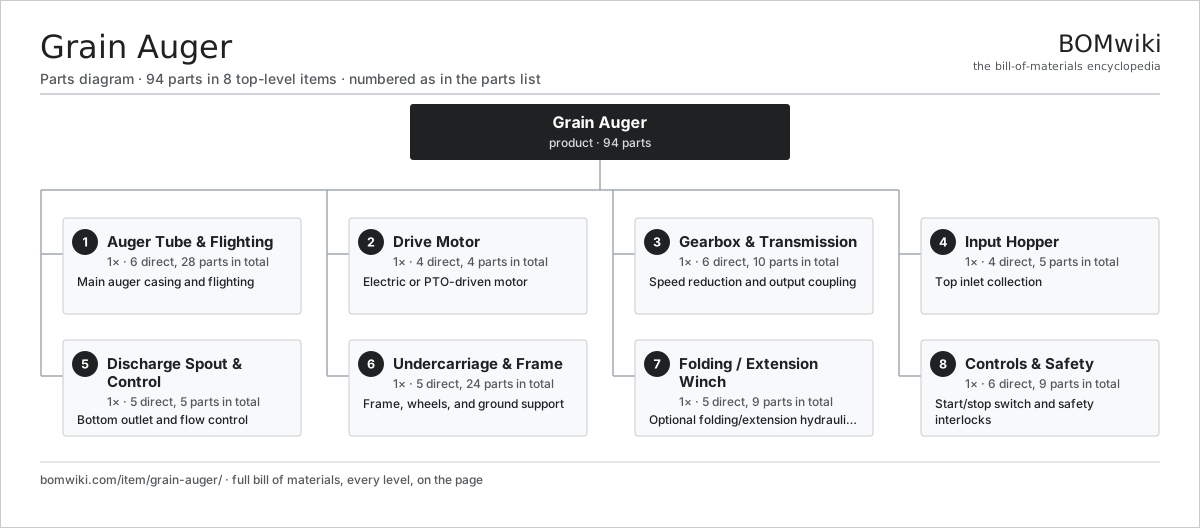
| # | Part | Qty | What it does |
|---|---|---|---|
| 1 | Auger Tube & Flighting 6 parts | 1× | Main auger casing and flighting |
| 2 | Drive Motor 4 parts | 1× | Electric or PTO-driven motor |
| 3 | Gearbox & Transmission 6 parts | 1× | Speed reduction and output coupling |
| 4 | Input Hopper 4 parts | 1× | Top inlet collection |
| 5 | Discharge Spout & Control 5 parts | 1× | Bottom outlet and flow control |
| 6 | Undercarriage & Frame 5 parts | 1× | Frame, wheels, and ground support |
| 7 | Folding / Extension Winch 5 parts | 1× | Optional folding/extension hydraulic or mechanical |
| 8 | Controls & Safety 6 parts | 1× | Start/stop switch and safety interlocks |
3D model
No 3D model yet. Have a CAD file of this? Add a 3D model. STL renders right on this page; STEP, FreeCAD, and OpenSCAD sources are welcome too (openly licensed, like all 3D models on BOMwiki).
Build & assembly graph
expand / collapse · shared sub-assemblies converge · links to related products · est. labourTap an assembly to expand/collapse · tap a part to open it · use “Open page” for any node · drag to pan, scroll to zoom.
Bill of materials for Grain Auger
8 top-level lines · 54 rows shown · 94 parts total · indented to 3 levels| # | Item / sub-assembly | Part no. | Qty/assy | Ext. qty | Parts | Type |
|---|---|---|---|---|---|---|
| 1 | Auger Tube & Flighting 6 parts | grain-auger-tube | 1× | 1 | 28 | assembly |
| 1.1 | Auger Shaft | grain-auger-shaft | 1× | 1 | · | part |
| 1.2 | Auger Flighting Section | grain-auger-flighting | 8× | 8 | · | part |
| 1.3 | Tube Section | grain-auger-tube-section | 8× | 8 | · | part |
| 1.4 | Tube Support Bearing | grain-auger-tube-bearing | 8× | 8 | · | part |
| 1.5 | Oil Seal | oil-seal | 2× | 2 | · | part |
| 1.6 | Fill Plug | grain-auger-fill-plug | 1× | 1 | · | part |
| 2 | Drive Motor 4 parts | grain-auger-motor | 1× | 1 | 4 | assembly |
| 2.1 | Electric Motor | grain-auger-electric-motor | 1× | 1 | · | part |
| 2.2 | Motor Starter | grain-auger-motor-starter | 1× | 1 | · | part |
| 2.3 | Motor Coupling | grain-auger-motor-coupling | 1× | 1 | · | part |
| 2.4 | Thermal Overload | grain-auger-thermal-protection | 1× | 1 | · | part |
| 3 | Gearbox & Transmission 6 parts | grain-auger-gearbox | 1× | 1 | 10 | assembly |
| 3.1 | Gearbox Housing | grain-auger-gearbox-housing | 1× | 1 | · | part |
| 3.2 | Input Gear | grain-auger-input-gear | 1× | 1 | · | part |
| 3.3 | Output Gear | grain-auger-output-gear | 1× | 1 | · | part |
| 3.4 | Ball Bearing | ball-bearing | 4× | 4 | · | part |
| 3.5 | Oil Seal | oil-seal | 2× | 2 | · | part |
| 3.6 | O-Ring Set | oring-set | 1× | 1 | · | part |
| 4 | Input Hopper 4 parts | grain-auger-hopper | 1× | 1 | 5 | assembly |
| 4.1 | Hopper Cone | grain-auger-hopper-cone | 1× | 1 | · | part |
| 4.2 | Support Ring | grain-auger-hopper-support-ring | 1× | 1 | · | part |
| 4.3 | Intake Ring | grain-auger-intake-ring | 1× | 1 | · | part |
| 4.4 | Hopper Brace | grain-auger-hopper-brace | 2× | 2 | · | part |
| 5 | Discharge Spout & Control 5 parts | grain-auger-discharge-spout | 1× | 1 | 5 | assembly |
| 5.1 | Spout Tube | grain-auger-spout-tube | 1× | 1 | · | part |
| 5.2 | Spout Elbow | grain-auger-spout-elbow | 1× | 1 | · | part |
| 5.3 | Swing Bearing | grain-auger-spout-swing-bearing | 1× | 1 | · | part |
| 5.4 | Flow Control Gate | grain-auger-flow-gate | 1× | 1 | · | part |
| 5.5 | Spout Arm | grain-auger-spout-support-arm | 1× | 1 | · | part |
| 6 | Undercarriage & Frame 5 parts | grain-auger-undercarriage | 1× | 1 | 24 | assembly |
| 6.1 | Frame Beam | grain-auger-frame-beam | 2× | 2 | · | part |
| 6.2 | Axle Assembly | grain-auger-axle | 1× | 1 | · | part |
| 6.3 | Wheel Assembly 5 parts | wheel-assembly | 2× | 2 | 9 | assembly |
| 6.3.1 | Alloy Wheel | alloy-wheel | 1× | 2 | · | part |
| 6.3.2 | Tire | tire | 1× | 2 | · | part |
| 6.3.3 | TPMS Sensor | tpms-sensor | 1× | 2 | · | part |
| 6.3.4 | Lug Nut | lug-nut | 5× | 10 | · | part |
| 6.3.5 | Valve Stem | valve-stem | 1× | 2 | · | part |
| 6.4 | Leveling Jack | grain-auger-leveling-jack | 2× | 2 | · | part |
| 6.5 | Fastener Set | fastener-set | 1× | 1 | · | part |
| 7 | Folding / Extension Winch 5 parts | grain-auger-winch | 1× | 1 | 9 | assembly |
| 7.1 | Winch Motor | grain-auger-winch-motor | 1× | 1 | · | part |
| 7.2 | Winch Drum | grain-auger-winch-drum | 1× | 1 | · | part |
| 7.3 | Winch Cable | grain-auger-winch-cable | 1× | 1 | · | part |
| 7.4 | Cable Guide | grain-auger-cable-guide | 4× | 4 | · | part |
| 7.5 | Folding Arm | grain-auger-folding-arm | 2× | 2 | · | part |
| 8 | Controls & Safety 6 parts | grain-auger-controls | 1× | 1 | 9 | assembly |
| 8.1 | Control Box | grain-auger-control-box | 1× | 1 | · | part |
| 8.2 | Start Button | grain-auger-start-button | 1× | 1 | · | part |
| 8.3 | Emergency Stop | grain-auger-emergency-stop | 1× | 1 | · | part |
| 8.4 | Thermal Switch | grain-auger-thermal-switch | 1× | 1 | · | part |
| 8.5 | Motor Contactor | grain-auger-motor-contactor | 1× | 1 | · | part |
| 8.6 | Connector | connector | 4× | 4 | · | part |
Something wrong in this list? Report a problem with this BOM.
Related products
same domain, ranked by shared parts Agricultural Tractor
306 parts · shares 8 with this page
Agricultural Tractor
306 parts · shares 8 with this page
 Feed Mixer Wagon
133 parts · shares 8 with this page
Feed Mixer Wagon
133 parts · shares 8 with this page
 Reversible Plough
131 parts · shares 8 with this page
Reversible Plough
131 parts · shares 8 with this page
 Silage Trailer
185 parts · shares 8 with this page
Silage Trailer
185 parts · shares 8 with this page
 Boom Sprayer
356 parts · shares 7 with this page
Boom Sprayer
356 parts · shares 7 with this page
 Combine Harvester
203 parts · shares 7 with this page
Combine Harvester
203 parts · shares 7 with this page
Sourcing: possible vendors
Browse the supplier directory → Prices, MOQ, and lead times are algorithmic estimates, not quotes, and not claims about these companies. Company mappings are curated by keyword; est. price band $5k–$800k. How estimates work| Vendor | HQ | Specialty | MOQ | Lead time |
|---|---|---|---|---|
| deere.com ↗ | Moline, US | Agriculture & turf | made to order | 14–24 wks |
| cnh.com ↗ | Basildon, GB | Agriculture (Case IH, New Holland) | made to order | 14–24 wks |
|
🇺🇸AGCO
agcocorp.com ↗
|
Duluth, US | Agriculture (Fendt, Massey Ferguson) | made to order | 14–24 wks |
|
🇩🇪Claas
claas.com ↗
|
Harsewinkel, DE | Harvesters & tractors | made to order | 14–24 wks |
|
🇯🇵Kubota
kubota.com ↗
|
Osaka, JP | Compact tractors & equipment | made to order | 14–24 wks |
1,157-word article