Gramophone
ProductOverview
The gramophone is a mechanical sound reproduction device that plays recorded grooves on a rotating disc through an acoustic horn, entirely powered by a wound mainspring and requiring no electricity. Invented by Emile Berliner in 1887, the gramophone became the dominant home music player by 1910, supplying recorded music to millions of households before the rise of radio and electric phonographs.
The device operates on a straightforward transduction chain: a sharp needle (stylus) tracks the spiral groove on a rotating record, vibrating in sympathy with the recorded signal. These vibrations are concentrated by a Soundbox into air pressure waves that are then amplified and shaped acoustically by the Horn.
Record and Turntable
The gramophone plays shellac records 10 or 12 inches in diameter, rotating at a constant 78 rpm. The Turntable Assembly is a cast iron or aluminum platter (250–300 mm diameter) mounted on a hardened Spindle post. The platter rotates on a low-friction Turntable Bearing, typically a felt-lined brass ring. A Label Ring (friction washer) presses the record label against the platter, ensuring centring to within 1 mm.
The drive from the motor to the platter is delivered through a Gear Drive, usually a worm gear or bevel pair that steps down the motor rotation to 78 rpm. Speed is held constant not by electronic feedback, but by a mechanical Governor that actively adjusts spring torque delivery, maintaining ±2% speed stability across the 3–5 minute runtime.
Motor and Governor
The Mechanical Drive is the heart of the machine. A large Mainspring, a wound steel ribbon 6–8 mm wide and 0.5–0.8 mm thick, is coiled into a Spring Barrel that functions as both a reservoir and torque source. The operator winds this spring using a Winding Key (detachable crank), storing 1000–2000 J of mechanical energy. As the spring unwinds, it drives the Drive Shaft.
Rather than allowing speed to decay as the spring releases its stored energy, a Governor maintains constant speed. The governor is a centrifugal regulator: as speed increases, small flyweights swing outward, progressively restricting spring torque delivery. Conversely, if speed drops (due to load), the flyweights collapse inward, allowing greater torque. This mechanical feedback loop keeps platter speed to within 2% of nominal 78 rpm for the entire 3–5 minute play duration, remarkable precision without electricity.
Tone Arm and Stylus
The Tone Arm is a pivoted aluminum or brass tube extending from a bearing across the record surface. One end holds a Cartridge Mount accepting the Needle Cartridge. The arm's fulcrum is a low-friction Tone Arm Bearing, usually a precision pivot jeweled with sapphire or agate.
The Needle Cartridge contains a Needle, historically sapphire (0.7–1.0 mm radius) or steel. Sapphire is preferred as it resists wear; a well-maintained sapphire needle lasts 50–100 plays before requiring replacement. Cheaper steel needles last only 10–20 plays. The needle is mounted in a Needle Sleeve that couples to a Cartridge Body, a rigid housing that bridges the needle point to the Soundbox diaphragm.
A Counterweight (50–100 g sliding mass) balances the arm, allowing proper needle-to-groove contact pressure (typically 50–150 grams-force). Without this balance, the stylus either skips from grooves (too light) or damages the record (too heavy). A Tone Arm Rest (mechanical notch) parks the arm when playback is finished, lifting it away from the platter.
Soundbox and Diaphragm
The Soundbox is a sealed chamber (typically 150–250 mL volume) acting as a mechanical transducer. A Diaphragm, a thin sheet of mica (0.3–0.5 mm) or aluminum, is glued at its edges. The Diaphragm Post, a rigid coupling rod, connects the diaphragm center to the needle cartridge. As the needle vibrates, the post drives the diaphragm in and out, modulating air pressure inside the chamber.
The soundbox chamber is tuned to resonance around 500–3000 Hz, the presence peak for human speech and music fundamentals. This resonance boosts the acoustic output, compensating for the horn''s inherent loss at low and very high frequencies. The soundbox must be sealed airtight; any leakage of air massively reduces efficiency. A Soundbox Gasket (felt or cork) seals the junction between soundbox and horn.
Horn Acoustic Design
The Horn is an acoustic transformer, converting the small pressure oscillations inside the soundbox into room-filling sound. It is an exponential or curved taper, beginning with a narrow Horn Entry Section (25–30 mm diameter entry) that widens gradually through Horn Mid-Range Section and terminates in a large Horn Bell (bell, 150–250 mm diameter).
This geometry serves two purposes:
- Impedance matching: The narrow entry matches the high acoustic impedance of the diaphragm; the wide bell matches the lower impedance of room air. The exponential taper smooths the transition, maximizing energy transfer across frequencies.
- Directivity: The horn focuses acoustic energy in a forward hemisphere, projecting sound into the room rather than allowing it to radiate omni-directionally.
Horn construction varies. Early gramophones used papier-mâché (lightweight, easy to mold, but prone to cracking). Later designs employed wood veneer glued over a frame. High-end machines used spun tin plate (durable, higher resonant frequency, brighter tone). Internal Horn Bracing (ribs and cross-members) stiffens the horn walls, reducing unwanted vibrational modes.
Horn length ranges 0.8–1.5 m, typically folded into a compact shape (coiled or zigzagged). Longer horns produce lower resonant frequencies and greater bass response; shorter horns are brighter and more articulate.
Operational Considerations
Before play, the operator winds the Mainspring with the Winding Key, typically 30–50 full rotations until spring torque becomes difficult. The record is placed on the Platter and centred using the Spindle. The tone arm is lifted from its rest and gently placed at the record outer edge (near the label).
As the arm moves across the record under gravity and the record''s slight spiral lead-in groove, it travels inward at 30 mm per minute. The journey takes 3–5 minutes. When the needle reaches the centre, the record rotates freely and the operator lifts the tone arm manually.
The Brake and Control includes a Friction Brake (felt pad against platter) that stops the record when engaged by a Brake Lever. Speed is checked using a stroboscopic disc: under room lighting at 50 or 60 Hz AC, a correctly tuned gramophone shows a stationary pattern; slow machines show a drifting pattern. Fine adjustment is available via the Speed Adjuster, a tension screw on the governor spring.
Sound Quality
Acoustic gramophones are limited to approximately 200 Hz–5 kHz frequency response, with severe roll-off above 3 kHz. The horn''s resonance peak (typically 1–3 kHz) creates a nasal, forward tone characteristic of acoustic-era recordings. Sound pressure level reaches 70–85 dB SPL at 1 m in a quiet room, sufficient for small to medium rooms but not for large halls.
Distortion is primarily mechanical: stylus wear, groove deformation, and diaphragm nonlinearity introduce harmonic distortion at levels acceptable for acoustic recordings (acoustic musicians and singers recorded knowing the playback limitations). Electric amplification was introduced in 1925–1930, replacing acoustic horns with electronic pickups and loudspeakers.
Maintenance and Longevity
Gramophones are robust machines, many surviving 80+ years with minimal repair. Key maintenance:
- Needle replacement: Every 50 plays (sapphire) or 10–20 plays (steel).
- Governor adjustment: Seasonal speed checks; if drift exceeds 3%, adjust tension screw.
- Lubrication: Light machine oil on bearings annually; avoid over-oiling, which thickens and increases friction.
- Spring maintenance: If mainspring breaks (rare), specialized repair shops can re-temper or replace.
- Horn: Papier-mâché horns may crack; tin-plate horns develop small dents but remain functional.
The gramophone remains valued by collectors and enthusiasts for its mechanical elegance, lack of dependency on electricity, and the warm, intimate tone of acoustic-era recordings played as originally intended.
Gramophone parts and their functions
7 top-level parts · 36 parts in total · full bill of materials below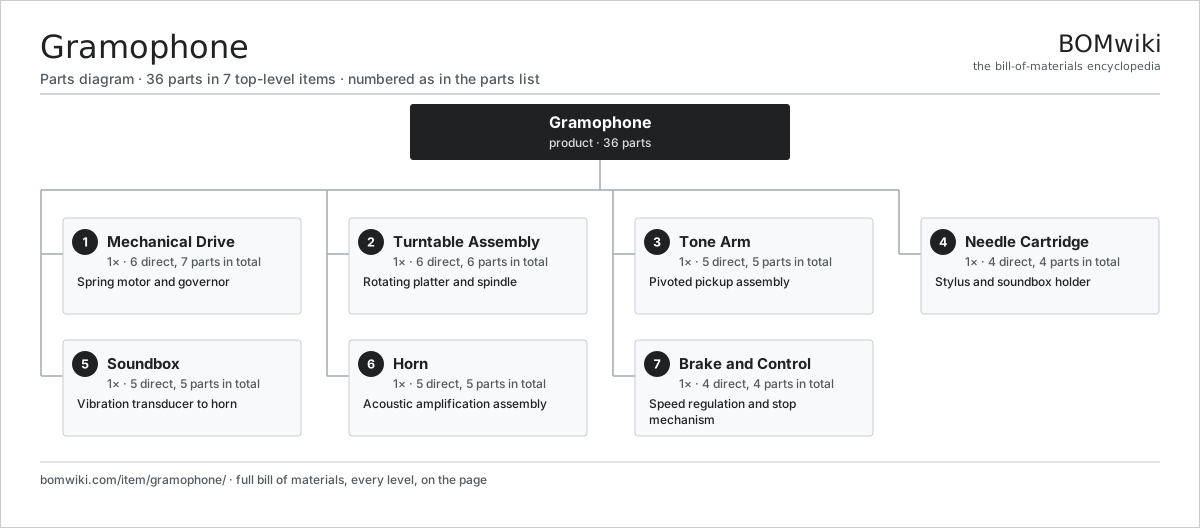
| # | Part | Qty | What it does |
|---|---|---|---|
| 1 | Mechanical Drive 6 parts | 1× | Spring motor and governor |
| 2 | Turntable Assembly 6 parts | 1× | Rotating platter and spindle |
| 3 | Tone Arm 5 parts | 1× | Pivoted pickup assembly |
| 4 | Needle Cartridge 4 parts | 1× | Stylus and soundbox holder |
| 5 | Soundbox 5 parts | 1× | Vibration transducer to horn |
| 6 | Horn 5 parts | 1× | Acoustic amplification assembly |
| 7 | Brake and Control 4 parts | 1× | Speed regulation and stop mechanism |
3D model
No 3D model yet. Have a CAD file of this? Add a 3D model. STL renders right on this page; STEP, FreeCAD, and OpenSCAD sources are welcome too (openly licensed, like all 3D models on BOMwiki).
Build & assembly graph
expand / collapse · shared sub-assemblies converge · links to related products · est. labourTap an assembly to expand/collapse · tap a part to open it · use “Open page” for any node · drag to pan, scroll to zoom.
Bill of materials for Gramophone
7 top-level lines · 42 rows shown · 36 parts total · indented to 3 levels| # | Item / sub-assembly | Part no. | Qty/assy | Ext. qty | Parts | Type |
|---|---|---|---|---|---|---|
| 1 | Mechanical Drive 6 parts | gramophone-mechanical-drive | 1× | 1 | 7 | assembly |
| 1.1 | Mainspring | gramophone-mainspring | 1× | 1 | · | part |
| 1.2 | Spring Barrel | gramophone-spring-barrel | 1× | 1 | · | part |
| 1.3 | Governor | gramophone-governor | 1× | 1 | · | part |
| 1.4 | Drive Shaft | gramophone-drive-shaft | 1× | 1 | · | part |
| 1.5 | Winding Key | gramophone-winding-key | 1× | 1 | · | part |
| 1.6 | Ball Bearing | ball-bearing | 2× | 2 | · | part |
| 2 | Turntable Assembly 6 parts | gramophone-turntable | 1× | 1 | 6 | assembly |
| 2.1 | Platter | gramophone-platter | 1× | 1 | · | part |
| 2.2 | Spindle | gramophone-spindle | 1× | 1 | · | part |
| 2.3 | Turntable Bearing | gramophone-turn-table-bearing | 1× | 1 | · | part |
| 2.4 | Label Ring | gramophone-label-ring | 1× | 1 | · | part |
| 2.5 | Gear Drive | gramophone-gear-drive | 1× | 1 | · | part |
| 2.6 | Fastener Set | fastener-set | 1× | 1 | · | part |
| 3 | Tone Arm 5 parts | gramophone-tone-arm | 1× | 1 | 5 | assembly |
| 3.1 | Tone Arm Tube | gramophone-tone-arm-tube | 1× | 1 | · | part |
| 3.2 | Tone Arm Bearing | gramophone-tone-arm-bearing | 1× | 1 | · | part |
| 3.3 | Counterweight | gramophone-tone-arm-counterweight | 1× | 1 | · | part |
| 3.4 | Tone Arm Rest | gramophone-tone-arm-rest | 1× | 1 | · | part |
| 3.5 | Cartridge Mount | gramophone-cartridge-mount | 1× | 1 | · | part |
| 4 | Needle Cartridge 4 parts | gramophone-needle-cartridge | 1× | 1 | 4 | assembly |
| 4.1 | Needle | gramophone-needle | 1× | 1 | · | part |
| 4.2 | Needle Sleeve | gramophone-needle-sleeve | 1× | 1 | · | part |
| 4.3 | Cartridge Body | gramophone-cartridge-body | 1× | 1 | · | part |
| 4.4 | Damping Insert | gramophone-damping-insert | 1× | 1 | · | part |
| 5 | Soundbox 5 parts | gramophone-soundbox | 1× | 1 | 5 | assembly |
| 5.1 | Soundbox Chamber | gramophone-soundbox-chamber | 1× | 1 | · | part |
| 5.2 | Diaphragm | gramophone-diaphragm | 1× | 1 | · | part |
| 5.3 | Diaphragm Post | gramophone-diaphragm-post | 1× | 1 | · | part |
| 5.4 | Soundbox Gasket | gramophone-soundbox-gasket | 1× | 1 | · | part |
| 5.5 | Horn Collar | gramophone-horn-collar | 1× | 1 | · | part |
| 6 | Horn 5 parts | gramophone-horn | 1× | 1 | 5 | assembly |
| 6.1 | Horn Entry Section | gramophone-horn-section-1 | 1× | 1 | · | part |
| 6.2 | Horn Mid-Range Section | gramophone-horn-section-2 | 1× | 1 | · | part |
| 6.3 | Horn Bell | gramophone-horn-section-3 | 1× | 1 | · | part |
| 6.4 | Horn Bracing | gramophone-horn-bracing | 1× | 1 | · | part |
| 6.5 | Horn Material | gramophone-horn-material | 1× | 1 | · | part |
| 7 | Brake and Control 4 parts | gramophone-brake-control | 1× | 1 | 4 | assembly |
| 7.1 | Friction Brake | gramophone-friction-brake | 1× | 1 | · | part |
| 7.2 | Brake Lever | gramophone-brake-lever | 1× | 1 | · | part |
| 7.3 | Speed Adjuster | gramophone-speed-adjuster | 1× | 1 | · | part |
| 7.4 | Engagement Clutch | gramophone-engagement-clutch | 1× | 1 | · | part |
Something wrong in this list? Report a problem with this BOM.
Related products
same domain, ranked by shared parts Broadcast Pedestal
83 parts · shares 1 with this page
Broadcast Pedestal
83 parts · shares 1 with this page
 DJ Controller
179 parts · shares 1 with this page
Film Wind Machine
102 parts · shares 1 with this page
Motorized Curtain Track
210 parts · shares 1 with this page
Motorized TV Lift
54 parts · shares 1 with this page
DJ Controller
179 parts · shares 1 with this page
Film Wind Machine
102 parts · shares 1 with this page
Motorized Curtain Track
210 parts · shares 1 with this page
Motorized TV Lift
54 parts · shares 1 with this page
 Projector
482 parts · shares 1 with this page
Projector
482 parts · shares 1 with this page
Sourcing: possible vendors
Browse the supplier directory → Prices, MOQ, and lead times are algorithmic estimates, not quotes, and not claims about these companies. Company mappings are curated by keyword; est. price band $50–$3k. How estimates work| Vendor | HQ | Specialty | MOQ | Lead time |
|---|---|---|---|---|
|
🇯🇵Sony
sony.com ↗
|
Tokyo, JP | Consumer electronics | 1,000 units | 8–12 wks |
| samsung.com ↗ | Suwon, KR | Electronics & displays | 1,000 units | 8–12 wks |
|
🇺🇸Harman
harman.com ↗
|
Stamford, US | Audio (JBL, AKG) | 1,000 units | 8–12 wks |
|
🇺🇸Bose
bose.com ↗
|
Framingham, US | Audio | 1,000 units | 8–12 wks |
| yamaha.com ↗ | Hamamatsu, JP | Audio & instruments | 1,000 units | 8–12 wks |
1,355-word article