Grease Interceptor
ProductOverview
A grease interceptor is a passive separation tank plumbed between a commercial kitchen's fixture drains and the sanitary sewer. Fats, oils, and grease (FOG) discharged from pot sinks, woks, and dishwashers congeal in sewer mains and are the leading cause of sanitary sewer overflows, so nearly every municipal sewer ordinance requires food-service establishments to intercept FOG on site. The device works on a single physical fact: grease is lighter than water (specific gravity around 0.9) and will float out of a wastewater stream if the stream is held still long enough.
The unit described here is a hydromechanical interceptor rated at 50 GPM and 100 lb of grease retention under ASME A112.14.3. Everything in the design, the Tank Shell volume, the Baffle System, the external Flow Control Fitting, exists to guarantee the wastewater spends enough quiet time in the vessel for separation to finish before the effluent leaves through the Outlet Assembly.
How it works
Hot, greasy wastewater first passes the Flow Control Fitting fitting mounted in the drain line upstream of the tank. Its Orifice Plate restricts the flow to the rated 50 GPM no matter how many fixtures discharge at once, and the Air Intake Elbow admits air behind the orifice so the line cannot siphon and the air entrained in the stream helps grease globules agglomerate and rise.
Inside the tank, the stream enters through the Inlet Assembly and is turned downward and spread across the tank width by the Inlet Baffle and the down-turned Inlet Diffuser Tee. With the inlet jet's energy dissipated, the water drifts horizontally toward the outlet at a few millimetres per second. During the roughly 90-second retention period, grease droplets rise to the surface and accumulate as a floating mat, while food solids heavier than water settle to the floor. The Intermediate Baffle divides the vessel into a primary chamber, where most separation happens, and a calmer secondary polishing chamber.
At the far end, the Outlet Baffle and the Outlet Dip Pipe together draw effluent only from the clear middle stratum, below the grease mat, above the sludge blanket. Clarified water exits through the Outlet Hub to the sewer. A capped Sampling Port on the outlet lets municipal inspectors verify the discharge stays under the local FOG limit, typically 100 mg/L.
Construction
The Tank Body is a welded 6 mm carbon-steel box with an internal fusion-bonded epoxy Internal Coating; kitchen wastewater is mildly acidic and uncoated steel tanks corrode through in a few years. Rotomolded HDPE bodies are increasingly common because they are immune to corrosion and weigh a third as much. Four Lifting Lugs allow rigging, and the Base Skid spreads the loaded weight, over 400 kg for this size when full, onto the slab.
All internals are serviceable: each baffle hangs on bolted Baffle Brackets so it can be lifted out during cleaning, and a Cleanout Plug on the inlet tee gives rodding access if the inlet line blocks. The top of the tank is closed by the Access Cover Assembly: gasketed Cover Plates seated in a recessed Cover Frame, sealed by Cover Gaskets, and bolted down. The gas-tight seal matters because the trapped grease layer turns rancid and generates hydrogen sulfide; covers are only opened during pump-outs.
Maintenance and the 25% rule
An interceptor only works while it has free volume. Most jurisdictions enforce the "25% rule": the combined depth of the floating grease mat and the settled solids must never exceed a quarter of the tank's liquid depth. Past that point retention time collapses and grease starts carrying over to the sewer.
Rather than relying on a manual dipstick check, this unit carries a Grease Level Alarm. A capacitive Grease Layer Probe suspended at the 25% depth distinguishes grease from water by dielectric constant; when the thickening mat reaches the probe, the panel sounds its Speaker, lights a lamp, and closes a Relay dry contact that can signal a building-management system or auto-dispatch the pumping contractor. Typical pump-out intervals for a busy kitchen on a tank this size run two to four weeks. During service, the hauler removes the full liquid contents, grease mat, water, and solids, scrapes the walls and baffles, and refills the tank with water so separation works immediately on restart.
Sizing and standards
Hydromechanical interceptors are certified by flow rate and grease capacity under ASME A112.14.3 and PDI G101: a compliant unit must retain at least 2 lb of grease per GPM of rated flow at 90% efficiency. Sizing starts from fixture drainage rates, a three-compartment pot sink alone can drive a 35–50 GPM requirement. Larger establishments use gravity grease interceptors, buried concrete tanks of 3,000 L and up with retention times of 30 minutes or more, but the operating principle, slow the flow, float the grease, draw from the middle, is identical to the floor-mounted unit described here.
Grease Interceptor parts and their functions
7 top-level parts · 45 parts in total · full bill of materials below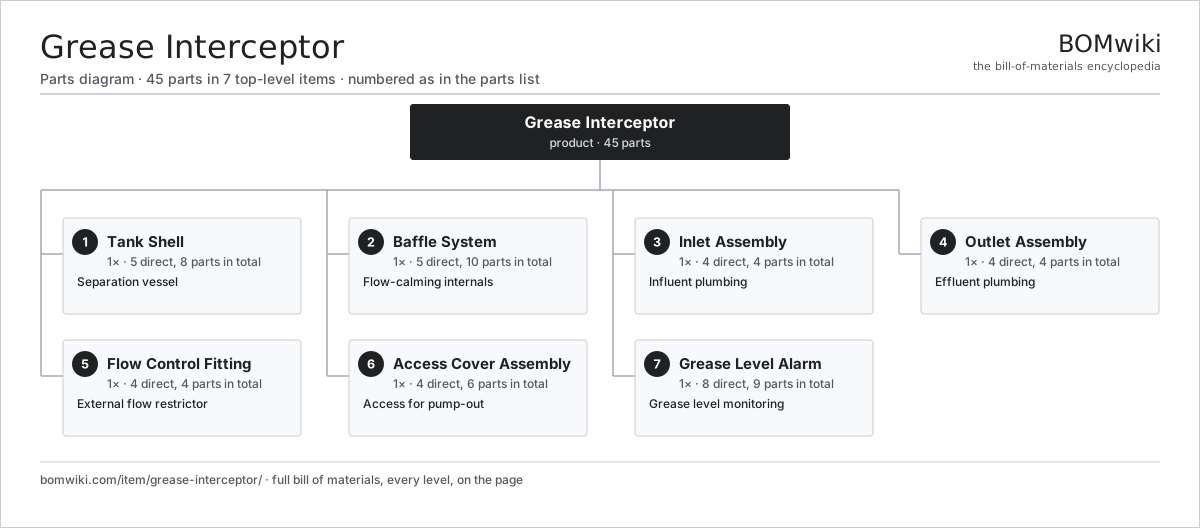
| # | Part | Qty | What it does |
|---|---|---|---|
| 1 | Tank Shell 5 parts | 1× | Separation vessel |
| 2 | Baffle System 5 parts | 1× | Flow-calming internals |
| 3 | Inlet Assembly 4 parts | 1× | Influent plumbing |
| 4 | Outlet Assembly 4 parts | 1× | Effluent plumbing |
| 5 | Flow Control Fitting 4 parts | 1× | External flow restrictor |
| 6 | Access Cover Assembly 4 parts | 1× | Access for pump-out |
| 7 | Grease Level Alarm 8 parts | 1× | Grease level monitoring |
3D model
No 3D model yet. Have a CAD file of this? Add a 3D model. STL renders right on this page; STEP, FreeCAD, and OpenSCAD sources are welcome too (openly licensed, like all 3D models on BOMwiki).
Build & assembly graph
expand / collapse · shared sub-assemblies converge · links to related products · est. labourTap an assembly to expand/collapse · tap a part to open it · use “Open page” for any node · drag to pan, scroll to zoom.
Bill of materials for Grease Interceptor
7 top-level lines · 41 rows shown · 45 parts total · indented to 3 levels| # | Item / sub-assembly | Part no. | Qty/assy | Ext. qty | Parts | Type |
|---|---|---|---|---|---|---|
| 1 | Tank Shell 5 parts | grease-interceptor-tank | 1× | 1 | 8 | assembly |
| 1.1 | Tank Body | grease-interceptor-tank-body | 1× | 1 | · | part |
| 1.2 | Internal Coating | grease-interceptor-coating | 1× | 1 | · | part |
| 1.3 | Lifting Lug | grease-interceptor-lifting-lug | 4× | 4 | · | part |
| 1.4 | Base Skid | grease-interceptor-base-skid | 1× | 1 | · | part |
| 1.5 | Fastener Set | fastener-set | 1× | 1 | · | part |
| 2 | Baffle System 5 parts | grease-interceptor-baffles | 1× | 1 | 10 | assembly |
| 2.1 | Inlet Baffle | grease-interceptor-inlet-baffle | 1× | 1 | · | part |
| 2.2 | Intermediate Baffle | grease-interceptor-mid-baffle | 1× | 1 | · | part |
| 2.3 | Outlet Baffle | grease-interceptor-outlet-baffle | 1× | 1 | · | part |
| 2.4 | Baffle Bracket | grease-interceptor-baffle-bracket | 6× | 6 | · | part |
| 2.5 | Fastener Set | fastener-set | 1× | 1 | · | part |
| 3 | Inlet Assembly 4 parts | grease-interceptor-inlet | 1× | 1 | 4 | assembly |
| 3.1 | Inlet Hub | grease-interceptor-inlet-hub | 1× | 1 | · | part |
| 3.2 | Inlet Diffuser Tee | grease-interceptor-inlet-tee | 1× | 1 | · | part |
| 3.3 | Cleanout Plug | grease-interceptor-cleanout-plug | 1× | 1 | · | part |
| 3.4 | O-Ring Set | oring-set | 1× | 1 | · | part |
| 4 | Outlet Assembly 4 parts | grease-interceptor-outlet | 1× | 1 | 4 | assembly |
| 4.1 | Outlet Hub | grease-interceptor-outlet-hub | 1× | 1 | · | part |
| 4.2 | Outlet Dip Pipe | grease-interceptor-dip-pipe | 1× | 1 | · | part |
| 4.3 | Sampling Port | grease-interceptor-sample-port | 1× | 1 | · | part |
| 4.4 | O-Ring Set | oring-set | 1× | 1 | · | part |
| 5 | Flow Control Fitting 4 parts | grease-interceptor-flow-control | 1× | 1 | 4 | assembly |
| 5.1 | Flow Control Body | grease-interceptor-fcf-body | 1× | 1 | · | part |
| 5.2 | Orifice Plate | grease-interceptor-orifice-plate | 1× | 1 | · | part |
| 5.3 | Air Intake Elbow | grease-interceptor-vent-elbow | 1× | 1 | · | part |
| 5.4 | Fastener Set | fastener-set | 1× | 1 | · | part |
| 6 | Access Cover Assembly 4 parts | grease-interceptor-covers | 1× | 1 | 6 | assembly |
| 6.1 | Cover Plate | grease-interceptor-cover-plate | 2× | 2 | · | part |
| 6.2 | Cover Frame | grease-interceptor-cover-frame | 1× | 1 | · | part |
| 6.3 | Cover Gasket | grease-interceptor-cover-gasket | 2× | 2 | · | part |
| 6.4 | Fastener Set | fastener-set | 1× | 1 | · | part |
| 7 | Grease Level Alarm 8 parts | grease-interceptor-alarm | 1× | 1 | 9 | assembly |
| 7.1 | Grease Layer Probe | grease-interceptor-probe | 1× | 1 | · | part |
| 7.2 | Bare PCB | pcb-bare | 1× | 1 | · | part |
| 7.3 | Microcontroller | mcu | 1× | 1 | · | part |
| 7.4 | SMD Passive (R/C/L) | smd-passives | 1× | 1 | · | part |
| 7.5 | Relay | relay | 1× | 1 | · | part |
| 7.6 | Speaker | speaker | 1× | 1 | · | part |
| 7.7 | Wire Bundle | wire-bundle | 1× | 1 | · | part |
| 7.8 | Connector | connector | 2× | 2 | · | part |
Something wrong in this list? Report a problem with this BOM.
Related products
same domain, ranked by shared parts Push-Rod Drain Camera
46 parts · shares 6 with this page
Push-Rod Drain Camera
46 parts · shares 6 with this page
 Musical Fountain System
214 parts · shares 5 with this page
Musical Fountain System
214 parts · shares 5 with this page
 Greywater Recycling Unit
77 parts · shares 7 with this page
Greywater Recycling Unit
77 parts · shares 7 with this page
 Heat-Pump Water Heater
152 parts · shares 7 with this page
Hot Water Recirculation Pump
107 parts · shares 7 with this page
Heat-Pump Water Heater
152 parts · shares 7 with this page
Hot Water Recirculation Pump
107 parts · shares 7 with this page
 Electronic Bidet Seat
197 parts · shares 6 with this page
Electronic Bidet Seat
197 parts · shares 6 with this page
Sourcing: possible vendors
Browse the supplier directory → Prices, MOQ, and lead times are algorithmic estimates, not quotes, and not claims about these companies. Company mappings are curated by keyword; est. price band $20–$3k. How estimates work| Vendor | HQ | Specialty | MOQ | Lead time |
|---|---|---|---|---|
|
🇺🇸Kohler
kohler.com ↗
|
Kohler, US | Plumbing fixtures | 1,000 units | 6–12 wks |
|
🇯🇵TOTO
toto.com ↗
|
Kitakyushu, JP | Sanitaryware | 1,000 units | 6–12 wks |
|
🇯🇵LIXIL
lixil.com ↗
|
Tokyo, JP | Plumbing (Grohe, American Std) | 1,000 units | 6–12 wks |
|
🇺🇸Moen
moen.com ↗
|
North Olmsted, US | Faucets & fixtures | 1,000 units | 6–12 wks |
|
🇨🇭Geberit
geberit.com ↗
|
Rapperswil, CH | Sanitary systems | 1,000 units | 6–12 wks |
871-word article