Greenhouse Climate Computer
ProductOverview
A greenhouse climate computer (also called a climate controller or greenhouse computer) is an automated environmental management system integrating sensors, logic, and actuators to maintain optimal growing conditions. The Main PLC continuously monitors temperature, humidity, CO2, solar radiation, and light intensity from a distributed Sensor Network. Based on programmed setpoints and growing stage, it modulates Vent Motor Actuator, heating, cooling, and lighting to maintain crop-optimal conditions with minimal human intervention.
Modern climate computers reduce manual labor by 80%, improve crop consistency by ±2°C and ±5% RH precision, and cut energy consumption by 15–30% through demand-responsive heating and cooling. They are standard equipment in commercial greenhouses >500 m² and increasingly installed in smaller operations.
System Architecture
Sensor Network: The Sensor Network includes minimum 4–8 Temperature-Humidity Sensor probes mounted in shaded, ventilated housings distributed evenly across the greenhouse floor, representing different microclimates. One CO2 Sensor measures bulk CO2 near plant canopy height; one Solar Radiation Sensor records incoming light energy on the roof.
Logic Controller: The Controller Cabinet houses the Main PLC, which reads all sensors every 10–30 seconds and executes control algorithms. Decision rules are programmed in IEC 61131-3 ladder logic or structured text:
- IF Temperature > Setpoint + 2°C, open Vent Motor Actuator to maximum.
- IF Temperature < Setpoint - 2°C, activate Heater Contactor.
- IF Humidity > Setpoint + 10%, increase Fan Speed Controller to 80%.
- IF CO2 < Setpoint - 100 ppm AND Light > 200 µmol/m²/s, activate CO2 generator.
Actuators: The controller energizes relays to modulate heaters, fans, and lights. For vents, a proportional output (0–24V) drives the Linear Motor Actuator, opening vents 0–100% based on temperature error. The Motor Feedback Potentiometer provides position feedback, enabling closed-loop control.
Operational Modes
Day Mode (Sunrise to Sunset):
- Light Intensity Sensor confirms natural light >500 µmol/m²/s.
- Supplemental Lighting Controller lamps remain off (saves energy).
- Vent opening increases if temperature rises above setpoint (e.g., 24°C → open 30%).
- Heating inactive; cooling (fans, evaporative pads) may activate if temperature exceeds setpoint + 3°C.
- CO2 enrichment is active if target is >400 ppm.
Night Mode (Sunset to Sunrise):
- All Lighting Controller lamps activate per Photoperiod Timer schedule.
- Vents close to minimize heat loss (but remain slightly open to prevent CO2 stagnation).
- Heating Output Control activates if temperature drops below setpoint (e.g., 20°C → activate heater).
- Cooling is inactive.
- CO2 enrichment typically stops (plants do not photosynthesize at night; CO2 enrichment is wasted).
Transition Periods (Early morning, late evening):
- Complex logic ensures smooth handoff between day and night modes.
- Hysteresis prevents rapid on/off cycling (setpoint ±2°C deadband).
Sensor Placement and Calibration
Proper sensor location is critical. Temperature-Humidity Sensor probes must be shaded (direct sunlight reading 5–10°C above true temperature) and positioned at working height (1–2 m above crop). Spreading sensors across the greenhouse reveals spatial gradients: roof vents warm the upper region first; cool air stratifies near the floor. Algorithms can weight sensors by zone (e.g., 50% average of all probes, 50% lowest temperature probe) to prioritize root-zone protection.
Sensors require quarterly calibration:
- Temperature: Verify against a certified thermometer in an ice bath (0°C) and warm water (40°C).
- Humidity: Expose to saturated salt solutions (75%, 93% RH chambers).
- CO2: Calibrate to zero air (nitrogen) and span gas (1000 ppm standard).
The Data Logger records all calibration events, enabling drift trending.
Energy Optimization Strategies
Ventilation Priority: Natural ventilation via vents is 5–10× more efficient than mechanical cooling (fans consume 0.5–2 kW; evaporative cooling evaporation consumes water only). Controllers prioritize vent opening before activating fans.
Thermal Mass: If greenhouse has water barrels, floor mass, or thermal storage, the controller can pre-cool at night (open vents fully, accept 15–18°C temperature) to absorb heat, then close vents at dawn, releasing stored heat throughout the day. This reduces active heating/cooling runtime.
Demand-Responsive Heating: Heating activates only when temperature falls below setpoint. Proportional solenoid valves modulate boiler output to minimum necessary, avoiding on/off cycling (which wastes fuel).
CO2 Scheduling: CO2 generation or injection occurs only during high-light hours (06:00–18:00) when photosynthetic rate justifies the cost. Night and cloudy day injection is disabled.
Adaptive Setpoints: Some systems adjust temperature and humidity setpoints based on growth stage:
- Germination: 24–26°C, 85–90% RH (high heat and moisture).
- Vegetative growth: 20–24°C, 60–75% RH (moderate, aerobic).
- Fruiting/flowering: 18–22°C, 50–65% RH (cooler to promote flowering, lower RH to reduce disease).
Alarms and Safety
The Main PLC monitors actuator faults and extreme conditions:
- Vent Stuck Open: If temperature remains below setpoint for >30 minutes despite heating, vent actuator may be jammed. Alarm triggers.
- Heater Failure: If temperature drops below setpoint - 5°C with heater commanded on, alarm alerts grower.
- Humidity Excessive: If humidity exceeds 95% RH despite ventilation, disease risk is critical; Humidity Limit Switch triggers emergency vent opening.
- CO2 High: If CO2 exceeds 2000 ppm (unsafe for humans), vents open fully regardless of temperature.
Alarms can log to SD Card Slot SD card and trigger SMS/push notifications via the GSM Modem (optional cellular module) or Mobile App.
Remote Access and Data Analysis
The Web Server Module provides a web portal accessible from any browser. Growers can:
- View real-time and historical sensor graphs (hourly, daily, weekly trends).
- Adjust setpoints remotely.
- Review alarm log and troubleshoot failed actuators.
- Export CSV data to spreadsheet for yield correlation studies.
The Data Logger records every sensor reading and actuator command at 15-minute intervals, creating a complete 1-year time-series (35 MB SD card). This data is invaluable for season-end analysis: correlating temperature/humidity patterns with pest outbreaks, disease incidence, or yield anomalies.
Integration with Hydroponic and Fertigation Systems
Climate computers often integrate with Controller Unit or Controller Unit modules:
- Irrigation controllers receive temperature feedback from greenhouse climate computer to adjust watering frequency (hot days → more water; cool days → less water).
- Nutrient concentration is adjusted based on growth stage signals (vegetative → higher nitrogen; fruiting → higher phosphorus).
- Emergency shutoff: If greenhouse temperature exceeds 40°C or drops below 2°C, irrigation pumps shut off to prevent damage.
Typical Installation Timeline
- Week 1: Survey greenhouse, identify sensor locations, plan duct runs for vents.
- Weeks 2–3: Install Controller Cabinet on protected wall; run sensor cables (shielded twisted pair to prevent noise) and power/relay wiring.
- Week 4: Program control logic in PLC, test manual actuator commands (vent open/close, heater on/off).
- Week 5: Commission sensors, calibrate temperature/humidity/CO2, verify closed-loop control.
- Week 6: Transition to full automatic mode, monitor alarms, adjust setpoints per crop phenology.
A typical 1000 m² greenhouse takes 80–120 labor hours to integrate; commercial vendors package this into a 3–6 week project.
Comparison to Manual Control and Simple Timers
Manual (no automation): Labor-intensive; variable performance (±5°C temperature swings, 20–30% humidity variance). Requires 2–4 hours daily for opening/closing vents, adjusting heating. Energy waste: 20–30% above optimized systems.
Simple timer (vent on/off at fixed times): Better consistency (±3°C) but blind to weather. Hot days with closed vents overheat; cold nights with open vents waste heat.
Full climate computer: ±1–2°C temperature control, ±5% humidity, energy reduction of 15–30%. ROI in 3–5 years for commercial operations through reduced labor, improved yield consistency, and energy savings.
Greenhouse Climate Computer parts and their functions
8 top-level parts · 46 parts in total · full bill of materials below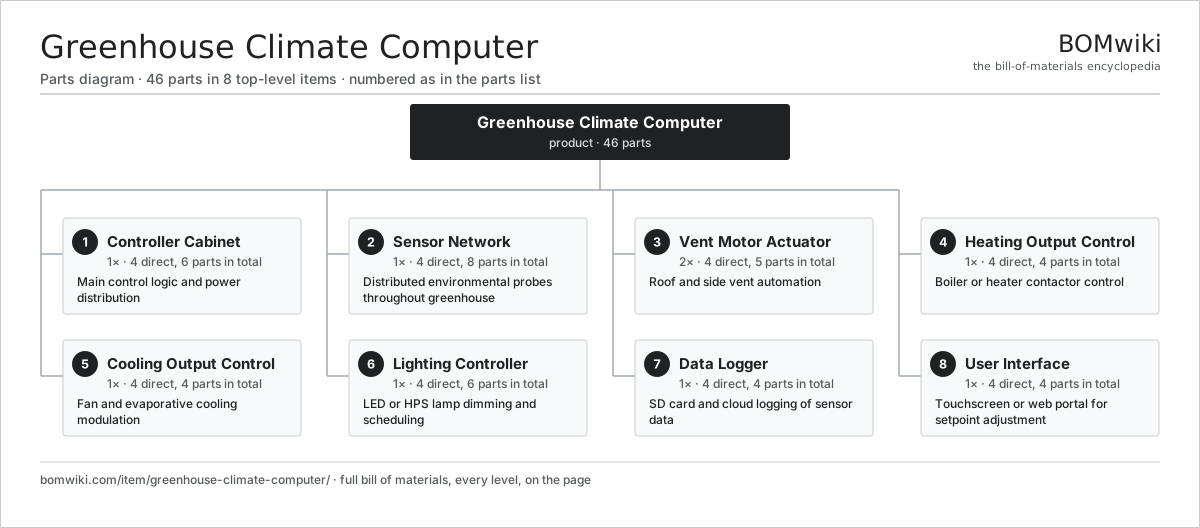
| # | Part | Qty | What it does |
|---|---|---|---|
| 1 | Controller Cabinet 4 parts | 1× | Main control logic and power distribution |
| 2 | Sensor Network 4 parts | 1× | Distributed environmental probes throughout greenhouse |
| 3 | Vent Motor Actuator 4 parts | 2× | Roof and side vent automation |
| 4 | Heating Output Control 4 parts | 1× | Boiler or heater contactor control |
| 5 | Cooling Output Control 4 parts | 1× | Fan and evaporative cooling modulation |
| 6 | Lighting Controller 4 parts | 1× | LED or HPS lamp dimming and scheduling |
| 7 | Data Logger 4 parts | 1× | SD card and cloud logging of sensor data |
| 8 | User Interface 4 parts | 1× | Touchscreen or web portal for setpoint adjustment |
3D model
No 3D model yet. Have a CAD file of this? Add a 3D model. STL renders right on this page; STEP, FreeCAD, and OpenSCAD sources are welcome too (openly licensed, like all 3D models on BOMwiki).
Build & assembly graph
expand / collapse · shared sub-assemblies converge · links to related products · est. labourTap an assembly to expand/collapse · tap a part to open it · use “Open page” for any node · drag to pan, scroll to zoom.
Bill of materials for Greenhouse Climate Computer
8 top-level lines · 40 rows shown · 46 parts total · indented to 3 levels| # | Item / sub-assembly | Part no. | Qty/assy | Ext. qty | Parts | Type |
|---|---|---|---|---|---|---|
| 1 | Controller Cabinet 4 parts | greenhouse-climate-computer-controller-cabinet | 1× | 1 | 6 | assembly |
| 1.1 | Main PLC | greenhouse-climate-computer-main-plc | 1× | 1 | · | part |
| 1.2 | Power Supply | greenhouse-climate-computer-power-supply | 1× | 1 | · | part |
| 1.3 | Relay Module | greenhouse-climate-computer-relay-module | 3× | 3 | · | part |
| 1.4 | IO Terminal Blocks | greenhouse-climate-computer-io-terminal-blocks | 1× | 1 | · | part |
| 2 | Sensor Network 4 parts | greenhouse-climate-computer-sensor-network | 1× | 1 | 8 | assembly |
| 2.1 | Temperature-Humidity Sensor | greenhouse-climate-computer-temp-humidity-sensor | 4× | 4 | · | part |
| 2.2 | CO2 Sensor | greenhouse-climate-computer-co2-sensor | 1× | 1 | · | part |
| 2.3 | Solar Radiation Sensor | greenhouse-climate-computer-solar-radiation-sensor | 1× | 1 | · | part |
| 2.4 | Pressure Sensor | greenhouse-climate-computer-pressure-sensor | 2× | 2 | · | part |
| 3 | Vent Motor Actuator 4 parts | greenhouse-climate-computer-vent-motor-actuator | 2× | 2 | 5 | assembly |
| 3.1 | Linear Motor Actuator | greenhouse-climate-computer-linear-motor | 1× | 2 | · | part |
| 3.2 | Motor Feedback Potentiometer | greenhouse-climate-computer-motor-feedback-pot | 1× | 2 | · | part |
| 3.3 | Mechanical Linkage | greenhouse-climate-computer-mechanical-linkage | 1× | 2 | · | part |
| 3.4 | Limit Switch | greenhouse-climate-computer-limit-switch | 2× | 4 | · | part |
| 4 | Heating Output Control 4 parts | greenhouse-climate-computer-heating-output | 1× | 1 | 4 | assembly |
| 4.1 | Heater Contactor | greenhouse-climate-computer-heater-contactor | 1× | 1 | · | part |
| 4.2 | Proportional Solenoid Valve | greenhouse-climate-computer-proportional-solenoid | 1× | 1 | · | part |
| 4.3 | Pressure Sensor | pressure-sensor | 1× | 1 | · | part |
| 4.4 | Relay | relay | 1× | 1 | · | part |
| 5 | Cooling Output Control 4 parts | greenhouse-climate-computer-cooling-output | 1× | 1 | 4 | assembly |
| 5.1 | Fan Contactor | greenhouse-climate-computer-fan-contactor | 1× | 1 | · | part |
| 5.2 | Fan Speed Controller | greenhouse-climate-computer-fan-speed-controller | 1× | 1 | · | part |
| 5.3 | Solenoid Water Valve | greenhouse-climate-computer-solenoid-water-valve | 1× | 1 | · | part |
| 5.4 | Humidity Limit Switch | greenhouse-climate-computer-humidity-limit-switch | 1× | 1 | · | part |
| 6 | Lighting Controller 4 parts | greenhouse-climate-computer-lighting-controller | 1× | 1 | 6 | assembly |
| 6.1 | Light Contactor | greenhouse-climate-computer-light-contactor | 2× | 2 | · | part |
| 6.2 | 0-10V Dimmer Output | greenhouse-climate-computer-0-10v-dimmer | 2× | 2 | · | part |
| 6.3 | Photoperiod Timer | greenhouse-climate-computer-photoperiod-timer | 1× | 1 | · | part |
| 6.4 | Light Intensity Sensor | greenhouse-climate-computer-light-intensity-sensor | 1× | 1 | · | part |
| 7 | Data Logger 4 parts | greenhouse-climate-computer-data-logger | 1× | 1 | 4 | assembly |
| 7.1 | SD Card Slot | greenhouse-climate-computer-sd-card-slot | 1× | 1 | · | part |
| 7.2 | GSM Modem | greenhouse-climate-computer-gsm-modem | 1× | 1 | · | part |
| 7.3 | Ethernet Port | greenhouse-climate-computer-ethernet-port | 1× | 1 | · | part |
| 7.4 | USB Port | greenhouse-climate-computer-usb-port | 1× | 1 | · | part |
| 8 | User Interface 4 parts | greenhouse-climate-computer-user-interface | 1× | 1 | 4 | assembly |
| 8.1 | Touchscreen Panel | greenhouse-climate-computer-touchscreen-panel | 1× | 1 | · | part |
| 8.2 | Web Server Module | greenhouse-climate-computer-web-server-module | 1× | 1 | · | part |
| 8.3 | Mobile App | greenhouse-climate-computer-mobile-app | 1× | 1 | · | part |
| 8.4 | Button Keypad | greenhouse-climate-computer-button-keypad | 1× | 1 | · | part |
Something wrong in this list? Report a problem with this BOM.
Related products
same domain, ranked by shared parts Articulated Tractor
1,229 parts · shares 2 with this page
Articulated Tractor
1,229 parts · shares 2 with this page
 Beet Cleaner Loader
228 parts · shares 2 with this page
Beet Cleaner Loader
228 parts · shares 2 with this page
 Boom Sprayer
356 parts · shares 2 with this page
Boom Sprayer
356 parts · shares 2 with this page
 Center-Pivot Irrigator
945 parts · shares 2 with this page
Center-Pivot Irrigator
945 parts · shares 2 with this page
 Continuous Grain Dryer
254 parts · shares 2 with this page
Continuous Grain Dryer
254 parts · shares 2 with this page
Sourcing: possible vendors
Browse the supplier directory → Prices, MOQ, and lead times are algorithmic estimates, not quotes, and not claims about these companies. Company mappings are curated by keyword; est. price band $5k–$800k. How estimates work| Vendor | HQ | Specialty | MOQ | Lead time |
|---|---|---|---|---|
| deere.com ↗ | Moline, US | Agriculture & turf | made to order | 14–24 wks |
| cnh.com ↗ | Basildon, GB | Agriculture (Case IH, New Holland) | made to order | 14–24 wks |
|
🇺🇸AGCO
agcocorp.com ↗
|
Duluth, US | Agriculture (Fendt, Massey Ferguson) | made to order | 14–24 wks |
|
🇩🇪Claas
claas.com ↗
|
Harsewinkel, DE | Harvesters & tractors | made to order | 14–24 wks |
|
🇯🇵Kubota
kubota.com ↗
|
Osaka, JP | Compact tractors & equipment | made to order | 14–24 wks |
1,329-word article