Grit Classifier
ProductOverview
A grit classifier (also called a grit washer or grit separator) is a secondary treatment unit that removes sand, gravel, and mineral solids from wastewater. Unlike primary grit removal (Mechanical Bar Screen), which captures large debris, a grit classifier operates on the mixed liquor exiting the primary clarifier, removing fine mineral particles that would otherwise damage downstream equipment and accumulate as inert solids in the biological treatment system.
The key mechanism is the Inclined Screw, an Archimedean screw tilted at 45–60° that exploits density differences: heavier mineral grit (density 2.4–2.7 g/cm³) settles rapidly, while organic solids (density ~1.05 g/cm³) remain suspended. As the screw lifts and compresses grit, organic coating is hydraulically sheared away, and wash water jets further clean it before discharge to a collection hopper.
Grit Removal Need
Municipal wastewater contains 5–50 grams of grit per 1000 m³ of influent, depending on:
- Combined sewer systems (stormwater dilution and street debris): 30–50 g/1000 m³
- Separated sewers (storm system overflow): 10–30 g/1000 m³
- Low-income areas (poor street sweeping): 20–50 g/1000 m³
Without grit removal, this mineral load accumulates in:
- Aeration tank: Layer of sand/gravel at bottom, occupying 0.5–2% of tank volume per year
- Secondary clarifier: Grit concentration in sludge increases; dewatering efficiency drops
- Equipment damage: Pump impeller and bearing wear; compressor valve erosion
Density Separation Principle
The grit classifier exploits Stokes Law for particle settling:
v_s = (g/18) × (ρ_p - ρ_l) / μ × d²
Where:
- v_s = settling velocity (m/s)
- ρ_p = particle density (kg/m³)
- ρ_l = liquid density (~1000 kg/m³)
- μ = dynamic viscosity (~0.001 Pa·s at 20°C)
- d = particle diameter (m)
For 0.1 mm particles:
- Grit (quartz, ρ = 2650 kg/m³): v_s = 0.0084 m/s = 30 m/h
- Organics (MLSS, ρ = 1050 kg/m³): v_s = 0.00032 m/s = 1.2 m/h
The 25× difference allows settling tanks to selectively remove grit while suspending organics. A horizontal flow velocity of 0.3–0.5 m/s (20–30 m/h) allows grit to settle completely within the tank length while organics reach the outlet weir.
Settling Basin Design
The Settling Tank is typically rectangular or semicircular with:
- Length: 2–10 m (longer = better separation, but higher cost)
- Width: 1–2 m
- Depth: 1.5–2.5 m
- Slope: Flat or slight grade toward drain sump
Detention Time:
t = L / v_horizontal = L / (Q / (W × D))
Example: L = 6 m, Q = 100 m³/day = 0.0694 m³/min, W = 1.5 m, D = 2 m t = 6 / (0.0694 / 3) = 259 seconds ≈ 4 minutes (adequate)
The Inlet Baffle smoothly decelerates inlet flow from piping velocity (~1–2 m/s) to basin velocity (0.3–0.5 m/s), preventing grit re-suspension.
Inclined Screw Operation
The Inclined Screw at 45–60° angle acts as both a classifier and dewatering mechanism:
Phase 1: Grit Consolidation (Lower Zone) Grit settling to the bottom is picked up by the rotating screw flights. As the screw rotates (10–30 rpm), grit is conveyed upward and compacted. The rising screw pitch squeezes water from grit and exposes fresh mineral surfaces for washing.
Phase 2: Hydraulic Shearing (Middle Zone) Trapped organics coating grit particles are hydraulically sheared away by the high-velocity relative motion between rotating screw and stationary housing. A thin organic slurry escapes downward through gaps in the screw flights, returning to the tank for re-circulation to treatment.
Phase 3: Wash Removal (Upper Zone) The Wash System applies spray jets of process water (10–50 L/m³ wastewater) to the upper screw surface. Wash water flushes remaining organics away and further polishes grit. Post-wash grit contains <5% organic matter by weight.
Discharge: Clean, dewatered grit exits the Discharge Chute at ~20–30% moisture content (vs. 80% for settled grit).
Inclined Screw Sizing
Screw design balances separation efficiency and power consumption:
- Shallow Angle (30–45°): Higher residence time, better separation, but higher power
- Steep Angle (45–60°): Faster grit movement, lower power, lower separation efficiency
- Screw Diameter: 200–400 mm typical; larger diameter improves mixing/shearing
Power requirement:
P = (M × g × sin(θ)) / η
Where M = mass of grit in screw, θ = screw angle, η = mechanical efficiency (~0.6–0.8).
For 100 kg grit at 60° angle: P = (100 × 9.81 × sin(60°)) / 0.7 = 1220 W ≈ 1.2 kW
Gearbox reduces motor speed from 1500 rpm to 10–30 rpm screw speed, providing 50–150:1 reduction.
Aerated vs. Non-Aerated Basins
Non-Aerated (Simple, Cost-Effective):
- Gravity settling in quiet basin
- Lower capital cost
- Risk: organics may begin decomposing → odor
- Best for small plants (<1000 m³/day)
Aerated (Fine Bubbles):
- Air diffusers below the tank maintain 0.5–2 mg/L dissolved oxygen
- Suppresses anaerobic conditions and odor
- Keeps light organics in suspension (easier separation)
- Preferred for larger plants (>1000 m³/day)
- Adds 0.5–1 kW power consumption
Grit Product Characteristics
Post-wash grit is clean mineral material suitable for:
- Landfill disposal (inert)
- Road base material or fill (depending on local regulations)
- Concrete aggregate (rare; must verify cleanliness)
- Recycling to cement plants (if clean enough)
Grit composition (typical):
- Quartz (SiO₂): 60–80%
- Feldspar: 10–20%
- Mica: 5–10%
- Organics: 1–5% post-wash
Volume reduction: A plant treating 1000 m³/day at 20 g/1000 m³ grit load produces:
- Annual grit: 20 kg/day × 365 = 7300 kg/year
- At ~80% moisture (20% dry solids): 1460 kg dry solids
- At 2.6 g/cm³ bulk density: ~560 liters/year ≈ 1–2 truck loads
Operational Issues
Bridging: Grit may cake and bridge across the screw if:
- Wash water inadequate
- Screw speed too low
- High sand load with sticky organics
Carryover: Organic solids (activated sludge) exit with grit if:
- Tank too short (insufficient settling)
- Inlet baffle clogged
- Horizontal velocity too high (>0.6 m/s)
Odor: Non-aerated tanks may smell of H₂S if:
- Organics anaerobic digestion in sump
- Solution: Add aeration or increase grit removal frequency
Maintenance
- Daily: Verify water level and grit discharge
- Weekly: Check wash water pressure, inspect for bridging
- Monthly: Sample grit for organic content and verify <5%
- Quarterly: Inspect screw for wear (typical life 3–5 years)
- Annually: Service bearings, check screw-housing clearance
Standards and References
- WPCF MOP 8: Design of Municipal Wastewater Treatment Plants
- ASCE: Wastewater Treatment Plant Design
- ASTM D2492: Mass of Sediment from Municipal Wastewater
Grit Classifier parts and their functions
8 top-level parts · 35 parts in total · full bill of materials below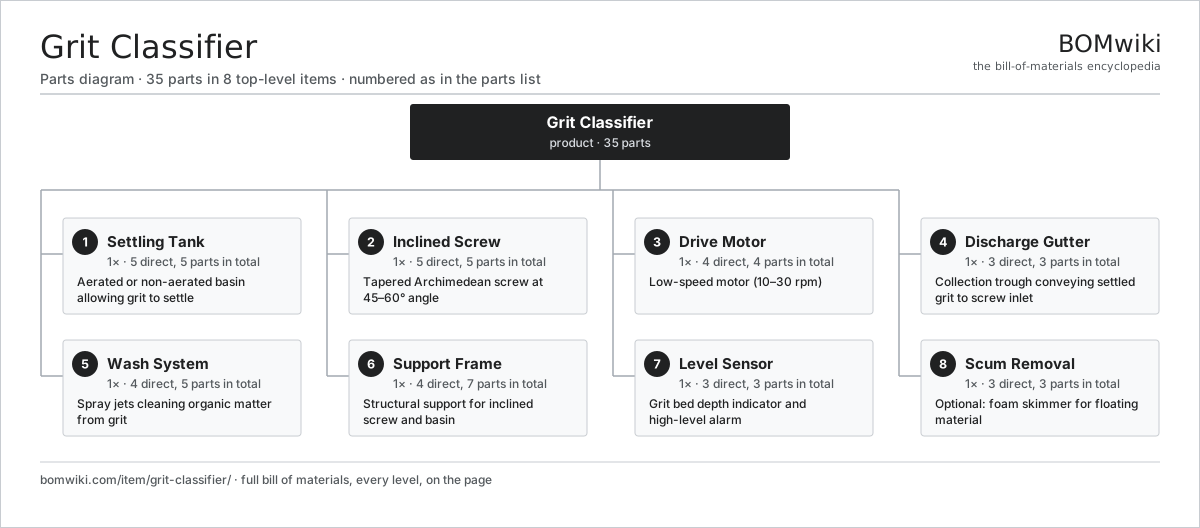
| # | Part | Qty | What it does |
|---|---|---|---|
| 1 | Settling Tank 5 parts | 1× | Aerated or non-aerated basin allowing grit to settle |
| 2 | Inclined Screw 5 parts | 1× | Tapered Archimedean screw at 45–60° angle |
| 3 | Drive Motor 4 parts | 1× | Low-speed motor (10–30 rpm) |
| 4 | Discharge Gutter 3 parts | 1× | Collection trough conveying settled grit to screw inlet |
| 5 | Wash System 4 parts | 1× | Spray jets cleaning organic matter from grit |
| 6 | Support Frame 4 parts | 1× | Structural support for inclined screw and basin |
| 7 | Level Sensor 3 parts | 1× | Grit bed depth indicator and high-level alarm |
| 8 | Scum Removal 3 parts | 1× | Optional: foam skimmer for floating material |
3D model
No 3D model yet. Have a CAD file of this? Add a 3D model. STL renders right on this page; STEP, FreeCAD, and OpenSCAD sources are welcome too (openly licensed, like all 3D models on BOMwiki).
Build & assembly graph
expand / collapse · shared sub-assemblies converge · links to related products · est. labourTap an assembly to expand/collapse · tap a part to open it · use “Open page” for any node · drag to pan, scroll to zoom.
Bill of materials for Grit Classifier
8 top-level lines · 39 rows shown · 35 parts total · indented to 3 levels| # | Item / sub-assembly | Part no. | Qty/assy | Ext. qty | Parts | Type |
|---|---|---|---|---|---|---|
| 1 | Settling Tank 5 parts | grit-classifier-settling-tank | 1× | 1 | 5 | assembly |
| 1.1 | Tank Basin | grit-classifier-tank-basin | 1× | 1 | · | part |
| 1.2 | Inlet Baffle | grit-classifier-inlet-baffle | 1× | 1 | · | part |
| 1.3 | Air Diffuser | grit-classifier-air-diffuser | 1× | 1 | · | part |
| 1.4 | Outlet Weir | grit-classifier-outlet-weir | 1× | 1 | · | part |
| 1.5 | Drain Sump | grit-classifier-drain-sump | 1× | 1 | · | part |
| 2 | Inclined Screw 5 parts | grit-classifier-inclined-screw | 1× | 1 | 5 | assembly |
| 2.1 | Screw Shaft | grit-classifier-screw-shaft | 1× | 1 | · | part |
| 2.2 | Screw Housing | grit-classifier-screw-housing | 1× | 1 | · | part |
| 2.3 | Inlet Bearing | grit-classifier-inlet-bearing | 1× | 1 | · | part |
| 2.4 | Discharge Bearing | grit-classifier-discharge-bearing | 1× | 1 | · | part |
| 2.5 | Discharge Chute | grit-classifier-discharge-chute | 1× | 1 | · | part |
| 3 | Drive Motor 4 parts | grit-classifier-drive-motor | 1× | 1 | 4 | assembly |
| 3.1 | Blower Motor | blower-motor | 1× | 1 | · | part |
| 3.2 | Gearbox | grit-classifier-gearbox | 1× | 1 | · | part |
| 3.3 | Motor Coupling | grit-classifier-motor-coupling | 1× | 1 | · | part |
| 3.4 | Motor Starter | package-wastewater-plant-motor-starter | 1× | 1 | · | part |
| 4 | Discharge Gutter 3 parts | grit-classifier-discharge-gutter | 1× | 1 | 3 | assembly |
| 4.1 | Gutter Pan | grit-classifier-gutter-pan | 1× | 1 | · | part |
| 4.2 | Scoop Blade | grit-classifier-scoop-blade | 1× | 1 | · | part |
| 4.3 | Bucket Elevator | grit-classifier-bucket-elevator | 1× | 1 | · | part |
| 5 | Wash System 4 parts | grit-classifier-wash-system | 1× | 1 | 5 | assembly |
| 5.1 | Wash Pump | grit-classifier-wash-pump | 1× | 1 | · | part |
| 5.2 | Wash Nozzles | grit-classifier-wash-nozzles | 2× | 2 | · | part |
| 5.3 | Wash Valve | grit-classifier-wash-valve | 1× | 1 | · | part |
| 5.4 | Pressure Sensor | pressure-sensor | 1× | 1 | · | part |
| 6 | Support Frame 4 parts | grit-classifier-support-frame | 1× | 1 | 7 | assembly |
| 6.1 | Frame Tubing | grit-classifier-frame-tube | 1× | 1 | · | part |
| 6.2 | Screw Mount Blocks | grit-classifier-screw-mount | 1× | 1 | · | part |
| 6.3 | Anchor Bolts | grit-classifier-anchor-bolt | 4× | 4 | · | part |
| 6.4 | Fastener Set | fastener-set | 1× | 1 | · | part |
| 7 | Level Sensor 3 parts | grit-classifier-level-sensor | 1× | 1 | 3 | assembly |
| 7.1 | Float Switch | grit-classifier-float-switch | 1× | 1 | · | part |
| 7.2 | Pressure Transmitter | grit-classifier-pressure-transmitter | 1× | 1 | · | part |
| 7.3 | Alarm Indicator | grit-classifier-alarm-indicator | 1× | 1 | · | part |
| 8 | Scum Removal 3 parts | grit-classifier-scum-removal | 1× | 1 | 3 | assembly |
| 8.1 | Skimmer Blade | grit-classifier-skimmer-blade | 1× | 1 | · | part |
| 8.2 | Skimmer Drive | grit-classifier-skimmer-drive | 1× | 1 | · | part |
| 8.3 | Scum Hopper | grit-classifier-scum-hopper | 1× | 1 | · | part |
Something wrong in this list? Report a problem with this BOM.
Related products
same domain, ranked by shared parts Belt Filter Press
57 parts · shares 3 with this page
Package Wastewater Plant
139 parts · shares 3 with this page
Belt Filter Press
57 parts · shares 3 with this page
Package Wastewater Plant
139 parts · shares 3 with this page
 Sludge Screw Press
31 parts · shares 3 with this page
Binder Jetting Printer
112 parts · shares 2 with this page
Sludge Screw Press
31 parts · shares 3 with this page
Binder Jetting Printer
112 parts · shares 2 with this page
 Brush Making Machine
50 parts · shares 2 with this page
Cable Armoring Machine
37 parts · shares 2 with this page
Brush Making Machine
50 parts · shares 2 with this page
Cable Armoring Machine
37 parts · shares 2 with this page
Sourcing: possible vendors
Browse the supplier directory → Prices, MOQ, and lead times are algorithmic estimates, not quotes, and not claims about these companies. Company mappings are curated by keyword; est. price band $5k–$2M. How estimates work| Vendor | HQ | Specialty | MOQ | Lead time |
|---|---|---|---|---|
| atlascopco.com ↗ | Stockholm, SE | Compressors & industrial | 10 units | 12–20 wks |
|
🇦🇹Andritz
andritz.com ↗
|
Graz, AT | Process plants & machinery | 10 units | 12–20 wks |
| buhlergroup.com ↗ | Uzwil, CH | Food & materials processing | 10 units | 12–20 wks |
| gea.com ↗ | Düsseldorf, DE | Process technology | 10 units | 12–20 wks |
| mhi.com ↗ | Tokyo, JP | Heavy machinery | 10 units | 12–20 wks |
1,071-word article