Seamless Gutter Machine
ProductOverview
Seamless gutter machines are portable roll-forming systems used by roofing contractors to fabricate custom-length gutters on-site. Traditional pre-formed gutter sections (10–20 ft) require multiple seams and end-caps, creating potential leak points. Seamless machines eliminate these seams, producing a single continuous gutter run up to 300 ft (limited only by handling and support infrastructure).
The machine unwinds coiled aluminum or steel stock (aluminum preferred for residential use due to corrosion resistance), progressively bends it through a series of forming rolls shaped to the desired profile (typically K-style, 6" nominal depth), and cuts the finished gutter to customer-specified length. The entire process occurs in the field, on a construction site or roofing contractor's job trailer, enabling immediate installation.
Modern seamless gutter machines are semi-automated, with a programmable logic controller (PLC) managing line speed, cutoff length, and hydraulic pressure. Older manual machines required hand-cranking and measuring; newer equipment includes touchscreen interfaces and memory presets for common gutter types and lengths.
Mechanical Design
Coil Feed System
The coil feed assembly begins with a tapered mandrel spindle that accepts 500 mm outer-diameter coils (approximately 2000 lbf or 1000 kg coils). A spring-applied brake holds the coil stationary until commanded to release.
As the machine starts, the brake releases and the dancer arm, a counterweighted lever, maintains constant 20 kgf tension on the advancing stock. A linear position transducer sends tension feedback to the variable-frequency drive controller, which adjusts motor speed to keep the dancer arm in equilibrium. This maintains consistent stock tension and reduces edge wrinkling during forming.
Roll Forming Stations
The roll forming assembly comprises 12 sequential stations, each pair consisting of upper and lower hardened steel forming rolls. The flat stock emerges from the coil feed, enters Station 1, and incremental bending occurs at each subsequent station.
Station 1 performs minor edge lift. Stations 2–5 bend the sides vertically. Station 6 begins the front profile. Stations 7–11 progressively form the K-style shape (front lip, back wall, decorative bend). Station 12 finalizes the profile and flattens the trailing edge.
Each top roll shaft is hydraulically tensioned against its lower counterpart via a single-acting cylinder maintaining 5 kN forming pressure. This pressure is programmable, lighter material requires 3 kN; thicker stock demands 7 kN.
The motor and gearbox reduce input speed from 1800 rpm to 50 rpm at the roll shafts. At 50 rpm, the machine produces gutter at approximately 150 linear feet per minute (fpm) for 0.032" aluminum, or 80 fpm for 0.040" steel.
Cutoff System
Finished gutter exits the final roll station and advances onto the outfeed table. A proximity sensor mounted on the table triggers when the gutter reaches programmer-set length. This energizes the cutoff solenoid valve, which pilots the double-acting hydraulic cylinder. The cylinder drives the shear blade down through the gutter in approximately 1.5 seconds. A scrap collection chute directs cut-off end pieces into a bin.
Cutoff accuracy is typically +/- 1/8" (3 mm) for lengths 10–100 ft, sufficient for field installation without custom trimming at the roof edge.
Hydraulic System
The hydraulic system provides pressure for roll tensioning and cutoff actuation. A fixed-displacement gear pump driven by the variable-frequency motor (through a separate electric motor at 1500 rpm) delivers 10 liters/minute at 280 bar maximum.
A pilot-operated relief valve protects the system from overpressure. A hydro-pneumatic accumulator (2 liter) dampens pressure spikes during cutoff cylinder acceleration and provides pilot flow to solenoid valves when the main pump is idle.
Hoses are SAE 100R2, 3/8" bore, rated 280 bar working pressure (1.3:1 safety factor). A 10 micron spin-on filter protects roll bearings from contamination.
Electrical & Control
The control panel houses a PLC processor with 32 digital I/O channels, Ethernet connectivity, and a 7" color touchscreen HMI (human-machine interface). The operator selects gutter type (K-style, half-round, box gutter, etc.) from a menu, enters desired length, and presses "Start."
The PLC:
- Commands the motor soft-starter to ramp the VFD motor to set speed.
- Monitors coil tension via the dancer transducer, adjusting VFD frequency to maintain setpoint.
- Polls the length sensor continuously.
- When sensor detects target length, energizes the cutoff solenoid, pauses motor speed, and resets length counter.
- Logs production data (gutter count, total feet, cycle times) for reporting.
An industrial-grade 24 VDC switching power supply powers the PLC and solenoid valves. An emergency stop button is latching, must be manually twisted to reset after activation, and interrupts all motor and hydraulic circuits.
Mechanical Support & Mobility
The entire machine is mounted on a welded structural steel frame designed for trailer towing. A forged steel tongue accepts a 2 5/16" ball coupler (standard trailer hitch). A rubber-torsion suspension axle supports 2000 lbf load and rides on two pneumatic tires, 16" diameter, 6-ply load rating.
Four hydraulic leveling feet allow the machine to be stabilized on sloped or uneven ground at the job site. Each foot is a single-acting jack rated 10 kN, controlled by a hand pump. Once stabilized, the feet prevent vibration-induced drift during forming.
The output support table includes motorized pinch rollers guiding coil edge into the first forming station, and passive support rollers throughout the line preventing sag. All roller heights are adjustable within 100 mm using worm-gear screws to accommodate different coil thicknesses.
Material Compatibility
Aluminum Alloys
5052-H19 aluminum (marine-grade, work-hardened) is the industry standard for residential seamless gutters. Thickness is typically 0.032" (0.8 mm) for K-style gutters in moderate climates, or 0.040" (1.0 mm) in coastal or high-snow regions. Aluminum offers:
- Lightweight (2.7 g/cm³ vs. 7.8 g/cm³ for steel).
- Superior corrosion resistance (forms protective Al₂O₃ oxide layer).
- Lower cost than copper, easier to form than steel.
- Thermal expansion 23 µm/m·°C (handles thermal cycling).
Tensile strength of 5052-H19 is approximately 220 MPa, sufficient to support 20–30 ft unsupported spans with proper downspout spacing.
Steel Options
Galvanized steel (G90 or G120 coating per ASTM A653) is available for climates where wind-driven rain is severe or mineral deposits accumulate. Benefits:
- Higher strength than aluminum (250–280 MPa).
- Better puncture resistance (suitable for rural hail-prone areas).
- Lower cost than aluminum in some markets.
Downsides: heavier (requires stiffer forming rolls), faster corrosion if galvanizing is compromised, harder to form (requires higher roll pressures, 6–7 kN vs. 4–5 kN for aluminum).
Field Installation Workflow
- Coil placement: Job foreman unloads aluminum coil from delivery, loads onto machine mandrel.
- Input parameters: Operator enters gutter length (e.g., 48 ft) and confirms K-style profile selection on touchscreen.
- Material threading: Unwind first 3–5 feet of stock, hand-feed through all roll stations and cutoff area, secure end piece to output table clamp.
- Motor start: Press "Start" button; soft-starter ramps VFD to forming speed (e.g., 200 fpm for 0.032" aluminum).
- Continuous feed: Dancer arm feedback maintains tension; operator monitors straightness visually or via proximity sensors.
- Cutoff trigger: Length sensor activates cutoff solenoid at 48 ft mark; shear blade cuts gutter in 1.5 seconds.
- Unload & repeat: Worker manually removes finished gutter, repositions it onto roof or support racks, machine resets length counter and awaits next cycle.
Typical production time per 40 ft gutter section: 3–5 minutes (including cutoff, unload, and re-thread for next section).
Maintenance & Durability
Preventive Maintenance Schedule
- After every 50 operating hours: Drain and refill hydraulic reservoir filter bowl; inspect hose fittings for weeping.
- Every 250 hours: Replace hydraulic filter cartridge; check roll bearing temperature (should be <60 °C).
- Every 1000 hours: Measure forming roll wear; order replacement roll tool sets if dimensions drift >0.5 mm.
- Annually: Recalibrate length sensor; inspect weld seams on frame for stress cracks; test emergency stop button actuation.
Roll Tool Replacement
Forming rolls wear gradually under continuous forming stress. The hard outer layer (case hardness 58–62 HRC) protects softer core steel from deformation. Tool wear is evident when finished gutter edges lose sharpness or surface finish degrades. A complete forming roll set replacement typically occurs every 5000–8000 operating hours, depending on material thickness and coil stock purity.
Replacement is straightforward: unbolt worn shafts from bearing blocks, slide new upper and lower roll shafts into place, and tighten. No special alignment tools are required beyond a feeler gauge to verify roll gap (typically 0.5 mm).
Seal & Bearing Life
Ball bearings used in roll stations are rated 500,000–1,000,000 cycles before fatigue failure. At 50 rpm continuous use, a bearing lasts approximately 150,000–300,000 hours (17–34 years of 8-hour days). Realistic field lifespan is shorter (2–5 years) due to intermittent operation and environmental exposure (temperature swings, dust).
Hydraulic seals (rod, piston, shaft seals in actuators) degrade under high-pressure cyclic stress and temperature. Expected service life is 1000–2000 cutoff cycles before weeping; seals are inexpensive ($10–50 per kit) and field-replaceable in 30 minutes.
Standards & Compliance
- ASTM A480/A480M: Specification for stainless steel bars and shapes (if using 304 stainless for corrosion-critical areas).
- ASTM A653/A653M: Specification for steel sheet, zinc-coated (for galvanized coil stock).
- ANSI/NFPA 79: Electrical standard for industrial machinery (electrical panel design).
- ISO 4287: Geometrical Product Specifications (GPS); surface texture (roll forming produces consistent surface finish Ra 0.4–0.8 µm).
- OSHA 1910.212: General requirements for all machines (guards, emergency stops).
Economic Considerations
A new seamless gutter machine costs $12,000–25,000 depending on automation level and mobile vs. fixed installation. A roofing contractor installing 30–50 houses annually recoups investment in 1–2 years through eliminated seam costs and labor efficiency. Used machines (5–10 years old) are available at $5,000–10,000 and represent a lower-risk entry point for small contractors.
Coil stock costs $0.15–0.40 per linear foot (in bulk, 2000 lbf coils), versus $1.50–3.00 per foot for pre-formed seamless sections. Upfront capital ($20,000 machine + $30,000 trailer) is offset by margin expansion: seamless gutters command premium pricing (20–30% higher than conventional) and project turnaround is faster.
Seamless Gutter Machine parts and their functions
8 top-level parts · 143 parts in total · full bill of materials below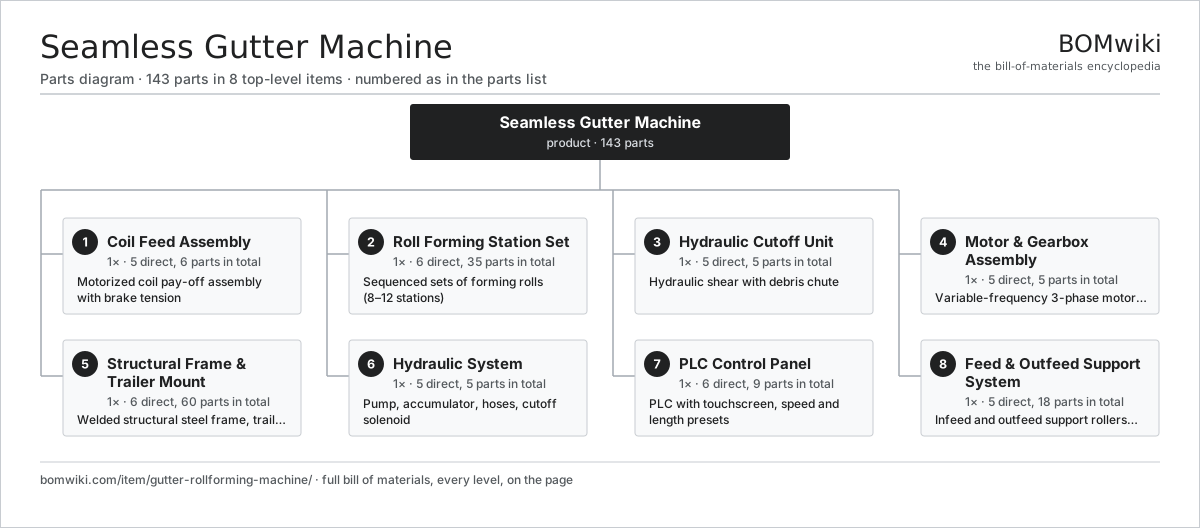
| # | Part | Qty | What it does |
|---|---|---|---|
| 1 | Coil Feed Assembly 5 parts | 1× | Motorized coil pay-off assembly with brake tension |
| 2 | Roll Forming Station Set 6 parts | 1× | Sequenced sets of forming rolls (8–12 stations) |
| 3 | Hydraulic Cutoff Unit 5 parts | 1× | Hydraulic shear with debris chute |
| 4 | Motor & Gearbox Assembly 5 parts | 1× | Variable-frequency 3-phase motor and gearbox |
| 5 | Structural Frame & Trailer Mount 6 parts | 1× | Welded structural steel frame, trailer-mounted |
| 6 | Hydraulic System 5 parts | 1× | Pump, accumulator, hoses, cutoff solenoid |
| 7 | PLC Control Panel 6 parts | 1× | PLC with touchscreen, speed and length presets |
| 8 | Feed & Outfeed Support System 5 parts | 1× | Infeed and outfeed support rollers, adjustable height |
3D model
No 3D model yet. Have a CAD file of this? Add a 3D model. STL renders right on this page; STEP, FreeCAD, and OpenSCAD sources are welcome too (openly licensed, like all 3D models on BOMwiki).
Build & assembly graph
expand / collapse · shared sub-assemblies converge · links to related products · est. labourTap an assembly to expand/collapse · tap a part to open it · use “Open page” for any node · drag to pan, scroll to zoom.
Bill of materials for Seamless Gutter Machine
8 top-level lines · 51 rows shown · 143 parts total · indented to 3 levels| # | Item / sub-assembly | Part no. | Qty/assy | Ext. qty | Parts | Type |
|---|---|---|---|---|---|---|
| 1 | Coil Feed Assembly 5 parts | gutter-rollforming-machine-coil-feed | 1× | 1 | 6 | assembly |
| 1.1 | Coil Mandrel Spindle | gutter-rollforming-machine-coil-mandrel | 1× | 1 | · | part |
| 1.2 | Pillow Block Bearing | gutter-rollforming-machine-mandrel-bearing | 2× | 2 | · | part |
| 1.3 | Spring-Applied Brake | gutter-rollforming-machine-tension-brake | 1× | 1 | · | part |
| 1.4 | Dancer Tension Arm | gutter-rollforming-machine-dancer-arm | 1× | 1 | · | part |
| 1.5 | Position Transducer | gutter-rollforming-machine-dancer-sensor | 1× | 1 | · | part |
| 2 | Roll Forming Station Set 6 parts | gutter-rollforming-machine-roll-stations | 1× | 1 | 35 | assembly |
| 2.1 | Forming Roll Tool Set | gutter-rollforming-machine-roll-tool-set | 1× | 1 | · | part |
| 2.2 | Top Roll Shaft Assembly | gutter-rollforming-machine-shaft-top | 1× | 1 | · | part |
| 2.3 | Bottom Roll Shaft Assembly | gutter-rollforming-machine-shaft-bottom | 1× | 1 | · | part |
| 2.4 | Ball Bearing | ball-bearing | 16× | 16 | · | part |
| 2.5 | Roll Tensioning Cylinder | gutter-rollforming-machine-shaft-tensioner | 4× | 4 | · | part |
| 2.6 | Station Bearing Block | gutter-rollforming-machine-station-block | 12× | 12 | · | part |
| 3 | Hydraulic Cutoff Unit 5 parts | gutter-rollforming-machine-cutoff-unit | 1× | 1 | 5 | assembly |
| 3.1 | Shear Blade | gutter-rollforming-machine-cutoff-blade | 1× | 1 | · | part |
| 3.2 | Cutoff Drive Cylinder | gutter-rollforming-machine-cutoff-cylinder | 1× | 1 | · | part |
| 3.3 | Cutoff Solenoid Valve | gutter-rollforming-machine-cutoff-trigger | 1× | 1 | · | part |
| 3.4 | Scrap Chute Assembly | gutter-rollforming-machine-debris-chute | 1× | 1 | · | part |
| 3.5 | Length Trigger Sensor | gutter-rollforming-machine-length-sensor | 1× | 1 | · | part |
| 4 | Motor & Gearbox Assembly 5 parts | gutter-rollforming-machine-motor-transmission | 1× | 1 | 5 | assembly |
| 4.1 | VFD Motor | gutter-rollforming-machine-vfd-motor | 1× | 1 | · | part |
| 4.2 | Variable Frequency Drive | gutter-rollforming-machine-vfd-drive | 1× | 1 | · | part |
| 4.3 | Inline Reduction Gearbox | gutter-rollforming-machine-gearbox | 1× | 1 | · | part |
| 4.4 | Drive Shaft & Coupling | gutter-rollforming-machine-drive-shaft | 1× | 1 | · | part |
| 4.5 | Oil Circulation Pump | gutter-rollforming-machine-lubrication-pump | 1× | 1 | · | part |
| 5 | Structural Frame & Trailer Mount 6 parts | gutter-rollforming-machine-frame-base | 1× | 1 | 60 | assembly |
| 5.1 | Main Frame Beam | gutter-rollforming-machine-main-frame-beam | 4× | 4 | · | part |
| 5.2 | Trailer Tongue Assembly | gutter-rollforming-machine-trailer-tongue | 1× | 1 | · | part |
| 5.3 | Rubber-Torsion Axle | gutter-rollforming-machine-trailer-axle | 1× | 1 | · | part |
| 5.4 | Pneumatic Tire & Rim | gutter-rollforming-machine-pneumatic-wheels | 2× | 2 | · | part |
| 5.5 | Hydraulic Leveling Foot | gutter-rollforming-machine-leveling-feet | 4× | 4 | · | part |
| 5.6 | Fastener Set | fastener-set | 48× | 48 | · | part |
| 6 | Hydraulic System 5 parts | gutter-rollforming-machine-hydraulic-system | 1× | 1 | 5 | assembly |
| 6.1 | Hydraulic Pump | gutter-rollforming-machine-hydraulic-pump | 1× | 1 | · | part |
| 6.2 | Pilot-Operated Relief Valve | gutter-rollforming-machine-relief-valve | 1× | 1 | · | part |
| 6.3 | Hydro-Pneumatic Accumulator | gutter-rollforming-machine-accumulator | 1× | 1 | · | part |
| 6.4 | Hydraulic Hose Assembly | gutter-rollforming-machine-hose-bundle | 1× | 1 | · | part |
| 6.5 | Hydraulic Filter Cartridge | gutter-rollforming-machine-filter-element | 1× | 1 | · | part |
| 7 | PLC Control Panel 6 parts | gutter-rollforming-machine-control-panel | 1× | 1 | 9 | assembly |
| 7.1 | PLC Processor Unit | gutter-rollforming-machine-plc-processor | 1× | 1 | · | part |
| 7.2 | Operator Touchscreen | gutter-rollforming-machine-touchscreen-hmi | 1× | 1 | · | part |
| 7.3 | 24 VDC Power Supply | gutter-rollforming-machine-24v-power-supply | 1× | 1 | · | part |
| 7.4 | Bare PCB | pcb-bare | 1× | 1 | · | part |
| 7.5 | Relay | relay | 4× | 4 | · | part |
| 7.6 | Emergency Stop Button | gutter-rollforming-machine-estop-button | 1× | 1 | · | part |
| 8 | Feed & Outfeed Support System 5 parts | gutter-rollforming-machine-output-table | 1× | 1 | 18 | assembly |
| 8.1 | Motorized Pinch Roller | gutter-rollforming-machine-feed-roller | 4× | 4 | · | part |
| 8.2 | Passive Support Roller | gutter-rollforming-machine-support-roller | 8× | 8 | · | part |
| 8.3 | Feed Roller Drive Motor | gutter-rollforming-machine-roller-motor | 1× | 1 | · | part |
| 8.4 | Height Adjuster | gutter-rollforming-machine-height-adjuster | 4× | 4 | · | part |
| 8.5 | Table Base Frame | gutter-rollforming-machine-table-frame | 1× | 1 | · | part |
Something wrong in this list? Report a problem with this BOM.
Related products
same domain, ranked by shared parts AAC Block Plant
155 parts · shares 1 with this page
Acoustic Banner Hoist
90 parts · shares 1 with this page
AAC Block Plant
155 parts · shares 1 with this page
Acoustic Banner Hoist
90 parts · shares 1 with this page
 Automatic Sliding Door
390 parts · shares 1 with this page
Automatic Sliding Door
390 parts · shares 1 with this page
 Automatic Sliding Gate
112 parts · shares 1 with this page
Automatic Sliding Gate
112 parts · shares 1 with this page
 Automatic Swing Door Operator
43 parts · shares 1 with this page
Brick Tunnel Kiln
877 parts · shares 1 with this page
Automatic Swing Door Operator
43 parts · shares 1 with this page
Brick Tunnel Kiln
877 parts · shares 1 with this page
Sourcing: possible vendors
Browse the supplier directory → Prices, MOQ, and lead times are algorithmic estimates, not quotes, and not claims about these companies. Company mappings are curated by keyword; est. price band $50–$10k. How estimates work| Vendor | HQ | Specialty | MOQ | Lead time |
|---|---|---|---|---|
| assaabloy.com ↗ | Stockholm, SE | Locks & access | 1,000 units | 8–12 wks |
|
🇺🇸Allegion
allegion.com ↗
|
Dublin, US | Security products (Schlage) | 1,000 units | 8–12 wks |
| dormakaba.com ↗ | Rümlang, CH | Access & door systems | 1,000 units | 8–12 wks |
| honeywell.com ↗ | Charlotte, US | Building & safety tech | 1,000 units | 8–12 wks |
| hikvision.com ↗ | Hangzhou, CN | Surveillance & security | 1,000 units | 8–12 wks |
1,910-word article