Hall Effect Thruster
ProductOverview
The Hall effect thruster is an electric propulsion system that generates thrust by accelerating ionized propellant (typically xenon) to extremely high velocities (20–40 km/s), compared to chemical rockets (3–5 km/s). This high exhaust velocity translates to high specific impulse (Isp = 1500–2500 seconds), meaning the thruster consumes propellant mass far more efficiently than chemical engines. The trade-off is low thrust (10–100 mN compared to thousands of newtons for chemical engines), making Hall thrusters suitable only for deep-space applications where mission timelines allow weeks or months of continuous low thrust.
The heart of the Hall Effect Thruster is a crossed-field plasma discharge: a strong Magnetic Circuit Assembly magnetic field (radial, pointing outward) perpendicular to a strong electric field (axial, pointing along the channel). Electrons emitted from the Hollow Cathode Assembly drift azimuthally in the crossed field, forming a ring of current that ionizes neutral xenon atoms. The resulting ions are then accelerated by the electric field and expelled at high velocity, creating thrust.
Plasma physics and operation
The discharge channel is a cylindrical Discharge Channel ceramic cavity, typically 30–100 mm in diameter and 20–50 mm deep. Inside the channel, a Anode and Gas Distributor injects neutral xenon atoms at a controlled rate (typically milligrams per second). A strong Magnetic Circuit Assembly magnetic field (radial, ~0.2–0.3 Tesla) is applied via an electromagnet surrounding the channel.
When high voltage (+200–500 V) is applied between the anode (positive) and the spacecraft ground (negative), an electric field develops along the channel axis. Electrons emitted from the Hollow Cathode Assembly thermionic emitter are repelled by the negative cathode and attracted to the positive anode. However, the radial magnetic field causes the electron trajectory to curve, preventing direct transit to the anode. Instead, electrons drift azimuthally around the channel in a rotational path, similar to the motion of a charged particle in a cyclotron.
As electrons drift around the channel, they collide with neutral xenon atoms, ionizing them through impact ionization. Each ionization removes an electron from a xenon atom, creating a positive xenon ion (Xe⁺). The ions, being much more massive than electrons (131 amu vs. electron), are much less affected by the magnetic field and drift primarily along the electric field lines. The ions are accelerated toward the exit of the discharge channel, reaching velocities of 15–30 km/s as they leave.
The electron drift ring itself (called the "Hall current") constitutes a substantial azimuthal current, often 10–30 A. The combined effect of ionization (electron impact) and acceleration (electric field on ions) produces both ionized propellant (for thrust) and a distinctive plasma glowing light bluish-green.
Specific impulse and exhaust velocity
Specific impulse is defined as the ratio of exhaust velocity to gravitational acceleration:
Isp = v_e / g₀
For a Hall thruster operating at 300 V discharge voltage with xenon (atomic mass 131), the ions are accelerated to approximately 18–22 km/s, yielding Isp ≈ 1800–2200 seconds. Higher discharge voltages produce higher exhaust velocities; a 400 V thruster achieves Isp ≈ 2500+ seconds. This is 300–500 times higher than chemical rockets, meaning a Hall thruster can achieve the same orbital velocity change with far less propellant, provided the mission timeline is flexible.
Hollow cathode and ionization
The Hollow Cathode Assembly is a critical component providing the electron source for ionization. The cathode is a small cylinder (5–10 mm diameter) containing a Cathode Insert (typically barium oxide or tungsten) heated to thermionic temperature (~1100 K). When heated by the Cathode Heater, the insert emits electrons, which are accelerated into the discharge channel.
A Cathode Keeper electrode is positioned at the cathode exit, at a small negative potential relative to ground, maintaining a discharge between the cathode and keeper. This keeper discharge sustains ionization near the cathode, ensuring a stable, repeatable ignition process.
The cathode also provides "neutralization current": for every ion expelled from the thruster, an electron must be supplied to neutralize the ion beam, preventing the spacecraft from building up a net positive charge. This neutralization is accomplished by sending a fraction of the cathode electrons directly to the thruster exit, where they recombine with ions, creating neutral xenon atoms in the exhaust plume.
Electromagnetic circuit
The Magnetic Circuit Assembly comprises a primary solenoid (copper wire coil) surrounding the discharge channel, with soft-iron pole pieces and an iron core that channel the magnetic field lines through the discharge region. The solenoid is energized by a low-power auxiliary power supply (typically <500 W), generating a field of 0.2–0.3 Tesla. The magnetic field strength is critical: insufficient field results in poor electron confinement and low ionization efficiency; excessive field leads to excessive electron drift and cathode erosion.
Power processing and control
The Power Processing Unit Interface and Thruster Control Electronics manage the high-voltage discharge and propellant flow. The power supply (called the Power Processing Unit, or PPU) receives spacecraft power (typically 28 V unregulated bus) and converts it to:
Main discharge: 200–500 VDC, sourced from a boost converter or DC-DC converter. A current feedback servo maintains the target discharge voltage (e.g., 300 V) by modulating the power converter output.
Magnet current: <500 W, typically at 12 or 24 VDC, driven through the Primary Solenoid to generate the magnetic field.
Cathode heater: 100–200 W, at 5–15 VDC, driving the Cathode Heater filament during preheat before ignition.
Propellant valve: ~2 W, a solenoid valve controlled by the Microcontroller microcontroller, regulating xenon flow to the Anode and Gas Distributor.
The Discharge Resistor protects the power supply from fault currents in the event of an arc or short circuit in the thruster; if discharge current exceeds a threshold, the resistor limits current and the power supply shuts down.
Thermal management
Hall thrusters are inefficient at converting input electrical power to thrust. Typical efficiency is 40–60%, meaning 40–60% of input power is wasted as heat. For a 5 kW thruster, 2–3 kW of waste heat must be dissipated. The Thermal Radiator and Radiator elements are large aluminum panels with high-emissivity coatings (typically black paint or anodized aluminum), radiating heat to the vacuum of space.
The Support Structure and MLI Blanket insulate the thruster from the spacecraft, preventing conducted heat from reaching sensitive spacecraft electronics.
Erosion and lifetime
The Discharge Channel walls erode slowly as ions are accelerated through the channel. The Channel Wall are made of high-erosion-resistance ceramic (boron nitride or layered ceramic composites), rated for tens of thousands of hours of operation. The Channel Inserts (erosion-resistant ceramic segments) are periodically replaced during spacecraft servicing.
Most Hall thrusters have demonstrated lifetimes of 10,000–15,000+ hours in flight testing and ground qualification. A typical deep-space mission (e.g., asteroid rendezvous, where continuous low thrust for months is acceptable) may consume only 1,000–5,000 hours of thruster life, keeping well within design margins.
Xenon propellant and storage
Xenon is an inert noble gas, naturally occurring in Earth's atmosphere at ~90 ppb concentration. For space applications, xenon is purified to 99.99%+ purity and stored in pressurized tanks at 2,000–3,000 psi. The Propellant Orifice Plate controls the mass flow rate by restricting the flow through a precision-drilled metering plate, typically delivering 2–10 mg/s of xenon per mN of desired thrust.
Xenon is non-toxic, non-corrosive, and chemically inert, making it safe for handling and storage. However, xenon is expensive (~$100–200 per kilogram) due to limited supply and complex purification, making propellant cost a significant factor in Hall thruster mission budgets.
Advantages and mission applications
Hall thrusters excel in missions where high specific impulse and long operational lifetime are valued over high thrust. Typical applications include:
- Orbit maintenance: Counteracting atmospheric drag on low-Earth-orbit satellites (10-year lifetime).
- Orbit raising: Gradually spiraling satellites from low-Earth orbit to geostationary orbit, trading thruster burn time for fuel savings (months of operation).
- Deep-space exploration: Asteroid rendezvous, lunar landing leg burns, comet encounters (high Isp reduces propellant mass).
- Station-keeping: Maintaining precise orbital position for Earth-science or communications satellites.
A single 5-count xenon tank (5 kg of xenon) on a small satellite can provide hundreds of m/s of delta-v over a 10-year mission with a single Hall thruster, something impossible for chemical propulsion.
Hall Effect Thruster parts and their functions
8 top-level parts · 32 parts in total · full bill of materials below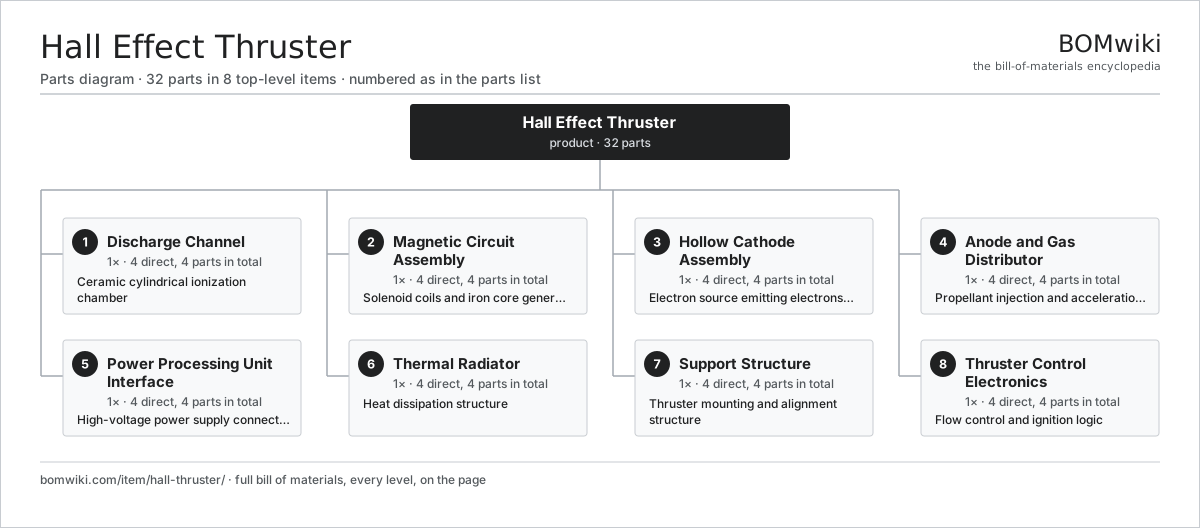
| # | Part | Qty | What it does |
|---|---|---|---|
| 1 | Discharge Channel 4 parts | 1× | Ceramic cylindrical ionization chamber |
| 2 | Magnetic Circuit Assembly 4 parts | 1× | Solenoid coils and iron core generating radial magnetic field |
| 3 | Hollow Cathode Assembly 4 parts | 1× | Electron source emitting electrons for ionization |
| 4 | Anode and Gas Distributor 4 parts | 1× | Propellant injection and acceleration grid |
| 5 | Power Processing Unit Interface 4 parts | 1× | High-voltage power supply connectors and feedback |
| 6 | Thermal Radiator 4 parts | 1× | Heat dissipation structure |
| 7 | Support Structure 4 parts | 1× | Thruster mounting and alignment structure |
| 8 | Thruster Control Electronics 4 parts | 1× | Flow control and ignition logic |
3D model
No 3D model yet. Have a CAD file of this? Add a 3D model. STL renders right on this page; STEP, FreeCAD, and OpenSCAD sources are welcome too (openly licensed, like all 3D models on BOMwiki).
Build & assembly graph
expand / collapse · shared sub-assemblies converge · links to related products · est. labourTap an assembly to expand/collapse · tap a part to open it · use “Open page” for any node · drag to pan, scroll to zoom.
Bill of materials for Hall Effect Thruster
8 top-level lines · 40 rows shown · 32 parts total · indented to 3 levels| # | Item / sub-assembly | Part no. | Qty/assy | Ext. qty | Parts | Type |
|---|---|---|---|---|---|---|
| 1 | Discharge Channel 4 parts | hall-thruster-discharge-channel | 1× | 1 | 4 | assembly |
| 1.1 | Channel Wall | hall-thruster-channel-walls | 1× | 1 | · | part |
| 1.2 | Channel Inserts | hall-thruster-channel-inserts | 1× | 1 | · | part |
| 1.3 | Exit Plane | hall-thruster-exit-plane | 1× | 1 | · | part |
| 1.4 | Fastener Set | fastener-set | 1× | 1 | · | part |
| 2 | Magnetic Circuit Assembly 4 parts | hall-thruster-magnetic-circuit | 1× | 1 | 4 | assembly |
| 2.1 | Primary Solenoid | hall-thruster-primary-solenoid | 1× | 1 | · | part |
| 2.2 | Pole Pieces | hall-thruster-pole-pieces | 1× | 1 | · | part |
| 2.3 | Iron Core | hall-thruster-iron-core | 1× | 1 | · | part |
| 2.4 | Fastener Set | fastener-set | 1× | 1 | · | part |
| 3 | Hollow Cathode Assembly 4 parts | hall-thruster-hollow-cathode | 1× | 1 | 4 | assembly |
| 3.1 | Cathode Heater | hall-thruster-cathode-heater | 1× | 1 | · | part |
| 3.2 | Cathode Insert | hall-thruster-cathode-insert | 1× | 1 | · | part |
| 3.3 | Cathode Keeper | hall-thruster-cathode-keeper | 1× | 1 | · | part |
| 3.4 | Fastener Set | fastener-set | 1× | 1 | · | part |
| 4 | Anode and Gas Distributor 4 parts | hall-thruster-anode-gas-distributor | 1× | 1 | 4 | assembly |
| 4.1 | Anode Ring | hall-thruster-anode-ring | 1× | 1 | · | part |
| 4.2 | Propellant Orifice Plate | hall-thruster-propellant-orifice | 1× | 1 | · | part |
| 4.3 | Distributor Body | hall-thruster-distributor-body | 1× | 1 | · | part |
| 4.4 | Fastener Set | fastener-set | 1× | 1 | · | part |
| 5 | Power Processing Unit Interface 4 parts | hall-thruster-ppu-interface | 1× | 1 | 4 | assembly |
| 5.1 | Connector | connector | 1× | 1 | · | part |
| 5.2 | Discharge Resistor | hall-thruster-discharge-resistor | 1× | 1 | · | part |
| 5.3 | Bias Supply | hall-thruster-bias-supply | 1× | 1 | · | part |
| 5.4 | Wire Bundle | wire-bundle | 1× | 1 | · | part |
| 6 | Thermal Radiator 4 parts | hall-thruster-thermal-radiator | 1× | 1 | 4 | assembly |
| 6.1 | Sheet Metal Panel | sheet-panel | 1× | 1 | · | part |
| 6.2 | Fastener Set | fastener-set | 1× | 1 | · | part |
| 6.3 | MLI Blanket | hall-thruster-mlti-blanket | 1× | 1 | · | part |
| 6.4 | Radiator | radiator | 1× | 1 | · | part |
| 7 | Support Structure 4 parts | hall-thruster-support-structure | 1× | 1 | 4 | assembly |
| 7.1 | Mounting Bracket | hall-thruster-mounting-bracket | 1× | 1 | · | part |
| 7.2 | Fastener Set | fastener-set | 1× | 1 | · | part |
| 7.3 | Wire Bundle | wire-bundle | 1× | 1 | · | part |
| 7.4 | Sheet Metal Panel | sheet-panel | 1× | 1 | · | part |
| 8 | Thruster Control Electronics 4 parts | hall-thruster-impulse-bit-electronics | 1× | 1 | 4 | assembly |
| 8.1 | Microcontroller | mcu | 1× | 1 | · | part |
| 8.2 | Bare PCB | pcb-bare | 1× | 1 | · | part |
| 8.3 | Relay | relay | 1× | 1 | · | part |
| 8.4 | Power MOSFET | mosfet | 1× | 1 | · | part |
Something wrong in this list? Report a problem with this BOM.
Related products
same domain, ranked by shared parts Reaction Wheel Assembly
39 parts · shares 2 with this page
Reaction Wheel Assembly
39 parts · shares 2 with this page
 GPS Navigation Satellite
2,640 parts · shares 2 with this page
GPS Navigation Satellite
2,640 parts · shares 2 with this page
 Lunar Lander
1,803 parts · shares 2 with this page
Lunar Lander
1,803 parts · shares 2 with this page
 Rocket Upper Stage
1,459 parts · shares 2 with this page
Rocket Upper Stage
1,459 parts · shares 2 with this page
 Satellite Laser Communication Terminal
197 parts · shares 2 with this page
Satellite Laser Communication Terminal
197 parts · shares 2 with this page
 Space Station Treadmill
151 parts · shares 2 with this page
Space Station Treadmill
151 parts · shares 2 with this page
Sourcing: possible vendors
Browse the supplier directory → Prices, MOQ, and lead times are algorithmic estimates, not quotes, and not claims about these companies. Company mappings are curated by keyword; est. price band $50k–$500M. How estimates work| Vendor | HQ | Specialty | MOQ | Lead time |
|---|---|---|---|---|
|
🇺🇸SpaceX
spacex.com ↗
|
Hawthorne, US | Launch & spacecraft | made to order | 52–104 wks |
| northropgrumman.com ↗ | Falls Church, US | Space & defense | made to order | 52–104 wks |
|
🇫🇷Airbus
airbus.com ↗
|
Toulouse, FR | Aerospace OEM | made to order | 52–104 wks |
| rocketlabusa.com ↗ | Long Beach, US | Launch & spacecraft | made to order | 52–104 wks |
| thalesaleniaspace.com ↗ | Cannes, FR | Satellites | made to order | 52–104 wks |
1,441-word article