Handloom
ProductOverview
The handloom is a mechanical loom for weaving cloth in which the operator controls thread separation and weft insertion entirely by hand, using foot treadles and hand-guided tools. Unlike automatic power looms that incorporate multiple mechanical functions (harness lifting, shuttle propulsion, weft insertion, fabric advance), the handloom distributes control to the weaver''s hands and feet. This demands skill and attention but allows rapid pattern changes and fine artistic control over the finished fabric.
The basic principle is simple: warp threads (running lengthwise) are held under tension. Weft thread is inserted crosswise by a shuttle. Periodically, alternate warp threads are lifted, creating a gap (shed) through which the shuttle passes. The reed then combs the weft firmly into place. The process repeats, building cloth one weft row (pick) at a time.
Loom Frame and Geometry
The Loom Frame is a sturdy wooden rectangle defining the loom''s boundaries and supporting all working elements. Typical dimensions are 1.5–2.0 m height and 0.8–1.2 m depth. The frame comprises:
- Uprights: Two vertical posts (oak or pine) supporting the entire structure.
- Top beam: Horizontal member at the top, from which harnesses are suspended.
- Bottom beam: Lower horizontal member supporting the beater pivot and warp tension.
- Side rails: Lateral bracing providing torsional rigidity against weft tension forces.
- Base: Platform upon which the treadle assembly sits.
Joinery is traditional: mortise and tenon, with adjustable bolts allowing disassembly for transport or setup changes.
Warp Preparation and Beam System
The Warp Beams consist of two large rollers:
Supply beam: Holds the entire warp thread supply, wound in parallel threads under tension. A typical warp might contain 100–500 individual threads (depending on loom width and desired fabric density), all wound side-by-side on the supply beam. Springs pull the beam away from the frame, maintaining constant warp tension as threads are consumed.
Takeup beam: Positioned at the front (toward the operator), this beam winds the advancing warp. As the operator manually cranks the warp advance crank, the takeup beam rotates, advancing fresh warp toward the weaving area and pushing completed cloth toward the cloth beam.
Bearings support both beams on the frame uprights, allowing rotation with minimal friction. Warp tension is the critical control variable: too loose, and weft sags, creating uneven cloth; too tight, and threads break. Springs provide a self-adjusting tension within a fixed range.
Harnesses and Heddles
The harnesses are the mechanism for lifting warp threads in specific patterns. Each harness is a rectangular frame suspended from the top beam, containing a set of vertical heddles.
A heddle is a small loop, traditionally made of string or wire, that passes through or around an individual warp thread. When the harness is lifted, all heddles in that harness pull their corresponding warp threads upward. When the harness is lowered, those threads drop. By raising and lowering different harnesses in sequence, the weaver creates the shed, the separation necessary for shuttle passage.
Two-harness looms (simplest, plain weave): Harness 1 lifts odd-numbered threads; Harness 2 lifts even-numbered threads. Alternating feet on the two treadles creates a 1/1 twill or plain weave.
Four-harness looms (more flexible): Four harnesses allow 2/2 twills, satin weaves, and complex patterns. Eight-harness looms permit intricate motifs.
Heddle density is critical. For a 150 cm wide loom at 20 threads per inch (0.8 mm spacing), a single harness might contain 3000+ heddles. The support bars (top and bottom) align the heddles vertically, preventing tangles or misalignment.
The linkage connects each harness frame to a corresponding treadle. Treadle pressure raises the harness against a return spring; releasing the treadle lowers the harness.
Reed and Beater
The reed and beater perform the most mechanically active function: advancing (packing) the weft thread firmly into the growing cloth.
The reed is a comb-like device, typically a thin wooden or metal frame containing parallel slats (dents) spaced 10–30 dents per inch (2.5–10 mm). The weft threads pass between the dents. A beater frame holds the reed and pivots on a pin at the bottom of the loom. This pivot allows the reed to swing forward and back.
Operation:
- Weaver depresses one or both treadles, lifting a harness (or two). This creates a shed, a triangle of separated warp threads.
- Weaver throws the shuttle through the shed from left to right (or vice versa). The shuttle carries weft thread through the gap.
- Weaver grasps a pull cord or the beater frame directly and pulls the reed toward themselves forcefully. The reed strikes the newly inserted weft, compacting it against the previous picks. This impact is heard as a distinctive "thack" sound characteristic of looms.
- Weaver releases the beater, which swings back to neutral position via the return spring.
- Weaver presses the opposite treadle (or releases the current one), lowering the previously lifted warp and raising the alternate threads, creating a new shed.
- Weaver throws the shuttle back (right to left), completing one pick (weft row).
The force of the reed impact is crucial. Insufficient packing creates loose, baggy cloth; excessive force breaks threads. Experienced weavers develop a consistent, rhythmic action.
Shuttle and Weft Delivery
The shuttle is a pointed projectile (50–150 mm long, 15–30 mm diameter) that carries weft thread through the shed. Traditional shuttles are wooden; modern versions use aluminum or composite materials.
The body is a tapered tube with an eye (opening) at the end. A small bobbin (spool) inside holds wound weft thread. As the shuttle passes through the shed, weft unwinds from the bobbin. The eyes (exit ports) are sized to allow smooth thread emergence. A pointed nose reduces air resistance and friction against warp threads.
Hand-throwing the shuttle requires skill. The weaver grips the end and propels it through the shed with a flicking motion, coordinating timing with the treadle pressure to ensure the shed is wide enough. Common variations include:
- Overhand throw: Shuttle thrown above the warp.
- Underhand throw: Shuttle rolled under the warp (gentler, less breakage).
- Scoop throw: Using a small stick or hook to guide shuttle (especially for wide looms).
Once the shuttle passes through, the weaver catches it on the opposite side and throws it back on the return pass.
Cloth Beam and Winding
The cloth beam winds finished fabric as it is produced. A roller rotates via a manual crank. A ratchet mechanism locks the beam in position between advances, preventing backslip.
As the operator manually winds the crank, the cloth beam rotates, pulling finished cloth away from the weaving area and storing it on the beam. The warp takeup beam automatically advances fresh warp, maintaining weaving plane geometry. This coordination ensures consistent warp tension and cloth width as production proceeds.
Treadle Control
The treadle system translates foot input to harness control. Two treadle boards (platforms) are mounted on a common fulcrum. Depressing one treadle lifts the connected harness via a rod linkage. A return spring restores treadles to neutral when released.
Experienced weavers develop a rhythmic pattern: left foot down (harness 1 up, shed opens), throw shuttle, right foot down (harness 1 down, harness 2 up, shed reverses), beat, throw shuttle back, repeat. The cadence is smooth and automatic, allowing focus on thread tension, color changes, and pattern.
Weaving Process and Production
A typical weaving sequence (2-harness plain weave):
- Harness 1 up, shed opens.
- Throw shuttle left-to-right.
- Beat (reed impact).
- Harness 1 down, Harness 2 up, shed reverses.
- Throw shuttle right-to-left.
- Beat.
- Wind cloth beam (advance warp).
- Repeat.
Production rate depends on:
- Loom width: Wider looms require longer shuttle throws and more beater force.
- Weave pattern: Complex patterns require more harness changes and slower rhythm.
- Operator skill: Expert weavers maintain 5–10 picks/minute; beginners 1–3 picks/minute.
- Thread tension and fragility: Delicate yarns (silk, fine linen) require gentler beating and slower pace.
A 1.2 m wide handloom producing plain-weave cotton fabric might yield 0.5–2 m per hour of finished cloth. High-count decorative weaves (with many harness changes or intricate color patterns) produce less.
Pattern and Design
Handlooms excel at pattern flexibility. By raising different combinations of harnesses, a weaver creates diverse patterns:
- Twills: Diagonal lines (2/2 twill, 3/1 twill).
- Satins: Long floats creating lustrous surfaces.
- Brocades: Raised, decorative motifs (often with supplementary yarn).
- Color patterns: Changing weft color between picks creates striping, gradients, or pictorial effects.
Unlike power looms, handlooms do not require punch cards or mechanical pattern cams. The weaver''s hands and treadles encode the pattern in real time, allowing spontaneous design changes or corrections mid-weave.
Historical and Contemporary Context
Handlooms have been central to fabric production for millennia, Egyptian linen, Chinese silk, Indian cotton, European wool cloth. Industrial power looms (beginning 1780s) mechanized production, but handlooms persist in artisanal, cultural, and small-batch contexts.
Today, handloom production survives in:
- Craft traditions: Japanese kimono silk, Indian sarees, Peruvian textiles.
- Artisan studios: Designers and weavers producing haute couture fabrics.
- Education: Art schools and craft centers teaching weaving fundamentals.
- Cultural preservation: Indigenous communities maintaining ancestral weaving practices.
The handloom''s greatest strength is not speed but flexibility: pattern complexity, color control, and the human eye''s ability to adjust in real time make handlooms irreplaceable for fine, expressive textile work.
Handloom parts and their functions
7 top-level parts · 61 parts in total · full bill of materials below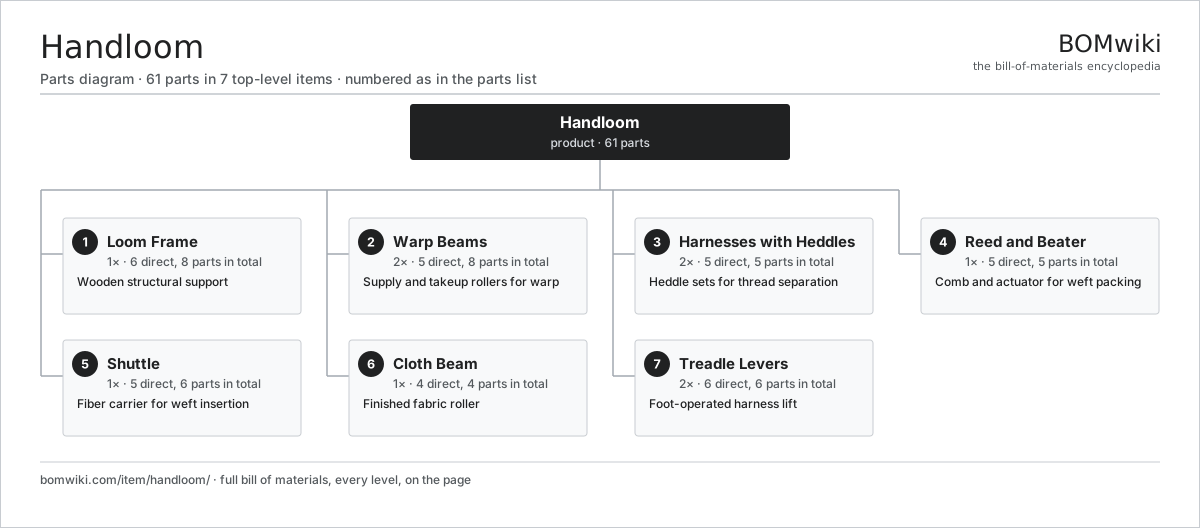
| # | Part | Qty | What it does |
|---|---|---|---|
| 1 | Loom Frame 6 parts | 1× | Wooden structural support |
| 2 | Warp Beams 5 parts | 2× | Supply and takeup rollers for warp |
| 3 | Harnesses with Heddles 5 parts | 2× | Heddle sets for thread separation |
| 4 | Reed and Beater 5 parts | 1× | Comb and actuator for weft packing |
| 5 | Shuttle 5 parts | 1× | Fiber carrier for weft insertion |
| 6 | Cloth Beam 4 parts | 1× | Finished fabric roller |
| 7 | Treadle Levers 6 parts | 2× | Foot-operated harness lift |
3D model
No 3D model yet. Have a CAD file of this? Add a 3D model. STL renders right on this page; STEP, FreeCAD, and OpenSCAD sources are welcome too (openly licensed, like all 3D models on BOMwiki).
Build & assembly graph
expand / collapse · shared sub-assemblies converge · links to related products · est. labourTap an assembly to expand/collapse · tap a part to open it · use “Open page” for any node · drag to pan, scroll to zoom.
Bill of materials for Handloom
7 top-level lines · 43 rows shown · 61 parts total · indented to 3 levels| # | Item / sub-assembly | Part no. | Qty/assy | Ext. qty | Parts | Type |
|---|---|---|---|---|---|---|
| 1 | Loom Frame 6 parts | handloom-frame | 1× | 1 | 8 | assembly |
| 1.1 | Frame Uprights | handloom-frame-uprights | 2× | 2 | · | part |
| 1.2 | Top Beam | handloom-frame-top-beam | 1× | 1 | · | part |
| 1.3 | Bottom Beam | handloom-frame-bottom-beam | 1× | 1 | · | part |
| 1.4 | Side Rails | handloom-frame-side-rails | 2× | 2 | · | part |
| 1.5 | Frame Base | handloom-frame-base | 1× | 1 | · | part |
| 1.6 | Fastener Set | fastener-set | 1× | 1 | · | part |
| 2 | Warp Beams 5 parts | handloom-warp-beams | 2× | 2 | 8 | assembly |
| 2.1 | Warp Supply Beam | handloom-warp-supply-beam | 1× | 2 | · | part |
| 2.2 | Warp Takeup Beam | handloom-warp-takeup-beam | 1× | 2 | · | part |
| 2.3 | Warp Beam Bearings | handloom-warp-beam-bearings | 4× | 8 | · | part |
| 2.4 | Warp Tension Springs | handloom-warp-tension-springs | 1× | 2 | · | part |
| 2.5 | Warp Advance Crank | handloom-warp-crank | 1× | 2 | · | part |
| 3 | Harnesses with Heddles 5 parts | handloom-harnesses | 2× | 2 | 5 | assembly |
| 3.1 | Harness Frame 1 | handloom-harness-frame-1 | 1× | 2 | · | part |
| 3.2 | Harness Frame 2 | handloom-harness-frame-2 | 1× | 2 | · | part |
| 3.3 | Heddles | handloom-heddles | 1× | 2 | · | part |
| 3.4 | Heddle Support Bars | handloom-heddle-support-bars | 1× | 2 | · | part |
| 3.5 | Harness Linkage | handloom-harness-linkage | 1× | 2 | · | part |
| 4 | Reed and Beater 5 parts | handloom-reed-beater | 1× | 1 | 5 | assembly |
| 4.1 | Reed | handloom-reed | 1× | 1 | · | part |
| 4.2 | Beater Frame | handloom-beater-frame | 1× | 1 | · | part |
| 4.3 | Beater Pivot | handloom-beater-pivot | 1× | 1 | · | part |
| 4.4 | Beater Pull Cord | handloom-beater-pull-cord | 1× | 1 | · | part |
| 4.5 | Beater Return Spring | handloom-beater-return-spring | 1× | 1 | · | part |
| 5 | Shuttle 5 parts | handloom-shuttle | 1× | 1 | 6 | assembly |
| 5.1 | Shuttle Body | handloom-shuttle-body | 1× | 1 | · | part |
| 5.2 | Shuttle Bobbin | handloom-shuttle-bobbin | 1× | 1 | · | part |
| 5.3 | Shuttle Eyes | handloom-shuttle-eyes | 2× | 2 | · | part |
| 5.4 | Shuttle Point | handloom-shuttle-point | 1× | 1 | · | part |
| 5.5 | Shuttle Weight | handloom-shuttle-weight | 1× | 1 | · | part |
| 6 | Cloth Beam 4 parts | handloom-cloth-beam | 1× | 1 | 4 | assembly |
| 6.1 | Cloth Beam Roller | handloom-cloth-beam-roller | 1× | 1 | · | part |
| 6.2 | Cloth Beam Bearing | handloom-cloth-beam-bearing | 1× | 1 | · | part |
| 6.3 | Cloth Advance Ratchet | handloom-cloth-advance-ratchet | 1× | 1 | · | part |
| 6.4 | Cloth Advance Crank | handloom-cloth-advance-crank | 1× | 1 | · | part |
| 7 | Treadle Levers 6 parts | handloom-treadle-levers | 2× | 2 | 6 | assembly |
| 7.1 | Treadle Board 1 | handloom-treadle-board-1 | 1× | 2 | · | part |
| 7.2 | Treadle Board 2 | handloom-treadle-board-2 | 1× | 2 | · | part |
| 7.3 | Treadle Pivot | handloom-treadle-pivot | 1× | 2 | · | part |
| 7.4 | Treadle Rod 1 | handloom-treadle-rod-1 | 1× | 2 | · | part |
| 7.5 | Treadle Rod 2 | handloom-treadle-rod-2 | 1× | 2 | · | part |
| 7.6 | Treadle Return Spring | handloom-treadle-spring | 1× | 2 | · | part |
Something wrong in this list? Report a problem with this BOM.
Sourcing: possible vendors
Browse the supplier directory → Prices, MOQ, and lead times are algorithmic estimates, not quotes, and not claims about these companies. Company mappings are curated by keyword; est. price band $10k–$1M. How estimates work| Vendor | HQ | Specialty | MOQ | Lead time |
|---|---|---|---|---|
|
🇨🇭Rieter
rieter.com ↗
|
Winterthur, CH | Spinning machinery | 10 units | 14–24 wks |
| truetzschler.com ↗ | Mönchengladbach, DE | Textile machinery | 10 units | 14–24 wks |
|
🇧🇪Picanol
picanol.be ↗
|
Ypres, BE | Weaving machines | 10 units | 14–24 wks |
| karlmayer.com ↗ | Obertshausen, DE | Warp knitting machines | 10 units | 14–24 wks |
|
🇨🇭Saurer
saurer.com ↗
|
Arbon, CH | Spinning & embroidery | 10 units | 14–24 wks |
1,694-word article