Handpan
ProductOverview
The handpan is a contemporary percussion instrument invented in 2000 by Felix Rohner and Sabina Schärer in Switzerland, building on concepts from Caribbean steel drums. It is made from two hydroformed steel hemispheres joined along the rim to form a sealed resonating chamber. The top hemisphere features eight to ten tuned note fields, arranged in a circle around a central ding (tonic note). The bottom hemisphere contains an opening producing a deep undertone (bass note). The player strikes various zones with hands and mallets to produce melodic and harmonic sequences.
The handpan rose to prominence in the 2000s–2010s through street performance, world music, and electronic music integration. Its warm, organic, meditative tone and intuitive pitch layout made it accessible to non-trained musicians while deep enough for virtuosos. Today, handpans are played in solo performance, ensemble contexts, and integrated into contemporary classical and electronic music.
The instrument's simplicity masks exquisite engineering: each note zone must be tuned to precise frequency (within cents), and the two shell hemispheres must be matched acoustically to produce balanced tone and sustain. Handpan makers are specialized craftspeople, and demand has far exceeded supply since the 2000s.
How it works
Sound in the handpan is produced by excitation of the top steel shell at specific zones. When a player strikes a note zone with a finger, palm, or soft mallet, the impact imparts energy to that localized region of steel. The struck zone vibrates at its natural resonant frequency, determined by the zone's geometry, thickness, and material properties.
The two steel hemispheres form a coupled oscillating system: vibration in the top shell transfers energy to the sealed air cavity between the shells, which compresses and expands, in turn exciting the bottom shell. This coupling produces a richer, more sustained tone than a single shell would.
The central ding zone (typically 120–150 mm diameter) is the primary melodic note and occupies the top center. It is typically the lowest of the top-shell pitches, acting as a tonic anchor. Surrounding the ding are typically 7–8 note fields, each tuned to intervals within a chosen scale (e.g., major, minor, pentatonic, chromatic).
The undertone is produced from the bottom hemisphere. The vent hole (40–80 mm diameter) on the bottom acts as a Helmholtz resonator. Air flowing in and out of this opening vibrates at a frequency determined by the opening size and the internal cavity volume. The undertone is typically 2–3 octaves below the ding, producing a deep bass that resonates sympathetically with top-shell strikes.
Sustain (ring-time) in a handpan is influenced by:
- Material damping: Steel composition and surface finish affect energy dissipation.
- Shell coupling: Tight rim sealing creates stronger cavity coupling and longer sustain.
- Striking technique: Soft, centered strikes produce longer sustain; off-center or hard strikes produce quicker decay.
Harmonic content is rich: striking a zone excites not just the fundamental pitch but a series of overtones. The two-shell coupling creates interference patterns that add character and perceived timbre. Professional handpan makers spend months tuning each instrument to achieve balanced overtone series and harmonic coherence.
Manufacturing process
Handpan production is highly specialized:
- Hydroforming: Two flat steel discs (typically mild steel or nitrided steel) are hydroformed in industrial presses to create hemispherical shapes.
- Dimpling: Dimples and field boundaries are impressed into the steel by pressing dies, defining where the note zones will be.
- Nitride treatment (optional): Surface nitridation hardens the steel and improves corrosion resistance.
- Tuning: Makers use controlled heating and precise hammering to adjust each note zone frequency. This is an iterative, manual process requiring years of skill development.
- Shell assembly: The two hemispheres are joined via welding or adhesive sealing, creating an airtight chamber.
- Final tuning: Acoustic testing and secondary hammering refinement ensure pitch accuracy and harmonic balance.
The undertone opening size and shape is critical: a 50 mm hole produces deeper undertone than a 70 mm hole. Makers tune the opening by precise grinding and sometimes apply damping material (felt, cloth) to fine-tune the bass frequency.
Scales and tuning
Handpans are available in numerous scale modes, allowing access to music from different cultures:
- Major/minor: Western diatonic scales suitable for melodic playing.
- Pentatonic: Asian-influenced scales (slap pan, hang).
- Dorian, Phrygian: Modal scales from Mediterranean and middle Eastern music.
- Kurd, Harmonic Minor: Middle Eastern scales.
Each scale is built around a chosen root note (ding), which is selectable during manufacturing: G, D, A, E, C, F, and others are common. The undertone is typically tuned to the ding's frequency minus one octave, providing a harmonic anchor.
Cultural impact and limitations
The handpan emerged from Caribbean steel pan traditions but quickly became its own instrument with a meditative, "new age" aesthetic. Its accessibility (no prior training needed to produce pleasant tones) and intuitive scale layout made it viral in world music and wellness contexts.
However, supply shortages from 2005–2020 created extreme demand, inflating prices to $2,500–$5,000+ for professional instruments. A small number of master makers (PANArt, Pantheon Steel, Lunatico, and others) control most of the market. In 2013, PANArt patented certain designs, temporarily restricting competition.
The warm, resonant tone and relatively low volume make handpans suitable for intimate venues, parks, and recording studios. They are less suitable for large concert halls or outdoor amplification (unlike steel drums).
Modern handpan technique has evolved from simple hand strikes to complex mallet work, layered loops, and integration with electronics (drums, synthesizers). Virtuosos like Manoush, Navid Mehr, and Yuki Koshimoto have elevated the instrument to concert legitimacy.
Handpan parts and their functions
6 top-level parts · 28 parts in total · full bill of materials below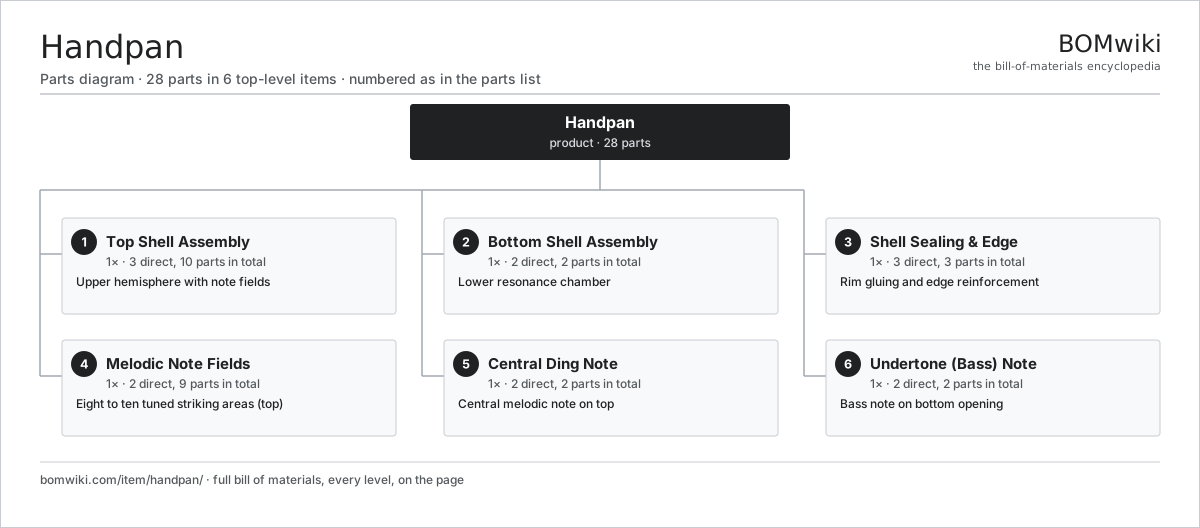
| # | Part | Qty | What it does |
|---|---|---|---|
| 1 | Top Shell Assembly 3 parts | 1× | Upper hemisphere with note fields |
| 2 | Bottom Shell Assembly 2 parts | 1× | Lower resonance chamber |
| 3 | Shell Sealing & Edge 3 parts | 1× | Rim gluing and edge reinforcement |
| 4 | Melodic Note Fields 2 parts | 1× | Eight to ten tuned striking areas (top) |
| 5 | Central Ding Note 2 parts | 1× | Central melodic note on top |
| 6 | Undertone (Bass) Note 2 parts | 1× | Bass note on bottom opening |
3D model
No 3D model yet. Have a CAD file of this? Add a 3D model. STL renders right on this page; STEP, FreeCAD, and OpenSCAD sources are welcome too (openly licensed, like all 3D models on BOMwiki).
Build & assembly graph
expand / collapse · shared sub-assemblies converge · links to related products · est. labourTap an assembly to expand/collapse · tap a part to open it · use “Open page” for any node · drag to pan, scroll to zoom.
Bill of materials for Handpan
6 top-level lines · 20 rows shown · 28 parts total · indented to 3 levels| # | Item / sub-assembly | Part no. | Qty/assy | Ext. qty | Parts | Type |
|---|---|---|---|---|---|---|
| 1 | Top Shell Assembly 3 parts | handpan-top-shell | 1× | 1 | 10 | assembly |
| 1.1 | Steel Disc Blank | handpan-steel-blank | 1× | 1 | · | part |
| 1.2 | Dimple Set | handpan-dimple-set | 1× | 1 | · | part |
| 1.3 | Tone Zone | handpan-tone-zone | 8× | 8 | · | part |
| 2 | Bottom Shell Assembly 2 parts | handpan-bottom-shell | 1× | 1 | 2 | assembly |
| 2.1 | Steel Disc Blank | handpan-steel-blank | 1× | 1 | · | part |
| 2.2 | Vent Hole | handpan-vent-hole | 1× | 1 | · | part |
| 3 | Shell Sealing & Edge 3 parts | handpan-shell-seal | 1× | 1 | 3 | assembly |
| 3.1 | Rim Weld or Seal | handpan-rim-weld | 1× | 1 | · | part |
| 3.2 | Edge Binding | handpan-edge-binding | 1× | 1 | · | part |
| 3.3 | Sealing Adhesive | handpan-glue | 1× | 1 | · | part |
| 4 | Melodic Note Fields 2 parts | handpan-note-fields | 1× | 1 | 9 | assembly |
| 4.1 | Field Zone | handpan-field-zone | 8× | 8 | · | part |
| 4.2 | Field Boundary Dimple | handpan-field-boundary | 1× | 1 | · | part |
| 5 | Central Ding Note 2 parts | handpan-ding | 1× | 1 | 2 | assembly |
| 5.1 | Ding Dome | handpan-ding-dome | 1× | 1 | · | part |
| 5.2 | Ding Tuning Mark | handpan-ding-tuning-mark | 1× | 1 | · | part |
| 6 | Undertone (Bass) Note 2 parts | handpan-undertone | 1× | 1 | 2 | assembly |
| 6.1 | Undertone Opening | handpan-undertone-opening | 1× | 1 | · | part |
| 6.2 | Undertone Damping | handpan-undertone-damping | 1× | 1 | · | part |
Something wrong in this list? Report a problem with this BOM.
Sourcing: possible vendors
Browse the supplier directory → Prices, MOQ, and lead times are algorithmic estimates, not quotes, and not claims about these companies. Company mappings are curated by keyword; est. price band $50–$5k. How estimates work| Vendor | HQ | Specialty | MOQ | Lead time |
|---|---|---|---|---|
| yamaha.com ↗ | Hamamatsu, JP | Audio & instruments | 200 units | 8–14 wks |
|
🇺🇸Fender
fender.com ↗
|
Los Angeles, US | Guitars & amps | 200 units | 8–14 wks |
|
🇺🇸Gibson
gibson.com ↗
|
Nashville, US | Guitars | 200 units | 8–14 wks |
|
🇯🇵Roland
roland.com ↗
|
Hamamatsu, JP | Electronic instruments | 200 units | 8–14 wks |
| steinway.com ↗ | New York, US | Pianos | 200 units | 8–14 wks |
988-word article