Hang Glider
ProductOverview
A hang glider is a foot-launched aircraft in which the pilot hangs prone beneath a flexible wing and controls it entirely by shifting body weight. The wing is a tensioned fabric membrane, the Sail, stretched over an aluminium-tube Wing Frame. There is no tail, no movable control surface and no engine: pitch stability comes from washout built into the wing itself, and the only "control system" is the pilot's mass hanging from a single point on the keel. A modern intermediate glider weighs about 29 kg, packs into a 5.5 m tube bag, and achieves a glide ratio around 12:1, enough for cross-country flights of several hundred kilometres in good thermal conditions.
Structure
The frame is a kite-like skeleton of three primary tubes. Two tapered Leading-Edge Tube members sweep back from the Nose Plate at a nose angle of roughly 125°, and a central Keel Tube runs aft along the line of symmetry. A two-piece Crossbar Tube, hinged at the keel, pushes the leading edges apart against the sail; tensioning the crossbar back with a cable and cleat is what turns a loose bag of fabric into a rigid, flyable wing during setup. The tubes are 7075-T6 aluminium, chosen for a yield strength near 500 MPa at low weight.
The sail itself is built from stitched Sail Panel gores of around 160 g/m² Dacron polyester, with stiff Mylar Insert film in the leading-edge pockets to hold a clean aerodynamic entry. Aerofoil shape comes from the Batten Set: 18 pre-bent Camber Batten ribs slide into sewn Batten Pocket sleeves at setup, each matched against a factory template, and a flexible Tip Wand spreads each Sail Tip. Because the battens define the camber, checking them against the template is a routine maintenance task, a bent batten changes the trim and turn behaviour of the whole wing.
How it works
The pilot hangs from the keel through the Hang System: a Hang Bolt fixes two sewn webbing Hang Loop members (main plus backup) at the certified hang point, and a locking Carabiner connects them to the Pilot Harness. In flight the pilot lies prone in the zipped Harness Shell and grips the Basetube of the Control Frame. Pulling the bar in moves the pilot's mass forward, pitching the glider down and accelerating it; pushing out slows it; shifting sideways banks it. Control authority is simply the moment of roughly 80 kg of pilot displaced up to half a metre about the hang point.
Pitch stability with no tail depends on washout, the wing twists so the tips fly at lower incidence than the root. The inboard Washout Sprog struts and the Luff Line cables from the Kingpost enforce a minimum twist even at zero or negative angles of attack, so the tips keep generating a nose-up restoring moment in a dive. This luff-line system is the certification-critical feature tested in HGMA and DHV pitch tests.
Flight loads run through the Rigging. Under positive g the wings try to fold upward, and the load passes from the leading edges down the 2.5 mm stainless Side Wire cables to the Corner Fitting at each end of the basetube, in flight the control frame is a structural compression member, not just a handle. The Nose Wire and Rear Wire brace it fore and aft, and every cable terminates in swaged hardware from the Tang Set. Limit load for a certified glider is +4 g / −1.5 g at maximum hook-in weight.
Flying
Launch is a short run down a slope until wing lift exceeds weight, typically at 25–30 km/h airspeed. Once airborne the pilot zips the Harness Zipper and settles prone. Soaring flight uses the same energy sources as a sailplane, thermals, ridge lift and wave, found with the help of a basetube-mounted Variometer, which senses pressure change with a barometric Pressure Sensor and reports climb rate as an audio tone through its Speaker so the pilot can keep eyes outside.
Landing is the reverse of launch: a final glide into wind, a progressive push-out, and a full "flare" that stalls the wing a metre off the ground so the pilot steps down to a standstill. The Downtube uprights are deliberately the sacrificial part, in a botched landing they bend and are replaced for a few tens of dollars, protecting the keel and leading edges. Small Wheel Assembly units on the basetube let training and tandem gliders roll out a landing instead.
A Reserve Parachute is carried on the harness chest; it is thrown by hand and brings glider and pilot down together at around 5.5 m/s. Setup and teardown take 15–20 minutes, and the packed glider travels on roof bars, which is the practical reason hang gliding survives as a sport: a complete aircraft that stores in a garage.
Hang Glider parts and their functions
8 top-level parts · 135 parts in total · full bill of materials below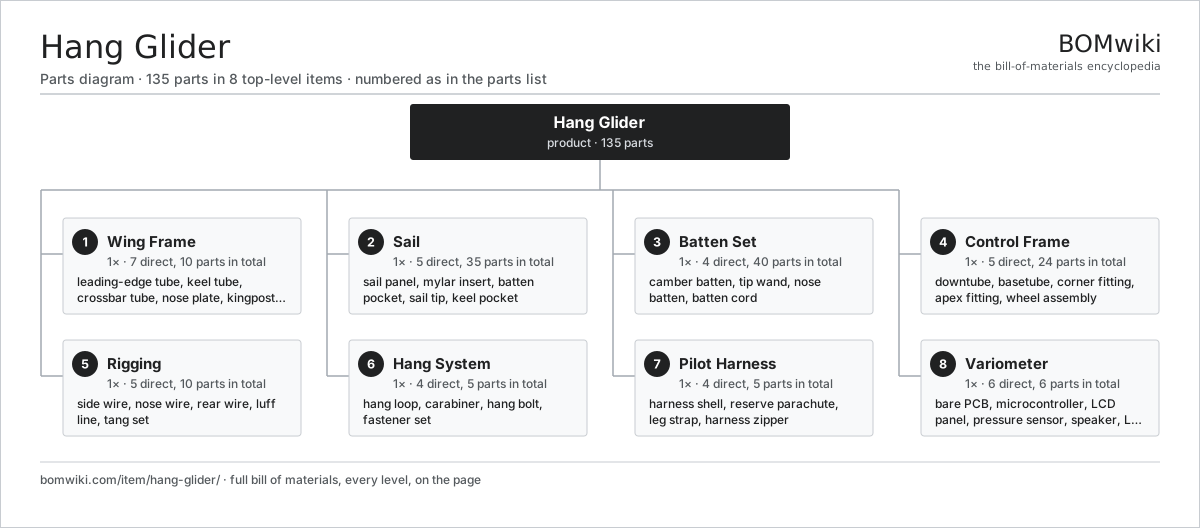
| # | Part | Qty | What it does |
|---|---|---|---|
| 1 | Wing Frame 7 parts | 1× | Aluminium-tube skeleton of leading edges, keel and crossbar that gives the flex wing its swept planform. |
| 2 | Sail 5 parts | 1× | Tensioned Dacron and Mylar membrane that forms the lifting surface over the frame. |
| 3 | Batten Set 4 parts | 1× | Pre-bent aluminium ribs slid into sail pockets to define the aerofoil camber. |
| 4 | Control Frame 5 parts | 1× | A-frame of two downtubes and a basetube the pilot pushes and pulls against to shift weight. |
| 5 | Rigging 5 parts | 1× | Stainless cable bracing that carries flight and ground loads between frame members. |
| 6 | Hang System 4 parts | 1× | Redundant webbing loops and carabiner connecting the harness to the keel hang point. |
| 7 | Pilot Harness 4 parts | 1× | Cocoon or pod harness suspending the pilot prone and carrying the reserve parachute. |
| 8 | Variometer 6 parts | 1× | Basetube-mounted flight instrument indicating climb and sink by tone and display. |
3D model
No 3D model yet. Have a CAD file of this? Add a 3D model. STL renders right on this page; STEP, FreeCAD, and OpenSCAD sources are welcome too (openly licensed, like all 3D models on BOMwiki).
Build & assembly graph
expand / collapse · shared sub-assemblies converge · links to related products · est. labourTap an assembly to expand/collapse · tap a part to open it · use “Open page” for any node · drag to pan, scroll to zoom.
Bill of materials for Hang Glider
8 top-level lines · 53 rows shown · 135 parts total · indented to 3 levels| # | Item / sub-assembly | Part no. | Qty/assy | Ext. qty | Parts | Type |
|---|---|---|---|---|---|---|
| 1 | Wing Frame 7 parts | hang-glider-wing-frame | 1× | 1 | 10 | assembly |
| 1.1 | Leading-Edge Tube | hang-glider-leading-edge-tube | 2× | 2 | · | part |
| 1.2 | Keel Tube | hang-glider-keel-tube | 1× | 1 | · | part |
| 1.3 | Crossbar Tube | hang-glider-crossbar-tube | 2× | 2 | · | part |
| 1.4 | Nose Plate | hang-glider-nose-plate | 1× | 1 | · | part |
| 1.5 | Kingpost | hang-glider-kingpost | 1× | 1 | · | part |
| 1.6 | Washout Sprog | hang-glider-sprog | 2× | 2 | · | part |
| 1.7 | Fastener Set | fastener-set | 1× | 1 | · | part |
| 2 | Sail 5 parts | hang-glider-sail | 1× | 1 | 35 | assembly |
| 2.1 | Sail Panel | hang-glider-sail-panel | 10× | 10 | · | part |
| 2.2 | Mylar Insert | hang-glider-mylar-insert | 2× | 2 | · | part |
| 2.3 | Batten Pocket | hang-glider-batten-pocket | 20× | 20 | · | part |
| 2.4 | Sail Tip | hang-glider-sail-tip | 2× | 2 | · | part |
| 2.5 | Keel Pocket | hang-glider-keel-pocket | 1× | 1 | · | part |
| 3 | Batten Set 4 parts | hang-glider-batten-set | 1× | 1 | 40 | assembly |
| 3.1 | Camber Batten | hang-glider-camber-batten | 18× | 18 | · | part |
| 3.2 | Tip Wand | hang-glider-tip-wand | 2× | 2 | · | part |
| 3.3 | Nose Batten | hang-glider-nose-batten | 2× | 2 | · | part |
| 3.4 | Batten Cord | hang-glider-batten-cord | 18× | 18 | · | part |
| 4 | Control Frame 5 parts | hang-glider-control-frame | 1× | 1 | 24 | assembly |
| 4.1 | Downtube | hang-glider-downtube | 2× | 2 | · | part |
| 4.2 | Basetube | hang-glider-basetube | 1× | 1 | · | part |
| 4.3 | Corner Fitting | hang-glider-corner-fitting | 2× | 2 | · | part |
| 4.4 | Apex Fitting | hang-glider-apex-fitting | 1× | 1 | · | part |
| 4.5 | Wheel Assembly 5 parts | wheel-assembly | 2× | 2 | 9 | assembly |
| 4.5.1 | Alloy Wheel | alloy-wheel | 1× | 2 | · | part |
| 4.5.2 | Tire | tire | 1× | 2 | · | part |
| 4.5.3 | TPMS Sensor | tpms-sensor | 1× | 2 | · | part |
| 4.5.4 | Lug Nut | lug-nut | 5× | 10 | · | part |
| 4.5.5 | Valve Stem | valve-stem | 1× | 2 | · | part |
| 5 | Rigging 5 parts | hang-glider-rigging | 1× | 1 | 10 | assembly |
| 5.1 | Side Wire | hang-glider-side-wire | 2× | 2 | · | part |
| 5.2 | Nose Wire | hang-glider-nose-wire | 2× | 2 | · | part |
| 5.3 | Rear Wire | hang-glider-rear-wire | 1× | 1 | · | part |
| 5.4 | Luff Line | hang-glider-luff-line | 4× | 4 | · | part |
| 5.5 | Tang Set | hang-glider-tang-set | 1× | 1 | · | part |
| 6 | Hang System 4 parts | hang-glider-hang-system | 1× | 1 | 5 | assembly |
| 6.1 | Hang Loop | hang-glider-hang-loop | 2× | 2 | · | part |
| 6.2 | Carabiner | hang-glider-carabiner | 1× | 1 | · | part |
| 6.3 | Hang Bolt | hang-glider-hang-bolt | 1× | 1 | · | part |
| 6.4 | Fastener Set | fastener-set | 1× | 1 | · | part |
| 7 | Pilot Harness 4 parts | hang-glider-harness | 1× | 1 | 5 | assembly |
| 7.1 | Harness Shell | hang-glider-harness-shell | 1× | 1 | · | part |
| 7.2 | Reserve Parachute | hang-glider-reserve-parachute | 1× | 1 | · | part |
| 7.3 | Leg Strap | hang-glider-leg-strap | 2× | 2 | · | part |
| 7.4 | Harness Zipper | hang-glider-harness-zipper | 1× | 1 | · | part |
| 8 | Variometer 6 parts | hang-glider-vario | 1× | 1 | 6 | assembly |
| 8.1 | Bare PCB | pcb-bare | 1× | 1 | · | part |
| 8.2 | Microcontroller | mcu | 1× | 1 | · | part |
| 8.3 | LCD Panel | lcd-panel | 1× | 1 | · | part |
| 8.4 | Pressure Sensor | pressure-sensor | 1× | 1 | · | part |
| 8.5 | Speaker | speaker | 1× | 1 | · | part |
| 8.6 | LiPo Cell | lipo-cell | 1× | 1 | · | part |
Something wrong in this list? Report a problem with this BOM.
Related products
same domain, ranked by shared parts Business Jet
1,654 parts · shares 8 with this page
Business Jet
1,654 parts · shares 8 with this page
 Hot Air Balloon
146 parts · shares 8 with this page
Hot Air Balloon
146 parts · shares 8 with this page
 Gyroplane
168 parts · shares 7 with this page
Gyroplane
168 parts · shares 7 with this page
 Jet Trainer Aircraft
319 parts · shares 7 with this page
Jet Trainer Aircraft
319 parts · shares 7 with this page
 Sailplane Glider
139 parts · shares 7 with this page
Sailplane Glider
139 parts · shares 7 with this page
 Ultralight Aircraft
455 parts · shares 7 with this page
Ultralight Aircraft
455 parts · shares 7 with this page
Sourcing: possible vendors
Browse the supplier directory → Prices, MOQ, and lead times are algorithmic estimates, not quotes, and not claims about these companies. Company mappings are curated by keyword; est. price band $50k–$300M. How estimates work| Vendor | HQ | Specialty | MOQ | Lead time |
|---|---|---|---|---|
|
🇺🇸Boeing
boeing.com ↗
|
Arlington, US | Aerospace OEM | made to order | 40–80 wks |
|
🇫🇷Airbus
airbus.com ↗
|
Toulouse, FR | Aerospace OEM | made to order | 40–80 wks |
| lockheedmartin.com ↗ | Bethesda, US | Aerospace & defense | made to order | 40–80 wks |
|
🇧🇷Embraer
embraer.com ↗
|
São José dos Campos, BR | Aircraft OEM | made to order | 40–80 wks |
| txtav.com ↗ | Wichita, US | Aircraft OEM | made to order | 40–80 wks |
887-word article