Diatonic Harmonica
ProductOverview
The ten-hole diatonic harmonica packs twenty notes into a body the size of a cigar. Each of its ten chambers holds two free reeds: one sounds when the player exhales (blow), the other when the player inhales (draw). The note layout, patented by Joseph Richter around 1826 and essentially unchanged since, stacks the tonic chord on the blow reeds and the dominant on the low draw reeds, so a player can get melody, chords, and the bent "blue" notes that made the instrument the voice of blues and folk music.
Mechanically it is a five-layer sandwich: the Cover Plates outside, the Blow Reed Plate and Draw Reed Plate inside, and the Comb in the middle, all clamped by the Fastener Kit.
How it works
A free reed is a metal tongue fixed at one end over a slot it almost exactly fits. When breath pressure builds across the plate, the tongue is pushed through its slot, momentarily sealing and then releasing the airflow; it springs back, overshoots, and the cycle repeats at the reed's natural frequency. The result is a pulsed air stream, the note. Pitch is set by the reed's length and thickness profile: about 20 mm long for C4, under 5 mm for C7. Manufacturers tune each reed by removing material, at the tip to raise pitch, at the root to lower it, to within a few cents.
Each Blow Reed is riveted on the inner face of its plate, inside the chamber, so exhaled air drives it. Each Draw Reed sits on the outer face of the lower plate, so inhaled air drives it instead. A single Reed Rivet clamps each reed root; the gap between reed and slot edge is a few hundredths of a millimetre, which is why a speck of lint can silence a note. The Reed Plate Blanks are brass about 0.9 mm thick with slots milled to match each reed.
The Comb Body does the routing. Its ten channels, separated by Comb Tines on roughly 7.5 mm centers, connect the player's lips to exactly one blow reed and one draw reed at a time. Airtightness between comb and plates is the main quality variable in a harmonica: leaks between chambers waste breath and kill bending response. Wooden combs need a Comb Sealant because breath moisture otherwise swells the tines until they protrude and chap the player's lips; ABS and aluminium combs avoid the problem.
Bending and the Richter layout
The famous draw bend is an interaction between both reeds in a chamber. When a player lowers the resonance of their vocal tract while drawing on hole 3, the draw reed is pulled below its natural pitch while the blow reed begins to speak as the actual oscillator; the pair settles at an intermediate pitch. Bends are only available where the two reeds in a chamber are far enough apart, up to four semitones on hole 3 of a Richter-tuned instrument. Overblows extend the technique to the missing chromatic notes. None of this requires extra mechanism; it is all in the reed pair and the player.
The Richter note layout repeats the major scale across three registers but omits some scale tones in the bottom octave in favor of chord tones, which is why the harmonica is sold in all twelve keys rather than played fully chromatically (the chromatic harmonica adds a slide for that purpose).
Construction and service
The Top Cover and Bottom Cover are stamped stainless shells that protect the reeds, with Cover Supports to keep grip pressure off the plates and Side Vents or open backs shaping projection. Modern instruments assemble with Plate Screws and Cover Screws rather than the nails of older production, so a player can open the instrument to clean, re-gap, or retune reeds. Reeds are the consumable: brass work-hardens and a hard-played draw 4 or 5 reed typically fatigues and drops pitch after one to three hundred playing hours, after which the plate (or on premium models the single reed) is replaced. Between sessions the instrument lives in its Case, mainly to keep lint and grit out of the slots.
Diatonic Harmonica parts and their functions
6 top-level parts · 74 parts in total · full bill of materials below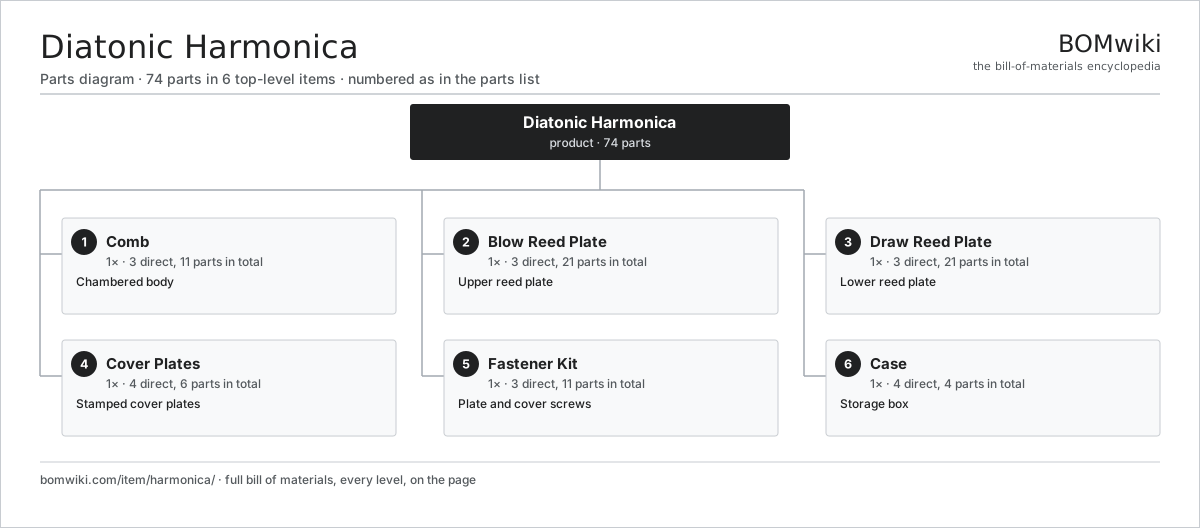
| # | Part | Qty | What it does |
|---|---|---|---|
| 1 | Comb 3 parts | 1× | Chambered body |
| 2 | Blow Reed Plate 3 parts | 1× | Upper reed plate |
| 3 | Draw Reed Plate 3 parts | 1× | Lower reed plate |
| 4 | Cover Plates 4 parts | 1× | Stamped cover plates |
| 5 | Fastener Kit 3 parts | 1× | Plate and cover screws |
| 6 | Case 4 parts | 1× | Storage box |
3D model
No 3D model yet. Have a CAD file of this? Add a 3D model. STL renders right on this page; STEP, FreeCAD, and OpenSCAD sources are welcome too (openly licensed, like all 3D models on BOMwiki).
Build & assembly graph
expand / collapse · shared sub-assemblies converge · links to related products · est. labourTap an assembly to expand/collapse · tap a part to open it · use “Open page” for any node · drag to pan, scroll to zoom.
Bill of materials for Diatonic Harmonica
6 top-level lines · 26 rows shown · 74 parts total · indented to 3 levels| # | Item / sub-assembly | Part no. | Qty/assy | Ext. qty | Parts | Type |
|---|---|---|---|---|---|---|
| 1 | Comb 3 parts | harmonica-comb-assembly | 1× | 1 | 11 | assembly |
| 1.1 | Comb Body | harmonica-comb-body | 1× | 1 | · | part |
| 1.2 | Comb Tine | harmonica-comb-tine | 9× | 9 | · | part |
| 1.3 | Comb Sealant | harmonica-comb-sealant | 1× | 1 | · | part |
| 2 | Blow Reed Plate 3 parts | harmonica-blow-reed-plate | 1× | 1 | 21 | assembly |
| 2.1 | Reed Plate Blank | harmonica-reed-plate-blank | 1× | 1 | · | part |
| 2.2 | Blow Reed | harmonica-blow-reed | 10× | 10 | · | part |
| 2.3 | Reed Rivet | harmonica-reed-rivet | 10× | 10 | · | part |
| 3 | Draw Reed Plate 3 parts | harmonica-draw-reed-plate | 1× | 1 | 21 | assembly |
| 3.1 | Reed Plate Blank | harmonica-reed-plate-blank | 1× | 1 | · | part |
| 3.2 | Draw Reed | harmonica-draw-reed | 10× | 10 | · | part |
| 3.3 | Reed Rivet | harmonica-reed-rivet | 10× | 10 | · | part |
| 4 | Cover Plates 4 parts | harmonica-cover-set | 1× | 1 | 6 | assembly |
| 4.1 | Top Cover | harmonica-top-cover | 1× | 1 | · | part |
| 4.2 | Bottom Cover | harmonica-bottom-cover | 1× | 1 | · | part |
| 4.3 | Cover Support | harmonica-cover-support | 2× | 2 | · | part |
| 4.4 | Side Vent | harmonica-side-vent | 2× | 2 | · | part |
| 5 | Fastener Kit 3 parts | harmonica-fastener-kit | 1× | 1 | 11 | assembly |
| 5.1 | Plate Screw | harmonica-plate-screw | 7× | 7 | · | part |
| 5.2 | Cover Screw | harmonica-cover-screw | 2× | 2 | · | part |
| 5.3 | Cover Nut | harmonica-cover-nut | 2× | 2 | · | part |
| 6 | Case 4 parts | harmonica-case | 1× | 1 | 4 | assembly |
| 6.1 | Case Shell | harmonica-case-shell | 1× | 1 | · | part |
| 6.2 | Case Hinge | harmonica-case-hinge | 1× | 1 | · | part |
| 6.3 | Case Clasp | harmonica-case-clasp | 1× | 1 | · | part |
| 6.4 | Case Liner | harmonica-case-liner | 1× | 1 | · | part |
Something wrong in this list? Report a problem with this BOM.
Sourcing: possible vendors
Browse the supplier directory → Prices, MOQ, and lead times are algorithmic estimates, not quotes, and not claims about these companies. Company mappings are curated by keyword; est. price band $50–$5k. How estimates work| Vendor | HQ | Specialty | MOQ | Lead time |
|---|---|---|---|---|
| yamaha.com ↗ | Hamamatsu, JP | Audio & instruments | 200 units | 8–14 wks |
|
🇺🇸Fender
fender.com ↗
|
Los Angeles, US | Guitars & amps | 200 units | 8–14 wks |
|
🇺🇸Gibson
gibson.com ↗
|
Nashville, US | Guitars | 200 units | 8–14 wks |
|
🇯🇵Roland
roland.com ↗
|
Hamamatsu, JP | Electronic instruments | 200 units | 8–14 wks |
| steinway.com ↗ | New York, US | Pianos | 200 units | 8–14 wks |
723-word article