Concert Pedal Harp
ProductOverview
The concert pedal harp is the largest orchestral string instrument played by plucking. It carries 47 strings under a combined tension near nine kilonewtons, held by a triangular frame made of three members: the Soundbox (the soundbox), the Neck along the top, and the Column closing the front. Seven foot pedals at the Base let the player re-pitch every string by a semitone in either direction, which is how an instrument strung with one diatonic scale plays fully chromatic music.
The strings are tuned to C-flat major. Each pedal controls one note name across all octaves: pressing the C pedal from its top notch to the middle notch raises every C-flat to C-natural; the bottom notch raises them to C-sharp. This double-action scheme was patented by Sébastien Érard in 1810 and the modern instrument is mechanically the same design.
How it works
Sound starts at the String Set. The lowest octave and a half uses copper-wound steel Wire Bass Strings, the middle four octaves use Gut Strings (C strings dyed red, F strings black so the player can navigate 47 identical-looking strings), and the top octave uses Nylon Strings. Each string is knotted at a String Anchor under the Soundboard, passes through a brass String Eyelet along the Center Strip, and runs up to a Tuning Pin in the neck. A Bridge Pin defines the top of the speaking length.
The soundboard is the loudspeaker. It is Sitka spruce, about 12 mm thick at the bass end tapering to roughly 2.5 mm at the treble, glued over the Body Shell and stiffened by Internal Braces. Because the strings pull upward on the board rather than across a bridge, the board slowly bellies over decades; a visible crown of several millimetres is normal on an older instrument.
Pitch changing happens in the Pedal Action, hidden between the two brass Action Plates. Every string passes two Fourchette Discs, each a brass disc with two forked pins. With the pedal up (flat position) both discs stand clear and the full string length sounds. The middle pedal notch rotates the upper disc so its fork grips the string and shortens it by a semitone; the bottom notch rotates the lower disc for a second semitone. Disc geometry is set so the fork also restores the tension lost to the shortened length, keeping the semitone true.
The command path runs the full height of the instrument. Each Pedal latches into a notch of the Pedal Slot Plate; a Pedal Crank in the base turns the pedal arc into vertical travel of a Pedal Rod about 1.5 m long inside the Column Shaft, held straight by Rod Guides. At the Crown the rod hands off to a Action Linkage in the neck, which rotates every disc for that note name simultaneously, the C pedal moves seven octaves of C discs at once. Pedal Felts and return Coil Springs keep the mechanism silent enough to operate mid-phrase. A full action contains on the order of 1,400 parts, mostly levers, axles, and discs riveted between the Action Frame and the plates.
Structure and loads
The frame is a pre-stressed triangle. String tension tries to fold the neck toward the body; the column carries the resulting compression and the body the bending. The Neck Arch is laminated maple cut to the "harmonic curve," the line that gives each string its correct speaking length and tension gradient, bass strings near 1.5 m, treble strings under 70 mm. The column must stay hollow for the pedal rods, so it is laminated and often fluted for stiffness without excess weight. The complete instrument weighs 36–40 kg and stands about 1.85 m tall, balanced on two Foot Blocks and the player's right shoulder when tipped back to play.
Maintenance and regulation
Gut strings stretch and break routinely; players restring through the Access Holes in the back shell. Every one or two years the action is "regulated": a technician adjusts disc timing so both forks grip with equal firmness and the semitones measure exactly 100 cents, and replaces worn pedal felts. Tuning is done daily with a key on the 47 tapered tuning pins, normally to A4 = 440–442 Hz with all pedals in the flat position.
Concert Pedal Harp parts and their functions
7 top-level parts · 554 parts in total · full bill of materials below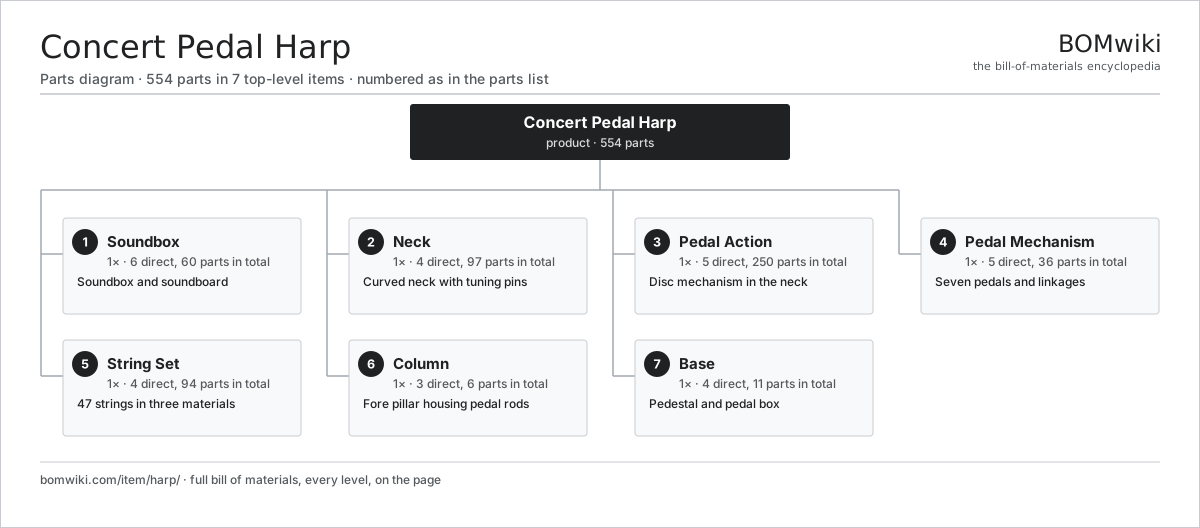
| # | Part | Qty | What it does |
|---|---|---|---|
| 1 | Soundbox 6 parts | 1× | Soundbox and soundboard |
| 2 | Neck 4 parts | 1× | Curved neck with tuning pins |
| 3 | Pedal Action 5 parts | 1× | Disc mechanism in the neck |
| 4 | Pedal Mechanism 5 parts | 1× | Seven pedals and linkages |
| 5 | String Set 4 parts | 1× | 47 strings in three materials |
| 6 | Column 3 parts | 1× | Fore pillar housing pedal rods |
| 7 | Base 4 parts | 1× | Pedestal and pedal box |
3D model
No 3D model yet. Have a CAD file of this? Add a 3D model. STL renders right on this page; STEP, FreeCAD, and OpenSCAD sources are welcome too (openly licensed, like all 3D models on BOMwiki).
Build & assembly graph
expand / collapse · shared sub-assemblies converge · links to related products · est. labourTap an assembly to expand/collapse · tap a part to open it · use “Open page” for any node · drag to pan, scroll to zoom.
Bill of materials for Concert Pedal Harp
7 top-level lines · 38 rows shown · 554 parts total · indented to 3 levels| # | Item / sub-assembly | Part no. | Qty/assy | Ext. qty | Parts | Type |
|---|---|---|---|---|---|---|
| 1 | Soundbox 6 parts | harp-body | 1× | 1 | 60 | assembly |
| 1.1 | Soundboard | harp-soundboard | 1× | 1 | · | part |
| 1.2 | Center Strip | harp-center-strip | 1× | 1 | · | part |
| 1.3 | Body Shell | harp-body-shell | 1× | 1 | · | part |
| 1.4 | String Eyelet | harp-string-eyelet | 47× | 47 | · | part |
| 1.5 | Internal Brace | harp-internal-brace | 6× | 6 | · | part |
| 1.6 | Access Hole | harp-access-panel | 4× | 4 | · | part |
| 2 | Neck 4 parts | harp-neck | 1× | 1 | 97 | assembly |
| 2.1 | Neck Arch | harp-neck-arch | 1× | 1 | · | part |
| 2.2 | Tuning Pin | harp-tuning-pin | 47× | 47 | · | part |
| 2.3 | Bridge Pin | harp-bridge-pin | 47× | 47 | · | part |
| 2.4 | Action Plate | harp-neck-plate | 2× | 2 | · | part |
| 3 | Pedal Action 5 parts | harp-action | 1× | 1 | 250 | assembly |
| 3.1 | Fourchette Disc | harp-fourchette-disc | 94× | 94 | · | part |
| 3.2 | Disc Axle | harp-disc-axle | 94× | 94 | · | part |
| 3.3 | Action Linkage | harp-action-linkage | 47× | 47 | · | part |
| 3.4 | Action Frame | harp-action-frame | 1× | 1 | · | part |
| 3.5 | Coil Spring | coil-spring | 14× | 14 | · | part |
| 4 | Pedal Mechanism 5 parts | harp-pedal-assembly | 1× | 1 | 36 | assembly |
| 4.1 | Pedal | harp-pedal | 7× | 7 | · | part |
| 4.2 | Pedal Rod | harp-pedal-rod | 7× | 7 | · | part |
| 4.3 | Pedal Slot Plate | harp-pedal-slot-plate | 1× | 1 | · | part |
| 4.4 | Pedal Felt | harp-pedal-felt | 14× | 14 | · | part |
| 4.5 | Coil Spring | coil-spring | 7× | 7 | · | part |
| 5 | String Set 4 parts | harp-string-set | 1× | 1 | 94 | assembly |
| 5.1 | Wire Bass String | harp-wire-string | 12× | 12 | · | part |
| 5.2 | Gut String | harp-gut-string | 26× | 26 | · | part |
| 5.3 | Nylon String | harp-nylon-string | 9× | 9 | · | part |
| 5.4 | String Anchor | harp-string-anchor | 47× | 47 | · | part |
| 6 | Column 3 parts | harp-column | 1× | 1 | 6 | assembly |
| 6.1 | Column Shaft | harp-column-shaft | 1× | 1 | · | part |
| 6.2 | Crown | harp-crown | 1× | 1 | · | part |
| 6.3 | Rod Guide | harp-rod-guide | 4× | 4 | · | part |
| 7 | Base 4 parts | harp-base | 1× | 1 | 11 | assembly |
| 7.1 | Base Frame | harp-base-frame | 1× | 1 | · | part |
| 7.2 | Pedal Crank | harp-pedal-crank | 7× | 7 | · | part |
| 7.3 | Foot Block | harp-foot-block | 2× | 2 | · | part |
| 7.4 | Fastener Set | fastener-set | 1× | 1 | · | part |
Something wrong in this list? Report a problem with this BOM.
Related products
same domain, ranked by shared parts


Sourcing: possible vendors
Browse the supplier directory → Prices, MOQ, and lead times are algorithmic estimates, not quotes, and not claims about these companies. Company mappings are curated by keyword; est. price band $50–$5k. How estimates work| Vendor | HQ | Specialty | MOQ | Lead time |
|---|---|---|---|---|
| yamaha.com ↗ | Hamamatsu, JP | Audio & instruments | 200 units | 8–14 wks |
|
🇺🇸Fender
fender.com ↗
|
Los Angeles, US | Guitars & amps | 200 units | 8–14 wks |
|
🇺🇸Gibson
gibson.com ↗
|
Nashville, US | Guitars | 200 units | 8–14 wks |
|
🇯🇵Roland
roland.com ↗
|
Hamamatsu, JP | Electronic instruments | 200 units | 8–14 wks |
| steinway.com ↗ | New York, US | Pianos | 200 units | 8–14 wks |
763-word article