Harpsichord
ProductOverview
The harpsichord is a keyboard-plucked-string instrument whose defining feature is mechanical plectrum plucking rather than hammering. Pressing a key causes a wooden jack to rise, bringing a quill or leather plectrum into contact with a string; the plectrum slides along the string, plucking it. When the key is released, the jack falls and a small cloth damper presses against the string, stopping vibration. This mechanism enables rapid repeated notes and rapid key action impossible on the contemporary piano.
The harpsichord produced a bright, cutting, metallic tone suited to accompaniment in Baroque chamber ensembles and continuo work. Unlike the piano, which uses hammers striking strings (enabling continuous dynamics via touch), the harpsichord produced either plucked or silent, no gradation in volume. Register sliders addressed this limitation by grouping jack sets, allowing timbral variety: plucking the same note twice (two 8' registers) produced a louder combined tone; a 4' (octave) register added a brighter upper partials; and a "buff" (muted) register replaced plectrum with soft leather, dampening the attack.
The harpsichord dominated keyboard music from the 16th to 18th centuries. Composers like J. S. Bach, Scarlatti, Couperin, and Handel wrote vast repertoires for it. The piano's invention and rise in the 19th century displaced it, though modern classical musicians have revived the harpsichord for historically informed early-music performance.
How it works
The harpsichord is fundamentally a plucking mechanism arranged in parallel. When a key is pressed downward, it rotates on its pivot pin, causing the rear end of the key lever to rise. This motion pushes upward on a jack, a wooden piece approximately 80 mm tall that slides vertically in a guide rail.
Inside each jack is a small slot housing a plectrum, a piece of quill (from a goose or raven feather) or leather, angled to face the string. As the jack rises, the plectrum slides along the string's side. The plectrum bends under the friction of the string, storing elastic energy; when it reaches the string's thickness, the friction exceeds the plectrum's stiffness and the plectrum slips past the string. This slip-and-pluck action generates the characteristic bright, percussive harpsichord tone.
The string rings freely as the key remains pressed. When the key is released, return springs pull the jacks back down rapidly. As the jack descends, a damper, typically a small piece of cloth or felt glued above the plectrum, presses against the string's underside, immediately stopping vibration.
Register sliders shift the jack groupings laterally. A typical harpsichord has multiple jacks per key, e.g., two jacks plucking the 8' unison pair, one plucking the 4' octave string. Register sliders move these jacks in and out of the path of strings. Pulling the 8' register slider moves those jacks away from the strings, silencing them; pushing the 4' register engages the octave jacks. A "buff" register replaces the plectrum with soft leather, dampening the attack and producing a lute-like mellow tone.
The soundboard, made of quarter-sawn spruce, vibrates in sympathy with the plucked strings. The case, a wing-shaped wooden enclosure, acts as a resonant chamber, amplifying and projecting the relatively quiet plucked tone into the performance space. The lid can be propped open at various angles to control volume.
Regional schools and construction
Three main regional harpsichord traditions developed:
Flemish (16th–18th centuries) – Double-keyboard instruments with two manuals, each controlling a separate set of registers. Soft and warm in tone, suitable for chamber music. The Ruckers family (Antwerp) built the most celebrated examples.
Italian – Single-keyboard, bright and brilliant tone achieved through thinner cases and lighter plectra. Smaller and more portable than Flemish types.
French – Two-manual designs derived from Flemish but with decorative cases (extensive veneer and gilding), emphasizing tonal richness and ornamental registers.
Building a harpsichord requires meticulous craftsmanship: the soundboard must be carefully grain-matched and dried to 8–10% humidity to avoid warping. Strings are wound on tuning pins (wrest pins) at the bentside, and pitch is adjusted by turning these pins, similar to a piano. Plectra are cut and shaped individually; quill plectra gradually soften and flatten with use, requiring periodic replacement (every 20–50 hours of playing).
The jack mechanism is the heart of the instrument. Jacks must be perfectly vertical and aligned; even 1 mm misalignment causes jacks to stick or plectra to miss strings. Register sliders must slide smoothly without binding. This precision makes harpsichord restoration and building a rare, expensive specialization, professional builders remain concentrated in a few European cities and the United States.
Modern harpsichords are built to historical specifications (Flemish, Italian, or French), though some use synthetic plectrum materials (Delrin plastic) for durability. Period-instrument ensembles prefer authentic quill and traditional construction for historical authenticity and tonal accuracy.
Harpsichord parts and their functions
8 top-level parts · 617 parts in total · full bill of materials below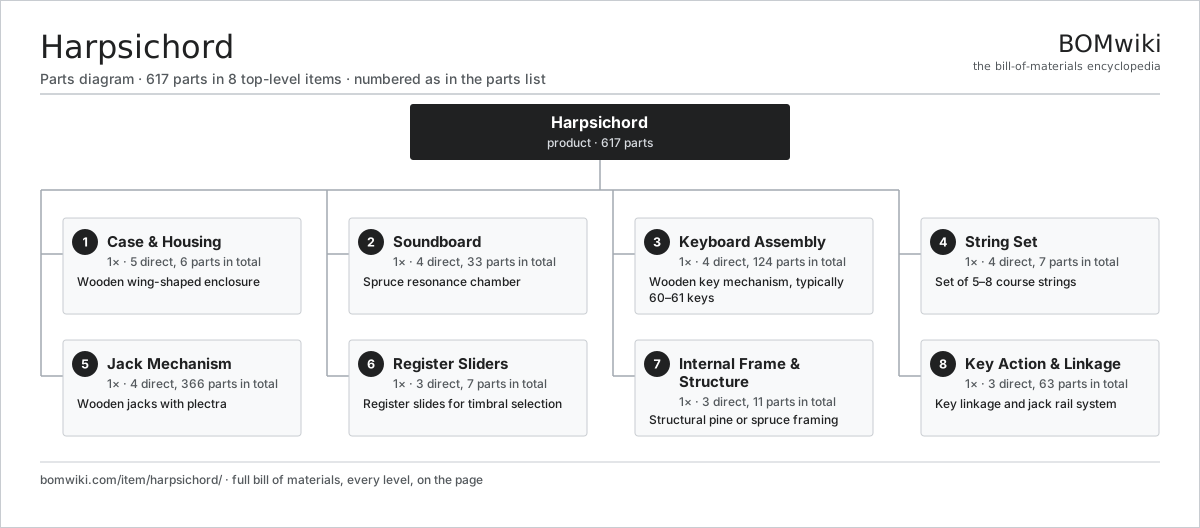
| # | Part | Qty | What it does |
|---|---|---|---|
| 1 | Case & Housing 5 parts | 1× | Wooden wing-shaped enclosure |
| 2 | Soundboard 4 parts | 1× | Spruce resonance chamber |
| 3 | Keyboard Assembly 4 parts | 1× | Wooden key mechanism, typically 60–61 keys |
| 4 | String Set 4 parts | 1× | Set of 5–8 course strings |
| 5 | Jack Mechanism 4 parts | 1× | Wooden jacks with plectra |
| 6 | Register Sliders 3 parts | 1× | Register slides for timbral selection |
| 7 | Internal Frame & Structure 3 parts | 1× | Structural pine or spruce framing |
| 8 | Key Action & Linkage 3 parts | 1× | Key linkage and jack rail system |
3D model
No 3D model yet. Have a CAD file of this? Add a 3D model. STL renders right on this page; STEP, FreeCAD, and OpenSCAD sources are welcome too (openly licensed, like all 3D models on BOMwiki).
Build & assembly graph
expand / collapse · shared sub-assemblies converge · links to related products · est. labourTap an assembly to expand/collapse · tap a part to open it · use “Open page” for any node · drag to pan, scroll to zoom.
Bill of materials for Harpsichord
8 top-level lines · 38 rows shown · 617 parts total · indented to 3 levels| # | Item / sub-assembly | Part no. | Qty/assy | Ext. qty | Parts | Type |
|---|---|---|---|---|---|---|
| 1 | Case & Housing 5 parts | harpsichord-case | 1× | 1 | 6 | assembly |
| 1.1 | Case Bottom | harpsichord-case-bottom | 1× | 1 | · | part |
| 1.2 | Case Cheek | harpsichord-case-cheek | 2× | 2 | · | part |
| 1.3 | Bentside | harpsichord-case-bentside | 1× | 1 | · | part |
| 1.4 | Lid with Prop | harpsichord-case-lid | 1× | 1 | · | part |
| 1.5 | Decorative Veneer | harpsichord-case-veneer | 1× | 1 | · | part |
| 2 | Soundboard 4 parts | harpsichord-soundboard | 1× | 1 | 33 | assembly |
| 2.1 | Soundboard Panel | harpsichord-soundboard-panel | 1× | 1 | · | part |
| 2.2 | Rose Hole Inlay | harpsichord-rose-hole | 1× | 1 | · | part |
| 2.3 | Tonal Bar | harpsichord-tonal-bar | 1× | 1 | · | part |
| 2.4 | Bridge Pin | harpsichord-bridge-pin | 30× | 30 | · | part |
| 3 | Keyboard Assembly 4 parts | harpsichord-keyboard | 1× | 1 | 124 | assembly |
| 3.1 | Key Blank | harpsichord-key-blank | 61× | 61 | · | part |
| 3.2 | Key Covering | harpsichord-key-covering | 1× | 1 | · | part |
| 3.3 | Key Pivot Pin | harpsichord-key-pin | 61× | 61 | · | part |
| 3.4 | Key Rail & Guide | harpsichord-key-rail | 1× | 1 | · | part |
| 4 | String Set 4 parts | harpsichord-strings | 1× | 1 | 7 | assembly |
| 4.1 | Treble String Course | harpsichord-string-course-treble | 2× | 2 | · | part |
| 4.2 | Mid String Course | harpsichord-string-course-mid | 2× | 2 | · | part |
| 4.3 | Bass String Course | harpsichord-string-course-bass | 2× | 2 | · | part |
| 4.4 | 4-Foot String Course | harpsichord-string-course-4foot | 1× | 1 | · | part |
| 5 | Jack Mechanism 4 parts | harpsichord-jack-mechanism | 1× | 1 | 366 | assembly |
| 5.1 | Jack Body | harpsichord-jack-body | 61× | 61 | · | part |
| 5.2 | Plectrum | harpsichord-jack-plectrum | 122× | 122 | · | part |
| 5.3 | Jack Return Spring | harpsichord-jack-spring | 61× | 61 | · | part |
| 5.4 | Jack Damper | harpsichord-jack-damper | 122× | 122 | · | part |
| 6 | Register Sliders 3 parts | harpsichord-registers | 1× | 1 | 7 | assembly |
| 6.1 | Register Slider | harpsichord-register-slider | 3× | 3 | · | part |
| 6.2 | Register Stop Knob | harpsichord-register-stop | 3× | 3 | · | part |
| 6.3 | Register Guide Frame | harpsichord-register-guide | 1× | 1 | · | part |
| 7 | Internal Frame & Structure 3 parts | harpsichord-frame | 1× | 1 | 11 | assembly |
| 7.1 | Frame Beam | harpsichord-frame-beam | 4× | 4 | · | part |
| 7.2 | Frame Brace | harpsichord-frame-brace | 6× | 6 | · | part |
| 7.3 | Fastener Set | fastener-set | 1× | 1 | · | part |
| 8 | Key Action & Linkage 3 parts | harpsichord-action-assembly | 1× | 1 | 63 | assembly |
| 8.1 | Jack Guide Rail | harpsichord-guide-rail | 1× | 1 | · | part |
| 8.2 | Jack Mechanism Rail | harpsichord-jack-rail | 1× | 1 | · | part |
| 8.3 | Action Key Pin | harpsichord-action-key-pin | 61× | 61 | · | part |
Something wrong in this list? Report a problem with this BOM.
Sourcing: possible vendors
Browse the supplier directory → Prices, MOQ, and lead times are algorithmic estimates, not quotes, and not claims about these companies. Company mappings are curated by keyword; est. price band $50–$5k. How estimates work| Vendor | HQ | Specialty | MOQ | Lead time |
|---|---|---|---|---|
| yamaha.com ↗ | Hamamatsu, JP | Audio & instruments | 200 units | 8–14 wks |
|
🇺🇸Fender
fender.com ↗
|
Los Angeles, US | Guitars & amps | 200 units | 8–14 wks |
|
🇺🇸Gibson
gibson.com ↗
|
Nashville, US | Guitars | 200 units | 8–14 wks |
|
🇯🇵Roland
roland.com ↗
|
Hamamatsu, JP | Electronic instruments | 200 units | 8–14 wks |
| steinway.com ↗ | New York, US | Pianos | 200 units | 8–14 wks |
840-word article