Hay Tedder
ProductOverview
A hay tedder (rotary tedder) speeds field drying of mown grass. A mower leaves the crop in dense swaths in which the bottom layer stays wet for days; the tedder picks those swaths up and scatters the crop across the full field surface in a loose, aerated layer. Exposing all of it to sun and wind can halve wilting time, often the difference between baling hay before rain and losing it. For silage the same machine takes grass from 80% moisture at mowing to the 65–70% target in a single sunny day.
The working width is covered by six overlapping Rotor Spiders, each about 1.4 m in sweep diameter and carrying six Tine Arms tipped with sprung Double Tines of 9–10 mm spring steel. Adjacent rotors turn in opposite directions at roughly 200 rpm, so each pair gathers crop between them and hurls it up and rearward; the tine tips travel near 15 m/s, fast enough to tease apart a wet swath but sprung so they ride over stones and comb the stubble without scalping soil.
How it works
Drive enters through the PTO Shaft at 540 rpm into the Main Gearbox, which splits it left and right along the frame. Hex Drive Shafts carry rotation through the frame tubes to a sealed Rotor Drive Head above each rotor; alternate heads are geared to reverse direction. At each fold joint a dog-type Finger Clutch lets the shafts separate as the wings fold and re-engage on unfolding in any relative position.
Ground following decides job quality. Each rotor rides on its own gauge wheel, set on a castoring Wheel Fork directly under the rotor centre, so tine height tracks the local surface rather than the average of the whole 7.7 m machine. A pinned Height Collar sets clearance in roughly 5 mm steps: tines too high leave wet crop behind; tines too low rake soil and ash into the forage, which shows up later as poor silage fermentation. The Pitch Adjuster on each wheel fork sets rotor pitch, steep for aggressive first tedding of heavy wet swaths, shallow for gentle final turning of nearly dry hay, when leaf shatter in legume crops becomes the dominant loss (lucerne can lose a substantial share of its feed-value-bearing leaves to over-aggressive tedding).
The machine is mounted on a Category 2 linkage through a swinging Headstock Frame: the frame pivots behind the tractor on corners and slopes, steadied by Pivot Dampers and recentered by Stabilizer Springs, so the rotors keep tracking the ground line rather than the tractor's yaw.
Two settings deal with field boundaries and weather. The Border Spreading Device tilts the machine so crop is thrown inward along hedges and watercourses instead of into them. The Night Swath Kit narrows the spread into loose windrows in the evening, reducing the surface area that overnight dew rewets, ready to be spread again next morning.
Transport and safety
For the road, two Fold Cylinders raise the four Wing Frame Sections vertical in about 30 seconds, bringing the machine inside 3.0 m width; mechanical Transport Locks hold the wings independently of hydraulic pressure, and Warning Panels mark the silhouette. In work, the Guard Bow around each rotor keeps people and obstacles out of the tine path.
The characteristic failure of any tedder is a fatigued tine breaking off and hiding in the forage, where it can wreck a baler knotter or, worse, be eaten by a cow. Every tine therefore carries a Tine Saver Clip retainer that keeps a fractured coil attached to its arm, a trivial part that the industry treats as mandatory.
Context
Six-rotor mounted machines around 7.7 m suit the 50–70 hp tractors of typical grassland farms and cover 7–9 ha/h. The same architecture scales from 4.5 m four-rotor models to 17 m trailed machines with ten or more rotors for large forage operations. In a grass-drying chain the tedder works between the mower (or mower-conditioner) and the rotary rake that gathers the dried crop back into windrows for the baler or forage harvester; on many farms it is the cheapest machine in that chain and the one whose timing matters most.
Hay Tedder parts and their functions
6 top-level parts · 272 parts in total · full bill of materials below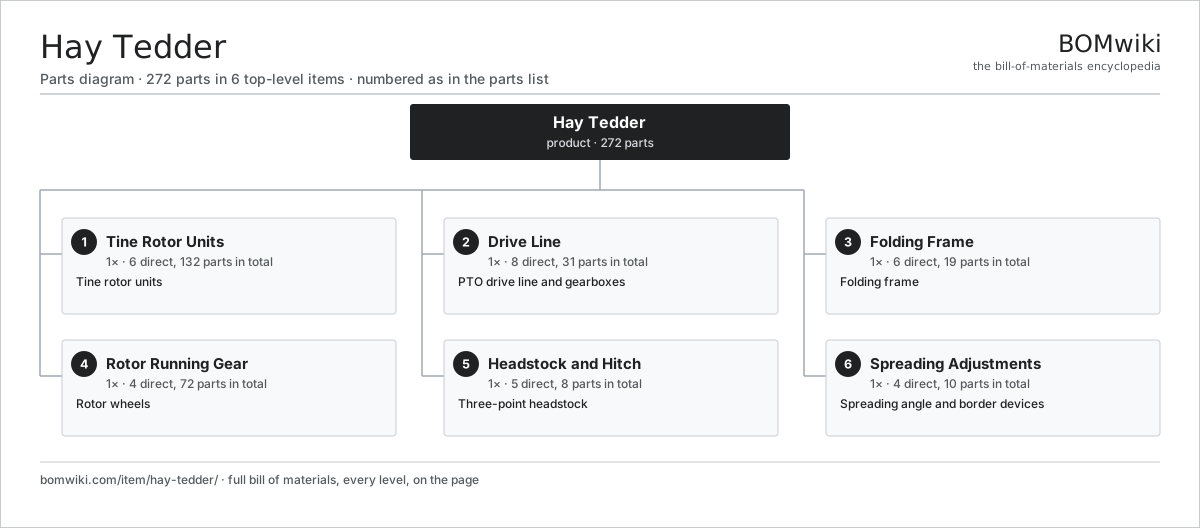
| # | Part | Qty | What it does |
|---|---|---|---|
| 1 | Tine Rotor Units 6 parts | 1× | Tine rotor units |
| 2 | Drive Line 8 parts | 1× | PTO drive line and gearboxes |
| 3 | Folding Frame 6 parts | 1× | Folding frame |
| 4 | Rotor Running Gear 4 parts | 1× | Rotor wheels |
| 5 | Headstock and Hitch 5 parts | 1× | Three-point headstock |
| 6 | Spreading Adjustments 4 parts | 1× | Spreading angle and border devices |
3D model
No 3D model yet. Have a CAD file of this? Add a 3D model. STL renders right on this page; STEP, FreeCAD, and OpenSCAD sources are welcome too (openly licensed, like all 3D models on BOMwiki).
Build & assembly graph
expand / collapse · shared sub-assemblies converge · links to related products · est. labourTap an assembly to expand/collapse · tap a part to open it · use “Open page” for any node · drag to pan, scroll to zoom.
Bill of materials for Hay Tedder
6 top-level lines · 44 rows shown · 272 parts total · indented to 3 levels| # | Item / sub-assembly | Part no. | Qty/assy | Ext. qty | Parts | Type |
|---|---|---|---|---|---|---|
| 1 | Tine Rotor Units 6 parts | hay-tedder-rotors | 1× | 1 | 132 | assembly |
| 1.1 | Rotor Spider | hay-tedder-rotor-spider | 6× | 6 | · | part |
| 1.2 | Tine Arm | hay-tedder-tine-arm | 36× | 36 | · | part |
| 1.3 | Double Tine | hay-tedder-double-tine | 36× | 36 | · | part |
| 1.4 | Tine Saver Clip | hay-tedder-tine-saver | 36× | 36 | · | part |
| 1.5 | Ball Bearing | ball-bearing | 12× | 12 | · | part |
| 1.6 | Fastener Set | fastener-set | 6× | 6 | · | part |
| 2 | Drive Line 8 parts | hay-tedder-driveline | 1× | 1 | 31 | assembly |
| 2.1 | PTO Shaft | hay-tedder-pto-shaft | 1× | 1 | · | part |
| 2.2 | Main Gearbox | hay-tedder-main-gearbox | 1× | 1 | · | part |
| 2.3 | Rotor Drive Head | hay-tedder-rotor-gearbox | 6× | 6 | · | part |
| 2.4 | Hex Drive Shaft | hay-tedder-hex-shaft | 5× | 5 | · | part |
| 2.5 | Finger Clutch | hay-tedder-finger-clutch | 5× | 5 | · | part |
| 2.6 | Helical Gear Pair | gear-pair | 6× | 6 | · | part |
| 2.7 | Gearbox Housing | gearbox-housing | 1× | 1 | · | part |
| 2.8 | Oil Seal | oil-seal | 6× | 6 | · | part |
| 3 | Folding Frame 6 parts | hay-tedder-frame | 1× | 1 | 19 | assembly |
| 3.1 | Centre Frame Section | hay-tedder-centre-section | 1× | 1 | · | part |
| 3.2 | Wing Frame Section | hay-tedder-wing-section | 4× | 4 | · | part |
| 3.3 | Fold Cylinder | hay-tedder-fold-cylinder | 2× | 2 | · | part |
| 3.4 | Transport Lock | hay-tedder-transport-lock | 2× | 2 | · | part |
| 3.5 | Guard Bow | hay-tedder-guard-bow | 6× | 6 | · | part |
| 3.6 | Coil Spring | coil-spring | 4× | 4 | · | part |
| 4 | Rotor Running Gear 4 parts | hay-tedder-running-gear | 1× | 1 | 72 | assembly |
| 4.1 | Wheel Assembly 5 parts | wheel-assembly | 6× | 6 | 9 | assembly |
| 4.1.1 | Alloy Wheel | alloy-wheel | 1× | 6 | · | part |
| 4.1.2 | Tire | tire | 1× | 6 | · | part |
| 4.1.3 | TPMS Sensor | tpms-sensor | 1× | 6 | · | part |
| 4.1.4 | Lug Nut | lug-nut | 5× | 30 | · | part |
| 4.1.5 | Valve Stem | valve-stem | 1× | 6 | · | part |
| 4.2 | Wheel Fork | hay-tedder-wheel-fork | 6× | 6 | · | part |
| 4.3 | Height Collar | hay-tedder-height-collar | 6× | 6 | · | part |
| 4.4 | Ball Bearing | ball-bearing | 6× | 6 | · | part |
| 5 | Headstock and Hitch 5 parts | hay-tedder-hitch | 1× | 1 | 8 | assembly |
| 5.1 | Headstock Frame | hay-tedder-headstock-frame | 1× | 1 | · | part |
| 5.2 | Pivot Damper | hay-tedder-pivot-damper | 2× | 2 | · | part |
| 5.3 | Lower Link Pin | hay-tedder-lower-link-pin | 2× | 2 | · | part |
| 5.4 | Stabilizer Spring | hay-tedder-stabilizer-spring | 2× | 2 | · | part |
| 5.5 | Parking Jack | hay-tedder-parking-jack | 1× | 1 | · | part |
| 6 | Spreading Adjustments 4 parts | hay-tedder-adjustment | 1× | 1 | 10 | assembly |
| 6.1 | Pitch Adjuster | hay-tedder-pitch-adjuster | 6× | 6 | · | part |
| 6.2 | Border Spreading Device | hay-tedder-border-device | 1× | 1 | · | part |
| 6.3 | Night Swath Kit | hay-tedder-night-swath-gear | 1× | 1 | · | part |
| 6.4 | Warning Panel | hay-tedder-warning-panel | 2× | 2 | · | part |
Something wrong in this list? Report a problem with this BOM.
Related products
same domain, ranked by shared parts Manure Spreader
146 parts · shares 10 with this page
Manure Spreader
146 parts · shares 10 with this page
 Rotary Hay Rake
271 parts · shares 10 with this page
Rotary Hay Rake
271 parts · shares 10 with this page
 Round Baler
208 parts · shares 10 with this page
Round Baler
208 parts · shares 10 with this page
 Fertilizer Spreader
164 parts · shares 9 with this page
Fertilizer Spreader
164 parts · shares 9 with this page
 Seed Drill
327 parts · shares 9 with this page
Seed Drill
327 parts · shares 9 with this page
 Self-Propelled Sprayer
482 parts · shares 9 with this page
Self-Propelled Sprayer
482 parts · shares 9 with this page
Sourcing: possible vendors
Browse the supplier directory → Prices, MOQ, and lead times are algorithmic estimates, not quotes, and not claims about these companies. Company mappings are curated by keyword; est. price band $5k–$800k. How estimates work| Vendor | HQ | Specialty | MOQ | Lead time |
|---|---|---|---|---|
| deere.com ↗ | Moline, US | Agriculture & turf | made to order | 14–24 wks |
| cnh.com ↗ | Basildon, GB | Agriculture (Case IH, New Holland) | made to order | 14–24 wks |
|
🇺🇸AGCO
agcocorp.com ↗
|
Duluth, US | Agriculture (Fendt, Massey Ferguson) | made to order | 14–24 wks |
|
🇩🇪Claas
claas.com ↗
|
Harsewinkel, DE | Harvesters & tractors | made to order | 14–24 wks |
|
🇯🇵Kubota
kubota.com ↗
|
Osaka, JP | Compact tractors & equipment | made to order | 14–24 wks |
760-word article