Headlight Aimer
ProductOverview
The headlight aimer is a precision optical tool that measures and corrects vehicle headlight beam alignment, ensuring drivers maintain safe low-beam projection and comply with federal lighting standards. A headlight beam pointed too high blinds oncoming drivers; a beam too low reduces the driver's forward visibility. The aimer uses a 25-foot reference distance (the standard NHTSA test distance), an Optical Enclosure equipped with a frosted viewing screen, and an optional Alignment Laser Assembly for precise center-beam targeting. The technician positions the aimer directly in front of the vehicle headlight, at height-adjusted center using the Vertical Rail and Adjustment Mechanism, then observes the beam pattern on the screen. A reference grid and Low-Beam Cutoff Line indicate the correct low-beam cutoff angle (typically 15° downward), allowing quick visual assessment and guidance for suspension or headlight adjustment.
Proper headlight aiming is often overlooked during routine vehicle maintenance, yet accidents linked to mis-aimed lights are significant (an estimated 10,000+ deaths annually in the U.S. per NHTSA). Newer vehicles with adaptive or LED headlights may drift out of alignment following suspension work, frame straightening, or accident repair. The aimer provides a quick, repeatable method to verify alignment before returning the vehicle to the customer.
Optical Principles
The Optical Lens Collimator acts as a collimator, collecting the diverging cone of light from the vehicle's headlight bulb and projecting it onto the Target Viewing Screen. The headlight's filament is imaged onto the screen, revealing the beam pattern: a sharp low-beam cutoff (the "hockey-stick" line in halogen headlights, a more gradual transition in LED units), the high-beam zone above that line, and the beam width. The screen is positioned precisely at a 1:1 reproduction scale to a vehicle 25 feet away, so any deviation in the pattern directly corresponds to a deviation in the on-road beam.
The Alignment Laser Assembly projects a small red dot onto the screen, marking the beam center. By adjusting the laser position until it aligns with the observed headlight filament image, the technician confirms that the aimer is centered on the headlight and ready for measurement.
Measurement and Adjustment Procedure
The technician positions the aimer 25 feet from the vehicle (verified with a chalk mark or floor tape) and uses the Sliding Carriage Block hand crank or optional Height Adjustment Motor to raise or lower the optical box until its center is aligned with the center of the headlight being measured (typically the low-beam filament). A Level Bubble Indicator ensures the aimer is plumb (not tilted).
Once positioned, the technician observes the headlight beam pattern on the Target Viewing Screen. If the Low-Beam Cutoff Line (the reference line marking correct low-beam cutoff) aligns with the actual observed cutoff in the beam, the headlight is correctly aimed. If the cutoff is above the reference (beam too high), the technician adjusts the headlight aim downward via the vehicle's aiming screws (typically located on the headlight housing, accessible from under the hood). If the cutoff is below the reference (beam too low), aim is adjusted upward.
Each adjustment is made in small increments (0.5–1° per turn of the aiming screw), and the pattern is re-observed after each change. The process continues until the observed cutoff aligns with the reference line and the beam width is centered. This typically requires 3–5 iterations.
Factors Affecting Accuracy
Vehicle suspension condition affects aiming; a lowered or jounced suspension changes the headlight angle relative to the road. Before aiming, the technician should verify that the vehicle is on level ground, the fuel tank is full (a half-full tank can shift the suspension geometry), and the tires are properly inflated. Some shops use a vehicle-level laser (a separate tool) to establish a plumb reference before aiming, especially after frame straightening or suspension work.
LED and adaptive headlights introduce additional complexity. Modern LED units are computer-controlled and may re-aim themselves in response to vehicle pitch and suspension load. The aimer captures a snapshot in time; if the system re-aims after the technician's adjustment, re-measurement may be necessary. Some newer vehicles require electronic adjustment via OBD-II scan tool rather than manual aiming screws.
Portable vs. Fixed Installation
The headlight aimer can be mobile (mounted on Caster Wheel Assembly with brakes) for flexibility in shop positioning, or fixed in place on a specific alignment bay floor. A fixed installation is more accurate because the 25-foot distance is permanently marked, and the aimer position is repeatable. A mobile unit is more versatile, allowing aiming in any bay, but requires careful positioning and distance verification each time.
Maintenance and Calibration
The Optical Lens Collimator should be cleaned periodically with lens tissue and lens cleaner to remove dust and road debris that reduce light transmission. The Target Viewing Screen may become scratched or dulled after years of use; replacement is straightforward (usually four fasteners). The Alignment Laser Assembly diode has a rated lifetime of 10,000+ hours; if output drops below 3 mW or the dot becomes dim, replacement is indicated.
Annual verification of aimer accuracy can be performed using a reference vehicle with known-good headlight alignment or by cross-checking aiming with a second shop's aimer. The Vertical Rail and Adjustment Mechanism bearings should be lubricated annually with light machine oil, and caster swivel points checked for wear.
Headlight Aimer parts and their functions
6 top-level parts · 16 parts in total · full bill of materials below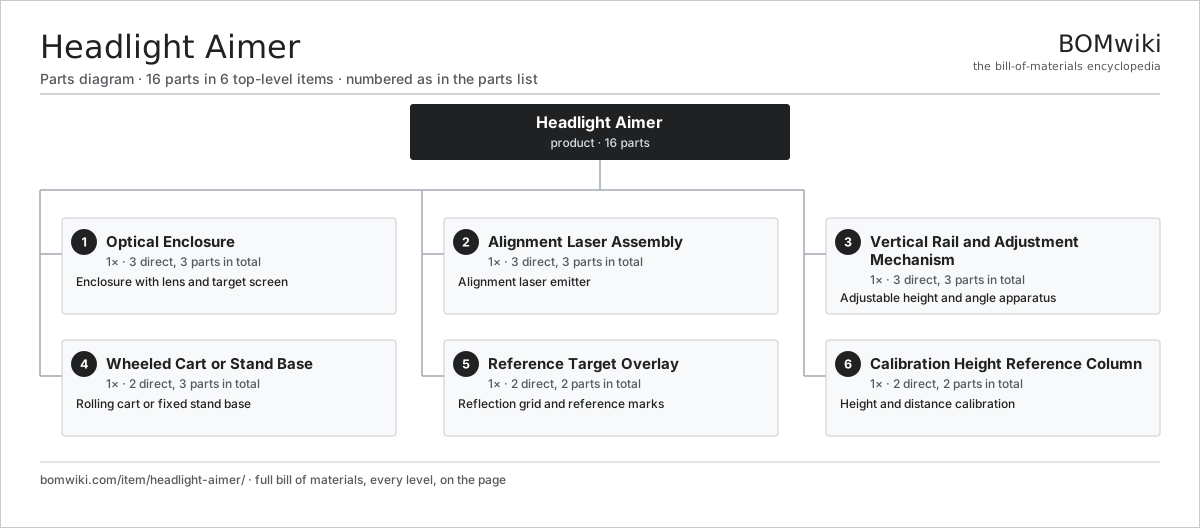
| # | Part | Qty | What it does |
|---|---|---|---|
| 1 | Optical Enclosure 3 parts | 1× | Enclosure with lens and target screen |
| 2 | Alignment Laser Assembly 3 parts | 1× | Alignment laser emitter |
| 3 | Vertical Rail and Adjustment Mechanism 3 parts | 1× | Adjustable height and angle apparatus |
| 4 | Wheeled Cart or Stand Base 2 parts | 1× | Rolling cart or fixed stand base |
| 5 | Reference Target Overlay 2 parts | 1× | Reflection grid and reference marks |
| 6 | Calibration Height Reference Column 2 parts | 1× | Height and distance calibration |
3D model
No 3D model yet. Have a CAD file of this? Add a 3D model. STL renders right on this page; STEP, FreeCAD, and OpenSCAD sources are welcome too (openly licensed, like all 3D models on BOMwiki).
Build & assembly graph
expand / collapse · shared sub-assemblies converge · links to related products · est. labourTap an assembly to expand/collapse · tap a part to open it · use “Open page” for any node · drag to pan, scroll to zoom.
Bill of materials for Headlight Aimer
6 top-level lines · 21 rows shown · 16 parts total · indented to 3 levels| # | Item / sub-assembly | Part no. | Qty/assy | Ext. qty | Parts | Type |
|---|---|---|---|---|---|---|
| 1 | Optical Enclosure 3 parts | headlight-aimer-optical-box | 1× | 1 | 3 | assembly |
| 1.1 | Enclosure Shell | headlight-aimer-box-body | 1× | 1 | · | part |
| 1.2 | Optical Lens Collimator | headlight-aimer-lens-assembly | 1× | 1 | · | part |
| 1.3 | Target Viewing Screen | headlight-aimer-screen | 1× | 1 | · | part |
| 2 | Alignment Laser Assembly 3 parts | headlight-aimer-laser-module | 1× | 1 | 3 | assembly |
| 2.1 | Laser Diode Element | headlight-aimer-laser-diode | 1× | 1 | · | part |
| 2.2 | Laser Collimator Lens | headlight-aimer-laser-optics | 1× | 1 | · | part |
| 2.3 | Laser Positioning Bracket | headlight-aimer-laser-mount | 1× | 1 | · | part |
| 3 | Vertical Rail and Adjustment Mechanism 3 parts | headlight-aimer-rail-system | 1× | 1 | 3 | assembly |
| 3.1 | Vertical Rail Track | headlight-aimer-rail-track | 1× | 1 | · | part |
| 3.2 | Sliding Carriage Block | headlight-aimer-rail-carriage | 1× | 1 | · | part |
| 3.3 | Height Adjustment Motor | headlight-aimer-rail-motor | 1× | 1 | · | part |
| 4 | Wheeled Cart or Stand Base 2 parts | headlight-aimer-wheel-base | 1× | 1 | 3 | assembly |
| 4.1 | Base Frame Structure | headlight-aimer-base-frame | 1× | 1 | · | part |
| 4.2 | Caster Wheel Assembly | headlight-aimer-casters | 2× | 2 | · | part |
| 5 | Reference Target Overlay 2 parts | headlight-aimer-targets | 1× | 1 | 2 | assembly |
| 5.1 | Target Grid Overlay | headlight-aimer-target-grid | 1× | 1 | · | part |
| 5.2 | Low-Beam Cutoff Line | headlight-aimer-target-cutoff-line | 1× | 1 | · | part |
| 6 | Calibration Height Reference Column 2 parts | headlight-aimer-measuring-column | 1× | 1 | 2 | assembly |
| 6.1 | Measuring Scale Rod | headlight-aimer-measuring-rod | 1× | 1 | · | part |
| 6.2 | Level Bubble Indicator | headlight-aimer-level-indicator | 1× | 1 | · | part |
Something wrong in this list? Report a problem with this BOM.
Sourcing: possible vendors
Browse the supplier directory → Prices, MOQ, and lead times are algorithmic estimates, not quotes, and not claims about these companies. Company mappings are curated by keyword; est. price band $0.50–$100. How estimates work| Vendor | HQ | Specialty | MOQ | Lead time |
|---|
918-word article