Heated Grips
ProductOverview
Heated grips are electric heating elements embedded in motorcycle handlebar grips that warm the rider's hands during cold-weather riding. A closed-loop temperature controller maintains the grip surface at a desired warmth (typically 40–60°C) by modulating heating power based on feedback from embedded temperature sensors. Modern heated grips consume 100–300 W at full power, drawing from the motorcycle's 12 V battery and requiring proper fuse protection. They are standard equipment on touring bikes and cold-climate motorcycles, significantly improving rider comfort and safety during winter rides.
Heat Transfer Fundamentals
Hand-Grip Thermal Exchange
The human hand loses heat rapidly in cold environments through:
- Convection: Wind moving across exposed skin (dominant in moving air).
- Radiation: Heat emission to cooler surroundings (minor contributor outdoors).
- Conduction: Direct contact with cold surfaces (dominant in grip contact).
At 100 km/h riding speed:
- Ambient air temp: -5°C
- Wind chill: ~-20°C (effective temperature perceived by skin)
- Unheated grip temp: ~0°C (aluminum bar, cooled by wind and rain)
- Hand heat loss (unheated grip): ~50–80 W (via conduction and convection)
Heated Grip Thermal Solution
A Left Heating Element generating 100 W of heat:
- Distributed across grip surface area (~4000 mm² for a 120×140 mm wrap).
- Heat flux: ~25 W/cm², or ~0.025 W/mm².
- Grip surface temperature rises to ~45–50°C (comfortable warmth without burning).
- Hand receives heat via conduction; skin-grip temperature difference drives heat flow into the hand.
Net effect: Hand loses 50–80 W to environment, but gains ~40–60 W from grip → net warming.
Thermal Time Constant
The grip assembly (rubber, insulation, heating element) has a thermal time constant:
τ ≈ (m × c) / h
Where:
- m = mass of grip + insulation (~200 g)
- c = specific heat capacity (~1.5 kJ/(kg·K) for rubber + aluminum)
- h = convective heat transfer coefficient (~50 W/(m²·K) in moving air)
τ ≈ (0.2 kg × 1500 J/(kg·K)) / (50 W/(m²·K) × 0.004 m²) ≈ 15 seconds
The grip reaches steady-state temperature within ~30 seconds of power-up, matching rider expectations.
Heating Element Design
Resistance Wire Calculation
A heated grip rated 100 W at 12 V:
- Resistance needed: R = V² / P = 144 V² / 100 W = 1.44 Ω
- Wire type: Nichrome (Ni80Cr20) with resistivity ρ = 1.09 Ω·mm²/m
- Wire diameter: 0.8 mm → cross-sectional area A = π(0.4)² ≈ 0.5 mm²
- Wire length: L = R × (ρ / A) = 1.44 Ω × (1.09 Ω·mm²/m / 0.5 mm²) ≈ 3.14 meters
The heating element is a coil of ~3.1 m of 0.8 mm nichrome wire, wound in a spiral pattern and embedded in the rubber grip material.
Heat Distribution
The Left Heating Element is wound in a uniform serpentine pattern across the grip:
- Coil spacing: 10–15 mm apart (ensures uniform heating, avoids hot spots).
- Pitch (vertical spacing): 5–8 mm (distributes heat along the length).
- Total wraps: ~40–50 coils for a 120 mm length grip.
This design ensures that heat is generated uniformly across the entire grip surface, preventing any area from getting excessively hot (>65°C).
Maximum Operating Temperature
Rubber grips have a glass transition temperature (Tg) around 70–80°C:
- Below Tg: Rubber is flexible, durable, safe to touch.
- Above Tg: Rubber begins to soften, lose elasticity, eventually crack.
- At >80°C: Risk of skin burns (human pain threshold at ~43–44°C for 5+ seconds of contact).
Design limit: Grip surface maintained at 50–60°C maximum, with a 15–20°C safety margin below rubber degradation.
Temperature Control Loop
The Temperature Controller implements a closed-loop control system:
Sensor Feedback
The Surface Temperature Sensor thermistor (NTC type, 10 kΩ @ 25°C) is embedded near the outer surface:
- Resistance vs. temperature: R(T) = R_0 × exp[β(1/T - 1/T_0)], where β ≈ 4000 K for typical NTC.
- At 25°C: R ≈ 10 kΩ
- At 50°C: R ≈ 2 kΩ
- At 70°C: R ≈ 0.5 kΩ
The Microcontroller measures the thermistor voltage using an analog-to-digital converter (ADC) and infers temperature.
Control Algorithm
The MCU runs a proportional-integral (PI) control loop:
''' error = setpoint_temperature - measured_temperature power_output = Kp × error + Ki × integral(error) '''
Where:
- Kp (proportional gain): ~50 (if error = 5°C, increase output by 250 W equivalent).
- Ki (integral gain): ~10 (accumulates error over time, eliminating steady-state offset).
PWM Modulation
Power to the heating elements is delivered via PWM (pulse-width modulation):
- Frequency: 500–1000 Hz (fast enough that grip temperature doesn't visibly fluctuate; human perception threshold is ~10 Hz).
- Duty cycle: 0–100%, adjusting heating power linearly.
- Duty cycle = 50%: Average power = 100 W × 0.5 = 50 W (medium heat).
- Duty cycle = 100%: Average power = 100 W (full heat).
The Power MOSFET Switch power MOSFET switches the 12 V supply on/off 500 times per second, creating the effective power modulation.
Rider Input Control
The Adjustment Potentiometer adjusts the setpoint temperature:
- Low: Rider adjusts dial to 40°C setpoint (minimal heat, low power draw).
- Medium: 50°C setpoint (comfortable warmth, typical mode).
- High: 60°C setpoint (maximum warmth, full power mode).
Some systems use a 4-position dial (Off / Low / Med / High); others use a continuous rotary dial.
Power Management
Current Draw
At 12 V DC, a 100 W heating element draws:
I = P / V = 100 W / 12 V ≈ 8.3 A per grip
Two grips at full power: ~16.7 A total (exceeds many motorcycle alternator outputs; must manage via PWM).
Battery Drain Calculation
Typical motorcycle battery: 12 Ah capacity.
If the rider runs heated grips at full power (16.7 A):
- Drain time: 12 Ah / 16.7 A ≈ 43 minutes.
- Reality: Most riders use medium heat (50% PWM), so actual drain ≈ 8.3 A, lasting ~90 minutes.
For a 1-hour ride, medium heat consumes ~8.3 Ah, leaving ~3.7 Ah in the battery (31% state of charge). This is adequate if the alternator is charging the battery during riding.
Charging Cycle
A 30 A alternator (typical on middleweight bikes) can provide ~30 A of charge:
- Charge rate: 30 A @ 14 V (regulated by the regulator/rectifier).
- Net charging: 30 A (from alternator) - 8.3 A (grips) = 21.7 A available for battery charging.
- Battery recharge time: 12 Ah / 21.7 A ≈ 33 minutes to fully recharge.
As long as the bike is ridden for >30–45 minutes at a time, the battery remains charged even with continuous heated grip use.
Undersized Alternator Risk
On smaller bikes (scooters, 125cc bikes) with 15–20 A alternators:
- Alternator output: 20 A
- Grips medium heat: 8.3 A
- Other electrical loads (lights, ignition, etc.): 5–8 A
- Net charge available: 20 A - 13.3 A = 6.7 A (marginal)
Extended cold-weather riding with full-power grips + lights will drain the battery over time.
Mitigation: Riders on small bikes should use low/medium heat settings or upgrade to a higher-output alternator.
Protection Circuit
The Inline Fuse inline fuse (30 A) protects against short-circuit:
- If a heating element shorts internally, current would spike to 30+ A.
- The 30 A fuse blows, cutting power to prevent wire melt or fire.
- Fuse replacement cost: ~USD 1; heating element replacement: ~USD 50–100.
Installation Considerations
OEM Grip Replacement
Heated grips are installed by replacing the original handlebar grips:
- Remove OEM grips: Cut off original grips with a utility knife or grip remover tool.
- Clean handlebar: Remove glue residue with rubbing alcohol.
- Apply grip adhesive: Spray or brush contact cement onto the handlebar and grip inner surface.
- Slide heated grip on: Roll the pre-assembled heated grip onto the handlebar, aligning the connector port.
- Secure connectors: Plug the thermistor and power connectors into the routed harness.
- Route harness: Run the power harness along the frame, under the fairing if possible, down to the controller and battery.
- Test: Power on the switch and verify that both grips warm up to the expected temperature.
Installation time: 1–2 hours for an experienced mechanic; 3–4 hours for DIY.
Grip Compatibility
Heated grips come in standard handlebar diameters:
- 22 mm (most common): Street bikes, sport bikes, cruisers.
- 25 mm (some cruisers): Thicker bars on heavy cruisers.
The rider must specify their bike model when purchasing to ensure correct diameter.
Cold-Weather Riding Benefit
Without heated grips on a winter ride (-5°C ambient):
- Ungloved hand temp: 8–10°C (risk of frostbite after 30 minutes).
- Thin glove: 15–18°C (still uncomfortably cold).
- Thick insulated glove: 25–30°C (adequate but bulky, reduces throttle sensitivity).
With heated grips at medium heat (50°C surface):
- Ungloved hand temp: 35–40°C (warm, comfortable, safe).
- Thin glove: 42–50°C (very warm, excellent comfort).
- Thick glove: 48–55°C (can be too warm; rider may lower heat setting to medium).
Safety benefit: Warm hands improve throttle control, braking precision, and grip strength; reducing hand numbness is critical for accident prevention.
Durability & Maintenance
Heating Element Lifespan
Nichrome wire in a heated grip typically lasts 3–5 years:
- Failure mode: Oxidation of the nichrome surface, increasing resistance over time.
- Symptom: Grip takes longer to warm up; power draw increases; eventually stops heating.
- Replacement: Full grip replacement (element is not serviceable).
Thermistor Drift
NTC thermistors slowly drift in accuracy (~1–2% per year):
- Effect: Control loop may run grips a few degrees hotter/cooler over time.
- Mitigation: Controller firmware can be recalibrated; or thermistor replaced if accuracy matters.
Connector Corrosion
Handlebar environment is wet and salty (in coastal regions):
- Risk: Connector oxidation, intermittent connection.
- Prevention: Apply dielectric grease to connectors annually; check connections if heating stops working.
Rubber Degradation
Grip rubber hardens and cracks after 5+ years of UV and heat exposure:
- Cosmetic issue: Cracks don't affect heating function.
- Functional issue: Grip becomes slippery; needs replacement for safety.
Regulatory & Safety
Heated grips are not subject to any official safety standard (ISO, SAE). However, manufacturers typically:
- Test wiring for 500+ insertion/removal cycles (connector durability).
- Test thermistor accuracy at 40–70°C range.
- Certify that surface temperature never exceeds 65°C even at maximum power (burn prevention).
Most quality brands (Barkbusters, Oxford, Gerbing) offer 2–3 year warranties and rigorous QC.
Power Consumption Summary
| Heating Level | Duty Cycle | Power Draw | Run Time (on battery) |
|---|---|---|---|
| Off | 0% | 0 W | Infinite |
| Low | 25% | 25 W (both) | 288 hours |
| Medium | 50% | 50 W (both) | 144 hours |
| High | 100% | 100 W (both) | 72 hours |
(Assuming 12 Ah battery, no alternator charging.)
In reality, with alternator charging at 20–30 A, medium heat is sustainable indefinitely on any motorcycle with a working charging system.
Heated Grips parts and their functions
5 top-level parts · 21 parts in total · full bill of materials below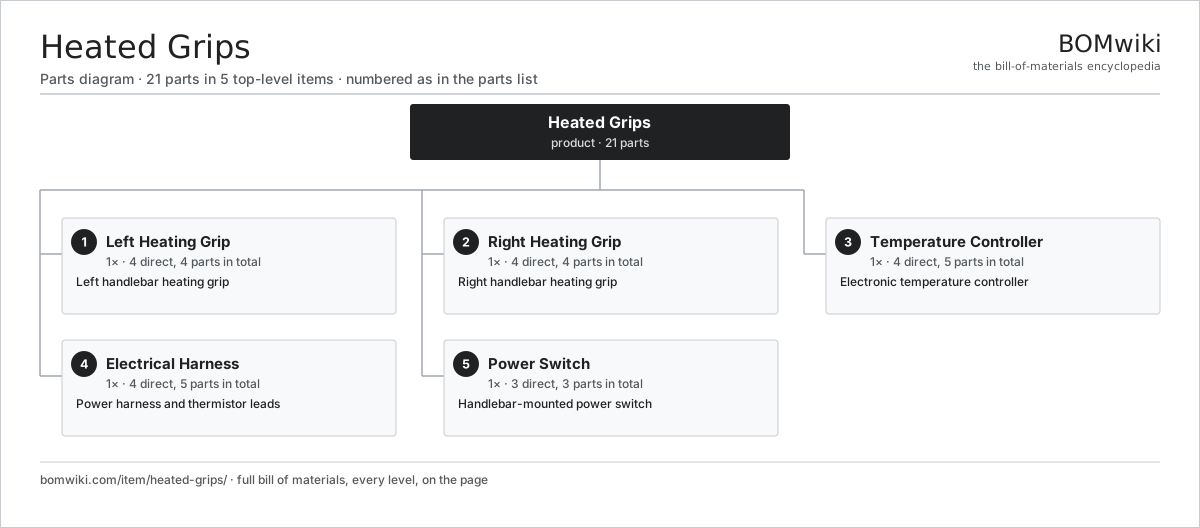
| # | Part | Qty | What it does |
|---|---|---|---|
| 1 | Left Heating Grip 4 parts | 1× | Left handlebar heating grip |
| 2 | Right Heating Grip 4 parts | 1× | Right handlebar heating grip |
| 3 | Temperature Controller 4 parts | 1× | Electronic temperature controller |
| 4 | Electrical Harness 4 parts | 1× | Power harness and thermistor leads |
| 5 | Power Switch 3 parts | 1× | Handlebar-mounted power switch |
3D model
No 3D model yet. Have a CAD file of this? Add a 3D model. STL renders right on this page; STEP, FreeCAD, and OpenSCAD sources are welcome too (openly licensed, like all 3D models on BOMwiki).
Build & assembly graph
expand / collapse · shared sub-assemblies converge · links to related products · est. labourTap an assembly to expand/collapse · tap a part to open it · use “Open page” for any node · drag to pan, scroll to zoom.
Bill of materials for Heated Grips
5 top-level lines · 24 rows shown · 21 parts total · indented to 3 levels| # | Item / sub-assembly | Part no. | Qty/assy | Ext. qty | Parts | Type |
|---|---|---|---|---|---|---|
| 1 | Left Heating Grip 4 parts | heated-grips-left-grip | 1× | 1 | 4 | assembly |
| 1.1 | Grip Outer Shell | heated-grips-grip-shell | 1× | 1 | · | part |
| 1.2 | Left Heating Element | heated-grips-heating-element-left | 1× | 1 | · | part |
| 1.3 | Surface Temperature Sensor | heated-grips-thermal-sensor | 1× | 1 | · | part |
| 1.4 | Inner Insulation Layer | heated-grips-grip-insulation | 1× | 1 | · | part |
| 2 | Right Heating Grip 4 parts | heated-grips-right-grip | 1× | 1 | 4 | assembly |
| 2.1 | Grip Outer Shell | heated-grips-grip-shell | 1× | 1 | · | part |
| 2.2 | Right Heating Element | heated-grips-heating-element-right | 1× | 1 | · | part |
| 2.3 | Surface Temperature Sensor | heated-grips-thermal-sensor | 1× | 1 | · | part |
| 2.4 | Inner Insulation Layer | heated-grips-grip-insulation | 1× | 1 | · | part |
| 3 | Temperature Controller 4 parts | heated-grips-controller | 1× | 1 | 5 | assembly |
| 3.1 | Microcontroller | heated-grips-controller-mcu | 1× | 1 | · | part |
| 3.2 | Power MOSFET Switch | heated-grips-controller-mosfet | 2× | 2 | · | part |
| 3.3 | Adjustment Potentiometer | heated-grips-controller-potentiometer | 1× | 1 | · | part |
| 3.4 | Controller Enclosure | heated-grips-controller-housing | 1× | 1 | · | part |
| 4 | Electrical Harness 4 parts | heated-grips-wiring | 1× | 1 | 5 | assembly |
| 4.1 | Power Cable | heated-grips-harness-power | 1× | 1 | · | part |
| 4.2 | Signal Wire Bundle | heated-grips-harness-signal | 1× | 1 | · | part |
| 4.3 | Waterproof Connector | heated-grips-harness-connector | 2× | 2 | · | part |
| 4.4 | Inline Fuse | heated-grips-harness-fuse | 1× | 1 | · | part |
| 5 | Power Switch 3 parts | heated-grips-switch | 1× | 1 | 3 | assembly |
| 5.1 | Switch Element | heated-grips-switch-button | 1× | 1 | · | part |
| 5.2 | Switch Housing | heated-grips-switch-housing | 1× | 1 | · | part |
| 5.3 | Status LED Indicator | heated-grips-switch-led | 1× | 1 | · | part |
Something wrong in this list? Report a problem with this BOM.
Sourcing: possible vendors
Browse the supplier directory → Prices, MOQ, and lead times are algorithmic estimates, not quotes, and not claims about these companies. Company mappings are curated by keyword; est. price band $300–$15k. How estimates work| Vendor | HQ | Specialty | MOQ | Lead time |
|---|---|---|---|---|
| global.honda ↗ | Tokyo, JP | Motorcycles & power products | made to order | 10–16 wks |
| yamaha-motor.com ↗ | Iwata, JP | Motorcycles & marine | made to order | 10–16 wks |
| heromotocorp.com ↗ | New Delhi, IN | Motorcycle & scooter maker | made to order | 10–16 wks |
| bajajauto.com ↗ | Pune, IN | Two- & three-wheeler maker | made to order | 10–16 wks |
| harley-davidson.com ↗ | Milwaukee, US | Motorcycles | made to order | 10–16 wks |
1,771-word article