Heliport Beacon
ProductOverview
A heliport beacon is the long-range "you are looking at a heliport" signal: an omnidirectional flashing light mounted on a mast or rooftop that a pilot can pick out of city clutter from kilometers away, before any of the perimeter or touchdown lighting resolves. ICAO Annex 14 Volume II calls for the beacon where long-range visual guidance is needed and other means are inadequate, and gives it a unique signature: the Morse letter H, four short flashes, repeated continuously. The flash code is the identification; a steady or single-flash light could be confused with an aerodrome beacon or obstruction light, but four dots in rhythm reads unambiguously as a heliport.
The instrument divides into the LED Array that produces the light, the Flash Controller that keys the code, the Power Section, the Photocell Assembly that runs it automatically, the weatherproof Enclosure, and the Tower Mount.
Photometrics
The beacon's job is detection range, so its key figure is effective intensity, the steady-light equivalent of a brief flash as the eye perceives it, computed by the Blondel-Rey relation. Annex 14 requires the flashes to deliver on the order of 2,000 candela effective at night across all 360° of azimuth, from the horizon up to about 10° of elevation, because that wedge of sky is where an approaching helicopter actually is. Dual-intensity models step up to 10,000 cd or more for daylight conspicuity and drop at night so the beacon does not glare out the precision lighting near the pad.
Shaping that wedge is the optics' work. The LED Tiers face radially outward from the Array Heatsink column, and the Prismatic Drum Lens compresses their vertical spread into a flat fan on the horizon, exactly as a marine lighthouse optic does. Light sent steeply upward or downward is wasted, which is why the Leveling Bolts and a bubble level matter at installation: a beacon tilted two degrees throws its peak intensity above or below the approach paths it exists to serve.
Legacy beacons made their flashes with xenon discharge tubes, genuinely instantaneous, but maintenance-heavy, with trigger circuits and tubes needing periodic replacement at the top of a mast. LED arrays now synthesize the flash electronically: the Microcontroller gates the tier currents through Power MOSFET switches, producing a rectangular pulse whose duration and amplitude are tuned to meet the effective-intensity requirement at minimum average power, typically 30–100 W for the whole unit.
Flash code and control
The controller times the H pattern, four flashes in quick succession, a gap, repeat, at an overall character rate giving 30 to 60 flashes per minute. Because the beacon is a certified aid, it must also know when it has failed: the Current Monitor verifies that each commanded flash actually drew array current, and a missed flash or an open LED string closes the alarm Relay toward the heliport's monitoring or AWOS system, so a dark beacon is a logged fault rather than a discovery by the next inbound pilot.
Operation is normally automatic. The Photodiode Sensor, looking through its sealed Photocell Window, switches the beacon on when ambient light falls through roughly 50–60 lux; the Threshold Circuit applies hysteresis and a time delay so headlight sweeps and lightning do not chatter the unit. The Remote Control Input overrides this for tower control, and at unattended hospital and offshore pads it ties into pilot-controlled lighting, where keyed clicks on the radio frequency bring up the beacon and pad lights for a timed window.
Environment and installation
A beacon occupies the most exposed point on the site, so the electrical design assumes lightning: the Surge Arrester clamps induced transients ahead of the Power Supply, and the Earth Point bonds the housing into the structure's lightning protection. The Base Casting and Clear Dome seal to IP66 with O-Ring Set gaskets, a Breather Vent membrane equalizes the daily thermal pumping that would otherwise work moisture past the seals, and the polycarbonate dome is a replaceable wear item since UV haze slowly costs transmission. The whole unit must run from −40 °C tower-top winters to +55 °C solar soak.
Siting follows the standard: on or adjacent to the heliport, elevated enough to be seen above local obstructions, but positioned so its flashes do not blind pilots on short final, Annex 14 explicitly warns against dazzle near the touchdown area. At hospital helipads several national rules substitute or add a green identification beacon, the same instrument with a different emitter color, flashing the same four-dot H into the night sky.
Heliport Beacon parts and their functions
6 top-level parts · 39 parts in total · full bill of materials below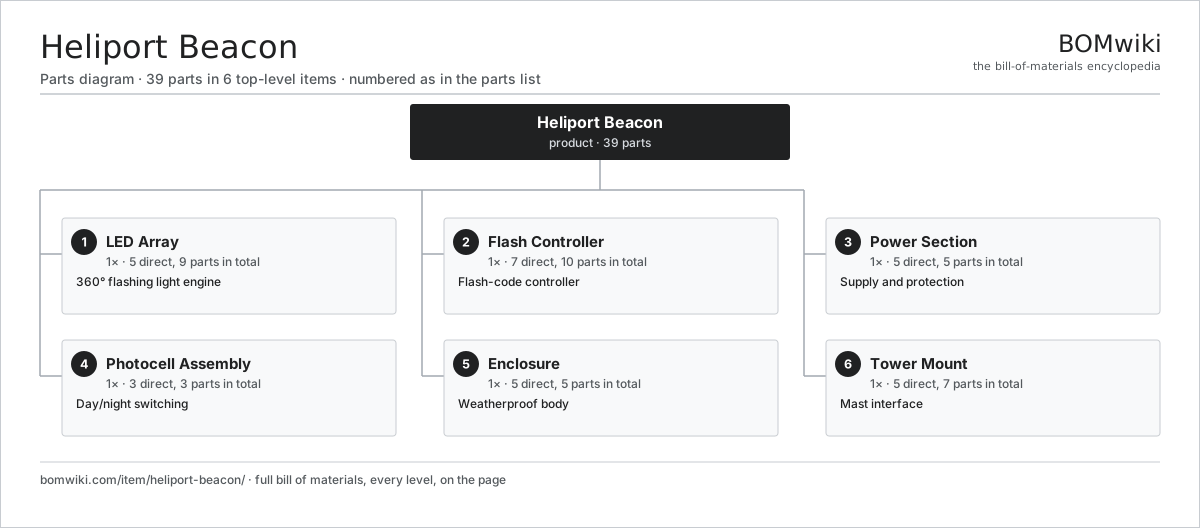
| # | Part | Qty | What it does |
|---|---|---|---|
| 1 | LED Array 5 parts | 1× | 360° flashing light engine |
| 2 | Flash Controller 7 parts | 1× | Flash-code controller |
| 3 | Power Section 5 parts | 1× | Supply and protection |
| 4 | Photocell Assembly 3 parts | 1× | Day/night switching |
| 5 | Enclosure 5 parts | 1× | Weatherproof body |
| 6 | Tower Mount 5 parts | 1× | Mast interface |
3D model
No 3D model yet. Have a CAD file of this? Add a 3D model. STL renders right on this page; STEP, FreeCAD, and OpenSCAD sources are welcome too (openly licensed, like all 3D models on BOMwiki).
Build & assembly graph
expand / collapse · shared sub-assemblies converge · links to related products · est. labourTap an assembly to expand/collapse · tap a part to open it · use “Open page” for any node · drag to pan, scroll to zoom.
Bill of materials for Heliport Beacon
6 top-level lines · 36 rows shown · 39 parts total · indented to 3 levels| # | Item / sub-assembly | Part no. | Qty/assy | Ext. qty | Parts | Type |
|---|---|---|---|---|---|---|
| 1 | LED Array 5 parts | heliport-beacon-led-array | 1× | 1 | 9 | assembly |
| 1.1 | LED Tiers | heliport-beacon-led-tiers | 3× | 3 | · | part |
| 1.2 | Tier Boards | heliport-beacon-tier-boards | 3× | 3 | · | part |
| 1.3 | Prismatic Drum Lens | heliport-beacon-drum-lens | 1× | 1 | · | part |
| 1.4 | Array Heatsink | heliport-beacon-array-heatsink | 1× | 1 | · | part |
| 1.5 | Connector | connector | 1× | 1 | · | part |
| 2 | Flash Controller 7 parts | heliport-beacon-flash-controller | 1× | 1 | 10 | assembly |
| 2.1 | Microcontroller | mcu | 1× | 1 | · | part |
| 2.2 | Bare PCB | pcb-bare | 1× | 1 | · | part |
| 2.3 | Power MOSFET | mosfet | 4× | 4 | · | part |
| 2.4 | Current Monitor | heliport-beacon-current-monitor | 1× | 1 | · | part |
| 2.5 | Remote Control Input | heliport-beacon-sync-input | 1× | 1 | · | part |
| 2.6 | SMD Passive (R/C/L) | smd-passives | 1× | 1 | · | part |
| 2.7 | Relay | relay | 1× | 1 | · | part |
| 3 | Power Section 5 parts | heliport-beacon-power-section | 1× | 1 | 5 | assembly |
| 3.1 | Power Supply | power-supply | 1× | 1 | · | part |
| 3.2 | Surge Arrester | heliport-beacon-surge-arrester | 1× | 1 | · | part |
| 3.3 | Terminal Block | heliport-beacon-terminal-block | 1× | 1 | · | part |
| 3.4 | Thermal Fuse | thermal-fuse | 1× | 1 | · | part |
| 3.5 | Wire Bundle | wire-bundle | 1× | 1 | · | part |
| 4 | Photocell Assembly 3 parts | heliport-beacon-photocell-assembly | 1× | 1 | 3 | assembly |
| 4.1 | Photodiode Sensor | heliport-beacon-photodiode | 1× | 1 | · | part |
| 4.2 | Photocell Window | heliport-beacon-photocell-window | 1× | 1 | · | part |
| 4.3 | Threshold Circuit | heliport-beacon-threshold-circuit | 1× | 1 | · | part |
| 5 | Enclosure 5 parts | heliport-beacon-enclosure | 1× | 1 | 5 | assembly |
| 5.1 | Base Casting | heliport-beacon-base-casting | 1× | 1 | · | part |
| 5.2 | Clear Dome | heliport-beacon-clear-dome | 1× | 1 | · | part |
| 5.3 | O-Ring Set | oring-set | 1× | 1 | · | part |
| 5.4 | Breather Vent | heliport-beacon-breather | 1× | 1 | · | part |
| 5.5 | Fastener Set | fastener-set | 1× | 1 | · | part |
| 6 | Tower Mount 5 parts | heliport-beacon-tower-mount | 1× | 1 | 7 | assembly |
| 6.1 | Mounting Flange | heliport-beacon-mounting-flange | 1× | 1 | · | part |
| 6.2 | Leveling Bolts | heliport-beacon-leveling-bolts | 3× | 3 | · | part |
| 6.3 | Conduit Entry | heliport-beacon-conduit-entry | 1× | 1 | · | part |
| 6.4 | Earth Point | heliport-beacon-earth-point | 1× | 1 | · | part |
| 6.5 | Fastener Set | fastener-set | 1× | 1 | · | part |
Something wrong in this list? Report a problem with this BOM.
Related products
same domain, ranked by shared parts Aviation Obstruction Light
192 parts · shares 6 with this page
Industrial UV Curing Lamp
300 parts · shares 5 with this page
Long-Range Searchlight
252 parts · shares 5 with this page
Aviation Obstruction Light
192 parts · shares 6 with this page
Industrial UV Curing Lamp
300 parts · shares 5 with this page
Long-Range Searchlight
252 parts · shares 5 with this page
 Studio Strobe Light
48 parts · shares 4 with this page
Lighthouse Rotating Beacon
250 parts · shares 4 with this page
Explosion-Proof Light Fixture
31 parts · shares 3 with this page
Studio Strobe Light
48 parts · shares 4 with this page
Lighthouse Rotating Beacon
250 parts · shares 4 with this page
Explosion-Proof Light Fixture
31 parts · shares 3 with this page
Sourcing: possible vendors
Browse the supplier directory → Prices, MOQ, and lead times are algorithmic estimates, not quotes, and not claims about these companies. Company mappings are curated by keyword; est. price band $3–$2k. How estimates work| Vendor | HQ | Specialty | MOQ | Lead time |
|---|---|---|---|---|
|
🇳🇱Signify
signify.com ↗
|
Eindhoven, NL | Lighting (Philips Hue) | 2,000 units | 6–10 wks |
| acuitybrands.com ↗ | Atlanta, US | Lighting & controls | 2,000 units | 6–10 wks |
|
🇦🇹Zumtobel
zumtobelgroup.com ↗
|
Dornbirn, AT | Lighting | 2,000 units | 6–10 wks |
| creelighting.com ↗ | Racine, US | LED lighting | 2,000 units | 6–10 wks |
|
🇮🇳Havells
havells.com ↗
|
Noida, IN | Electrical & lighting | 2,000 units | 6–10 wks |
801-word article