Helmet Intercom System
ProductOverview
A helmet intercom system enables wireless voice communication between motorcyclists while riding. Riders can speak to each other, listen to navigation, or take phone calls without removing helmets or interrupting their ride. Most systems use Bluetooth for short range (100–200 m) or proprietary mesh protocols for extended range (2–3 km with relay), making them ideal for group rides, touring, and commercial applications (delivery, police).
Communication Architecture
Bluetooth Topology
Most consumer helmet intercoms use Bluetooth 5.0 Low Energy (BLE) with a star or mesh topology:
Star Topology (1 master + up to 7 slaves):
- One "master" rider initiates connections; up to 7 others pair to that master.
- Simplest, lowest latency (50–100 ms voice delay).
- Range: ~100 m line-of-sight.
- Limitation: If the master bike falls back, the chain breaks.
Mesh Topology (peer-to-peer relay):
- Each unit relays messages from others, extending range.
- Any unit can relay; no central master.
- Range: 500 m–2 km depending on relay network density.
- Latency: 200–400 ms (due to hop delays).
- More robust; if one rider drops out, others stay connected.
Proprietary Mesh Networks
Some premium systems (e.g., Cardo, SENA) use proprietary UHF or 2.4 GHz mesh protocols instead of Bluetooth:
- Frequency: 2.4 GHz ISM band (unlicensed, shared with WiFi, BLE).
- Range: 500 m–2 km per hop.
- Hop limit: 4–6 hops before latency becomes excessive.
- Network size: 100+ riders in a mesh (vs. 8 in Bluetooth).
These proprietary systems offer better range and lower latency than BLE mesh, but require all riders to use compatible equipment.
Signal Chain: Microphone to Speaker
Microphone Subsystem
The Microphone Capsule is positioned 20–30 mm from the mouth via the Boom Arm:
- Acoustic capture: Cardioid condenser microphone picks up the rider's voice (200–3500 Hz dominant).
- Wind rejection: Windscreen Filter foam (10–15 mm closed-cell polyurethane) attenuates wind noise by 20+ dB at 100 km/h. Wind noise is a low-frequency rushing sound (50–500 Hz); foam blocks these frequencies while allowing voice (speech intelligibility peaks at 500–2000 Hz).
- Preamp gain: Microphone Preamplifier boosts the tiny condenser signal (~1 mV) to line level (~100 mV) with 40–60 dB gain.
- ADC conversion: Audio Codec samples the microphone signal at 16 kHz, 16-bit resolution (65,536 amplitude levels).
Audio Codec & Compression
The Audio Codec audio codec performs:
- Sampling: 16 kHz sampling rate (covers 0–8 kHz audio bandwidth, sufficient for voice intelligibility).
- Quantization: 16-bit linear PCM, no loss at this stage.
- Compression (optional): Some systems apply narrowband voice codecs (e.g., AMR-NB, Opus) to reduce data rate for transmission. Compression from 256 kbps raw to 16–32 kbps encoded.
Raw audio without compression: 16 kHz × 16 bits = 256 kbps per direction. Compressed with AMR-NB: 6.6–12.2 kbps per direction (20:1 compression).
Bluetooth Radio Transmission
The Radio Module transmits audio packets over Bluetooth:
- Bluetooth audio codecs: SBC (mandatory, 44–192 kbps), AAC, aptX (optional, lower latency).
- Latency: Bluetooth typically adds 50–150 ms one-way delay due to frame buffering and retransmission.
- Bandwidth: Bluetooth supports up to 3 Mbps in theory, but practical audio throughput is ~100–200 kbps per direction.
Speaker Subsystem
The Speaker Driver in each ear receives:
- DAC conversion: Audio codec converts digital PCM (16 kHz, 16-bit) back to analog voltage.
- Amplification: Audio Amplifier class-D amplifier boosts the signal to 0.5–1 W into the speaker.
- Speaker reproduction: Speaker Driver Unit (16–20 mm dynamic speaker) converts electrical signal to acoustic pressure. Frequency response optimized for 200–4000 Hz (voice range).
Voice Quality & Noise Management
Speech Intelligibility
Modern helmet intercoms use narrowband audio (16 kHz sampling, 0–8 kHz bandwidth) optimized for voice:
- Frequency range 300–3400 Hz carries 95% of speech intelligibility.
- Wind noise, engine noise, and road noise concentrated below 300 Hz or above 3000 Hz.
- Filtering reduces out-of-band noise while preserving intelligibility.
Result: Even at 100 km/h with high wind noise, speech remains intelligible at moderate volume (~60 dB SPL in helmet).
Noise Cancellation
Advanced systems employ:
- Spectral subtraction: Microphone samples background noise during a quiet moment, then subtracts an estimate of that noise from the voice signal.
- Voice activity detection (VAD): MCU detects when the rider is speaking (energy spike) vs. silence, suppressing transmission when nobody talks.
- Beam-forming (dual-mic systems): Two microphones positioned at the mouth can phase-cancel wind noise sources while amplifying voice from the mouth.
Combined effect: ~15–25 dB noise reduction vs. raw microphone, allowing clear voice even in high-noise environments.
Power Management & Battery Life
Standby vs. Active
The Rechargeable Battery (2000–4000 mAh Li-ion) provides:
- Standby (radio on, no talk): 100–200 mW average consumption → 12–20 hours per charge.
- Active talking: 300–500 mW (microphone ADC, Bluetooth transmission, speaker amplifier) → 4–8 hours continuous.
- Idle (radio off): <10 mW → 30+ days standby.
Typical use case: Rider talks intermittently (10–20% of riding time) → real-world battery life ~15–20 hours, refill every 2–3 days of heavy riding.
Power Budgets
| Component | Current | Notes |
|---|---|---|
| Bluetooth radio (active TX) | 80–120 mA | Transmitting voice packets |
| Microphone ADC | 5–10 mA | Sampling at 16 kHz |
| Speaker amplifier | 100–150 mA | 0.5–1 W output |
| MCU + codec | 20–30 mA | Processing and routing |
| Total active | ~250–300 mA | ~1.2 W power |
| Idle/standby | <5 mA | Radio listening mode |
With a 3000 mAh battery: 3000 mAh / 250 mA ≈ 12 hours active talking time.
Charging
Most systems use USB micro or USB-C with a micro-charging circuit (500 mA–2 A) for 1.5–2 hour recharge. Some premium kits include dock chargers that charge while mounted on the helmet.
Installation & Pairing
Installation typically requires:
- Speaker mounting: Adhesive or clip-mount Speaker Mounting Bracket inside helmet at ear level, using 3M foam tape or mechanical clips. Must not obstruct the ear canal.
- Boom mic positioning: Boom arm routed along the helmet interior, microphone positioned 20–30 mm from mouth (tested by saying a word and checking for loud "pop" at peak mouth opening).
- Control unit placement: Wearable clip-on unit (goggles, collar, armband) or hardwired to helmet.
- Pairing: Units are powered on simultaneously; they initiate Bluetooth pairing, exchange keys, and connect. Typical pairing time: 10–30 seconds.
Multicycle Mesh Configuration
For group rides:
- All riders turn on their units within range (500 m).
- Units automatically discover each other and form a mesh network (no manual config needed).
- When Rider A speaks, their audio is transmitted directly to Riders B & C (if in range) and relayed through other units to reach Riders D, E, F (at greater distances).
- Typical network stabilization: 30–60 seconds after all units power on.
Standards & Regulations
Helmet intercom systems comply with:
- FCC Part 15 (USA): Bluetooth devices operate in unlicensed 2.4 GHz ISM band; must not cause harmful interference. Typical maximum transmitted power 20 dBm (100 mW), regulated by Bluetooth spec.
- CE (EU): Similar spectrum regulations (ETSI EN 301 489-1 for EMC, EN 300 328 for radio equipment).
- Helmet mounting safety: Intercom units must not protrude from helmet or interfere with safety padding/retention system. Most kits are designed to fit within standard helmet geometry.
Driving Laws
In some jurisdictions:
- USA: Helmet intercoms are generally legal (not considered "devices" that impair vision or hearing, unlike headphone regulations in some states).
- UK/EU: Legal in helmets; must not cause distraction (law ambiguous, but intercoms are de facto accepted).
- Australia/NZ: Mostly legal but vary by territory; check local road rules.
Market Segments
Consumer (Group Rides, Touring)
- Affordable systems (USD 150–400)
- 4–8 rider capacity
- 100–200 m range (sufficient for group riding)
- Examples: Cardo Freecom, SENA SMH10, Shure Pilot
Professional (Delivery, Police)
- Rugged systems (IP67+, drop-resistant)
- Large mesh networks (100+ riders)
- GPS integration, emergency SOS
- Cost USD 400–1000+
- Examples: SENA 30K Mesh, Cardo Packtalk Edge
Racing/Track (Limited Use)
- Lightweight, low-latency systems
- Pit-to-rider communication (1-way, limited range)
- Integrated with race timing
- Specialized teams only
Troubleshooting Common Issues
Connectivity Loss
- Cause: Units out of range (>200 m), Bluetooth interference (nearby WiFi).
- Fix: Reduce distance, restart units, move away from WiFi router.
Audio Dropout
- Cause: Weak Bluetooth signal, low battery.
- Fix: Recharge battery, reduce distance between riders.
Wind Noise in Microphone
- Cause: Windscreen degraded or torn, microphone positioned too far from face.
- Fix: Replace windscreen, reposition boom microphone 20–30 mm from mouth.
No Charging
- Cause: Faulty USB cable, charging circuit IC failure.
- Fix: Try different cable, check battery connector (may be corroded), or service unit.
Typical Specification Summary
A modern helmet intercom balances range, battery life, audio quality, and price:
- BLE star topology: Good for 2–4 riders, simple pairing, lower cost.
- Proprietary mesh: Better for larger groups (5+), extended range, higher cost.
- Audio quality: Narrowband (16 kHz) sufficient for voice; premium codecs (aptX, opus) improve quality but drain battery faster.
- Durability: IP67 water resistance, rugged construction for outdoor use, typical lifespan 3–5 years before battery degradation.
The sweet spot for most riders: 300–400 mAh battery, 100–200 m Bluetooth range, 8–12 hour talk time, priced USD 200–350.
Helmet Intercom System parts and their functions
6 top-level parts · 23 parts in total · full bill of materials below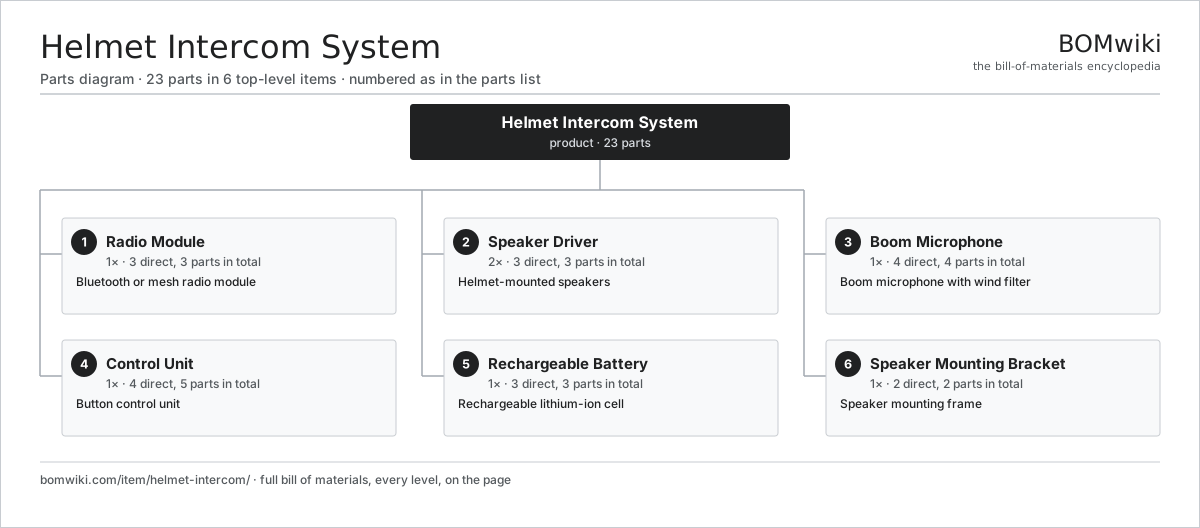
| # | Part | Qty | What it does |
|---|---|---|---|
| 1 | Radio Module 3 parts | 1× | Bluetooth or mesh radio module |
| 2 | Speaker Driver 3 parts | 2× | Helmet-mounted speakers |
| 3 | Boom Microphone 4 parts | 1× | Boom microphone with wind filter |
| 4 | Control Unit 4 parts | 1× | Button control unit |
| 5 | Rechargeable Battery 3 parts | 1× | Rechargeable lithium-ion cell |
| 6 | Speaker Mounting Bracket 2 parts | 1× | Speaker mounting frame |
3D model
No 3D model yet. Have a CAD file of this? Add a 3D model. STL renders right on this page; STEP, FreeCAD, and OpenSCAD sources are welcome too (openly licensed, like all 3D models on BOMwiki).
Build & assembly graph
expand / collapse · shared sub-assemblies converge · links to related products · est. labourTap an assembly to expand/collapse · tap a part to open it · use “Open page” for any node · drag to pan, scroll to zoom.
Bill of materials for Helmet Intercom System
6 top-level lines · 25 rows shown · 23 parts total · indented to 3 levels| # | Item / sub-assembly | Part no. | Qty/assy | Ext. qty | Parts | Type |
|---|---|---|---|---|---|---|
| 1 | Radio Module 3 parts | helmet-intercom-radio | 1× | 1 | 3 | assembly |
| 1.1 | Bluetooth Chipset | helmet-intercom-radio-chipset | 1× | 1 | · | part |
| 1.2 | Antenna Element | helmet-intercom-radio-antenna | 1× | 1 | · | part |
| 1.3 | Oscillator Reference | helmet-intercom-radio-crystal | 1× | 1 | · | part |
| 2 | Speaker Driver 3 parts | helmet-intercom-speaker | 2× | 2 | 3 | assembly |
| 2.1 | Speaker Driver Unit | helmet-intercom-speaker-driver | 1× | 2 | · | part |
| 2.2 | Audio Amplifier | helmet-intercom-speaker-amp | 1× | 2 | · | part |
| 2.3 | Speaker Enclosure | helmet-intercom-speaker-enclosure | 1× | 2 | · | part |
| 3 | Boom Microphone 4 parts | helmet-intercom-microphone | 1× | 1 | 4 | assembly |
| 3.1 | Microphone Capsule | helmet-intercom-mic-capsule | 1× | 1 | · | part |
| 3.2 | Boom Arm | helmet-intercom-mic-boom | 1× | 1 | · | part |
| 3.3 | Microphone Preamplifier | helmet-intercom-mic-preamp | 1× | 1 | · | part |
| 3.4 | Windscreen Filter | helmet-intercom-mic-windscreen | 1× | 1 | · | part |
| 4 | Control Unit 4 parts | helmet-intercom-control | 1× | 1 | 5 | assembly |
| 4.1 | Main Processor | helmet-intercom-control-mcu | 1× | 1 | · | part |
| 4.2 | Audio Codec | helmet-intercom-control-codec | 1× | 1 | · | part |
| 4.3 | Multifunction Button | helmet-intercom-control-button | 2× | 2 | · | part |
| 4.4 | Status LED | helmet-intercom-control-led | 1× | 1 | · | part |
| 5 | Rechargeable Battery 3 parts | helmet-intercom-battery | 1× | 1 | 3 | assembly |
| 5.1 | Lithium-Ion Cell | helmet-intercom-battery-cell | 1× | 1 | · | part |
| 5.2 | Battery Protection PCB | helmet-intercom-battery-protection | 1× | 1 | · | part |
| 5.3 | Battery Connector | helmet-intercom-battery-connector | 1× | 1 | · | part |
| 6 | Speaker Mounting Bracket 2 parts | helmet-intercom-bracket | 1× | 1 | 2 | assembly |
| 6.1 | Speaker Frame | helmet-intercom-bracket-frame | 1× | 1 | · | part |
| 6.2 | Mounting Adhesive | helmet-intercom-bracket-adhesive | 1× | 1 | · | part |
Something wrong in this list? Report a problem with this BOM.
Sourcing: possible vendors
Browse the supplier directory → Prices, MOQ, and lead times are algorithmic estimates, not quotes, and not claims about these companies. Company mappings are curated by keyword; est. price band $300–$15k. How estimates work| Vendor | HQ | Specialty | MOQ | Lead time |
|---|---|---|---|---|
| global.honda ↗ | Tokyo, JP | Motorcycles & power products | made to order | 10–16 wks |
| yamaha-motor.com ↗ | Iwata, JP | Motorcycles & marine | made to order | 10–16 wks |
| heromotocorp.com ↗ | New Delhi, IN | Motorcycle & scooter maker | made to order | 10–16 wks |
| bajajauto.com ↗ | Pune, IN | Two- & three-wheeler maker | made to order | 10–16 wks |
| harley-davidson.com ↗ | Milwaukee, US | Motorcycles | made to order | 10–16 wks |
1,563-word article