High-Speed Camera
ProductOverview
High-speed cameras capture fast transient phenomena, fluid jets, mechanical vibration, ballistic events, material failure, by buffering thousands of frames into onboard DRAM before the event has even finished unfolding. Instead of streaming every pixel to storage in real time (which would demand prohibitive bandwidth), the camera writes a circular ring buffer, triggering a record of pre-event and post-event frames. The CMOS sensor delivers 1000–5000 frames per second at megapixel resolution, timing is controlled to microsecond precision, and the whole unit is ruggedized for field and lab environments where optical quality and durability matter more than form factor.
The Sensor Module is the optical front-end: a backside-illuminated CMOS array with global electronic shutter control, mounted on a precision board behind a interchangeable Lens Mount Assembly. The Memory System is the distinguishing feature, multiple gigabytes of DRAM and a dedicated controller that writes frames into a circular buffer, stopping only when the trigger condition fires. The Electronics Assembly board houses the image processor and FPGA, which orchestrates sensor timing, memory write protocol, and the low-latency trigger logic. Sustained frame rates demand aggressive cooling, handled by the Cooling Assembly assembly. The Interface Module exports frames over GigE Vision or USB 3.0, and the Trigger I/O Module accepts external TTL signals to synchronize with external events.
How it works
A CMOS sensor integrates a pixel array with row and column decoders that read all pixels simultaneously (global shutter), eliminating rolling-shutter distortion that would smear fast motion. The Timing Control IC generates pixel clock signals at the sensor's rated speed, often 100+ MHz, and the Image Processor SoC SoC receives raw pixel data at sustained rates, routing it directly to the Memory Controller IC.
The memory controller implements circular buffering: it writes incoming pixel data into a DRAM ring as a continuous stream, wrapping around to overwrite old frames once the buffer fills. When an external trigger arrives, a photodiode detecting a flash, a mechanical contact closure, a TTL pulse from a laser or strobe, the controller freezes the buffer, halting the circular write. The captured frames, both before and after the trigger instant, are now locked in place and ready for readout. The application then reads them out over Interface Module at leisure, exporting full frame stacks for offline analysis.
Global shutter control in the Sensor Module is crucial: it charges all pixels simultaneously, exposes them for a uniform interval (typically 100 nanoseconds to a few microseconds), and reads all rows in parallel, ensuring every pixel sees the same instant in time. This prevents the skew that rolling shutter introduces on moving subjects.
Thermal management is critical because sustained 1000+ fps operation generates continuous power dissipation in the sensor and memory arrays. The Cooling Assembly assembly transfers heat through thermal pads to an aluminum heatsink, and the magnesium body radiates it to the environment. Without active cooling, sustained operation would quickly saturate, forcing lower frame rates or shorter duty cycles.
Trigger latency, the delay between the external trigger signal and the actual frame freeze, must be microsecond-class for scientific reproducibility, so the Trigger Conditioning Circuit uses dedicated comparators and FPGA fabric to capture the trigger edge with minimal propagation delay.
Applications
High-speed imaging is indispensable in dynamics analysis, failure forensics, fluid mechanics visualization, and ballistic testing. Researchers use it to study shock-wave propagation, crack initiation in materials, and the transient response of mechanical systems that respond on millisecond or sub-millisecond timescales. In manufacturing, high-speed playback reveals assembly defects, solder reflow wetting, and component alignment faults. In automotive and aerospace, crash testing and bird-strike analysis rely on multi-thousand-frame captures to reconstruct the event and measure deformation.
High-Speed Camera parts and their functions
9 top-level parts · 183 parts in total · full bill of materials below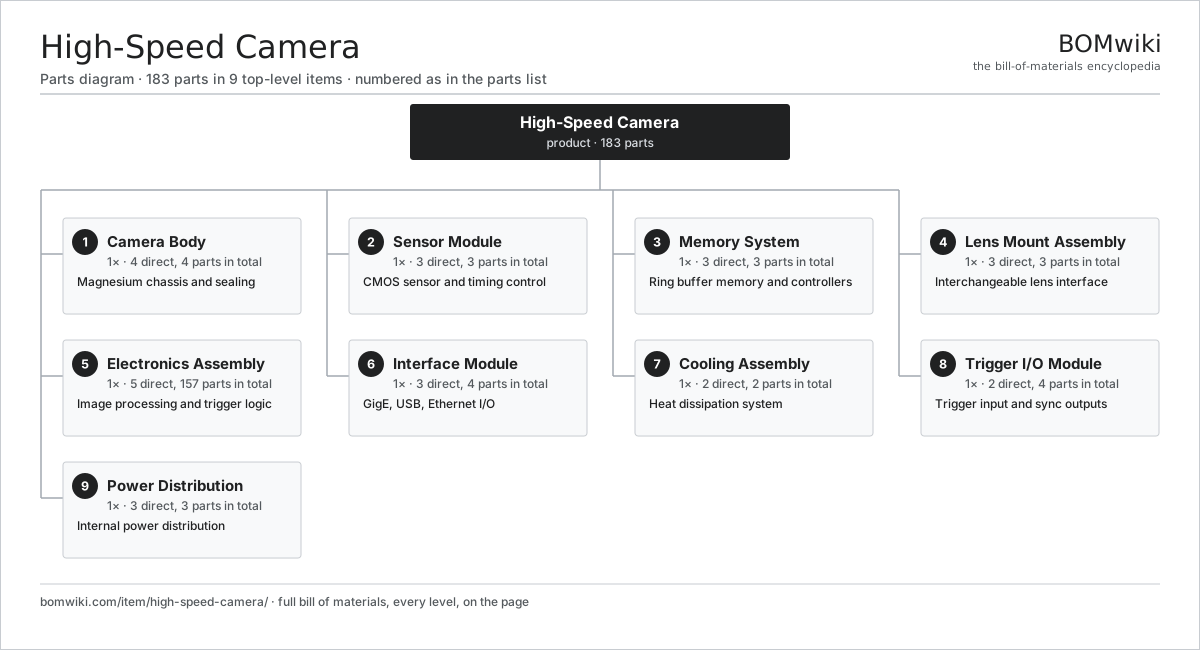
| # | Part | Qty | What it does |
|---|---|---|---|
| 1 | Camera Body 4 parts | 1× | Magnesium chassis and sealing |
| 2 | Sensor Module 3 parts | 1× | CMOS sensor and timing control |
| 3 | Memory System 3 parts | 1× | Ring buffer memory and controllers |
| 4 | Lens Mount Assembly 3 parts | 1× | Interchangeable lens interface |
| 5 | Electronics Assembly 5 parts | 1× | Image processing and trigger logic |
| 6 | Interface Module 3 parts | 1× | GigE, USB, Ethernet I/O |
| 7 | Cooling Assembly 2 parts | 1× | Heat dissipation system |
| 8 | Trigger I/O Module 2 parts | 1× | Trigger input and sync outputs |
| 9 | Power Distribution 3 parts | 1× | Internal power distribution |
3D model
No 3D model yet. Have a CAD file of this? Add a 3D model. STL renders right on this page; STEP, FreeCAD, and OpenSCAD sources are welcome too (openly licensed, like all 3D models on BOMwiki).
Build & assembly graph
expand / collapse · shared sub-assemblies converge · links to related products · est. labourTap an assembly to expand/collapse · tap a part to open it · use “Open page” for any node · drag to pan, scroll to zoom.
Bill of materials for High-Speed Camera
9 top-level lines · 37 rows shown · 183 parts total · indented to 3 levels| # | Item / sub-assembly | Part no. | Qty/assy | Ext. qty | Parts | Type |
|---|---|---|---|---|---|---|
| 1 | Camera Body 4 parts | high-speed-camera-body | 1× | 1 | 4 | assembly |
| 1.1 | Magnesium Chassis | high-speed-camera-chassis | 1× | 1 | · | part |
| 1.2 | Front Panel Assembly | high-speed-camera-front-panel | 1× | 1 | · | part |
| 1.3 | Back Panel Assembly | high-speed-camera-back-panel | 1× | 1 | · | part |
| 1.4 | O-Ring Set | oring-set | 1× | 1 | · | part |
| 2 | Sensor Module 3 parts | high-speed-camera-sensor-module | 1× | 1 | 3 | assembly |
| 2.1 | CMOS Image Sensor | image-sensor | 1× | 1 | · | part |
| 2.2 | Sensor Interface Board | high-speed-camera-sensor-board | 1× | 1 | · | part |
| 2.3 | Timing Control IC | high-speed-camera-timing-ic | 1× | 1 | · | part |
| 3 | Memory System 3 parts | high-speed-camera-memory-system | 1× | 1 | 3 | assembly |
| 3.1 | DRAM Buffer Module | high-speed-camera-dram-module | 1× | 1 | · | part |
| 3.2 | Memory Controller IC | high-speed-camera-memory-controller | 1× | 1 | · | part |
| 3.3 | Bare PCB | pcb-bare | 1× | 1 | · | part |
| 4 | Lens Mount Assembly 3 parts | high-speed-camera-lens-mount | 1× | 1 | 3 | assembly |
| 4.1 | Mount Ring | high-speed-camera-mount-ring | 1× | 1 | · | part |
| 4.2 | Lens Contact Pins | high-speed-camera-mount-contacts | 1× | 1 | · | part |
| 4.3 | Fastener Set | fastener-set | 1× | 1 | · | part |
| 5 | Electronics Assembly 5 parts | high-speed-camera-electronics | 1× | 1 | 157 | assembly |
| 5.1 | Bare PCB | pcb-bare | 1× | 1 | · | part |
| 5.2 | FPGA Timing Engine | high-speed-camera-fpga | 1× | 1 | · | part |
| 5.3 | Image Processor SoC | high-speed-camera-processor | 1× | 1 | · | part |
| 5.4 | SMD Passive (R/C/L) | smd-passives | 150× | 150 | · | part |
| 5.5 | Connector | connector | 4× | 4 | · | part |
| 6 | Interface Module 3 parts | high-speed-camera-interface-module | 1× | 1 | 4 | assembly |
| 6.1 | GigE PHY Transceiver | high-speed-camera-gige-transceiver | 1× | 1 | · | part |
| 6.2 | USB 3.0 Controller | high-speed-camera-usb-controller | 1× | 1 | · | part |
| 6.3 | Connector | connector | 2× | 2 | · | part |
| 7 | Cooling Assembly 2 parts | high-speed-camera-cooling | 1× | 1 | 2 | assembly |
| 7.1 | Aluminum Heatsink | high-speed-camera-heatsink | 1× | 1 | · | part |
| 7.2 | Thermal Interface Material | high-speed-camera-thermal-pads | 1× | 1 | · | part |
| 8 | Trigger I/O Module 2 parts | high-speed-camera-trigger-io | 1× | 1 | 4 | assembly |
| 8.1 | Trigger Conditioning Circuit | high-speed-camera-trigger-circuit | 1× | 1 | · | part |
| 8.2 | Connector | connector | 3× | 3 | · | part |
| 9 | Power Distribution 3 parts | high-speed-camera-power-supply | 1× | 1 | 3 | assembly |
| 9.1 | Power Supply | power-supply | 1× | 1 | · | part |
| 9.2 | Regulator Board | high-speed-camera-regulator-board | 1× | 1 | · | part |
| 9.3 | Connector | connector | 1× | 1 | · | part |
Something wrong in this list? Report a problem with this BOM.
Related products
same domain, ranked by shared parts Police Body Camera
189 parts · shares 4 with this page
Police Body Camera
189 parts · shares 4 with this page
 Structured-Light 3D Scanner
373 parts · shares 4 with this page
WiFi IP Camera
193 parts · shares 4 with this page
Structured-Light 3D Scanner
373 parts · shares 4 with this page
WiFi IP Camera
193 parts · shares 4 with this page
 Digital Cinema Camera
305 parts · shares 3 with this page
Digital Cinema Camera
305 parts · shares 3 with this page
 Document Camera
247 parts · shares 3 with this page
Document Camera
247 parts · shares 3 with this page
 Microfilm Scanner
348 parts · shares 3 with this page
Microfilm Scanner
348 parts · shares 3 with this page
Sourcing: possible vendors
Browse the supplier directory → Prices, MOQ, and lead times are algorithmic estimates, not quotes, and not claims about these companies. Company mappings are curated by keyword; est. price band $100–$8k. How estimates work| Vendor | HQ | Specialty | MOQ | Lead time |
|---|---|---|---|---|
|
🇯🇵Canon
canon.com ↗
|
Tokyo, JP | Imaging & optics | 500 units | 10–16 wks |
|
🇯🇵Nikon
nikon.com ↗
|
Tokyo, JP | Imaging & optics | 500 units | 10–16 wks |
|
🇩🇪ZEISS
zeiss.com ↗
|
Oberkochen, DE | Optics & optoelectronics | 500 units | 10–16 wks |
| leica-camera.com ↗ | Wetzlar, DE | Cameras & optics | 500 units | 10–16 wks |
| flir.com ↗ | Wilsonville, US | Thermal imaging | 500 units | 10–16 wks |
652-word article