Home Coffee Roaster
ProductOverview
A home coffee roaster is a small-batch roasting appliance that transforms green (unroasted) coffee beans into finished roasted beans through controlled heating and agitation. The operator loads 200–250 g of green beans into the rotating Roasting Drum Assembly, selects a roast profile (light, medium, or dark) via the Roast Profile Switch, and presses Start Button. The Main Control PCB then begins heating via a Heating Element (1500 W) while simultaneously turning the drum at 30 rpm via a AC Drum Motor and gearbox. Heated air circulates through the perforated Drum Barrel (180–240 °C depending on roast stage), and the rotating Internal Baffle Blade tumble the beans to ensure even heat exposure. As the beans develop color and release moisture and oils, lightweight chaff is blown into a Cyclone Separator separator and collected in a Chaff Collection Tray. When the target temperature is reached, the heater cuts off and a Cooling Blower rapidly cools the beans on a Perforated Cooling Tray. The entire cycle, roast, cool, and discharge, takes 18–25 minutes.
The RTD Temperature Probe (Pt100 RTD) continuously measures bean temperature inside the drum, feeding data to the Main Control PCB. The board runs a closed-loop PID algorithm, modulating the heater via a Relay to maintain the target temperature curve. The 16x2 LCD Display shows real-time temperature and elapsed time, allowing the operator to monitor first-crack, second-crack, and other roasting milestones.
How it works
Setup. The operator measures 200–250 g of green coffee beans (small, pale, hard pellets) on a scale and pours them into a small bowl. They insert this into the roaster by opening a hinged gate at the rear of the Housing & Frame, which provides access to the entrance of the rotating Roasting Drum Assembly. They then rotate the Roast Profile Switch to select a roast profile (or set manual temperature via buttons), press Start Button, and monitor the 16x2 LCD Display.
Preheat phase (0–4 minutes). The Main Control PCB energizes the Heating Element (1500 W) via a triac dimmer relay. The Blower Motor (550 W) and AC Drum Motor (90 W) both start at full speed. Air is drawn through the Intake Grill, heated in the Heater Chamber to 180 °C, and blown into the drum. The Drum Barrel rotates at 30 rpm, and the internal Internal Baffle Blade lift and tumble the cold beans. The RTD Temperature Probe reads the bean temperature climbing from room temperature.
Early development phase (4–8 minutes). The beans absorb heat and begin to dry out. Internal pressure builds; water is released. The beans lose color initially (drying phase), then gradually develop a tan color. The Main Control PCB monitors the ramp rate; if temperature rises too quickly, the heater modulates down via the triac. If too slowly, it increases. The chaff (thin papery husk) begins separating from the beans and is carried into the Cyclone Separator, where it spirals down and collects in the Chaff Collection Tray.
First crack phase (8–12 minutes, depending on profile). Beans reach ≈200 °C. Internal pressure from steam and gases causes the hard shell to crack with an audible popping sound ("first crack"). The 16x2 LCD Display can alert the operator via an alarm or milestone label. Beans are now light brown; light roast can be halted here (60% of roast).
Development phase (12–16 minutes). Temperature continues rising toward the target (e.g., 220 °C for medium roast). The beans continue browning. Oils migrate to the surface. The operator can choose to stop here (medium roast, ~80% of roast) or continue heating.
Second crack phase (16–18 minutes, dark roast only). Beans exceed 215 °C; the shell cracks again ("second crack"), more violently. The beans become shiny with surface oil. A dark roast extends past the second crack to ≈230 °C (100% of roast curve). The operator typically observes first-crack visually through a small viewing window (if present) to confirm timing.
End of roast. When the target temperature is reached (indicated by the Main Control PCB and displayed on the LCD), the heater cuts off. The Blower Motor may shift to cooling mode (lower speed) or continue at full speed. The operator can press a stop button to manually halt the roast early if they prefer a lighter roast.
Cooling phase (5 minutes). The beans are still hot (≈220 °C) as they exit the drum via the Discharge Chute onto the Perforated Cooling Tray. The Cooling Blower (120 W) runs at high speed, pushing cool ambient air upward through the perforated tray and the beans. The beans cool from 220 °C to <40 °C in approximately 5 minutes. As they cool, they harden and lock in the roasted flavor profile. The operator catches the cooled beans in a bowl and can transfer them to an airtight container for storage.
Chaff and cleanup. Throughout roasting, chaff accumulates in the Chaff Collection Tray at the base of the Cyclone Separator. After each roast, this tray is emptied into a trash bin. A HEPA Chaff Filter (HEPA pleated) at the exhaust outlet traps any remaining chaff particles before air exits to the kitchen; this filter is replaced every 20–30 roasts.
All electrical components draw power via the Power Cord, which passes through a Mains Plug (20 A thermal breaker) and a Thermal Fuse (20 A main cutout). The Main Control PCB MCU switches three Relays (heater, blower, drum motor) based on the Roast Profile Switch selection and real-time RTD Temperature Probe feedback.
Home Coffee Roaster parts and their functions
8 top-level parts · 88 parts in total · full bill of materials below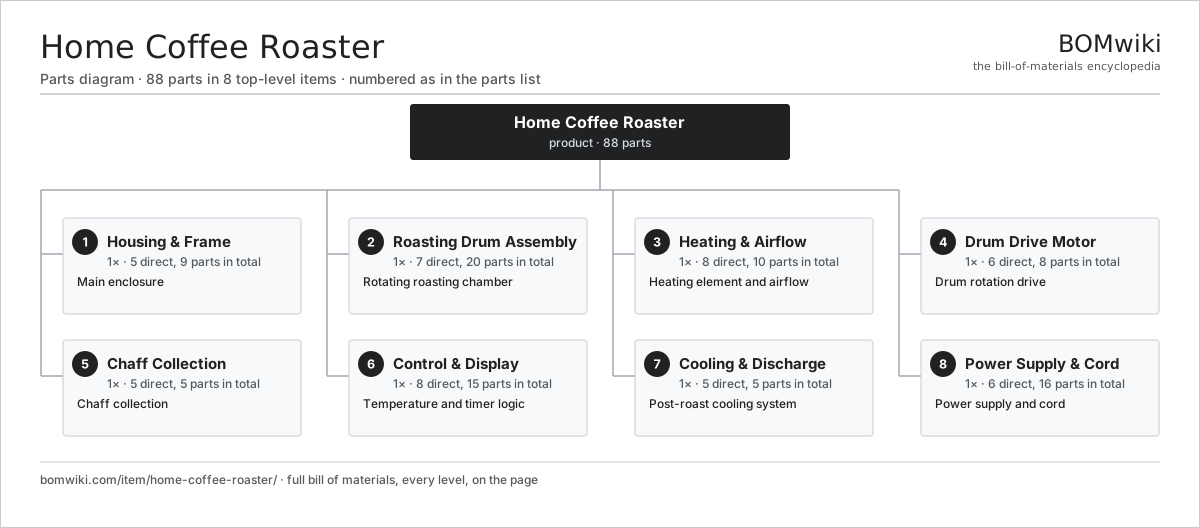
| # | Part | Qty | What it does |
|---|---|---|---|
| 1 | Housing & Frame 5 parts | 1× | Main enclosure |
| 2 | Roasting Drum Assembly 7 parts | 1× | Rotating roasting chamber |
| 3 | Heating & Airflow 8 parts | 1× | Heating element and airflow |
| 4 | Drum Drive Motor 6 parts | 1× | Drum rotation drive |
| 5 | Chaff Collection 5 parts | 1× | Chaff collection |
| 6 | Control & Display 8 parts | 1× | Temperature and timer logic |
| 7 | Cooling & Discharge 5 parts | 1× | Post-roast cooling system |
| 8 | Power Supply & Cord 6 parts | 1× | Power supply and cord |
3D model
No 3D model yet. Have a CAD file of this? Add a 3D model. STL renders right on this page; STEP, FreeCAD, and OpenSCAD sources are welcome too (openly licensed, like all 3D models on BOMwiki).
Build & assembly graph
expand / collapse · shared sub-assemblies converge · links to related products · est. labourTap an assembly to expand/collapse · tap a part to open it · use “Open page” for any node · drag to pan, scroll to zoom.
Bill of materials for Home Coffee Roaster
8 top-level lines · 58 rows shown · 88 parts total · indented to 3 levels| # | Item / sub-assembly | Part no. | Qty/assy | Ext. qty | Parts | Type |
|---|---|---|---|---|---|---|
| 1 | Housing & Frame 5 parts | home-coffee-roaster-housing | 1× | 1 | 9 | assembly |
| 1.1 | Stainless Steel Shell | home-coffee-roaster-outer-shell | 1× | 1 | · | part |
| 1.2 | Internal Heat Shield | home-coffee-roaster-heat-shield | 1× | 1 | · | part |
| 1.3 | Internal Frame | home-coffee-roaster-mounting-frame | 1× | 1 | · | part |
| 1.4 | Vibration Damping Foot | home-coffee-roaster-feet | 4× | 4 | · | part |
| 1.5 | Fastener Set | fastener-set | 2× | 2 | · | part |
| 2 | Roasting Drum Assembly 7 parts | home-coffee-roaster-drum | 1× | 1 | 20 | assembly |
| 2.1 | Drum Barrel | home-coffee-roaster-drum-barrel | 1× | 1 | · | part |
| 2.2 | Drum End Cap | home-coffee-roaster-drum-seal | 2× | 2 | · | part |
| 2.3 | Drive Shaft | home-coffee-roaster-drum-shaft | 1× | 1 | · | part |
| 2.4 | Bearing Block | home-coffee-roaster-bearing-block | 2× | 2 | · | part |
| 2.5 | Internal Baffle Blade | home-coffee-roaster-baffles | 8× | 8 | · | part |
| 2.6 | Ball Bearing | ball-bearing | 4× | 4 | · | part |
| 2.7 | O-Ring Set | oring-set | 2× | 2 | · | part |
| 3 | Heating & Airflow 8 parts | home-coffee-roaster-heater | 1× | 1 | 10 | assembly |
| 3.1 | Heating Element | heating-element | 1× | 1 | · | part |
| 3.2 | Heater Chamber | home-coffee-roaster-heater-housing | 1× | 1 | · | part |
| 3.3 | Centrifugal Blower | home-coffee-roaster-blower | 1× | 1 | · | part |
| 3.4 | Blower Motor | home-coffee-roaster-blower-motor | 1× | 1 | · | part |
| 3.5 | Intake Grill | home-coffee-roaster-intake-grill | 1× | 1 | · | part |
| 3.6 | Temperature Control | home-coffee-roaster-thermostat | 1× | 1 | · | part |
| 3.7 | Thermal Fuse | thermal-fuse | 1× | 1 | · | part |
| 3.8 | Connector | connector | 3× | 3 | · | part |
| 4 | Drum Drive Motor 6 parts | home-coffee-roaster-motor | 1× | 1 | 8 | assembly |
| 4.1 | AC Drum Motor | home-coffee-roaster-drum-motor | 1× | 1 | · | part |
| 4.2 | Worm Gearbox | home-coffee-roaster-drum-gearbox | 1× | 1 | · | part |
| 4.3 | Timing Belt Drive | home-coffee-roaster-timing-belt | 1× | 1 | · | part |
| 4.4 | Drum Pulley | home-coffee-roaster-drum-pulley | 1× | 1 | · | part |
| 4.5 | Ball Bearing | ball-bearing | 2× | 2 | · | part |
| 4.6 | Connector | connector | 2× | 2 | · | part |
| 5 | Chaff Collection 5 parts | home-coffee-roaster-chaff-system | 1× | 1 | 5 | assembly |
| 5.1 | Cyclone Separator | home-coffee-roaster-cyclone | 1× | 1 | · | part |
| 5.2 | Chaff Collection Tray | home-coffee-roaster-chaff-tray | 1× | 1 | · | part |
| 5.3 | Exit Duct | home-coffee-roaster-exit-ducting | 1× | 1 | · | part |
| 5.4 | HEPA Chaff Filter | home-coffee-roaster-chaff-filter | 1× | 1 | · | part |
| 5.5 | Fastener Set | fastener-set | 1× | 1 | · | part |
| 6 | Control & Display 8 parts | home-coffee-roaster-controls | 1× | 1 | 15 | assembly |
| 6.1 | Main Control PCB | home-coffee-roaster-control-board | 1× | 1 | · | part |
| 6.2 | RTD Temperature Probe | home-coffee-roaster-temp-probe | 1× | 1 | · | part |
| 6.3 | 16x2 LCD Display | home-coffee-roaster-lcd-display | 1× | 1 | · | part |
| 6.4 | Start Button | home-coffee-roaster-start-button | 1× | 1 | · | part |
| 6.5 | Roast Profile Switch | home-coffee-roaster-mode-switch | 1× | 1 | · | part |
| 6.6 | Relay | relay | 3× | 3 | · | part |
| 6.7 | Microcontroller | mcu | 1× | 1 | · | part |
| 6.8 | Connector | connector | 6× | 6 | · | part |
| 7 | Cooling & Discharge 5 parts | home-coffee-roaster-cooling | 1× | 1 | 5 | assembly |
| 7.1 | Perforated Cooling Tray | home-coffee-roaster-cooling-tray | 1× | 1 | · | part |
| 7.2 | Cooling Fan Motor | home-coffee-roaster-cooling-motor | 1× | 1 | · | part |
| 7.3 | Cooling Blower | home-coffee-roaster-cooling-fan | 1× | 1 | · | part |
| 7.4 | Discharge Chute | home-coffee-roaster-discharge-chute | 1× | 1 | · | part |
| 7.5 | Connector | connector | 1× | 1 | · | part |
| 8 | Power Supply & Cord 6 parts | home-coffee-roaster-power | 1× | 1 | 16 | assembly |
| 8.1 | Power Cord | home-coffee-roaster-power-cord | 1× | 1 | · | part |
| 8.2 | Mains Plug | home-coffee-roaster-plug | 1× | 1 | · | part |
| 8.3 | Main Disconnect Switch | home-coffee-roaster-disconnect-switch | 1× | 1 | · | part |
| 8.4 | Thermal Fuse | thermal-fuse | 1× | 1 | · | part |
| 8.5 | Wire Bundle | wire-bundle | 4× | 4 | · | part |
| 8.6 | Connector | connector | 8× | 8 | · | part |
Something wrong in this list? Report a problem with this BOM.
Related products
same domain, ranked by shared parts Home Pasta Extruder
82 parts · shares 3 with this page
Hot Dog Roller Grill
81 parts · shares 3 with this page
Home Pasta Extruder
82 parts · shares 3 with this page
Hot Dog Roller Grill
81 parts · shares 3 with this page
 Milk Frother
56 parts · shares 3 with this page
Milk Frother
56 parts · shares 3 with this page
 Soy Milk Maker
66 parts · shares 3 with this page
Soy Milk Maker
66 parts · shares 3 with this page
Sourcing: possible vendors
Browse the supplier directory → Prices, MOQ, and lead times are algorithmic estimates, not quotes, and not claims about these companies. Company mappings are curated by keyword; est. price band $20–$600. How estimates work| Vendor | HQ | Specialty | MOQ | Lead time |
|---|---|---|---|---|
|
🇦🇺Breville
breville.com ↗
|
Sydney, AU | Kitchen appliances | 2,000 units | 6–10 wks |
| groupeseb.com ↗ | Écully, FR | Cookware & small appliances | 2,000 units | 6–10 wks |
| hamiltonbeach.com ↗ | Glen Allen, US | Small appliances | 2,000 units | 6–10 wks |
| panasonic.com ↗ | Osaka, JP | Electronics & appliances | 2,000 units | 6–10 wks |
|
🇨🇳Midea
midea.com ↗
|
Foshan, CN | Home appliances | 2,000 units | 6–10 wks |
1,017-word article