Home Elevator
ProductOverview
A home elevator is a small passenger elevator designed for private residences, where the constraints are the opposite of commercial practice: travel is short (two to five stops), traffic is light, and the building offers no machine room, no deep pit and often only a single-phase power supply. The dominant modern configuration is machine-room-less gearless traction. A compact permanent-magnet Gearless PM Machine sits on the guide rails in the shaft headroom, drives the cab through coated flat belts, and the entire installation fits a shaft of roughly 1.4 × 1.5 m with a pit only 200–300 mm deep. Hydraulic and screw-drive variants exist, but belt-traction units dominate new installations because they run on a 230 V single-phase supply, need no oil and are the quietest of the three.
Rated load is typically 400 kg, five persons, or one wheelchair user with an attendant, at 0.15–0.3 m/s. Residential codes (EN 81-41 in Europe, ASME A17.1 Section 5.3 in North America) permit these low speeds and in exchange relax some commercial requirements, which is what makes the shallow pit and reduced headroom possible.
Drive and suspension
The Gearless PM Machine is a gearless permanent-magnet synchronous motor of 1.5–2.2 kW. Sixteen Neodymium Magnet poles on the rotor allow high torque at very low shaft speed, so no gearbox is needed; an Encoder closes the velocity loop. Because the machine hangs from the rail tops rather than a machine-room floor, its mass and the suspended load pass straight down the rails to the pit.
Suspension is the most distinctive element. Instead of round wire ropes, the Belt Suspension uses three flat Coated Steel Belts, polyurethane-jacketed bands about 30 mm wide containing parallel high-tensile steel cords. The jacket grips the Traction Sheave by friction without grooves, and because the belts tolerate bend radii far tighter than rope, the sheave can be only about 100 mm in diameter, which is what lets the whole machine shrink enough to fit inside the shaft. Each belt ends in a wedge-clamp Belt Termination, and a Belt Monitor passes a sense current through the cords to flag broken strands long before failure, replacing the visual rope inspection of conventional elevators. Two independent spring-applied Disc Brake circuits hold the machine, satisfying the redundancy demanded by EN 81-41.
Cab and shaft
The Passenger Cab hangs from a bolted Cab Sling riding two T50/T70 rail lines of the Guide Rail System system on polymer-gibbed Guide Shoes. The Cab Floor carries the load-weighing sensors; the Cab Ceiling integrates LED lighting and the required emergency light. A two-panel telescopic Car Door closes the cab opening, protected by an infrared Light Curtain rather than a mechanical safety edge.
Each floor has a Landing Door, usually a side-hinged Door Leaf in a steel Door Frame, chosen because a swing door can be finished like ordinary interior joinery and needs no header mechanism. A hydraulic Door Closer returns it shut, and the Door Interlock enforces the same rule as in any elevator: the door stays locked unless the cab is level at that floor, and the cab cannot move while any door is open.
Safety and power failure
At 0.3 m/s and below, codes permit instantaneous Safety Gear: cam-type grippers on the sling that bite the rail blades when the Overspeed Governor trips, stopping the cab within a few centimetres without the progressive-braking machinery a faster elevator requires. Solid polyurethane Pit Buffers in the shallow pit handle terminal overrun. Power failure is treated as a normal event rather than an emergency: the Controller carries an 12 V Battery pack sized to release the brakes and run the drive long enough to lower the cab to the nearest landing and open the doors, so no occupant is ever trapped by an outage.
Control
The Controller is a single wall cabinet. A small inverter built from six IGBT Power Modules rectifies the single-phase supply and synthesises three-phase output for the PM machine, ramping it through soft jerk-limited profiles; peak draw stays within a domestic 16 A circuit because the counterweighted load rarely demands more than about 2 kW. Safety-chain Relay contactors, the belt monitor input, door interlocks and the Car Operating Panel all terminate on the logic board, with the Traveling Cable linking the moving cab. A two-way intercom or GSM dialler in the cab is mandatory under both EN 81-41 and A17.1, since a home elevator cannot rely on building staff to answer an alarm.
Home Elevator parts and their functions
7 top-level parts · 133 parts in total · full bill of materials below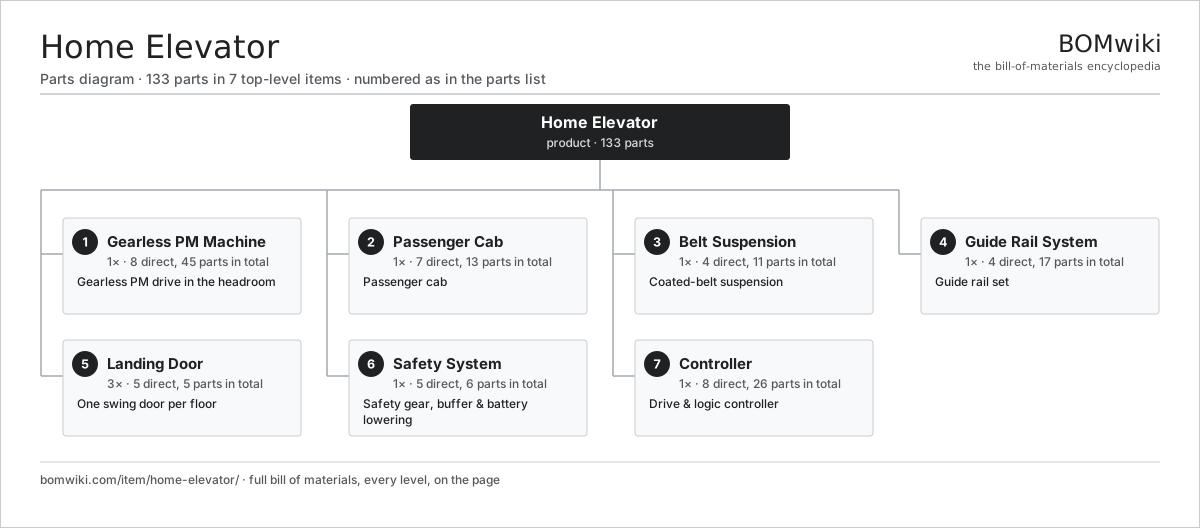
| # | Part | Qty | What it does |
|---|---|---|---|
| 1 | Gearless PM Machine 8 parts | 1× | Gearless PM drive in the headroom |
| 2 | Passenger Cab 7 parts | 1× | Passenger cab |
| 3 | Belt Suspension 4 parts | 1× | Coated-belt suspension |
| 4 | Guide Rail System 4 parts | 1× | Guide rail set |
| 5 | Landing Door 5 parts | 3× | One swing door per floor |
| 6 | Safety System 5 parts | 1× | Safety gear, buffer & battery lowering |
| 7 | Controller 8 parts | 1× | Drive & logic controller |
3D model
No 3D model yet. Have a CAD file of this? Add a 3D model. STL renders right on this page; STEP, FreeCAD, and OpenSCAD sources are welcome too (openly licensed, like all 3D models on BOMwiki).
Build & assembly graph
expand / collapse · shared sub-assemblies converge · links to related products · est. labourTap an assembly to expand/collapse · tap a part to open it · use “Open page” for any node · drag to pan, scroll to zoom.
Bill of materials for Home Elevator
7 top-level lines · 55 rows shown · 133 parts total · indented to 3 levels| # | Item / sub-assembly | Part no. | Qty/assy | Ext. qty | Parts | Type |
|---|---|---|---|---|---|---|
| 1 | Gearless PM Machine 8 parts | home-elevator-machine | 1× | 1 | 45 | assembly |
| 1.1 | Stator Assembly 3 parts | stator-assembly | 1× | 1 | 3 | assembly |
| 1.1.1 | Stator Core (laminations) | stator-core | 1× | 1 | · | part |
| 1.1.2 | Copper Winding | copper-winding | 1× | 1 | · | part |
| 1.1.3 | Slot Insulation | stator-insulation | 1× | 1 | · | part |
| 1.2 | Rotor Assembly 4 parts | rotor-assembly | 1× | 1 | 19 | assembly |
| 1.2.1 | Rotor Shaft | rotor-shaft | 1× | 1 | · | part |
| 1.2.2 | Rotor Core | rotor-core | 1× | 1 | · | part |
| 1.2.3 | Neodymium Magnet | neodymium-magnet | 16× | 16 | · | part |
| 1.2.4 | Ball Bearing | ball-bearing | 1× | 1 | · | part |
| 1.3 | Neodymium Magnet | neodymium-magnet | 16× | 16 | · | part |
| 1.4 | Motor Housing | motor-housing | 1× | 1 | · | part |
| 1.5 | Ball Bearing | ball-bearing | 2× | 2 | · | part |
| 1.6 | Traction Sheave | home-elevator-traction-sheave | 1× | 1 | · | part |
| 1.7 | Disc Brake | home-elevator-brake | 2× | 2 | · | part |
| 1.8 | Encoder | encoder | 1× | 1 | · | part |
| 2 | Passenger Cab 7 parts | home-elevator-cab | 1× | 1 | 13 | assembly |
| 2.1 | Sheet Metal Panel | sheet-panel | 4× | 4 | · | part |
| 2.2 | Cab Floor | home-elevator-cab-floor | 1× | 1 | · | part |
| 2.3 | Cab Ceiling | home-elevator-cab-ceiling | 1× | 1 | · | part |
| 2.4 | Car Door | home-elevator-car-door | 1× | 1 | · | part |
| 2.5 | Car Operating Panel | home-elevator-cop | 1× | 1 | · | part |
| 2.6 | Cab Sling | home-elevator-sling | 1× | 1 | · | part |
| 2.7 | Guide Shoe | home-elevator-guide-shoe | 4× | 4 | · | part |
| 3 | Belt Suspension 4 parts | home-elevator-suspension | 1× | 1 | 11 | assembly |
| 3.1 | Coated Steel Belt | home-elevator-belt | 3× | 3 | · | part |
| 3.2 | Belt Termination | home-elevator-belt-termination | 6× | 6 | · | part |
| 3.3 | Belt Monitor | home-elevator-belt-monitor | 1× | 1 | · | part |
| 3.4 | Fastener Set | fastener-set | 1× | 1 | · | part |
| 4 | Guide Rail System 4 parts | home-elevator-rails | 1× | 1 | 17 | assembly |
| 4.1 | Guide Rail Section | home-elevator-rail-section | 6× | 6 | · | part |
| 4.2 | Rail Bracket | home-elevator-rail-bracket | 8× | 8 | · | part |
| 4.3 | Pit Channel | home-elevator-pit-channel | 1× | 1 | · | part |
| 4.4 | Fastener Set | fastener-set | 2× | 2 | · | part |
| 5 | Landing Door 5 parts | home-elevator-landing-door | 3× | 3 | 5 | assembly |
| 5.1 | Door Leaf | home-elevator-door-panel | 1× | 3 | · | part |
| 5.2 | Door Interlock | home-elevator-interlock | 1× | 3 | · | part |
| 5.3 | Door Frame | home-elevator-door-frame | 1× | 3 | · | part |
| 5.4 | Door Closer | home-elevator-door-closer | 1× | 3 | · | part |
| 5.5 | Hall Sensor | hall-sensor | 1× | 3 | · | part |
| 6 | Safety System 5 parts | home-elevator-safety | 1× | 1 | 6 | assembly |
| 6.1 | Overspeed Governor | home-elevator-governor | 1× | 1 | · | part |
| 6.2 | Safety Gear | home-elevator-safety-gear | 1× | 1 | · | part |
| 6.3 | Pit Buffer | home-elevator-buffer | 2× | 2 | · | part |
| 6.4 | 12 V Battery | lv-battery | 1× | 1 | · | part |
| 6.5 | Light Curtain | home-elevator-light-curtain | 1× | 1 | · | part |
| 7 | Controller 8 parts | home-elevator-controller | 1× | 1 | 26 | assembly |
| 7.1 | Bare PCB | pcb-bare | 2× | 2 | · | part |
| 7.2 | Microcontroller | mcu | 1× | 1 | · | part |
| 7.3 | Relay | relay | 4× | 4 | · | part |
| 7.4 | IGBT Power Module | igbt-module | 6× | 6 | · | part |
| 7.5 | Power Supply | power-supply | 1× | 1 | · | part |
| 7.6 | Connector | connector | 8× | 8 | · | part |
| 7.7 | Wire Bundle | wire-bundle | 3× | 3 | · | part |
| 7.8 | Traveling Cable | home-elevator-traveling-cable | 1× | 1 | · | part |
Something wrong in this list? Report a problem with this BOM.
Related products
same domain, ranked by shared parts Moving Walkway
1,050 parts · shares 16 with this page
Pneumatic Vacuum Elevator
122 parts · shares 14 with this page
Freight Elevator
229 parts · shares 15 with this page
Moving Walkway
1,050 parts · shares 16 with this page
Pneumatic Vacuum Elevator
122 parts · shares 14 with this page
Freight Elevator
229 parts · shares 15 with this page
 Wheelchair Platform Lift
89 parts · shares 14 with this page
Wheelchair Platform Lift
89 parts · shares 14 with this page
 Dumbwaiter
128 parts · shares 14 with this page
Residential Stair Lift
143 parts · shares 13 with this page
Dumbwaiter
128 parts · shares 14 with this page
Residential Stair Lift
143 parts · shares 13 with this page
Sourcing: possible vendors
Browse the supplier directory → Prices, MOQ, and lead times are algorithmic estimates, not quotes, and not claims about these companies. Company mappings are curated by keyword; est. price band $10k–$200k. How estimates work| Vendor | HQ | Specialty | MOQ | Lead time |
|---|---|---|---|---|
|
🇺🇸Otis
otis.com ↗
|
Farmington, US | Elevators & escalators | 20 units | 14–24 wks |
| schindler.com ↗ | Ebikon, CH | Elevators & escalators | 20 units | 14–24 wks |
|
🇫🇮KONE
kone.com ↗
|
Espoo, FI | Elevators & escalators | 20 units | 14–24 wks |
| tkelevator.com ↗ | Düsseldorf, DE | Elevators | 20 units | 14–24 wks |
| mitsubishielectric.com ↗ | Tokyo, JP | Elevators & electronics | 20 units | 14–24 wks |
820-word article