Home Energy Monitor
ProductOverview
A home energy monitor is a non-invasive system that clamps onto a household main service line and measures real-time electricity consumption without any electrical modifications to the home. The split-core current transformers wrap around the line, and the Power Measurement Module computes power and integrates energy consumption. The WiFi Gateway Module uploads data to a cloud backend every 10 seconds, where the Cloud Analytics Backend analytics platform displays consumption graphs, calculates utility bills, and alerts users to anomalies.
Unlike utility smart meters (which require professional installation), home energy monitors are a DIY product popular with environmentally conscious homeowners, solar installers, and energy auditors. They serve as a bridge between the customer and their utility data, enabling conservation and informed load-shifting.
How it works
The household main service line carries current at 0–200 A. The Current Clamp Assembly are clamped around the line (two clamps for split-phase or three for three-phase). Each CT generates a proportional 0–5 V secondary signal, which travels via shielded cable to the Power Measurement Module.
The measurement unit simultaneously samples:
- Voltage via precision divider from line to neutral (120 V or 240 V stepped down to 0–3.3 V)
- Current via CT secondary (0–5 V proportional to line current)
The dual ADC digitizes both at 1 kHz. The firmware computes instantaneous power: P(t) = V(t) × I(t), averaging over a 1-second window to produce RMS power in kW. This is the most accurate method for non-linear loads (LEDs, switching supplies, heat pumps).
Energy consumption is accumulated: integrating kW over time yields kWh. Daily, monthly, and yearly snapshots are computed and buffered in local flash (survives WiFi outages for 30 days).
Every 10 seconds, the WiFi hub uploads the current power (kW), recent average (10-minute), and running daily total (kWh) to the cloud. The backend stores this in a time-series database and serves it to the web dashboard and mobile app.
Accuracy limitations
Unlike utility meters (Class 1, ±1 %), home monitors achieve ±3–5 % accuracy due to:
- CT accuracy: Split-core CTs are ±2–3 % at best (vs. ±0.5 % for utility CTs with precision burden networks).
- Voltage divider linearity: Resistor tolerances and temperature drift add ±1–2 % error.
- Phase shift: The CT secondary lags the current by a few degrees; firmware assumes perfect 0° phase to simplify cost. At power factors <0.95, this introduces 1–2 % error.
- Harmonics: Non-sinusoidal waveforms (from LED dimmer loads, wireless chargers) are partially mishandled if firmware assumes pure 50/60 Hz.
Despite these limits, monitors are useful for consumption tracking (identifying appliances drawing >500 W) and conservation (comparing before/after LED upgrades). For accurate billing audits, a utility-grade meter is required.
Per-circuit monitoring
Advanced setups add multiple CT clamps to individual sub-panel circuits, creating a granular consumption map:
- Kitchen circuit: stove, dishwasher, microwave (shared)
- Air conditioning circuit: central AC unit
- EV charging circuit: Level 2 charger
Each sub-circuit is metered separately, and the cloud dashboard displays a pie chart breaking down whole-home consumption. A homeowner can immediately identify that the air conditioner is running 16 hours/day (unusual) and investigate a stuck thermostat or refrigerant leak.
Demand response integration
Utilities increasingly integrate home monitors with demand-response programs. During a peak pricing event (4–9 PM summer), the Cloud Analytics Backend sends a webhook to the home's smart energy hub (Nest, EcoFlow, etc.), which receives the pricing signal and automatically:
- Delays EV charging until 11 PM (off-peak)
- Raises water heater setpoint by 5 °C (reducing compressor runtime)
- Pre-cools the house to 68 °F (enabling setpoint rise to 74 °F during peak without discomfort)
The meter captures the reduced consumption; the customer receives a $5–20 credit on next month's bill. Aggregating thousands of homes, utilities reduce peak demand by 5–15 %, deferring costly peaker generation.
Privacy considerations
Consumption data is sensitive: appliance-level consumption (when EV charges, when dishwasher runs) reveals occupancy and daily routines. Home monitor companies must:
- Encrypt data in transit (HTTPS/TLS) and at rest
- Provide opt-out for third-party data sharing
- Allow users to delete historical data
- Comply with local data privacy laws (GDPR, CCPA)
Some utilities provide competing smart meter data via web portal; users choose between utility meter data (authoritative but limited to monthly/daily snapshots) and home monitor data (real-time but potentially higher variance).
Cloud failure resilience
If the WiFi hub loses connectivity, the measurement unit buffers 30 days of hourly snapshots in flash. When WiFi is restored, the unit uploads the buffer and resumes real-time reporting. This means users can still access consumption history locally (via optional LCD display) even during extended outages.
However, if local storage is lost (hardware failure), historical data is unrecoverable. Some high-end monitors include cellular (LTE-M) as backup to WiFi, but cost >$400.
Retrofit solar and battery tracking
Home monitors are essential for solar + battery homes. A second meter tracks solar generation (CTs on the solar inverter output), and the monitor subtracts generation from consumption:
- Net import/export = consumption − generation
- Battery charge = consumption − generation + charging from grid
- Self-consumption ratio = (generation − export) / generation
These metrics inform decisions: Should the battery charge now (cheap nighttime grid power) or wait for solar generation tomorrow? Monitors with per-circuit metering can identify which loads are running during solar peak, optimizing solar self-use.
Comparison with utility smart meters
| Feature | Home Monitor | Utility Smart Meter |
|---|---|---|
| Installation | DIY, 10 min | Professional, may require hot work |
| Cost | $150–300 hardware + $5–15/mo cloud | Usually free or $0.50–2/mo fee |
| Accuracy | ±3–5 % | ±0.5–1 % |
| Data frequency | 10 sec real-time | 15–60 min intervals |
| Privacy | Customer controls, local storage | Utility controls, data governed by law |
| Tamper-proof | No | Yes (sealed, audited) |
Home monitors excel at near-real-time feedback; utility meters excel at accurate billing. Many homes use both: utility meter for billing, home monitor for conservation insights.
Home Energy Monitor parts and their functions
7 top-level parts · 38 parts in total · full bill of materials below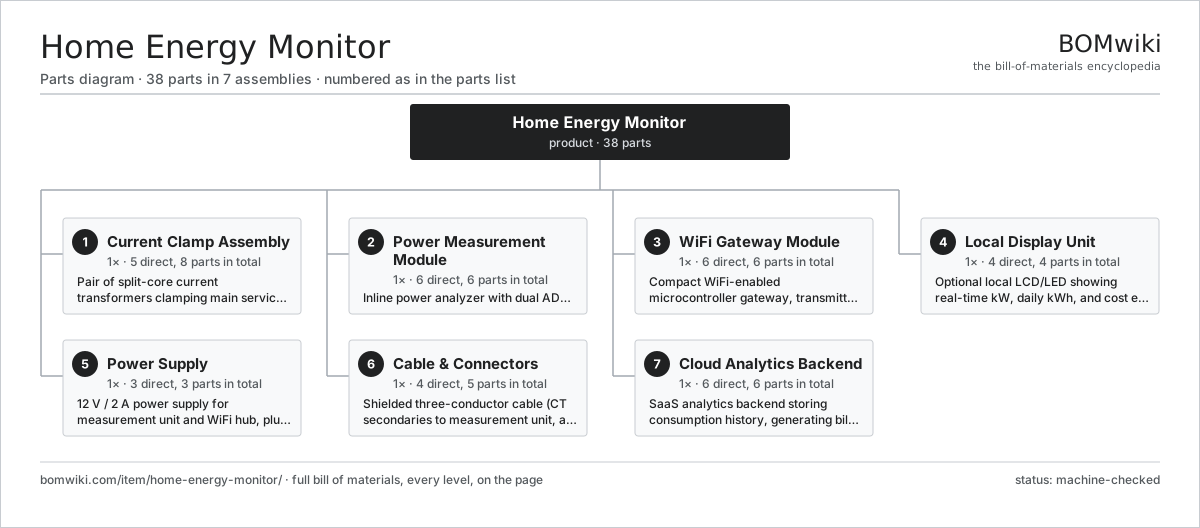
| # | Part | Qty | What it does |
|---|---|---|---|
| 1 | Current Clamp Assembly 5 parts | 1× | Pair of split-core current transformers clamping main service line, providing 0–5 V output |
| 2 | Power Measurement Module 6 parts | 1× | Inline power analyzer with dual ADC channels, sampling voltage and current, computing instantaneous power |
| 3 | WiFi Gateway Module 6 parts | 1× | Compact WiFi-enabled microcontroller gateway, transmitting data to cloud dashboard every 10 seconds |
| 4 | Local Display Unit 4 parts | 1× | Optional local LCD/LED showing real-time kW, daily kWh, and cost estimate |
| 5 | Power Supply 3 parts | 1× | 12 V / 2 A power supply for measurement unit and WiFi hub, plugging into nearby outlet |
| 6 | Cable & Connectors 4 parts | 1× | Shielded three-conductor cable (CT secondaries to measurement unit, and Ethernet to hub) |
| 7 | Cloud Analytics Backend 6 parts | 1× | SaaS analytics backend storing consumption history, generating bills, and enabling demand notifications |
3D model
No 3D model yet. Have a CAD file of this? Add a 3D model — STL renders right on this page; STEP, FreeCAD, and OpenSCAD sources are welcome too (openly licensed, like all 3D models on BOMwiki).
Build & assembly graph
expand / collapse · shared sub-assemblies converge · links to related products · est. labourTap an assembly to expand/collapse · tap a part to open it · use “Open page” for any node · drag to pan, scroll to zoom.
Bill of materials for Home Energy Monitor
7 top-level lines · 41 rows shown · 38 parts total · indented to 3 levels| # | Item / sub-assembly | Part no. | Qty/assy | Ext. qty | Parts | Type |
|---|---|---|---|---|---|---|
| 1 | Current Clamp Assembly 5 parts | home-energy-monitor-ct-clamps | 1× | 1 | 8 | assembly |
| 1.1 | Split-Core Toroid | home-energy-monitor-ct-core | 2× | 2 | · | part |
| 1.2 | Secondary Winding | home-energy-monitor-ct-secondary | 2× | 2 | · | part |
| 1.3 | Burden Resistor | home-energy-monitor-ct-burden | 1× | 1 | · | part |
| 1.4 | Clamp Housing | home-energy-monitor-ct-housing | 1× | 1 | · | part |
| 1.5 | Shielded CT Cable | home-energy-monitor-ct-cable | 2× | 2 | · | part |
| 2 | Power Measurement Module 6 parts | home-energy-monitor-measurement-unit | 1× | 1 | 6 | assembly |
| 2.1 | Measurement MCU | home-energy-monitor-measurement-mcu | 1× | 1 | · | part |
| 2.2 | Dual 16-Bit ADC | home-energy-monitor-adc-dual | 1× | 1 | · | part |
| 2.3 | Voltage Divider Network | home-energy-monitor-voltage-divider | 1× | 1 | · | part |
| 2.4 | Power Computation Firmware | home-energy-monitor-computation-engine | 1× | 1 | · | part |
| 2.5 | Energy Integrator | home-energy-monitor-energy-accumulator | 1× | 1 | · | part |
| 2.6 | Local Storage Buffer | home-energy-monitor-local-storage | 1× | 1 | · | part |
| 3 | WiFi Gateway Module 6 parts | home-energy-monitor-wifi-hub | 1× | 1 | 6 | assembly |
| 3.1 | WiFi 5 Module | home-energy-monitor-wifi-module | 1× | 1 | · | part |
| 3.2 | WiFi MCU Core | home-energy-monitor-wifi-mcu-core | 1× | 1 | · | part |
| 3.3 | Secure Enclave Coprocessor | home-energy-monitor-secure-enclave | 1× | 1 | · | part |
| 3.4 | Flash Memory | home-energy-monitor-flash-storage | 1× | 1 | · | part |
| 3.5 | Ethernet Port | home-energy-monitor-ethernet-interface | 1× | 1 | · | part |
| 3.6 | Antenna | home-energy-monitor-antenna | 1× | 1 | · | part |
| 4 | Local Display Unit 4 parts | home-energy-monitor-display | 1× | 1 | 4 | assembly |
| 4.1 | LCD Panel | home-energy-monitor-display-lcd | 1× | 1 | · | part |
| 4.2 | LCD Controller | home-energy-monitor-display-driver | 1× | 1 | · | part |
| 4.3 | Display Update Firmware | home-energy-monitor-display-update-logic | 1× | 1 | · | part |
| 4.4 | Display Case | home-energy-monitor-display-housing | 1× | 1 | · | part |
| 5 | Power Supply 3 parts | home-energy-monitor-ac-adapter | 1× | 1 | 3 | assembly |
| 5.1 | Power Supply | power-supply | 1× | 1 | · | part |
| 5.2 | EMI Filter & Output Conditioning | home-energy-monitor-supply-filtering | 1× | 1 | · | part |
| 5.3 | Overcurrent Protection | home-energy-monitor-supply-protection | 1× | 1 | · | part |
| 6 | Cable & Connectors 4 parts | home-energy-monitor-wiring | 1× | 1 | 5 | assembly |
| 6.1 | Twisted-Pair Shielded Cable | home-energy-monitor-ct-cable-shielded | 1× | 1 | · | part |
| 6.2 | BNC or Screw Terminal | home-energy-monitor-connector-bnc | 2× | 2 | · | part |
| 6.3 | Ethernet Cable | home-energy-monitor-ethernet-cable | 1× | 1 | · | part |
| 6.4 | Cable Clips | home-energy-monitor-cable-management | 1× | 1 | · | part |
| 7 | Cloud Analytics Backend 6 parts | home-energy-monitor-cloud-service | 1× | 1 | 6 | assembly |
| 7.1 | Data Ingestion API | home-energy-monitor-ingest-api | 1× | 1 | · | part |
| 7.2 | Time-Series Database | home-energy-monitor-timeseries-db | 1× | 1 | · | part |
| 7.3 | Billing Logic | home-energy-monitor-billing-engine | 1× | 1 | · | part |
| 7.4 | ML Anomaly Detector | home-energy-monitor-anomaly-detection | 1× | 1 | · | part |
| 7.5 | GraphQL/REST Gateway | home-energy-monitor-api-gateway | 1× | 1 | · | part |
| 7.6 | Web/Mobile Dashboard | home-energy-monitor-dashboard-frontend | 1× | 1 | · | part |
Related products
same domain, ranked by shared parts Air-Insulated Substation Bay
1,329 parts · shares 1 with this page
Bottom Ash Handling System
1,782 parts · shares 1 with this page
Air-Insulated Substation Bay
1,329 parts · shares 1 with this page
Bottom Ash Handling System
1,782 parts · shares 1 with this page
 Circuit-Level Energy Monitor
57 parts · shares 1 with this page
Circuit-Level Energy Monitor
57 parts · shares 1 with this page
 Coal Pulverizer Mill
313 parts · shares 1 with this page
Coal Pulverizer Mill
313 parts · shares 1 with this page
 Combined Heat and Power Unit
522 parts · shares 1 with this page
Combined Heat and Power Unit
522 parts · shares 1 with this page
Sourcing: possible vendors
Prices, MOQ, and lead times are algorithmic estimates, not quotes, and not claims about these companies. Company mappings are curated by keyword; est. price band $5k–$50M. How estimates work| Vendor | HQ | Specialty | MOQ | Lead time |
|---|---|---|---|---|
| gevernova.com ↗ | Cambridge, US | Power generation | made to order | 20–40 wks |
| siemens-energy.com ↗ | Munich, DE | Power & grid | made to order | 20–40 wks |
| hitachienergy.com ↗ | Zurich, CH | Grid & transformers | made to order | 20–40 wks |
|
🇨🇭ABB
abb.com ↗
|
Zurich, CH | Electrification & automation | made to order | 20–40 wks |
| se.com ↗ | Rueil-Malmaison, FR | Electrical & automation | made to order | 20–40 wks |
1,075-word article