Home Proofing Box
ProductOverview
A home proofing box is a compact insulated chamber maintaining precise temperature (24–28°C) and humidity (70–80% RH) during dough fermentation. In baking, "proofing" is the final fermentation stage where shaped dough rises before baking. Temperature is critical: at 24°C, fermentation proceeds at an ideal pace (3–4 hours for bulk, 1–2 hours for final proof); at 20°C, fermentation slows to 5–6 hours (risking overoxidation and flavor loss); at 30°C, fermentation accelerates dangerously, leading to overproofing (dough collapses) and weak gluten structure.
A proofing box eliminates seasonal and ambient variability. A baker in a cold climate (basement proofing in winter at 15°C) or tropical climate (kitchen at 32°C) can now achieve the same 26°C proofing environment year-round, producing consistent, high-quality bread without guesswork.
How It Works
Insulation and Thermal Stability
The Insulated Enclosure, made of molded polypropylene or expanded styrofoam, is a lightweight box ≈40×30×30 cm (≈36 L internal volume). The walls are ≥3 cm thick, filled with EPS or polyurethane foam (R-value ≥12), providing good insulation while keeping the unit portable.
The Lid Hinge Assembly on the removable or flip-back lid allows easy access to dough; the Chamber Gasket, silicone or foam strips, reduces thermal leakage when the lid is closed.
Thermal mass is minimal (the box is light, not a masonry oven), so the Heating Pad & Control must run continuously to maintain setpoint.
Heating System
The Heating Pad, a 100–200W thin-film silicone pad bonded to the bottom or side interior, provides gentle, distributed heat. The pad is energized and de-energized by a Thermostat Switch, a bimetal snap-disk thermostat with ±1°C hysteresis.
Operation: As chamber temperature drops below 26°C (setpoint), the bimetal disk flexes, closing the heater circuit. The pad warms the chamber. When temperature reaches 27°C (26°C + 1°C hysteresis), the disk snaps open, disconnecting the heater. Dough mass and insulation provide thermal lag, preventing temperature from overshooting. This simple on/off cycle maintains 26±1°C continuously.
Heating power is modest (≈100–200W), so the box draws only ≈1 A at 240V, suitable for any standard kitchen outlet. Heat-up time from 20°C ambient to 26°C setpoint is ≈30–45 minutes (faster if dough is pre-warmed).
Humidity Control
Fermented dough's surface should not dry out during proof, a crust would form, preventing rise and creating ugly tears on the baked loaf. The Humidity Management, a damp cloth or water tray, maintains 70–80% relative humidity.
Simple method: A Water Tray, shallow polypropylene or stainless tray (≈10×10 cm), is filled with water. A Damp Cloth, cotton or linen, is draped over the tray, wicking water and keeping the interior moist. The cloth is checked daily and re-dampened as needed.
Advanced method: An optional Humidity Sensor (Optional), a capacitive RH sensor, monitors humidity and displays on an external MCU. If RH drops below 65%, an automated humidifier mist (not included in basic models) is triggered.
At 70–80% RH, dough surface remains slightly tacky, allowing the gluten network to stretch freely during rise. At <60% RH, surface dries and hardens, restricting expansion.
Shelving and Batch Management
The Shelf Inserts & Spacing, 2–3 removable wire shelves spaced ≥8 cm apart, allows stacking of dough in multiple forms:
- Bulk fermentation bowls (≥2 kg dough per bowl, ≤2 bowls per shelf)
- Shaped loaves on sheet pans (4–6 loaves per shelf)
- Bannetons (woven proofing baskets, 2–3 per shelf)
Each Shelf Decking supports ≥5 kg, and Shelf Spacer Clips adjust height by ≥2 cm increments, accommodating different dough volumes and fermentation vessel heights.
Temperature Monitoring
The Digital Thermometer & Display, a battery-powered digital thermometer with external Temperature Probe, displays real-time internal temperature on an LCD screen. Most units include min/max memory, recording the coldest and warmest temps during a proof cycle, useful for diagnosing heating issues.
The probe wire (≥2 meter, food-safe shielded) runs from the chamber interior to a Display Mounting Bracket on the exterior, where the display sits visible to the baker.
Dough Fermentation Physiology
Yeast (Saccharomyces cerevisiae for bread) metabolizes sugars in the dough, producing CO₂ (which inflates the dough) and ethanol (which evaporates during baking, contributing flavor). Temperature dramatically affects yeast metabolic rate:
- 20°C: Slow fermentation, ≈6–8 hours for bulk proof. Extended time allows complex flavor development but risks flavor oxidation (stale-bread notes).
- 26°C: Optimal rate, ≈3–4 hours for bulk, ≈1–1.5 hours for final proof. Balanced speed and flavor development.
- 30°C: Fast fermentation, ≈2–3 hours. Risk of overproofing (dough collapses) and unbalanced sour/yeasty flavors.
Lactic-acid bacteria (wild fermentation in sourdough) also thrive at 26°C, producing the desired sourness without excessive tang.
A proofing box set to 26°C is thus the professional standard: fermentation proceeds at a predictable pace, and flavor develops consistently.
Practical Workflow
Dough mixing and initial bulk fermentation (optional, pre-box): Dough is mixed, left to autolyse (30 min) or bulk ferment at room temperature (0–4 hours, depending on room temp and baker preference). If already proofed elsewhere, dough is shaped and brought to the proofing box.
Loading: Shaped dough (loaves, boules, batards in bannetons or on sheet pans) is arranged on Shelf Inserts & Spacing inside the closed chamber.
Environmental setup: Damp cloth is placed on Water Tray. Heating pad is plugged in. Thermostat Switch activates, maintaining 26°C. Digital Thermometer & Display displays internal temp (should reach 26°C in ≈30 min).
Proofing: Dough rests in the controlled environment. Final proof duration depends on dough strength and fermentation level:
- Well-fermented, shaped dough: 45 min–1.5 hours (quick proof).
- Cold-fermented dough (overnight bulk in fridge): 2–3 hours (slower warm-up and continued fermentation).
Readiness check: Baker performs the "poke test", pressing a floured finger gently into the dough. If the indent springs back slowly (≈80% recovery), dough is properly proofed. If it springs back immediately, under-proofed (proof longer). If it doesn't spring back at all, over-proofed (bake immediately or discard).
Baking: Dough is removed and transferred to a preheated oven (typically 450–500°F / 230–260°C). The Home Proofing Box is left plugged in for the next batch.
Typical Proofing Timeline
A baker's morning workflow with the proofing box:
- 6:00 AM: Dough from overnight cold ferment is shaped and loaded into box.
- 6:30 AM: Box reaches 26°C.
- 7:45 AM: Dough is poked and deemed properly proofed.
- 8:00 AM: Dough is scored and loaded into preheated oven.
- 8:35 AM: Bread emerges baked and cooling.
- 9:00 AM: Freshly baked bread is sliced and served.
Without a proofing box, the baker would manually monitor room temperature (risky if ambient is cool or variable) and guess proof duration. The box eliminates guesswork.
Design Variants
Compact travel unit: Smaller 25×20×20 cm box for bakers baking at different locations (pop-up bakeries, farmers markets). Still maintains 26°C but holds fewer loaves per batch.
Smart proofing box: MCU-based controller with WiFi, logging temperature and humidity throughout proof, alerting the baker when proof is complete via smartphone notification.
Banquette-style proofing box: Larger, insulated bench unit (60×40×40 cm) for commercial or serious-amateur use, holding ≥20 loaves per batch.
Dual-zone proofing box: Two separate chambers, each at different temperatures, allowing simultaneous proofing of doughs at 24°C (slow, complex flavor) and 28°C (fast, fresher flavor).
Home Proofing Box parts and their functions
7 top-level parts · 28 parts in total · full bill of materials below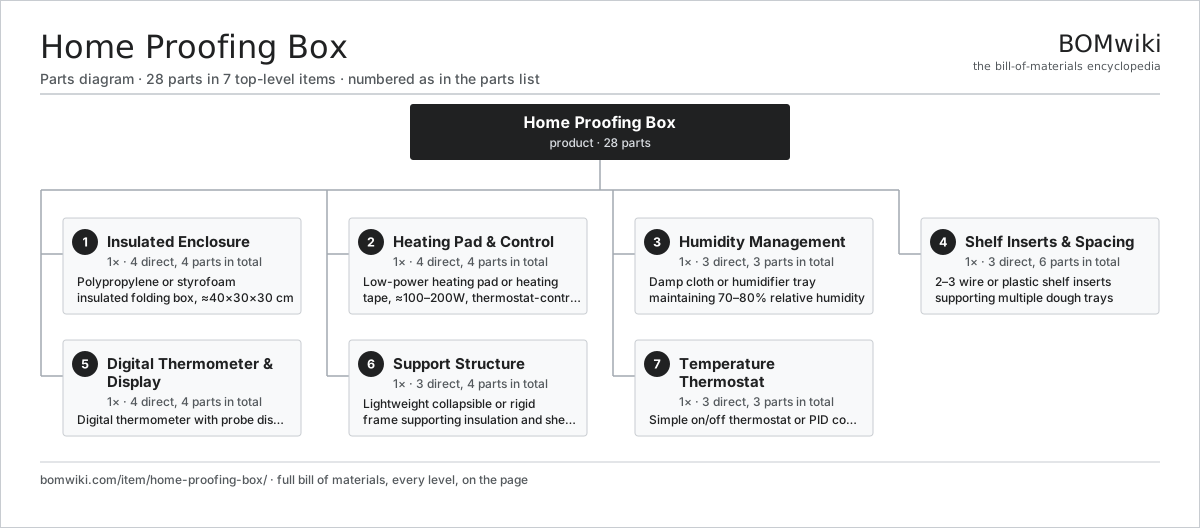
| # | Part | Qty | What it does |
|---|---|---|---|
| 1 | Insulated Enclosure 4 parts | 1× | Polypropylene or styrofoam insulated folding box, ≈40×30×30 cm |
| 2 | Heating Pad & Control 4 parts | 1× | Low-power heating pad or heating tape, ≈100–200W, thermostat-controlled |
| 3 | Humidity Management 3 parts | 1× | Damp cloth or humidifier tray maintaining 70–80% relative humidity |
| 4 | Shelf Inserts & Spacing 3 parts | 1× | 2–3 wire or plastic shelf inserts supporting multiple dough trays |
| 5 | Digital Thermometer & Display 4 parts | 1× | Digital thermometer with probe displaying internal temperature |
| 6 | Support Structure 3 parts | 1× | Lightweight collapsible or rigid frame supporting insulation and shelves |
| 7 | Temperature Thermostat 3 parts | 1× | Simple on/off thermostat or PID controller maintaining setpoint |
3D model
No 3D model yet. Have a CAD file of this? Add a 3D model. STL renders right on this page; STEP, FreeCAD, and OpenSCAD sources are welcome too (openly licensed, like all 3D models on BOMwiki).
Build & assembly graph
expand / collapse · shared sub-assemblies converge · links to related products · est. labourTap an assembly to expand/collapse · tap a part to open it · use “Open page” for any node · drag to pan, scroll to zoom.
Bill of materials for Home Proofing Box
7 top-level lines · 31 rows shown · 28 parts total · indented to 3 levels| # | Item / sub-assembly | Part no. | Qty/assy | Ext. qty | Parts | Type |
|---|---|---|---|---|---|---|
| 1 | Insulated Enclosure 4 parts | home-proofing-box-insulated-chamber | 1× | 1 | 4 | assembly |
| 1.1 | Chamber Shell | home-proofing-box-chamber-plastic | 1× | 1 | · | part |
| 1.2 | Insulation Foam | home-proofing-box-insulation-liner | 1× | 1 | · | part |
| 1.3 | Lid Hinge Assembly | home-proofing-box-lid-hinge | 1× | 1 | · | part |
| 1.4 | Chamber Gasket | home-proofing-box-gasket-seal | 1× | 1 | · | part |
| 2 | Heating Pad & Control 4 parts | home-proofing-box-heating-element | 1× | 1 | 4 | assembly |
| 2.1 | Heating Pad | home-proofing-box-heating-pad | 1× | 1 | · | part |
| 2.2 | Thermostat Switch | home-proofing-box-thermostat-switch | 1× | 1 | · | part |
| 2.3 | Temperature Probe | home-proofing-box-temperature-sensor | 1× | 1 | · | part |
| 2.4 | Power Cord & Plug | home-proofing-box-power-cord | 1× | 1 | · | part |
| 3 | Humidity Management 3 parts | home-proofing-box-humidity-control | 1× | 1 | 3 | assembly |
| 3.1 | Water Tray | home-proofing-box-water-tray | 1× | 1 | · | part |
| 3.2 | Damp Cloth | home-proofing-box-humidity-cloth | 1× | 1 | · | part |
| 3.3 | Humidity Sensor (Optional) | home-proofing-box-humidity-sensor | 1× | 1 | · | part |
| 4 | Shelf Inserts & Spacing 3 parts | home-proofing-box-shelving | 1× | 1 | 6 | assembly |
| 4.1 | Shelf Framework | home-proofing-box-shelf-rack | 1× | 1 | · | part |
| 4.2 | Shelf Decking | home-proofing-box-shelf-decks | 3× | 3 | · | part |
| 4.3 | Shelf Spacer Clips | home-proofing-box-shelf-spacer-clips | 2× | 2 | · | part |
| 5 | Digital Thermometer & Display 4 parts | home-proofing-box-temperature-monitor | 1× | 1 | 4 | assembly |
| 5.1 | Digital Thermometer Display | home-proofing-box-thermometer-body | 1× | 1 | · | part |
| 5.2 | Temperature Probe | home-proofing-box-temp-probe | 1× | 1 | · | part |
| 5.3 | Probe Shielded Wire | home-proofing-box-probe-wire | 1× | 1 | · | part |
| 5.4 | Display Mounting Bracket | home-proofing-box-mounting-bracket | 1× | 1 | · | part |
| 6 | Support Structure 3 parts | home-proofing-box-frame | 1× | 1 | 4 | assembly |
| 6.1 | Frame Corner Posts | home-proofing-box-frame-corner-posts | 1× | 1 | · | part |
| 6.2 | Frame Cross-Braces | home-proofing-box-frame-cross-braces | 2× | 2 | · | part |
| 6.3 | Frame Feet | home-proofing-box-frame-feet | 1× | 1 | · | part |
| 7 | Temperature Thermostat 3 parts | home-proofing-box-controller | 1× | 1 | 3 | assembly |
| 7.1 | Thermostat Unit | home-proofing-box-thermostat-unit | 1× | 1 | · | part |
| 7.2 | Controller Enclosure | home-proofing-box-controller-housing | 1× | 1 | · | part |
| 7.3 | Power Relay Switch | home-proofing-box-power-relay | 1× | 1 | · | part |
Something wrong in this list? Report a problem with this BOM.
Sourcing: possible vendors
Browse the supplier directory → Prices, MOQ, and lead times are algorithmic estimates, not quotes, and not claims about these companies. Company mappings are curated by keyword; est. price band $20–$600. How estimates work| Vendor | HQ | Specialty | MOQ | Lead time |
|---|---|---|---|---|
|
🇦🇺Breville
breville.com ↗
|
Sydney, AU | Kitchen appliances | 2,000 units | 6–10 wks |
| groupeseb.com ↗ | Écully, FR | Cookware & small appliances | 2,000 units | 6–10 wks |
| hamiltonbeach.com ↗ | Glen Allen, US | Small appliances | 2,000 units | 6–10 wks |
| panasonic.com ↗ | Osaka, JP | Electronics & appliances | 2,000 units | 6–10 wks |
|
🇨🇳Midea
midea.com ↗
|
Foshan, CN | Home appliances | 2,000 units | 6–10 wks |
1,308-word article