Hoof Trimming Chute
ProductOverview
A hoof-trimming chute is a specialized cattle restraint device designed specifically for hoof care, the process of regular trimming and maintenance of cattle hooves. Unlike general-purpose squeeze chutes (which restrain cattle for vaccination or examination), trimming chutes incorporate features to safely elevate and position individual legs for farrier access. The key innovation is the combination of a belly-band lift (supporting animal weight) and four independent leg-lifting systems (rope-and-pulley or hydraulic winches) that hold each leg in the optimal working position.
Modern hoof trimming is essential for dairy and beef cattle: untrimmed hooves lead to lameness, reduced milk production, poor growth rates, and animal welfare issues. Professional farriers typically trim hooves every 8–12 weeks. A dedicated trimming chute reduces labor time per animal by 30–40% compared to traditional manual restraint methods (rope halters, manual leg holding).
This technology emerged in the 1980s in Northern Europe (particularly Denmark, Germany) and became standard in commercial dairy operations by the 2000s. North American adoption increased significantly after 2010 as hoof health concerns (digital dermatitis, interdigital lesions) became more prevalent.
How it works
Animal Entry & Restraint: The animal is herded down a narrow alley and enters the chute. Control Gates (front and rear) are closed and latched, securing the animal within the chute. Optional Squeeze Plates can be activated to apply light pressure, immobilizing the animal sideways (preventing side-to-side shifting).
Belly Band Positioning & Lift: The Belly Strap (heavy-duty canvas, 1.5 m wide) is positioned under the animal's abdomen, just behind the elbows. The operator engages a proportional lever that activates the Belly Band Lift. Pressurized oil flows to the cylinder, extending the rod and lifting the belly band. As the cylinder extends, the animal's belly is lifted upward by 150–300 mm, partially supporting its weight. This elevation serves two purposes:
- Comfort: The animal's weight is partially supported, reducing stress on standing legs and preventing crushing injuries to the limbs.
- Access: The elevation creates clearance below the animal, allowing the farrier to work on hooves from below (rather than awkwardly bending over at ground level).
Mechanical Cylinder Limit Switch prevents over-lift beyond 300 mm; excessive height would cause animal stress.
Leg Positioning via Winches: With the animal suspended comfortably by the belly band, the farrier selects one leg to trim (typically starts with one front leg). The appropriate hoof-trim-leg-iron (a rigid cradle that supports the leg above the knee) is positioned under that leg. The Winch Rope attached to the leg iron is then slowly tightened using the Winch Motor (either a hand-crank for manual operation or a small hydraulic motor).
As the winch rope tightens, the leg is drawn upward and held in a fixed position, typically with the leg fully extended forward (for front legs) or backward (for rear legs). The rope tension is carefully controlled to prevent excessive strain on the leg joints; typical tension is 200–400 N (equivalent to lifting 20–40 kg force).
Padded leg irons (with foam-lined cups) prevent bruising. Rope angle and pulley placement ensure smooth motion without lateral stress on the leg.
Trimming Operation: With the leg secured in the leg iron, the Trimming Platform (a raised work surface at 1.2 m height) positions the farrier at ergonomic height. The farrier uses hand-held trimming tools (sharp knives for horn removal, rasps for shaping, grindstones for finishing) to:
- Remove excess overgrown horn (dead tissue at the sole).
- Balance the hoof symmetrically (left-to-right and front-to-back).
- Trim the hoof wall to optimal length and angle (typically 50–55 mm at heel, with 2–5 degree break-over angle).
- Address any lesions or abnormal wear patterns.
Trimming time per leg is typically 10–15 minutes, depending on hoof condition. Total per-animal time: 40–60 minutes for all four hooves.
Leg Release & Repositioning: After the first leg is trimmed, the farrier loosens the winch rope on that leg (reversing the hydraulic motor or unspooling the hand-crank rope). The leg is carefully lowered back to ground contact, and the rope is detached. The animal shifts weight to that leg, and the process repeats for the remaining three legs.
Release & Exit: After all four legs are trimmed, the belly-band lift is gradually lowered (proportional valve slowly vents pressure), and the animal's weight returns to the four hooves evenly. The Control Gates are unlatched, and the animal exits forward into a clean pen.
Operational Workflow
Daily Setup:
- Chute is inspected for rope damage, hose leaks, or mechanical wear.
- Hydraulic fluid level is verified (should maintain full level to within 50 mm).
- Winch motors are tested (manually rotate if hand-crank; energize if hydraulic).
- Work platform is cleared of tools and debris.
Per-Animal Trimming Session (45–60 minutes):
- Animal enters chute; gates are closed.
- Belly band is positioned and lifted to comfortable height (150–250 mm elevation).
- First leg is selected; leg iron is positioned under that leg.
- Winch rope is spooled and tension is applied gradually (5–10 seconds to full tension).
- Farrier trims hoof from platform (10–15 minutes).
- Winch rope is released; leg is lowered.
- Steps 3–6 are repeated for remaining three legs.
- Belly band is lowered to release animal weight from lift.
- Gates are opened; animal exits.
High-Volume Operation (large dairy or feedlot):
- Two-farrier teams can trim 30–40 animals per day per chute.
- Assembly-line approach: Farrier 1 works on front legs; Farrier 2 works on rear legs (reduces total time/animal to 30–40 minutes).
- Animals are kept in a comfortable hold pen between chutes to minimize stress.
Manual vs. Hydraulic Leg Winches
Manual Rope-and-Crank:
- Operator uses hand-crank lever to tighten/release winch rope.
- Advantage: No motor or solenoid to fail; low maintenance.
- Disadvantage: Slower (10–15 seconds per leg to achieve full tension); operator fatigue (200+ turns of crank for full session).
Hydraulic Motor-Driven (described here):
- Small hydraulic motor (2–3 cc/rev) drives winch drum.
- Proportional valve allows smooth, variable-speed winch control (fast initial takeup, then slow creep to final tension).
- Advantage: Fast (5–10 seconds to full tension); no operator physical effort.
- Disadvantage: More complex plumbing; higher capital cost (+$5000–8000 for four motors and controls).
Most modern chutes use hydraulic motors; larger operations justify the cost through labor savings.
Rope & Pulley System Details
Rope Sizing:
- Steel wire rope (6 mm diameter, galvanized or stainless) rated for 1770 N breaking strength.
- Each leg winch has independent 5 m rope length (allows full-range leg motion).
- Rope is rated for minimum 4:1 safety factor (4×1770 N = 7080 N safe working load, vs. typical 200–400 N tension per leg).
Pulley Placement:
- Pulleys are positioned on overhead or diagonal boom arms extending from the chute frame.
- Pulley height is typically 2.0–2.2 m (above animal height).
- Rope angle from leg iron to pulley should be 15–30 degrees from vertical (prevents lateral stress on leg).
- Multiple pulleys may be used if boom arm is distant from chute (reduces friction losses).
Tension Control:
- Hydraulic proportional valve allows fine metering of motor speed; operator ramps up tension slowly (5–10 sec) rather than snap-loading.
- Gauge or sensor measures actual rope tension (load cell in rope anchor, or pressure gauge monitoring motor output).
- Farrier learns optimal tension by observing animal comfort (no struggling = tension is correct).
Ergonomic Design for Farrier
Research in agricultural ergonomics (Journal of Agromedicine, 2010–2023) shows hoof-trimming chiropractic stress is high. Dedicated chutes reduce injury by:
Height Adjustment:
- Work platform at fixed 1.2 m height reduces forward bending (vs. ground-level work at 0.5 m, which requires 60-degree forward trunk flexion).
- Some modern chutes have adjustable platform height (0.8–1.5 m range) to accommodate different farrier heights or hoof positions.
Leg Position Optimization:
- Leg iron holds leg at 45–90-degree hip extension (front leg extended forward; rear leg extended backward).
- This position is naturally comfortable for cattle and prevents resistance.
- Farrier can approach hoof from multiple angles (medial, lateral, ground surface) without excessive reaching.
Support Equipment:
- Anti-fatigue mat on work platform reduces leg fatigue during 8–10 hour trimming sessions.
- Tool rack nearby reduces reaching and bending for tool selection.
- Adjustable stool or saddle allows farrier to sit while trimming rear hooves (reduces lumbar strain).
Common Issues & Troubleshooting
Animal Won't Lift in Belly Band: Strap positioning is off, or cylinder is not extending fully.
- Verify strap is centered under animal (symmetrical left-to-right).
- Check cylinder pressure gauge; should reach 80–100 bar during lift (verify pump is running at full displacement).
- If pressure is low, pump may be failing; check engine RPM (should maintain 1500) and pump displacement setting.
Rope Won't Tighten: Winch motor is not rotating or rope is slipping on drum.
- Verify motor is energized (solenoid should click; listen for motor hum).
- Check rope spooling on drum (should be even, not twisted); manually unwind and respool if necessary.
- Verify rope tension is sufficient (adjust proportional valve to increase motor pressure if rope slips).
Leg Iron Slips Off Leg: Padding is worn, or cup diameter is too loose.
- Inspect foam padding; if <15 mm thick remaining, remove and glue new padding.
- Measure leg diameter; if <180 mm, select smaller iron; if >220 mm, larger iron may be needed.
Rope Fraying or Breaking: Rope age or mechanical damage.
- Inspect entire rope length for kinks, abrasions, or stranding damage.
- If damage is localized (one section), rope can be cut and splice-reconnected using three-part splices (temporary fix).
- If extensive damage (>10% of rope length), entire rope must be replaced (~$200–400 per leg including labor).
Hydraulic Oil Overheating: Continuous operation at high pressure without cooling.
- Verify hydraulic cooler is operating (thermostat should activate fan if oil temp >55°C).
- Check if cooler fins are clogged with dust/hay; compressed air cleaning may restore efficiency.
- If cooler is functioning but oil still overheats, cooler capacity may be undersized; larger cooler unit needed (~$1500–3000).
Animal Excessive Struggling: Rope tension too high, leg positioning uncomfortable, or animal fearful.
- Reduce rope tension by 50 N; re-evaluate animal response (animal should stand quietly).
- Verify leg iron cup is properly padded and positioned to avoid pressure points.
- Gradual introduction of younger animals (start with belly band without leg lift; progress to full restraint over 2–3 uses) reduces fear response.
Maintenance & Seasonal Care
Weekly:
- Inspect all hydraulic hoses for leaks; tighten connections if weeping.
- Check winch ropes for fraying or visible damage; replace any questionable sections.
- Test proportional valve lever movement (should move smoothly, no sticking).
Monthly:
- Drain and visually inspect hydraulic filter element for contamination (oil should be amber/clear, not dark brown or black).
- Replace filter if discolored or clogged.
- Verify hydraulic fluid level and top up if below half-full mark.
Every 3–4 Months (or 500 trimming sessions):
- Replace winch rope (wear from spooling adds up over time; rope efficiency degrades).
- Deep-clean belly band (remove hair, dried blood, manure); pressure-wash with hot water.
- Inspect all mechanical connections for corrosion or looseness; tighten fasteners.
Annually:
- Drain and replace all hydraulic fluid (oil absorbs moisture and oxidizes with age).
- Pressure-test all hoses; replace any holding <80% of rated pressure.
- Inspect proportional valve for sticking plunger; clean or replace if necessary.
- Replace engine air and fuel filters.
Off-Season Storage:
- Drain fuel from engine (if gasoline); store fuel-stabilized alternative if engine will not be used 2+ months.
- Lower all hydraulic actuators to lowest position (prevent seal compression).
- Cover entire chute with tarp to minimize UV and weather exposure.
- Disconnect hydraulic hoses from cylinders to prevent moisture condensation in lines.
Economics & ROI
A new hoof-trimming chute costs $30,000–50,000 depending on features (manual vs. hydraulic winches, platform options).
Labor savings:
- Traditional method (rope halter, manual leg holding): 90–120 minutes per animal.
- Trimming chute: 45–60 minutes per animal.
- Savings: 30–60 minutes per animal × 50 animals/year × $25/hour = $625–1,500/year per farrier equivalent.
Larger operations (100+ animals trimmed/year):
- One dedicated chute supports one full-time farrier (200–250 animals/year).
- Labor cost savings: ~$6000–10,000 per year.
- Payback: 3–5 years from labor alone; improved animal health (reduced lameness) provides additional ROI.
Shared Equipment Model:
- Smaller operations (30–50 animals/year) often share a chute with neighboring farms or hire a traveling farrier with mobile equipment.
- Mobile trimming chutes (trailer-mounted, hydraulic-powered) cost $45,000–65,000 and serve 3–5 farms on rotation.
Integration with Hoof Health Programs
Effective hoof care requires:
Regular Trimming Schedule: Every 8–12 weeks for dairy cattle; less frequent (12–16 weeks) for beef cattle or animals in pasture-only systems.
Preventive Measures:
- Footbath (copper sulfate or organic sanitizer) after trimming reduces digital dermatitis transmission.
- Dry cow beds (sand or lime) reduce moisture exposure (high moisture promotes lesion development).
- Adequate exercise (pasture turnout) promotes hoof strength and natural wear.
Health Monitoring:
- Farrier observes hoof lesions (heel erosion, sole ulcers, interdigital necrotica) and reports to veterinarian.
- Early lesion detection allows treatment before lameness becomes severe.
- Lameness reduces milk production by 15–25% and requires treatment cost; prevention via good hoof care is economical.
Genetic Selection:
- Hoof health is a heritable trait; selecting replacement heifers with strong feet improves herd-wide health.
- Hoof quality metrics (sole depth, heel height, claw shape) can be scored on pedigree databases.
Hoof Trimming Chute parts and their functions
8 top-level parts · 157 parts in total · full bill of materials below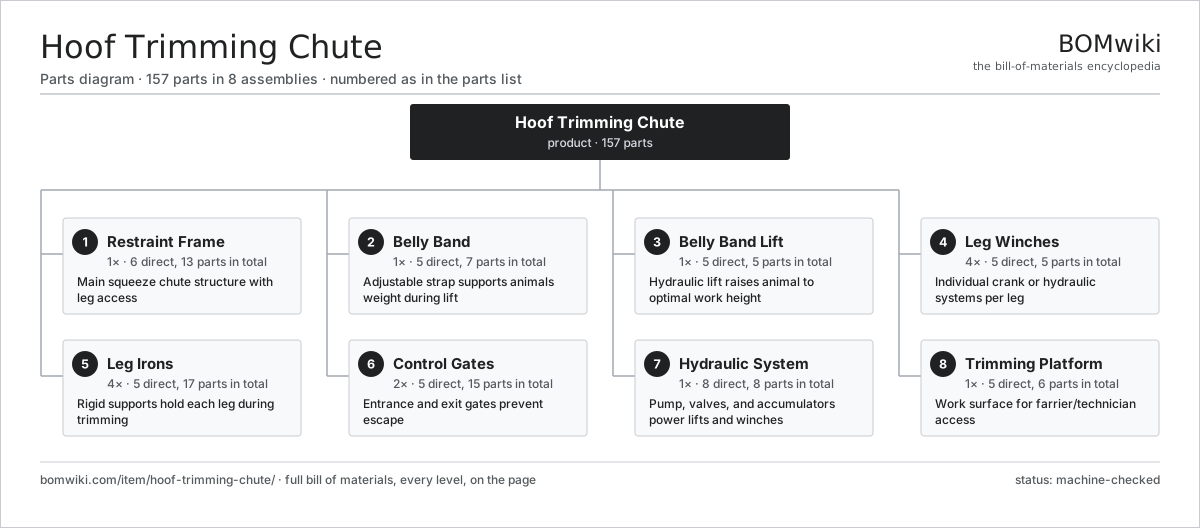
| # | Part | Qty | What it does |
|---|---|---|---|
| 1 | Restraint Frame 6 parts | 1× | Main squeeze chute structure with leg access |
| 2 | Belly Band 5 parts | 1× | Adjustable strap supports animals weight during lift |
| 3 | Belly Band Lift 5 parts | 1× | Hydraulic lift raises animal to optimal work height |
| 4 | Leg Winches 5 parts | 4× | Individual crank or hydraulic systems per leg |
| 5 | Leg Irons 5 parts | 4× | Rigid supports hold each leg during trimming |
| 6 | Control Gates 5 parts | 2× | Entrance and exit gates prevent escape |
| 7 | Hydraulic System 8 parts | 1× | Pump, valves, and accumulators power lifts and winches |
| 8 | Trimming Platform 5 parts | 1× | Work surface for farrier/technician access |
3D model
No 3D model yet. Have a CAD file of this? Add a 3D model — STL renders right on this page; STEP, FreeCAD, and OpenSCAD sources are welcome too (openly licensed, like all 3D models on BOMwiki).
Build & assembly graph
expand / collapse · shared sub-assemblies converge · links to related products · est. labourTap an assembly to expand/collapse · tap a part to open it · use “Open page” for any node · drag to pan, scroll to zoom.
Bill of materials for Hoof Trimming Chute
8 top-level lines · 52 rows shown · 157 parts total · indented to 3 levels| # | Item / sub-assembly | Part no. | Qty/assy | Ext. qty | Parts | Type |
|---|---|---|---|---|---|---|
| 1 | Restraint Frame 6 parts | hoof-trim-restraint-frame | 1× | 1 | 13 | assembly |
| 1.1 | Main Beam | hoof-trim-main-beam | 1× | 1 | · | part |
| 1.2 | Side Rails | hoof-trim-side-rails | 4× | 4 | · | part |
| 1.3 | Cross Bracing | hoof-trim-cross-bracing | 4× | 4 | · | part |
| 1.4 | Floor Grate | hoof-trim-floor-grate | 1× | 1 | · | part |
| 1.5 | Squeeze Plates | hoof-trim-squeeze-plates | 2× | 2 | · | part |
| 1.6 | Fastener Set | fastener-set | 1× | 1 | · | part |
| 2 | Belly Band 5 parts | hoof-trim-belly-band | 1× | 1 | 7 | assembly |
| 2.1 | Belly Strap | hoof-trim-belly-strap | 1× | 1 | · | part |
| 2.2 | Belly Attachment Points | hoof-trim-belly-attachment-points | 2× | 2 | · | part |
| 2.3 | Belly Ring | hoof-trim-belly-ring | 2× | 2 | · | part |
| 2.4 | Belly Padding | hoof-trim-belly-padding | 1× | 1 | · | part |
| 2.5 | Fastener Set | fastener-set | 1× | 1 | · | part |
| 3 | Belly Band Lift 5 parts | hoof-trim-belly-band-cylinder | 1× | 1 | 5 | assembly |
| 3.1 | Belly Cylinder | hoof-trim-belly-cylinder-unit | 1× | 1 | · | part |
| 3.2 | Cylinder Rod End | hoof-trim-belly-cylinder-rod-end | 1× | 1 | · | part |
| 3.3 | Cylinder Base | hoof-trim-belly-cylinder-base | 1× | 1 | · | part |
| 3.4 | Cylinder Limit Switch | hoof-trim-cylinder-limit-switch | 1× | 1 | · | part |
| 3.5 | Fastener Set | fastener-set | 1× | 1 | · | part |
| 4 | Leg Winches 5 parts | hoof-trim-leg-winches | 4× | 4 | 5 | assembly |
| 4.1 | Winch Motor | hoof-trim-winch-motor | 1× | 4 | · | part |
| 4.2 | Winch Drum | hoof-trim-winch-drum | 1× | 4 | · | part |
| 4.3 | Winch Rope | hoof-trim-winch-rope | 1× | 4 | · | part |
| 4.4 | Winch Pulley | hoof-trim-winch-pulley | 1× | 4 | · | part |
| 4.5 | Fastener Set | fastener-set | 1× | 4 | · | part |
| 5 | Leg Irons 5 parts | hoof-trim-leg-irons | 4× | 4 | 17 | assembly |
| 5.1 | Leg Iron Frame | hoof-trim-leg-iron-frame | 4× | 16 | · | part |
| 5.2 | Leg Iron Cup | hoof-trim-leg-iron-cup | 4× | 16 | · | part |
| 5.3 | Leg Iron Padding | hoof-trim-leg-iron-padding | 4× | 16 | · | part |
| 5.4 | Rope Attachment | hoof-trim-leg-iron-rope-attachment | 4× | 16 | · | part |
| 5.5 | Fastener Set | fastener-set | 1× | 4 | · | part |
| 6 | Control Gates 5 parts | hoof-trim-control-gates | 2× | 2 | 15 | assembly |
| 6.1 | Gate Frame | hoof-trim-gate-frame | 2× | 4 | · | part |
| 6.2 | Gate Bars | hoof-trim-gate-bars | 6× | 12 | · | part |
| 6.3 | Gate Hinges | hoof-trim-gate-hinges | 4× | 8 | · | part |
| 6.4 | Gate Latch | hoof-trim-gate-latch | 2× | 4 | · | part |
| 6.5 | Fastener Set | fastener-set | 1× | 2 | · | part |
| 7 | Hydraulic System 8 parts | hoof-trim-hydraulic-system | 1× | 1 | 8 | assembly |
| 7.1 | Pump Motor | hoof-trim-pump-motor | 1× | 1 | · | part |
| 7.2 | Hydraulic Pump | hoof-trim-hydraulic-pump | 1× | 1 | · | part |
| 7.3 | Hydraulic Reservoir | hoof-trim-hydraulic-reservoir | 1× | 1 | · | part |
| 7.4 | Proportional Valve | hoof-trim-proportional-valve | 1× | 1 | · | part |
| 7.5 | Winch Control Valve | hoof-trim-winch-control-valve | 1× | 1 | · | part |
| 7.6 | Pressure Relief | hoof-trim-pressure-relief | 1× | 1 | · | part |
| 7.7 | Filter Assembly | hoof-trim-filter-assembly | 1× | 1 | · | part |
| 7.8 | Fastener Set | fastener-set | 1× | 1 | · | part |
| 8 | Trimming Platform 5 parts | hoof-trim-trimming-platform | 1× | 1 | 6 | assembly |
| 8.1 | Platform Deck | hoof-trim-platform-deck | 1× | 1 | · | part |
| 8.2 | Platform Supports | hoof-trim-platform-supports | 2× | 2 | · | part |
| 8.3 | Platform Steps | hoof-trim-platform-steps | 1× | 1 | · | part |
| 8.4 | Tool Rack | hoof-trim-tool-rack | 1× | 1 | · | part |
| 8.5 | Fastener Set | fastener-set | 1× | 1 | · | part |
Sourcing: possible vendors
Prices, MOQ, and lead times are algorithmic estimates, not quotes, and not claims about these companies. Company mappings are curated by keyword; est. price band $5k–$800k. How estimates work| Vendor | HQ | Specialty | MOQ | Lead time |
|---|---|---|---|---|
| deere.com ↗ | Moline, US | Agriculture & turf | made to order | 14–24 wks |
| cnh.com ↗ | Basildon, GB | Agriculture (Case IH, New Holland) | made to order | 14–24 wks |
|
🇺🇸AGCO
agcocorp.com ↗
|
Duluth, US | Agriculture (Fendt, Massey Ferguson) | made to order | 14–24 wks |
|
🇩🇪Claas
claas.com ↗
|
Harsewinkel, DE | Harvesters & tractors | made to order | 14–24 wks |
|
🇯🇵Kubota
kubota.com ↗
|
Osaka, JP | Compact tractors & equipment | made to order | 14–24 wks |
2,288-word article