Horizontal Grinder
ProductOverview
The horizontal grinder is a large-scale stationary mill for processing biomass, demolition wood, and waste timber into uniform chips or mulch. It features a high-speed Rotor Assembly with replaceable hammer bars that impact and shred material fed via a Infeed Conveyor with adjustable Crusher Roller. Material passes through a Screen Deck for sizing before discharge. Horizontal grinders are deployed in biomass energy facilities, recycling centers, and large-scale composting operations.
The mill is typically stationary, mounted on a concrete foundation with bolted connections via Foundation Mounting anchor plates. A large diesel Prime Mover drives the rotor, conveyor, and crush roller at controlled speeds. The entire system operates continuously, processing 30–80 tonnes of feedstock per hour depending on material type and desired output size.
How it works
Material (wood waste, demolition debris, tree waste, or whole logs) is loaded into the infeed hopper mounted above the Infeed Conveyor. The conveyor, driven by a Conveyor Motor at 50–100 rpm, advances material onto the Crusher Roller at a controlled feed rate.
The crusher roller is a Roller Drum (600 mm diameter, elastomer-coated) driven by a Roller Motor at 100–200 rpm. It presses material against a fixed anvil in the mill housing, pre-conditioning and compacting the feedstock. The gap between roller and anvil is adjustable via Roller Mount hydraulic cylinders, allowing operators to tune the pre-compression force to material properties (dense hardwoods require more pressure than softwoods or light demolition waste).
Once crushed, material feeds into the main grinding chamber housing the Rotor Assembly. The rotor is a Rotor Shaft (100 mm diameter, forged steel) spinning at 800–1200 rpm, studded with 20 replaceable Hammer Bar hardened steel bars. As the rotor spins, these hammers impact the pre-crushed material with tremendous force, shattering cellulose fibers and reducing the wood to chips.
Material exiting the rotor falls through the Screen Deck, a replaceable Mesh Insert mesh (typically 20–40 mm openings). Chips smaller than the mesh openings pass through and exit the mill; larger particles bounce back into the rotor for further grinding. This recirculation ensures uniform chip size in the final product.
The entire process is continuous and operator-attended: the diesel Prime Mover runs at steady state, and conveyor and crush roller speeds are modulated via proportional control valves to maintain consistent material flow into the rotor. When rotor load increases (denser feedstock), the proportional valve automatically reduces material feed rate to prevent stalling.
Rotor and Hammer Design
The Rotor Assembly is the heart of the system. The Rotor Shaft is a forged steel shaft 100 mm diameter and approximately 2000 mm long, supported in heavy-duty Rotor Bearing cylindrical roller bearings that can withstand high radial and impact loads.
Twenty Hammer Bar hardened steel bars (200×50 mm) are mounted radially around the shaft in two circles of ten bars each, spaced 180° apart. The bars are replaceable: each is socket-bolted to the shaft via hardened fasteners, allowing quick tool-free removal when dulled. Hammer material is typically alloy steel heat-treated to 50–55 HRC hardness, providing impact resistance and durability.
At 800–1200 rpm rotor speed, each hammer bar travels at approximately 40–60 m/s at its tip. The impact energy (kinetic energy of 20 hammers × rotation rate) is sufficient to shatter logs, pallets, and recycled timber in a single pass. The Rotor Housing is a cast ductile iron chamber 1000×1200 mm that encloses the rotor and directs ground material toward the discharge screen.
Dual Rotor Seal oil seals protect the rotor bearings from dust and moisture ingress, critical for mill longevity since air-borne wood dust and moisture from wet feedstock are harsh contaminants.
Infeed and Crush Systems
The Infeed Conveyor is a chain-and-flight conveyor 4.0 m long, inclined 30°. A Conveyor Chain (300 mm pitch) with welded steel flight bars carries material upslope from the hopper toward the crusher. The conveyor is driven by a Conveyor Motor (typically hydraulic) via a Conveyor Sprocket system (40-tooth drive, 30-tooth tail).
Feed rate is controlled by modulating conveyor motor flow, typically 50–100 rpm (0.5–1.5 m/min material advance). Overloading the conveyor stalls the chain; proportional control reduces flow if rotor load exceeds a set threshold (monitored via motor pressure transducers).
The Crusher Roller assembly applies pre-compression to material before grinding. The roller Roller Drum (600 mm diameter, 5 mm elastomer coating) rotates at 100–200 rpm, pressing against a fixed anvil. The Roller Mount system allows the gap to be adjusted hydraulically from 0 (contact) to 50 mm (light touch). Dense hardwoods benefit from tight crushing (10–20 mm gap, high pressure), while light demolition waste may require only light touch (30–50 mm gap).
Screen and Discharge
The Screen Deck is a replaceable mesh screening system installed inside the rotor chamber. The Mesh Insert is woven steel mesh available in 20 mm (fine chips), 30 mm (standard), or 40 mm (coarse) openings. Mesh is mounted in a Screen Frame steel box frame with four Screen Clamp quick-release levers, allowing field changes without tools.
As ground material strikes the mesh, only particles smaller than the opening fall through to discharge; larger particles bounce back into the grinding zone. This size-segregating design automatically produces uniform output. For trommel (rotary) screen models, the mesh rotates, improving throughput and reducing screen blinding (clogging).
Hydraulic System and Control
The Rotor Drive Motor is the main rotor drive: a large bent-axis fixed-displacement motor (400 cc/rev) receiving constant flow from the Prime Mover via a proportional directional control valve. The motor spins at 800–1200 rpm depending on pump displacement and system pressure (typically 280 bar).
The conveyor motor and crush roller motor are smaller proportional units controlled by pilot-operated spool valves. An electronic load-sensing system monitors rotor motor pressure; if pressure exceeds 280 bar (indicating rotor binding or overload), a proportional valve reduces conveyor and crush roller flow, backing off the material feed until rotor load decreases. This automatic load regulation prevents catastrophic jamming.
The Machine Frame is a massive welded box-section steel structure (5.0 m × 3.0 m base) anchored to concrete via Foundation Mounting bolts and anchor plates. Four Vibration Isolator elastomer-metal vibration isolators at the frame corners decouple the machine from the building, reducing vibration transmission (critical in urban composting facilities).
Performance and Applications
A horizontal grinder processes 30–80 tonnes of biomass per hour depending on feedstock type and target chip size:
- Wood chips (30 mm): 60–80 tonnes/hour (low resistance to grinding)
- Demolition wood (mixed): 40–60 tonnes/hour (nails and metal contamination increase rotor wear)
- Tree waste (branches, stumps): 30–50 tonnes/hour (fibrous, high density)
- Whole logs: 20–40 tonnes/hour (requires long rotor engagement time)
Key maintenance:
- Replace dull hammer bars every 100–200 hours of operation (demolition feedstock wears bars faster).
- Replace or clean mesh screen every 50–100 hours.
- Inspect rotor and crusher roller bearings quarterly.
- Flush hydraulic system annually.
Common applications:
- Biomass energy (chipping waste wood for boiler fuel)
- Recycling facilities (demolition wood, pallets, cardboard commingling)
- Composting operations (shredding bulky organics before aerobic digestion)
- Sawmill waste processing (converting sawdust and bark to mulch)
- Storm debris processing (grinding fallen trees and limbs post-hurricane)
Manufacturers like Woodland Mills, Morbark, and Vecoplan produce horizontal grinders ranging from compact models (60 kW, 5 tonnes/hour) suitable for small operators, to massive industrial units (500+ kW, 200 tonnes/hour) serving large recycling networks. The horizontal design (rotor axis parallel to ground) is particularly suited to stationary installations where floor space is available, unlike vertical grinders that occupy less footprint but are less forgiving of contamination.
Horizontal Grinder parts and their functions
7 top-level parts · 54 parts in total · full bill of materials below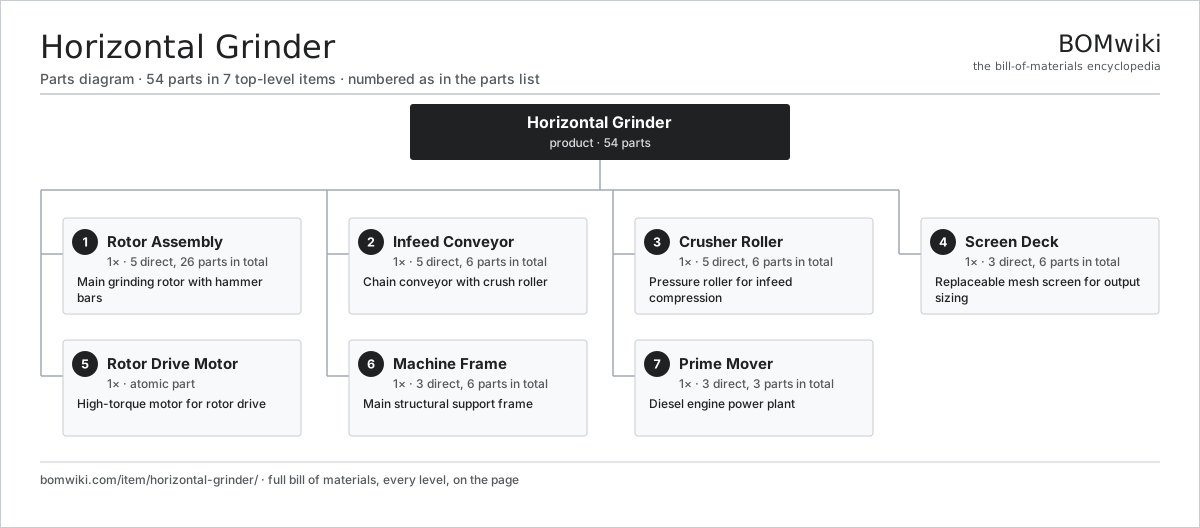
| # | Part | Qty | What it does |
|---|---|---|---|
| 1 | Rotor Assembly 5 parts | 1× | Main grinding rotor with hammer bars |
| 2 | Infeed Conveyor 5 parts | 1× | Chain conveyor with crush roller |
| 3 | Crusher Roller 5 parts | 1× | Pressure roller for infeed compression |
| 4 | Screen Deck 3 parts | 1× | Replaceable mesh screen for output sizing |
| 5 | Rotor Drive Motor | 1× | High-torque motor for rotor drive |
| 6 | Machine Frame 3 parts | 1× | Main structural support frame |
| 7 | Prime Mover 3 parts | 1× | Diesel engine power plant |
3D model
No 3D model yet. Have a CAD file of this? Add a 3D model. STL renders right on this page; STEP, FreeCAD, and OpenSCAD sources are welcome too (openly licensed, like all 3D models on BOMwiki).
Build & assembly graph
expand / collapse · shared sub-assemblies converge · links to related products · est. labourTap an assembly to expand/collapse · tap a part to open it · use “Open page” for any node · drag to pan, scroll to zoom.
Bill of materials for Horizontal Grinder
7 top-level lines · 31 rows shown · 54 parts total · indented to 3 levels| # | Item / sub-assembly | Part no. | Qty/assy | Ext. qty | Parts | Type |
|---|---|---|---|---|---|---|
| 1 | Rotor Assembly 5 parts | horizontal-grinder-rotor-assembly | 1× | 1 | 26 | assembly |
| 1.1 | Rotor Shaft | horizontal-grinder-rotor-shaft | 1× | 1 | · | part |
| 1.2 | Hammer Bar | horizontal-grinder-hammer-bar | 20× | 20 | · | part |
| 1.3 | Rotor Housing | horizontal-grinder-rotor-housing | 1× | 1 | · | part |
| 1.4 | Rotor Bearing | horizontal-grinder-rotor-bearing | 2× | 2 | · | part |
| 1.5 | Rotor Seal | horizontal-grinder-rotor-seal | 2× | 2 | · | part |
| 2 | Infeed Conveyor 5 parts | horizontal-grinder-infeed-conveyor | 1× | 1 | 6 | assembly |
| 2.1 | Conveyor Frame | horizontal-grinder-conveyor-frame | 1× | 1 | · | part |
| 2.2 | Conveyor Chain | horizontal-grinder-conveyor-chain | 1× | 1 | · | part |
| 2.3 | Conveyor Motor | horizontal-grinder-conveyor-motor | 1× | 1 | · | part |
| 2.4 | Conveyor Sprocket | horizontal-grinder-conveyor-sprocket | 2× | 2 | · | part |
| 2.5 | Conveyor Idler | horizontal-grinder-conveyor-idler | 1× | 1 | · | part |
| 3 | Crusher Roller 5 parts | horizontal-grinder-crusher-roller | 1× | 1 | 6 | assembly |
| 3.1 | Roller Shaft | horizontal-grinder-roller-shaft | 1× | 1 | · | part |
| 3.2 | Roller Drum | horizontal-grinder-roller-drum | 1× | 1 | · | part |
| 3.3 | Roller Bearing | horizontal-grinder-roller-bearing | 2× | 2 | · | part |
| 3.4 | Roller Motor | horizontal-grinder-roller-motor | 1× | 1 | · | part |
| 3.5 | Roller Mount | horizontal-grinder-roller-mounting | 1× | 1 | · | part |
| 4 | Screen Deck 3 parts | horizontal-grinder-screen-deck | 1× | 1 | 6 | assembly |
| 4.1 | Screen Frame | horizontal-grinder-screen-frame | 1× | 1 | · | part |
| 4.2 | Mesh Insert | horizontal-grinder-mesh-insert | 1× | 1 | · | part |
| 4.3 | Screen Clamp | horizontal-grinder-screen-clamp | 4× | 4 | · | part |
| 5 | Rotor Drive Motor | horizontal-grinder-motor | 1× | 1 | · | part |
| 6 | Machine Frame 3 parts | horizontal-grinder-frame | 1× | 1 | 6 | assembly |
| 6.1 | Frame Base | horizontal-grinder-frame-base | 1× | 1 | · | part |
| 6.2 | Foundation Mounting | horizontal-grinder-frame-mounting | 1× | 1 | · | part |
| 6.3 | Vibration Isolator | horizontal-grinder-vibration-isolator | 4× | 4 | · | part |
| 7 | Prime Mover 3 parts | horizontal-grinder-engine | 1× | 1 | 3 | assembly |
| 7.1 | Engine Block | horizontal-grinder-engine-block | 1× | 1 | · | part |
| 7.2 | Turbocharger | horizontal-grinder-engine-turbo | 1× | 1 | · | part |
| 7.3 | Fuel System | horizontal-grinder-fuel-system | 1× | 1 | · | part |
Something wrong in this list? Report a problem with this BOM.
Sourcing: possible vendors
Browse the supplier directory → Prices, MOQ, and lead times are algorithmic estimates, not quotes, and not claims about these companies. Company mappings are curated by keyword; est. price band $5k–$800k. How estimates work| Vendor | HQ | Specialty | MOQ | Lead time |
|---|---|---|---|---|
| deere.com ↗ | Moline, US | Agriculture & turf | made to order | 14–24 wks |
| cnh.com ↗ | Basildon, GB | Agriculture (Case IH, New Holland) | made to order | 14–24 wks |
|
🇺🇸AGCO
agcocorp.com ↗
|
Duluth, US | Agriculture (Fendt, Massey Ferguson) | made to order | 14–24 wks |
|
🇩🇪Claas
claas.com ↗
|
Harsewinkel, DE | Harvesters & tractors | made to order | 14–24 wks |
|
🇯🇵Kubota
kubota.com ↗
|
Osaka, JP | Compact tractors & equipment | made to order | 14–24 wks |
1,364-word article