Hot Air Balloon
ProductOverview
A hot air balloon is the simplest certificated aircraft flying: a fabric Envelope full of heated air, a propane Burner System to heat it, and a wicker Basket hanging underneath. Lift follows directly from the density difference between the air inside and outside the envelope. Air at 100 °C is about 25% less dense than ambient at 15 °C, so a 2,550 m³ envelope displaces roughly 3,100 kg of cold air while containing about 2,300 kg of hot air, a gross lift in the order of 800 kg, enough for the balloon itself, four occupants and fuel.
The balloon has no propulsion and no steering. It drifts with the wind, and directional control consists of climbing or descending into layers where the wind blows a different way. Everything the pilot actively controls is vertical, and the only control inputs are burning and venting.
Envelope
The envelope is sewn from 24 vertical Gore Panel segments of coated ripstop nylon weighing about 60 g/m². The fabric carries almost no structural load: sewn along every seam is a polyester Load Tape, and it is this webbing skeleton, vertical tapes from mouth to crown plus horizontal circumferential tapes, that carries the basket weight. All vertical tapes gather at the Crown Ring at the top. The fabric only has to hold the very small pressure difference across it, a few tens of pascals near the crown.
The crown aperture is closed by the Parachute Valve, a fabric disc held in place by internal pressure. Pulling its Control Line from the basket spills hot air for descent; releasing the line lets pressure re-seat the valve. Two Turning Vent openings on opposite sides exhaust air tangentially so the pilot can rotate the basket, useful for aiming the basket's long side at the ground before landing. At the mouth, a Skirt of flame-resistant Nomex protects the nylon from burner heat. Envelope temperature is the structural limit of the aircraft: nylon degrades quickly above about 120 °C, so a Temperature Transmitter at the crown reports the actual air temperature to the pilot, with an alarm typically set at 110 °C.
Burners and fuel
Each Burner Unit draws liquid propane from the tanks and passes it through a Vaporising Coil wrapped in its own flame; the vaporised gas then burns at a brass Jet Ring. A continuously lit Pilot Light ignites each burn. The pilot's main control is the Blast Valve, a full blast from a double burner releases around 4.5 MW of heat, raising envelope temperature a few degrees per second. A separate Whisper Valve burns liquid propane directly in a softer, quieter flame for use over livestock. The burners sit on a Burner Frame above the pilot's head, on a Gimbal Mount so the flame can be aimed into the tilted mouth during inflation.
Fuel is carried in four 60 L stainless cylinders of the Fuel System, strapped upright in the basket corners. Each Propane Tank feeds liquid propane through a dip tube in its Tank Valve; vapour pressure (about 7 bar at 15 °C) pushes the fuel to the burners through armoured Fuel Hose runs, so no pump is needed. The pilot switches tanks with the Fuel Manifold and watches the Contents Gauge on each cylinder; total endurance is typically two hours with reserve.
Basket
The Wicker Body is still genuinely woven willow, not nostalgia: wicker flexes and absorbs landing impact better per kilogram than rigid alternatives, then springs back. Stainless Basket Wire cables run beneath the Floor Board and up through the corner posts to the burner frame, so the envelope load path bypasses the wicker entirely. Padded Rim Padding and woven Step Hole footholds finish the structure.
Flight
A flight begins before dawn or in the evening, when thermal activity is weakest. The envelope is laid out downwind and cold-inflated with the petrol-engined Inflation Fan, which packs it with ambient air in a few minutes. The pilot then aims the gimballed burner into the mouth and heats the air until the envelope stands up and develops positive lift, with crew holding a crown line against premature lift-off.
In flight the pilot manages altitude by anticipation: a balloon responds to a burn after a lag of several seconds, so burning is rhythmic and pre-emptive rather than reactive. The Flight Pack supplies altitude, climb rate and GPS groundspeed; an air-band Air-Band Radio keeps contact with airspace and the retrieve crew following by road. Equilibrium is never stable, the envelope cools continuously at roughly 1 °C every 10–15 seconds, so flight is a steady cycle of short burns.
Landing is flown into the wind gradient close to the ground, ending with a sustained pull on the parachute valve at touchdown to deflate the envelope and keep the basket from dragging. In winds above about 15 km/h the basket tips and drags on its long side, which is why the pilot rotates it with the turning vents beforehand and passengers brace in the landing position.
Hot Air Balloon parts and their functions
6 top-level parts · 146 parts in total · full bill of materials below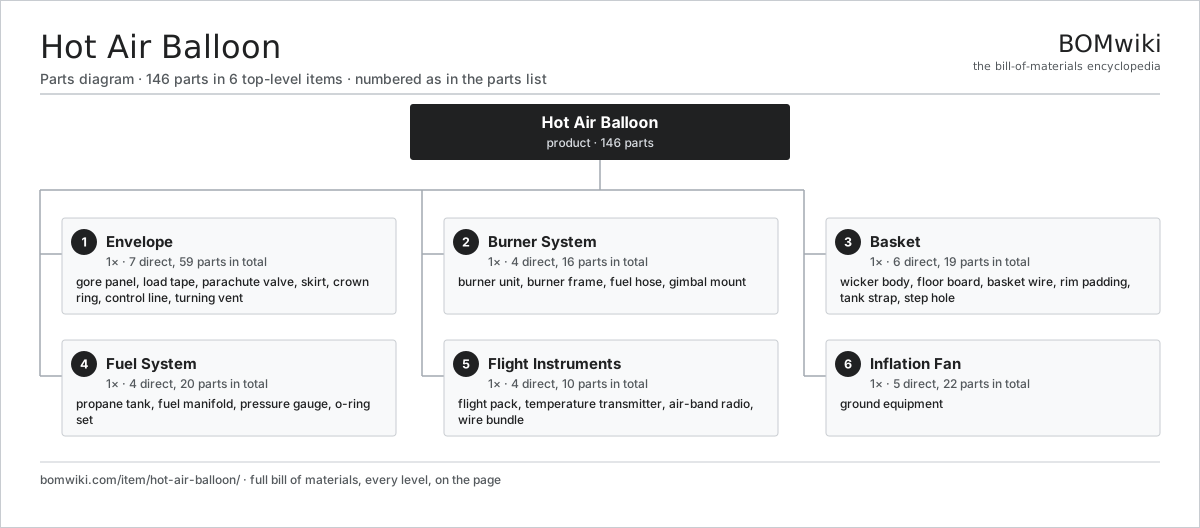
| # | Part | Qty | What it does |
|---|---|---|---|
| 1 | Envelope 7 parts | 1× | Ripstop-nylon gas bag of about 2,500 m3 whose heated air provides all lift. |
| 2 | Burner System 4 parts | 1× | Twin propane burners on a gimballed frame delivering up to 4.5 MW of heat. |
| 3 | Basket 6 parts | 1× | Woven wicker gondola carrying pilot, passengers and fuel tanks. |
| 4 | Fuel System 4 parts | 1× | Four stainless propane cylinders with valves, gauges and manifold plumbing. |
| 5 | Flight Instruments 4 parts | 1× | Altimeter-variometer pack and envelope temperature monitoring. |
| 6 | Inflation Fan 5 parts | 1× | ground equipment |
3D model
No 3D model yet. Have a CAD file of this? Add a 3D model. STL renders right on this page; STEP, FreeCAD, and OpenSCAD sources are welcome too (openly licensed, like all 3D models on BOMwiki).
Build & assembly graph
expand / collapse · shared sub-assemblies converge · links to related products · est. labourTap an assembly to expand/collapse · tap a part to open it · use “Open page” for any node · drag to pan, scroll to zoom.
Bill of materials for Hot Air Balloon
6 top-level lines · 56 rows shown · 146 parts total · indented to 3 levels| # | Item / sub-assembly | Part no. | Qty/assy | Ext. qty | Parts | Type |
|---|---|---|---|---|---|---|
| 1 | Envelope 7 parts | hot-air-balloon-envelope | 1× | 1 | 59 | assembly |
| 1.1 | Gore Panel | hot-air-balloon-gore-panel | 24× | 24 | · | part |
| 1.2 | Load Tape | hot-air-balloon-load-tape | 28× | 28 | · | part |
| 1.3 | Parachute Valve | hot-air-balloon-parachute-valve | 1× | 1 | · | part |
| 1.4 | Skirt | hot-air-balloon-skirt | 1× | 1 | · | part |
| 1.5 | Crown Ring | hot-air-balloon-crown-ring | 1× | 1 | · | part |
| 1.6 | Control Line | hot-air-balloon-control-line | 2× | 2 | · | part |
| 1.7 | Turning Vent | hot-air-balloon-turning-vent | 2× | 2 | · | part |
| 2 | Burner System 4 parts | hot-air-balloon-burner-system | 1× | 1 | 16 | assembly |
| 2.1 | Burner Unit 5 parts | hot-air-balloon-burner-unit | 2× | 2 | 5 | assembly |
| 2.1.1 | Vaporising Coil | hot-air-balloon-vaporising-coil | 1× | 2 | · | part |
| 2.1.2 | Blast Valve | hot-air-balloon-blast-valve | 1× | 2 | · | part |
| 2.1.3 | Whisper Valve | hot-air-balloon-whisper-valve | 1× | 2 | · | part |
| 2.1.4 | Pilot Light | hot-air-balloon-pilot-light | 1× | 2 | · | part |
| 2.1.5 | Jet Ring | hot-air-balloon-jet-ring | 1× | 2 | · | part |
| 2.2 | Burner Frame | hot-air-balloon-burner-frame | 1× | 1 | · | part |
| 2.3 | Fuel Hose | hot-air-balloon-fuel-hose | 4× | 4 | · | part |
| 2.4 | Gimbal Mount | hot-air-balloon-gimbal-mount | 1× | 1 | · | part |
| 3 | Basket 6 parts | hot-air-balloon-basket | 1× | 1 | 19 | assembly |
| 3.1 | Wicker Body | hot-air-balloon-wicker-body | 1× | 1 | · | part |
| 3.2 | Floor Board | hot-air-balloon-floor-board | 1× | 1 | · | part |
| 3.3 | Basket Wire | hot-air-balloon-basket-wire | 8× | 8 | · | part |
| 3.4 | Rim Padding | hot-air-balloon-rim-padding | 1× | 1 | · | part |
| 3.5 | Tank Strap | hot-air-balloon-tank-strap | 4× | 4 | · | part |
| 3.6 | Step Hole | hot-air-balloon-step-hole | 4× | 4 | · | part |
| 4 | Fuel System 4 parts | hot-air-balloon-fuel-system | 1× | 1 | 20 | assembly |
| 4.1 | Propane Tank 4 parts | hot-air-balloon-propane-tank | 4× | 4 | 4 | assembly |
| 4.1.1 | Tank Cylinder | hot-air-balloon-tank-cylinder | 1× | 4 | · | part |
| 4.1.2 | Tank Valve | hot-air-balloon-tank-valve | 1× | 4 | · | part |
| 4.1.3 | Contents Gauge | hot-air-balloon-contents-gauge | 1× | 4 | · | part |
| 4.1.4 | Padding Jacket | hot-air-balloon-padding-jacket | 1× | 4 | · | part |
| 4.2 | Fuel Manifold | hot-air-balloon-manifold | 1× | 1 | · | part |
| 4.3 | Pressure Gauge | hot-air-balloon-pressure-gauge | 2× | 2 | · | part |
| 4.4 | O-Ring Set | oring-set | 1× | 1 | · | part |
| 5 | Flight Instruments 4 parts | hot-air-balloon-instruments | 1× | 1 | 10 | assembly |
| 5.1 | Flight Pack 6 parts | hot-air-balloon-flight-pack | 1× | 1 | 7 | assembly |
| 5.1.1 | Bare PCB | pcb-bare | 1× | 1 | · | part |
| 5.1.2 | Microcontroller | mcu | 1× | 1 | · | part |
| 5.1.3 | LCD Panel | lcd-panel | 1× | 1 | · | part |
| 5.1.4 | Pressure Sensor | pressure-sensor | 1× | 1 | · | part |
| 5.1.5 | LiPo Cell | lipo-cell | 1× | 1 | · | part |
| 5.1.6 | Connector | connector | 2× | 2 | · | part |
| 5.2 | Temperature Transmitter | hot-air-balloon-temp-transmitter | 1× | 1 | · | part |
| 5.3 | Air-Band Radio | hot-air-balloon-radio | 1× | 1 | · | part |
| 5.4 | Wire Bundle | wire-bundle | 1× | 1 | · | part |
| 6 | Inflation Fan 5 parts | hot-air-balloon-inflation-fan | 1× | 1 | 22 | assembly |
| 6.1 | Fan Blade | hot-air-balloon-fan-blade | 1× | 1 | · | part |
| 6.2 | Fan Engine | hot-air-balloon-fan-engine | 1× | 1 | · | part |
| 6.3 | Fan Frame | hot-air-balloon-fan-frame | 1× | 1 | · | part |
| 6.4 | Fan Guard | hot-air-balloon-fan-guard | 1× | 1 | · | part |
| 6.5 | Wheel Assembly 5 parts | wheel-assembly | 2× | 2 | 9 | assembly |
| 6.5.1 | Alloy Wheel | alloy-wheel | 1× | 2 | · | part |
| 6.5.2 | Tire | tire | 1× | 2 | · | part |
| 6.5.3 | TPMS Sensor | tpms-sensor | 1× | 2 | · | part |
| 6.5.4 | Lug Nut | lug-nut | 5× | 10 | · | part |
| 6.5.5 | Valve Stem | valve-stem | 1× | 2 | · | part |
Something wrong in this list? Report a problem with this BOM.
Related products
same domain, ranked by shared parts Hang Glider
135 parts · shares 8 with this page
Hang Glider
135 parts · shares 8 with this page
 Jet Trainer Aircraft
319 parts · shares 8 with this page
Jet Trainer Aircraft
319 parts · shares 8 with this page
 Sailplane Glider
139 parts · shares 8 with this page
Sailplane Glider
139 parts · shares 8 with this page
 Ultralight Aircraft
455 parts · shares 8 with this page
Ultralight Aircraft
455 parts · shares 8 with this page
 Business Jet
1,654 parts · shares 7 with this page
Business Jet
1,654 parts · shares 7 with this page
 Gyroplane
168 parts · shares 7 with this page
Gyroplane
168 parts · shares 7 with this page
Sourcing: possible vendors
Browse the supplier directory → Prices, MOQ, and lead times are algorithmic estimates, not quotes, and not claims about these companies. Company mappings are curated by keyword; est. price band $50k–$300M. How estimates work| Vendor | HQ | Specialty | MOQ | Lead time |
|---|---|---|---|---|
|
🇺🇸Boeing
boeing.com ↗
|
Arlington, US | Aerospace OEM | made to order | 40–80 wks |
|
🇫🇷Airbus
airbus.com ↗
|
Toulouse, FR | Aerospace OEM | made to order | 40–80 wks |
| lockheedmartin.com ↗ | Bethesda, US | Aerospace & defense | made to order | 40–80 wks |
|
🇧🇷Embraer
embraer.com ↗
|
São José dos Campos, BR | Aircraft OEM | made to order | 40–80 wks |
| txtav.com ↗ | Wichita, US | Aircraft OEM | made to order | 40–80 wks |
941-word article