Hot Isostatic Press
ProductOverview
Hot isostatic pressing (HIP) is a secondary finishing process that applies simultaneous heat and isotropic (uniform in all directions) gas pressure to consolidate powder preforms or to "heal" casting porosity. In the HIP process, a part (or powder compact) is sealed in a thin steel capsule and loaded into a pressure vessel. The vessel is heated to 1000–2000 °C and pressurized with inert gas to 50–200 MPa. Under these extreme conditions, material flows plastically, closing internal voids and welding surface micro-cracks.
The result is a near-fully dense ingot or part with superior strength, fatigue resistance, and fracture toughness compared to the starting material. HIP is particularly valuable for aerospace superalloys, turbine blades, and medical implants where material integrity is critical.
How it works
A HIP cycle typically follows this sequence:
Loading phase: A part (cast ingot, forged billet, or powder compact) is sealed in a thin steel capsule, with a thermocouple probe inserted to monitor internal temperature. The capsule is loaded into the HIP vessel, and the vessel endcap is bolted closed and sealed.
Evacuation and backfill: The gas supply system purges air from the vessel and chamber, replacing it with dry inert gas (argon or nitrogen). A desiccant filter ensures moisture is removed, protecting seals and preventing oxidation of the part.
Heating phase: The internal heating element is energized, raising the chamber temperature at a controlled ramp (10–50 °C/min, depending on material and capsule thickness). The PID temperature controller monitors the thermocouple and adjusts heating power to maintain the ramp rate, preventing thermal shock to the vessel and part.
As temperature rises, the gas pump remains inactive initially, maintaining only atmospheric or low pressure inside the vessel. Once the part reaches a target "soak" temperature (typically 80–90 % of final temperature), the pump engages and pressurizes the chamber. Pressure rises to the setpoint (50–200 MPa) over 10–30 minutes.
High-temperature hold: The part is held at final temperature and pressure for a dwell time (typically 1–4 hours, depending on part size and porosity severity). During this dwell, material flows plastically under stress, closing voids and micro-cracks. The flow rate is proportional to stress (pressure) and inversely to material strength (temperature).
Cooling phase: After the dwell, the pressure control system vents gas, allowing internal pressure to drop to atmospheric. Once pressure is released, the heating element is de-energized and the part cools at a controlled ramp (5–20 °C/min) to ambient temperature. Fast cooling can induce thermal stress and new cracking, so cooling rate is critical.
Unloading: Once the vessel is cool (typically 30–60 °C), the endcap is unbolted, the capsule is removed, and the part is extracted from its capsule. The part is now fully dense and ready for machining or final assembly.
Metallurgical principles
HIP exploits the Nabarro–Herring creep mechanism: under high stress and temperature, atoms diffuse through crystal lattice, closing voids. The process is governed by the equation:
$$dot{ arepsilon} = k cdot sigma cdot T^{-1} cdot e^{-Q/RT}$$
where strain rate (void closure) depends on pressure (σ), temperature (T), and material-specific activation energy (Q). Higher pressure and temperature accelerate void healing.
For casting porosity, a 200 MPa isotropic pressure is equivalent to a 5 mm stress concentration in uniaxial tension, enough to force plastic flow and void healing without fracture. For powder preforms, HIP consolidates individual particles by diffusion bonding at contact surfaces.
Applications and material types
HIP is essential for:
- Superalloy turbine blades: Ni-based superalloys (Inconel, René alloys) are cast with microscopic shrinkage voids; HIP heals these, increasing fatigue strength by 20–40 %.
- Medical implants: Titanium alloys and cobalt-chromium must be porosity-free; HIP achieves >99.9 % density.
- Aerospace forgings: Large titanium or steel forgings may have internal laps (small delaminations); HIP welds these shut.
- Powder-metallurgy parts: Atomized metal powders can be pressed without melting (cold pressing) and then HIPed to full density.
Design of HIP cycles
HIP parameters (temperature, pressure, dwell time) must be carefully selected for each alloy. For example:
| Alloy | Temperature | Pressure | Dwell | Cooling Rate |
|---|---|---|---|---|
| Inconel 718 | 1180 °C | 100 MPa | 2 hours | 10 °C/min |
| Titanium Ti-6Al-4V | 920 °C | 150 MPa | 2 hours | 10 °C/min |
| Tool Steel | 1100 °C | 150 MPa | 1 hour | 5 °C/min |
Over-aggressive cycles (too-high temperature, too-fast cooling) can cause unwanted grain growth or new cracking. Under-aggressive cycles leave residual porosity.
Industrial HIP systems
Production HIP vessels typically have:
- Chamber size: 300–500 mm OD (allowing parts up to ~100 mm diameter)
- Working pressure: 150–200 MPa (typical; some specialized systems reach 300 MPa)
- Temperature: 1000–1800 °C (higher-end systems for superalloys)
- Cycle time: 8–24 hours (including heat-up, hold, cool-down)
- Throughput: 20–100 parts per month per vessel
Large foundries may operate 2–5 HIP vessels in parallel to meet demand.
Capsule design and material
Each part must be enclosed in a capsule (a thin-walled steel container) to prevent direct contact with inert gas. The capsule is evacuated and sealed before HIP. Material choices:
- Mild steel: Economical, suitable for non-reactive alloys (irons, most tool steels)
- Stainless steel (304L): Better corrosion resistance for reactive alloys (titanium, superalloys)
- Boron nitride (BN): High-temperature, inert; used for highest-temperature applications
After HIP, the capsule is removed (typically machined off or separated chemically).
Economic considerations
A single HIP vessel costs $500,000–$3 million depending on size and temperature capability. Consumable costs per cycle:
- Inert gas (argon): ~$100–500
- Electrical energy: ~$200–500
- Capsule material: ~$50–200
- Maintenance: ~$100–300
Total cost per HIP cycle: ~$500–1500, or ~$5–50 per kilogram of part (depending on part size).
For aerospace superalloy turbine blades (value: $50–200 per part), HIP cost is justified by the strength and reliability gain. For commodity castings, HIP is uneconomical.
Troubleshooting and safety
Common HIP defects:
- Residual porosity: Cycle not aggressive enough (increase pressure or temperature)
- Recracking during cooling: Cooling too fast (reduce cooling rate)
- Capsule failure: Capsule too thin or material incompatible (use thicker or better material)
Safety concerns: A HIP vessel contains ~100 MPa pressure and 1800 °C temperature simultaneously. Failure modes include:
- Vessel rupture: Sudden release of pressure and high-temperature gas (explosion hazard)
- Seal failure: Pressure leakage through endcap O-ring, requiring shutdown
Multiple safety systems protect against catastrophic failure: pressure-relief valve, rupture disk, and safety interlocks preventing operator error.
Integration with foundry operations
HIP is typically performed by specialized contractors (not in-house at foundries). A foundry ships cast parts or powder preforms to a HIP service center, which runs cycles (batching multiple parts per vessel for efficiency) and ships finished parts back. Turnaround is typically 2–4 weeks.
Some large aerospace foundries maintain in-house HIP vessels for critical parts, justifying capital investment through higher throughput and proprietary cycle control.
Hot Isostatic Press parts and their functions
8 top-level parts · 42 parts in total · full bill of materials below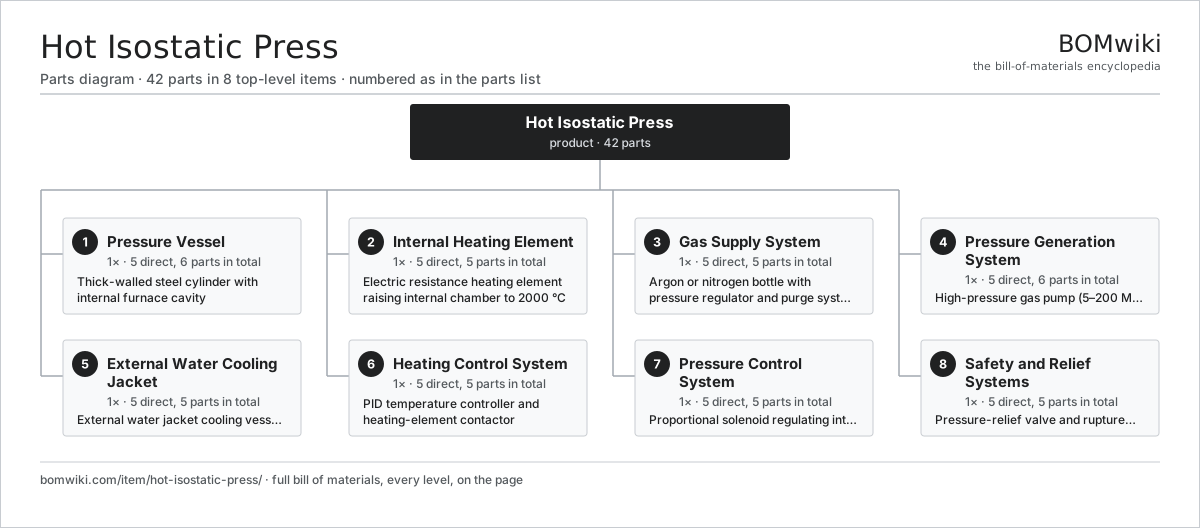
| # | Part | Qty | What it does |
|---|---|---|---|
| 1 | Pressure Vessel 5 parts | 1× | Thick-walled steel cylinder with internal furnace cavity |
| 2 | Internal Heating Element 5 parts | 1× | Electric resistance heating element raising internal chamber to 2000 °C |
| 3 | Gas Supply System 5 parts | 1× | Argon or nitrogen bottle with pressure regulator and purge system |
| 4 | Pressure Generation System 5 parts | 1× | High-pressure gas pump (5–200 MPa) driving isotactic pressure |
| 5 | External Water Cooling Jacket 5 parts | 1× | External water jacket cooling vessel walls |
| 6 | Heating Control System 5 parts | 1× | PID temperature controller and heating-element contactor |
| 7 | Pressure Control System 5 parts | 1× | Proportional solenoid regulating internal gas pressure |
| 8 | Safety and Relief Systems 5 parts | 1× | Pressure-relief valve and rupture-disk backup systems |
3D model
No 3D model yet. Have a CAD file of this? Add a 3D model. STL renders right on this page; STEP, FreeCAD, and OpenSCAD sources are welcome too (openly licensed, like all 3D models on BOMwiki).
Build & assembly graph
expand / collapse · shared sub-assemblies converge · links to related products · est. labourTap an assembly to expand/collapse · tap a part to open it · use “Open page” for any node · drag to pan, scroll to zoom.
Bill of materials for Hot Isostatic Press
8 top-level lines · 48 rows shown · 42 parts total · indented to 3 levels| # | Item / sub-assembly | Part no. | Qty/assy | Ext. qty | Parts | Type |
|---|---|---|---|---|---|---|
| 1 | Pressure Vessel 5 parts | hot-isostatic-press-pressure-vessel | 1× | 1 | 6 | assembly |
| 1.1 | Pressure Vessel Shell | hot-isostatic-press-vessel-shell | 1× | 1 | · | part |
| 1.2 | Vessel End Caps | hot-isostatic-press-vessel-endcaps | 2× | 2 | · | part |
| 1.3 | Seal Assembly | hot-isostatic-press-seal-system | 1× | 1 | · | part |
| 1.4 | Internal Insulation | hot-isostatic-press-insulation-lining | 1× | 1 | · | part |
| 1.5 | Structural Load Frame | hot-isostatic-press-load-frame | 1× | 1 | · | part |
| 2 | Internal Heating Element 5 parts | hot-isostatic-press-furnace | 1× | 1 | 5 | assembly |
| 2.1 | Heating Element Wire | hot-isostatic-press-heating-element | 1× | 1 | · | part |
| 2.2 | Heating Power Supply | hot-isostatic-press-heating-power-supply | 1× | 1 | · | part |
| 2.3 | Temperature Probe | hot-isostatic-press-thermocouple | 1× | 1 | · | part |
| 2.4 | PID Temperature Controller | hot-isostatic-press-temperature-controller | 1× | 1 | · | part |
| 2.5 | Element Support Fixture | hot-isostatic-press-heating-element-support | 1× | 1 | · | part |
| 3 | Gas Supply System 5 parts | hot-isostatic-press-gas-supply | 1× | 1 | 5 | assembly |
| 3.1 | Gas Supply Cylinder | hot-isostatic-press-gas-bottle | 1× | 1 | · | part |
| 3.2 | Primary Gas Regulator | hot-isostatic-press-primary-regulator | 1× | 1 | · | part |
| 3.3 | Purge Solenoid Valve | hot-isostatic-press-purge-valve | 1× | 1 | · | part |
| 3.4 | Backfill Gas Line | hot-isostatic-press-backfill-line | 1× | 1 | · | part |
| 3.5 | Desiccant Moisture Filter | hot-isostatic-press-desiccant-filter | 1× | 1 | · | part |
| 4 | Pressure Generation System 5 parts | hot-isostatic-press-pump-compressor | 1× | 1 | 6 | assembly |
| 4.1 | Isostatic Gas Pump | hot-isostatic-press-isostatic-pump | 1× | 1 | · | part |
| 4.2 | Pump Drive Motor | hot-isostatic-press-pump-motor | 1× | 1 | · | part |
| 4.3 | Pump Discharge Valve | hot-isostatic-press-pressure-control-valve | 1× | 1 | · | part |
| 4.4 | One-Way Check Valve | hot-isostatic-press-check-valve | 2× | 2 | · | part |
| 4.5 | Pressure Accumulator | hot-isostatic-press-accumulator | 1× | 1 | · | part |
| 5 | External Water Cooling Jacket 5 parts | hot-isostatic-press-water-cooling | 1× | 1 | 5 | assembly |
| 5.1 | Water Cooling Jacket | hot-isostatic-press-water-jacket | 1× | 1 | · | part |
| 5.2 | Cooling Water Pump | hot-isostatic-press-cooling-pump | 1× | 1 | · | part |
| 5.3 | Air-Cooled Heat Exchanger | hot-isostatic-press-cooling-tower | 1× | 1 | · | part |
| 5.4 | Water Temperature Valve | hot-isostatic-press-water-thermostatic-valve | 1× | 1 | · | part |
| 5.5 | Water Supply Filter | hot-isostatic-press-water-filter | 1× | 1 | · | part |
| 6 | Heating Control System 5 parts | hot-isostatic-press-heating-controls | 1× | 1 | 5 | assembly |
| 6.1 | PID Temperature Module | hot-isostatic-press-temp-controller-module | 1× | 1 | · | part |
| 6.2 | Heating Contactor | hot-isostatic-press-heating-contactor | 1× | 1 | · | part |
| 6.3 | Ramp Rate Limiter | hot-isostatic-press-ramp-rate-limiter | 1× | 1 | · | part |
| 6.4 | Proportional Heating Valve | hot-isostatic-press-proportional-valve | 1× | 1 | · | part |
| 6.5 | Data Logger | hot-isostatic-press-data-recorder | 1× | 1 | · | part |
| 7 | Pressure Control System 5 parts | hot-isostatic-press-pressure-control | 1× | 1 | 5 | assembly |
| 7.1 | Pressure Transducer | hot-isostatic-press-pressure-transducer | 1× | 1 | · | part |
| 7.2 | Proportional Pressure Valve | hot-isostatic-press-proportional-pressure-valve | 1× | 1 | · | part |
| 7.3 | Pressure Relief Valve | hot-isostatic-press-pressure-relief-valve | 1× | 1 | · | part |
| 7.4 | Pressure Vent Solenoid | hot-isostatic-press-pressure-vent-solenoid | 1× | 1 | · | part |
| 7.5 | Analog Pressure Gauge | hot-isostatic-press-hyd-pressure-gauge | 1× | 1 | · | part |
| 8 | Safety and Relief Systems 5 parts | hot-isostatic-press-safety-interlocks | 1× | 1 | 5 | assembly |
| 8.1 | Main Relief Valve | hot-isostatic-press-relief-valve | 1× | 1 | · | part |
| 8.2 | Burst Disk Assembly | hot-isostatic-press-rupture-disk | 1× | 1 | · | part |
| 8.3 | Pressure Alarm Switch | hot-isostatic-press-pressure-alarm-switch | 1× | 1 | · | part |
| 8.4 | Safety Interlock Module | hot-isostatic-press-interlock-relay | 1× | 1 | · | part |
| 8.5 | Emergency Stop Button | hot-isostatic-press-emergency-stop | 1× | 1 | · | part |
Something wrong in this list? Report a problem with this BOM.
Sourcing: possible vendors
Browse the supplier directory → Prices, MOQ, and lead times are algorithmic estimates, not quotes, and not claims about these companies. Company mappings are curated by keyword; est. price band $5k–$2M. How estimates work| Vendor | HQ | Specialty | MOQ | Lead time |
|---|---|---|---|---|
| atlascopco.com ↗ | Stockholm, SE | Compressors & industrial | 10 units | 12–20 wks |
|
🇦🇹Andritz
andritz.com ↗
|
Graz, AT | Process plants & machinery | 10 units | 12–20 wks |
| buhlergroup.com ↗ | Uzwil, CH | Food & materials processing | 10 units | 12–20 wks |
| gea.com ↗ | Düsseldorf, DE | Process technology | 10 units | 12–20 wks |
| mhi.com ↗ | Tokyo, JP | Heavy machinery | 10 units | 12–20 wks |
1,201-word article