Hot Melt Adhesive Line
ProductOverview
A hot-melt adhesive extrusion line is a continuous production system for manufacturing solid thermoplastic adhesive pellets from granular feed material. Twin-screw extruders are standard because their intermeshing flights create intense mixing and uniform melting, critical for consistent adhesive properties.
Hot-melt adhesives are polymer solids (polyolefins, polyesters, polyamides, ethylene-vinyl acetates) that melt at 100–200°C and bond surfaces upon cooling. Production via extrusion allows rapid throughput (100–500 kg/h) and precise batch blending (different grades, tackifiers, resins).
How it works
Adhesive granules (e.g., EVA copolymer, polyolefin) are loaded into the Feed Hopper. The Extruder Barrel Cylinder is pre-heated to zone setpoints (typically 160–190°C) via Cartridge Heater cartridges. The Screw Drive Motor (5–30 kW) drives the Twin Screw Set at 50–150 rpm.
As screws rotate, granules are pushed forward, compressed, and sheared between flights. The Water Jacket Coil in the feed section keeps incoming granules from pre-melting (preventing bridging). As material moves downstream, Cartridge Heater zones progressively raise temperature. By the discharge end, material is molten (~180°C) and homogeneous.
The molten stream exits into the Melt Metering Pump, a heated gear pump that pressurizes at 30–80 bar and meter-discharges at a constant rate. The Pressure Transducer feeds back pressure to the Process Control and HMI PLC, which adjusts the Pump Drive Motor speed to maintain constant discharge pressure (critical for pellet uniformity).
Melt flows into the Pelletizing System. The Strand Die extrudes strands (2–8 mm diameter) into a Cooling Water Tank filled with chilled water (10–25°C via Water Chiller Unit)). Strands solidify in seconds and fall. The Strand Cutter Blade blade (synchronized to extrusion rate) cuts strands into 4–8 mm pellets. A Vibrating Dryer Tray vibrating tray removes surface water, and pellets drop into the Pellet Collection Hopper.
The Process Control and HMI PLC automates the entire line. Operators set throughput (kg/h) target, heating zones, and pellet cutter frequency via the HMI Touchscreen. The PLC adjusts Pump Drive Motor speed to hit throughput and maintains temperature ±2°C via proportional Solid-State Relay firing to each Cartridge Heater zone.
Key subsystems
Twin-screw extruder: The Extruder Barrel Cylinder houses two Twin Screw Set that rotate and intermesh, creating a self-wiping profile (minimal dead volume). Co-rotating designs (screws turn the same direction) are simpler; counter-rotating is rarer but gentler on degradation-sensitive polymers.
Screws are hardened steel (58–62 HRC) with precisely machined flights. Compression ratio (ratio of feed section volume to discharge section volume) is typically 3:1 to 4:1, driving granules forward progressively.
The barrel is divided into four to six heating zones:
- Feed zone: Inlet, water-cooled, prevents bridging
- Transition zones: Melting occurs, temperature ramped from 140°C to 180°C
- Metering zone: Discharge end, maximum temperature, drives homogeneous melt
Heating system: Each zone has a Cartridge Heater (3–6 kW cartridge element) and Zone Thermocouple temperature sensor. The Temperature Controller PLC independently controls each zone via Solid-State Relay proportional heating (on-time modulation).
Melt pump: The Melt Metering Pump is a heated gear pump (internal or external gear, hardened steel). Displacement ranges 5–50 cc/rev depending on throughput target. The pump is heated via a Pump Drive Motor coupled to a small Heated Pump Block block heater (3–5 kW) maintaining 170–190°C melt.
A Pump Relief Valve valve (20–100 bar setpoint, field-adjustable) protects the pump. The Pressure Transducer (0–150 bar) feeds back to the PLC, which adjusts pump speed via Pump Drive Motor VFD to maintain setpoint pressure. This constant-pressure discharge ensures consistent pellet weight.
Pelletizing: The Strand Die die head extrudes molten adhesive as continuous strands into the Cooling Water Tank. Chilled water (10–25°C) from the Water Chiller Unit is circulated by Cooling Circulation Pump (30–100 L/min) through internal cooling coils in the bath.
The Strand Cutter Blade is a rotary-blade cutter on a variable-speed motor (100–2000 rpm). It must be synchronized to strand extrusion rate: if extrusion is 100 kg/h (assuming 5 mm pellets at ~0.3 g each), the cutter must cycle ~1200 cuts/min. The Process Control and HMI PLC coordinates cutter speed with Pump Drive Motor discharge rate.
Finally, the Vibrating Dryer Tray is a vibrating tray with integrated heater, removing surface moisture and allowing pellets to air-dry before bagging.
Cooling system: The Water Chiller Unit is a standalone refrigeration unit (5–20 kW capacity). A Water Flow Switch on the water inlet line detects loss of cooling flow (e.g., if pump fails); loss of flow triggers Process Control and HMI to shut down heaters immediately.
Control automation: The Process Control and HMI PLC executes recipes with:
- Zone temperature setpoints (4–6 independent loops)
- Pump speed target (throughput in kg/h)
- Cutter frequency synchronization
- Pressure feedback control
- Safety interlocks (water flow, E-stop, overpressure)
The HMI Touchscreen allows operators to load recipes and monitor real-time temperature, pressure, and amperage. The Data Logging Module records all parameters for traceability.
Materials and construction
Barrel: Cast iron or bimetallic steel (hardened steel inner lining, cast iron outer jacket for strength and thermal stability). Precision-bored to ±0.05 mm concentricity to minimize wear.
Screws: Hardened alloy steel (58–62 HRC after nitriding). Flight design varies: some have barrier sections (dedicated compression flights), others use simple single-helical or double-helical designs. Custom screw designs suit specific adhesive formulations.
Sealing: Dual mechanical seals (back-to-back or tandem) at screw exit prevent melt escape. Seal materials are typically tungsten carbide faces with Viton springs.
Melt pump: Gear materials are hardened steel (58–65 HRC) for both pinion and gear. Casing is ductile iron or alu
minum alloy, heated via electric immersion heaters to maintain 180°C minimum (prevents melt solidification in pump).
Pellet die: Stainless steel or hardened steel, externally heated with Cartridge Heater to prevent die blockage. Multi-hole dies (4–8 holes) enable parallel strand extrusion, increasing throughput.
Operating procedure
- Load granular adhesive into Feed Hopper, e.g., 500 kg of EVA pellets.
- Set zone temperatures on HMI Touchscreen: Feed 140°C, Transition 1 160°C, Transition 2 180°C, Metering/Die 190°C.
- Start Cartridge Heater cartridges; allow 30–45 minutes to stabilize temperature.
- Start Water Chiller Unit at 15°C setpoint.
- Start Screw Drive Motor at low speed (20 rpm); verify Zone Thermocouple are within ±5°C of setpoints.
- Ramp Screw Drive Motor to 80 rpm; wait for steady melt output.
- Start Melt Metering Pump at low speed; observe pressure via Pressure Transducer on HMI Touchscreen.
- Set target throughput (kg/h) on Process Control and HMI; PLC ramps Pump Drive Motor and main motor to achieve rate.
- Set Strand Cutter Blade frequency (typically 1000–1500 rpm for 5 mm pellets).
- Monitor Zone Temperature Display and Pressure Transducer trending. Stable production = ±2°C zones and steady 50 bar melt pressure.
- Collect pellets from Pellet Collection Hopper; inspect for size uniformity and surface quality.
- At end of shift, ramp speeds to zero over 10 minutes.
- Stop heaters and Water Chiller Unit.
- Once cooled (~2 hours), clear barrel by pushing out solidified plug via screw rotation at low speed.
Performance and optimization
Throughput: Typical extrusion rates are 100–500 kg/h depending on adhesive type and screw design. Low-viscosity hot-melts (EVA, polyolefins) extrude faster; high-viscosity adhesives (polyamides) require slower speeds to avoid pressure spikes.
Pellet quality: Uniform pellet size (±5% weight variation) requires stable discharge pressure (±2 bar) and synchronized cutter speed. Any pressure drift (due to granule degradation or die wear) causes pellet weight to vary.
Energy consumption: A typical 30 kW extruder with 20 kW heating at full throughput consumes ~40–50 kWh per ton of adhesive produced.
Screw wear: Softer adhesives (EVA, polyolefins) cause less wear; harder/filled adhesives wear screws faster. Typical screw life is 2000–5000 operating hours before re-nitride or replacement.
Die blockage: If adhesive degrades (long residence time, high temperature), degradation products can plug the die. Modern controls monitor pressure: if pressure rises above setpoint and speed is constant, a blocked die is suspected, and Process Control and HMI trigger an alarm.
Variants
Strand cooler vs. water-bath: Strand coolers use spray or immersion cooling; water-bath coolers (shown here) are simple and reliable. Air-cooled strands are slower but reduce water consumption.
Pellet cutter vs. strand winder: Some lines wind cooled strands onto spools (for hot-glue guns) instead of cutting pellets. Winder speed is typically 10–50 m/min.
Multi-die configurations: High-throughput lines (500+ kg/h) use four to eight die heads in parallel, each with its own cutter and cooler.
In-line blending: Some designs include a second Feed Hopper with additives (tackifiers, flame retardants), fed to a different Cartridge Heater zone via a hot-melt-extruder-monomer-feed-style pump, for on-line customization.
Cooling by ambient air: Low-throughput lab lines omit the Water Chiller Unit; strands cool in ambient air and drop onto a Vibrating Dryer Tray vibrating table.
Hot Melt Adhesive Line parts and their functions
7 top-level parts · 45 parts in total · full bill of materials below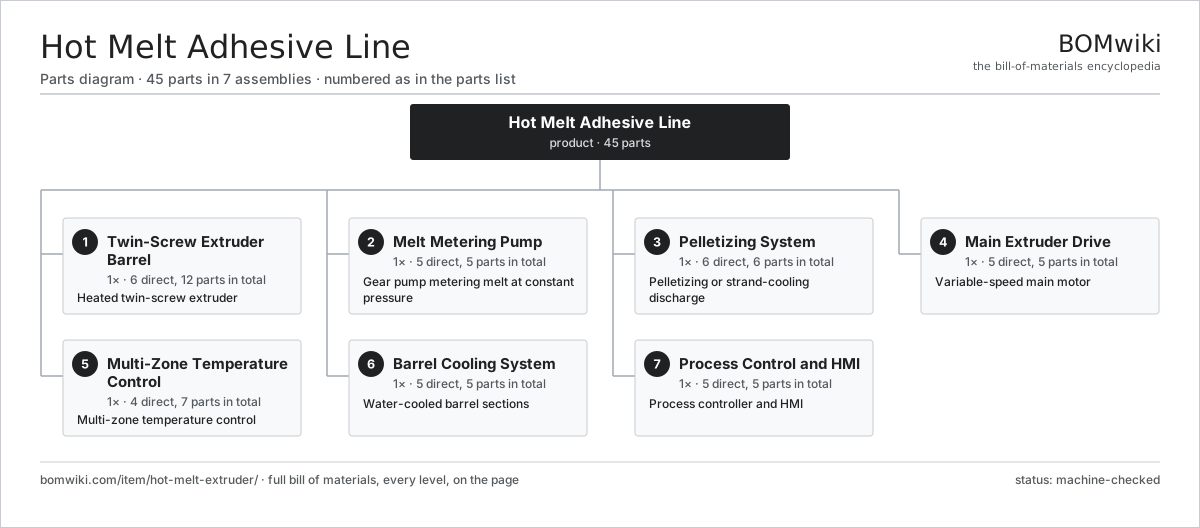
| # | Part | Qty | What it does |
|---|---|---|---|
| 1 | Twin-Screw Extruder Barrel 6 parts | 1× | Heated twin-screw extruder |
| 2 | Melt Metering Pump 5 parts | 1× | Gear pump metering melt at constant pressure |
| 3 | Pelletizing System 6 parts | 1× | Pelletizing or strand-cooling discharge |
| 4 | Main Extruder Drive 5 parts | 1× | Variable-speed main motor |
| 5 | Multi-Zone Temperature Control 4 parts | 1× | Multi-zone temperature control |
| 6 | Barrel Cooling System 5 parts | 1× | Water-cooled barrel sections |
| 7 | Process Control and HMI 5 parts | 1× | Process controller and HMI |
3D model
No 3D model yet. Have a CAD file of this? Add a 3D model — STL renders right on this page; STEP, FreeCAD, and OpenSCAD sources are welcome too (openly licensed, like all 3D models on BOMwiki).
Build & assembly graph
expand / collapse · shared sub-assemblies converge · links to related products · est. labourTap an assembly to expand/collapse · tap a part to open it · use “Open page” for any node · drag to pan, scroll to zoom.
Bill of materials for Hot Melt Adhesive Line
7 top-level lines · 43 rows shown · 45 parts total · indented to 3 levels| # | Item / sub-assembly | Part no. | Qty/assy | Ext. qty | Parts | Type |
|---|---|---|---|---|---|---|
| 1 | Twin-Screw Extruder Barrel 6 parts | hot-melt-extruder-twin-screw | 1× | 1 | 12 | assembly |
| 1.1 | Extruder Barrel Cylinder | hot-melt-extruder-barrel-body | 1× | 1 | · | part |
| 1.2 | Twin Screw Set | hot-melt-extruder-screw-pair | 1× | 1 | · | part |
| 1.3 | Cartridge Heater | hot-melt-extruder-barrel-heater | 4× | 4 | · | part |
| 1.4 | Zone Thermocouple | hot-melt-extruder-barrel-thermocouples | 4× | 4 | · | part |
| 1.5 | Cooling Jacket | hot-melt-extruder-barrel-jacket | 1× | 1 | · | part |
| 1.6 | Feed Hopper | hot-melt-extruder-hopper | 1× | 1 | · | part |
| 2 | Melt Metering Pump 5 parts | hot-melt-extruder-melt-pump | 1× | 1 | 5 | assembly |
| 2.1 | Pump Drive Motor | hot-melt-extruder-pump-motor | 1× | 1 | · | part |
| 2.2 | Pump Gear Set | hot-melt-extruder-pump-gears | 1× | 1 | · | part |
| 2.3 | Heated Pump Block | hot-melt-extruder-pump-housing | 1× | 1 | · | part |
| 2.4 | Pump Relief Valve | hot-melt-extruder-pressure-relief | 1× | 1 | · | part |
| 2.5 | Pressure Transducer | hot-melt-extruder-pressure-transducer | 1× | 1 | · | part |
| 3 | Pelletizing System 6 parts | hot-melt-extruder-pelletizer | 1× | 1 | 6 | assembly |
| 3.1 | Strand Die | hot-melt-extruder-pellet-die | 1× | 1 | · | part |
| 3.2 | Cooling Water Tank | hot-melt-extruder-cooling-bath | 1× | 1 | · | part |
| 3.3 | Cooling Circulation Pump | hot-melt-extruder-cooling-water-pump | 1× | 1 | · | part |
| 3.4 | Strand Cutter Blade | hot-melt-extruder-pellet-cutter | 1× | 1 | · | part |
| 3.5 | Vibrating Dryer Tray | hot-melt-extruder-pellet-dryer | 1× | 1 | · | part |
| 3.6 | Pellet Collection Hopper | hot-melt-extruder-collection-hopper | 1× | 1 | · | part |
| 4 | Main Extruder Drive 5 parts | hot-melt-extruder-motor-drive | 1× | 1 | 5 | assembly |
| 4.1 | Screw Drive Motor | hot-melt-extruder-main-motor | 1× | 1 | · | part |
| 4.2 | Variable-Frequency Drive | hot-melt-extruder-vfd-drive | 1× | 1 | · | part |
| 4.3 | Speed Reduction Gearbox | hot-melt-extruder-gearbox | 1× | 1 | · | part |
| 4.4 | Flexible Shaft Coupling | hot-melt-extruder-coupling | 1× | 1 | · | part |
| 4.5 | In-Line Torque Cell | hot-melt-extruder-torque-sensor | 1× | 1 | · | part |
| 5 | Multi-Zone Temperature Control 4 parts | hot-melt-extruder-heating-zones | 1× | 1 | 7 | assembly |
| 5.1 | Temperature Controller | hot-melt-extruder-zone-controller | 1× | 1 | · | part |
| 5.2 | Solid-State Relay | hot-melt-extruder-heater-contactor | 4× | 4 | · | part |
| 5.3 | Zone Temperature Display | hot-melt-extruder-temperature-display | 1× | 1 | · | part |
| 5.4 | PID Temperature Control | hot-melt-extruder-pid-algorithm | 1× | 1 | · | part |
| 6 | Barrel Cooling System 5 parts | hot-melt-extruder-cooling | 1× | 1 | 5 | assembly |
| 6.1 | Water Jacket Coil | hot-melt-extruder-barrel-water-jacket | 1× | 1 | · | part |
| 6.2 | Water Chiller Unit | hot-melt-extruder-water-chiller | 1× | 1 | · | part |
| 6.3 | Water Circulation Pump | hot-melt-extruder-cooling-pump | 1× | 1 | · | part |
| 6.4 | Water Temperature Gauge | hot-melt-extruder-cooling-thermometer | 1× | 1 | · | part |
| 6.5 | Water Flow Switch | hot-melt-extruder-flow-switch | 1× | 1 | · | part |
| 7 | Process Control and HMI 5 parts | hot-melt-extruder-controls | 1× | 1 | 5 | assembly |
| 7.1 | Programmable Logic Controller | hot-melt-extruder-plc | 1× | 1 | · | part |
| 7.2 | HMI Touchscreen | hot-melt-extruder-hmi-touchscreen | 1× | 1 | · | part |
| 7.3 | Data Logging Module | hot-melt-extruder-data-logger | 1× | 1 | · | part |
| 7.4 | Safety Relay Module | hot-melt-extruder-safety-relay | 1× | 1 | · | part |
| 7.5 | Power Distribution Panel | hot-melt-extruder-power-distribution | 1× | 1 | · | part |
Sourcing: possible vendors
Prices, MOQ, and lead times are algorithmic estimates, not quotes, and not claims about these companies. Company mappings are curated by keyword; est. price band $5k–$2M. How estimates work| Vendor | HQ | Specialty | MOQ | Lead time |
|---|---|---|---|---|
| atlascopco.com ↗ | Stockholm, SE | Compressors & industrial | 10 units | 12–20 wks |
|
🇦🇹Andritz
andritz.com ↗
|
Graz, AT | Process plants & machinery | 10 units | 12–20 wks |
| buhlergroup.com ↗ | Uzwil, CH | Food & materials processing | 10 units | 12–20 wks |
| gea.com ↗ | Düsseldorf, DE | Process technology | 10 units | 12–20 wks |
| mhi.com ↗ | Tokyo, JP | Heavy machinery | 10 units | 12–20 wks |
1,682-word article