HPLC System
ProductOverview
High-performance liquid chromatography (HPLC) is a separation technique that dissolves a sample mixture in a mobile phase (solvent) and forces it through a stationary phase (packed column) under high pressure. Compounds partition between phases based on hydrophobicity, polarity, or molecular weight, emerging at different times (retention times) for identification and quantification. The instrument consists of a pump generating precise flow, an autosampler for reproducible injection, a temperature-controlled column oven, and a detector converting separated compounds into electrical signals.
HPLC dominates pharmaceutical, environmental, and food chemistry laboratories. A single system can analyze hundreds of samples per day with minimal manual intervention, providing limits of detection in the parts-per-billion range for UV-absorbing compounds.
How it works
Solvent Delivery: The quaternary pump draws from four solvent reservoirs (A, B, C, D) through check valves and blends them in programmable ratios before each run. Two reciprocating piston chambers (in parallel for pressure ripple damping) push solvent to 400 bar maximum, corresponding to flow rates of 0.1–10 mL/min depending on column ID. A back-pressure sensor continuously monitors system health; if pressure spikes, a fault is logged and the autosampler halts to prevent column rupture.
Sample Injection: The autosampler carousel holds 96 or 192 microplate-compatible vials in a temperature-controlled environment (typically 4–10 °C to prevent evaporation). A robotic arm retrieves a vial, positions a fixed-volume syringe needle above it, aspirates 0.1–100 µL (user-programmable), then drives the arm to the column inlet and injects over 0.3–2 seconds. The system can execute a method (pump program, temperature ramp, detector wavelengths) independently of sample preparation, enabling true walkaway operation overnight.
Column Oven: Separation chemistry is temperature-dependent; most reversed-phase methods run 25–40 °C. The oven chamber encloses a 150–250 mm column in a machined aluminum block, heated by a 1000 W cartridge heater and sensed by a four-wire PT-100 RTD. A PID loop maintains ±0.1 °C setpoint stability. Isothermal operation reduces baseline drift and band-broadening compared to unheated columns.
Detection: The diode array detector splits light from a UV/Vis lamp (deuterium or xenon arc) at specific wavelengths using a holographic grating, focuses the dispersed spectrum onto a 1024-pixel photodiode array, and records all wavelengths simultaneously. The flow cell (quartz, 10 mm pathlength) sits directly in the light beam. As a compound elutes, it absorbs photons proportional to its molar absorptivity and concentration, generating a chromatogram, a time-indexed absorbance trace. The 1024-pixel array allows retrospective wavelength selection and purity assessment (same compound must absorb equally across expected wavelengths).
Degassing: Dissolved oxygen and other gases can form bubbles under reduced pressure, collapsing baseline and splitting peaks. The in-line degasser uses a Teflon membrane permeable to gas but not liquid. Connected to a low-vacuum pump (0.5 bar absolute), it extracts gas molecules from the mobile phase as they flow through, eliminating bubble formation in the detector or autosampler.
Control Loop: A microcontroller orchestrates all subsystems. At method start, it ramps pump gradients, initiates column heating, and cues the autosampler. While the sample separates, the detector continuously streams absorbance data (>40 Hz sampling) to the host PC. Software integration tools (peak detection, retention time calibration, quantitation vs. calibration curves) run post-acquisition. Modern systems include two independent control loops: real-time pump/detector management on the instrument, offline data processing and reporting on the connected workstation.
Applications
Pharmaceutical development and QA rely on HPLC for assay of active pharmaceutical ingredients (API), purity of drug candidates, and stability testing under accelerated conditions. Environmental labs measure pesticide residues, industrial solvents, and heavy metals in soil and water. Food chemistry screens for allergens, additives, and contaminants. Forensics and toxicology labs identify drugs of abuse and poisons in biological samples.
Key Design Features
- Modular architecture: Each subsystem (pump, sampler, oven, detector) is independent, allowing instrument customization and repair without full system downtime.
- Redundant check valves: Four inlet check valves prevent backflow and channel cross-contamination during blending.
- Sapphire plungers: The pump uses precision sapphire rather than stainless steel plungers in high-pressure chambers, resisting corrosion from acidic mobile phases.
- Simultaneous multi-wavelength detection: The DAD captures all 190–600 nm data in a single run, reducing method development time.
- Thermal inertia: The aluminum oven block has high mass, stabilizing column temperature against solvent flow transients.
Maintenance and Consumables
- Column replacement: 3–6 month lifespan depending on sample complexity and mobile phase pH.
- Mobile phase: A-D solvents (water, acetonitrile, methanol, tetrahydrofuran) require regular degassing and filtration.
- Seal replacements: Pump pistons and check valve seats wear after 500–1000 hours of operation.
- Lamp aging: Deuterium lamps degrade after 1000 hours, reducing UV sensitivity and requiring calibration or replacement.
HPLC System parts and their functions
7 top-level parts · 37 parts in total · full bill of materials below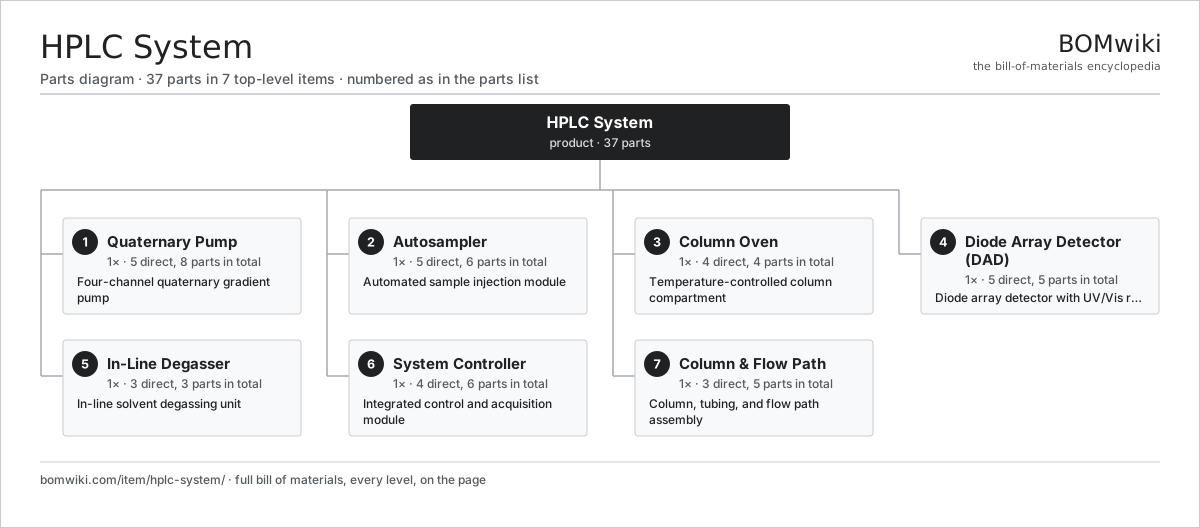
| # | Part | Qty | What it does |
|---|---|---|---|
| 1 | Quaternary Pump 5 parts | 1× | Four-channel quaternary gradient pump |
| 2 | Autosampler 5 parts | 1× | Automated sample injection module |
| 3 | Column Oven 4 parts | 1× | Temperature-controlled column compartment |
| 4 | Diode Array Detector (DAD) 5 parts | 1× | Diode array detector with UV/Vis range |
| 5 | In-Line Degasser 3 parts | 1× | In-line solvent degassing unit |
| 6 | System Controller 4 parts | 1× | Integrated control and acquisition module |
| 7 | Column & Flow Path 3 parts | 1× | Column, tubing, and flow path assembly |
3D model
No 3D model yet. Have a CAD file of this? Add a 3D model. STL renders right on this page; STEP, FreeCAD, and OpenSCAD sources are welcome too (openly licensed, like all 3D models on BOMwiki).
Build & assembly graph
expand / collapse · shared sub-assemblies converge · links to related products · est. labourTap an assembly to expand/collapse · tap a part to open it · use “Open page” for any node · drag to pan, scroll to zoom.
Bill of materials for HPLC System
7 top-level lines · 36 rows shown · 37 parts total · indented to 3 levels| # | Item / sub-assembly | Part no. | Qty/assy | Ext. qty | Parts | Type |
|---|---|---|---|---|---|---|
| 1 | Quaternary Pump 5 parts | hplc-system-pump | 1× | 1 | 8 | assembly |
| 1.1 | Pump Head Assembly | hplc-system-pump-head | 1× | 1 | · | part |
| 1.2 | Stepper Motor & Cam | hplc-system-pump-motor | 1× | 1 | · | part |
| 1.3 | Check Valve Set | hplc-system-check-valves | 4× | 4 | · | part |
| 1.4 | Pressure Sensor | pressure-sensor | 1× | 1 | · | part |
| 1.5 | Bare PCB | pcb-bare | 1× | 1 | · | part |
| 2 | Autosampler 5 parts | hplc-system-autosampler | 1× | 1 | 6 | assembly |
| 2.1 | Sample Carousel | hplc-system-sample-carousel | 1× | 1 | · | part |
| 2.2 | Injection Syringe | hplc-system-injection-syringe | 1× | 1 | · | part |
| 2.3 | Robotic Arm | hplc-system-autosampler-arm | 1× | 1 | · | part |
| 2.4 | Motor Housing | motor-housing | 2× | 2 | · | part |
| 2.5 | Bare PCB | pcb-bare | 1× | 1 | · | part |
| 3 | Column Oven 4 parts | hplc-system-column-oven | 1× | 1 | 4 | assembly |
| 3.1 | Oven Chamber | hplc-system-oven-chamber | 1× | 1 | · | part |
| 3.2 | Heating Element | heating-element | 1× | 1 | · | part |
| 3.3 | Temperature Sensor | temperature-sensor | 1× | 1 | · | part |
| 3.4 | Bare PCB | pcb-bare | 1× | 1 | · | part |
| 4 | Diode Array Detector (DAD) 5 parts | hplc-system-detector | 1× | 1 | 5 | assembly |
| 4.1 | UV Lamp | hplc-system-uv-lamp | 1× | 1 | · | part |
| 4.2 | Flow Cell | hplc-system-flow-cell | 1× | 1 | · | part |
| 4.3 | Photodiode Array | hplc-system-photodiode-array | 1× | 1 | · | part |
| 4.4 | Optical Assembly | hplc-system-optics | 1× | 1 | · | part |
| 4.5 | Bare PCB | pcb-bare | 1× | 1 | · | part |
| 5 | In-Line Degasser 3 parts | hplc-system-degasser | 1× | 1 | 3 | assembly |
| 5.1 | Degasser Chamber | hplc-system-degasser-chamber | 1× | 1 | · | part |
| 5.2 | Vacuum Pump | hplc-system-vacuum-pump | 1× | 1 | · | part |
| 5.3 | Bare PCB | pcb-bare | 1× | 1 | · | part |
| 6 | System Controller 4 parts | hplc-system-controller | 1× | 1 | 6 | assembly |
| 6.1 | Bare PCB | pcb-bare | 2× | 2 | · | part |
| 6.2 | Microcontroller | mcu | 1× | 1 | · | part |
| 6.3 | SMD Passive (R/C/L) | smd-passives | 1× | 1 | · | part |
| 6.4 | Connector | connector | 2× | 2 | · | part |
| 7 | Column & Flow Path 3 parts | hplc-system-plumbing | 1× | 1 | 5 | assembly |
| 7.1 | Analytical Column | hplc-system-column | 1× | 1 | · | part |
| 7.2 | Connector | connector | 3× | 3 | · | part |
| 7.3 | Wire Bundle | wire-bundle | 1× | 1 | · | part |
Something wrong in this list? Report a problem with this BOM.
Related products
same domain, ranked by shared parts Rotary Evaporator
208 parts · shares 4 with this page
Rotary Evaporator
208 parts · shares 4 with this page
 Climate Test Chamber
64 parts · shares 3 with this page
Climate Test Chamber
64 parts · shares 3 with this page
 Gas Chromatograph
450 parts · shares 3 with this page
Gas Chromatograph
450 parts · shares 3 with this page
 Thermogravimetric Analyzer (TGA)
661 parts · shares 3 with this page
Thermogravimetric Analyzer (TGA)
661 parts · shares 3 with this page
Sourcing: possible vendors
Browse the supplier directory → Prices, MOQ, and lead times are algorithmic estimates, not quotes, and not claims about these companies. Company mappings are curated by keyword; est. price band $1k–$500k. How estimates work| Vendor | HQ | Specialty | MOQ | Lead time |
|---|---|---|---|---|
| thermofisher.com ↗ | Waltham, US | Lab instruments | 100 units | 10–18 wks |
|
🇺🇸Agilent
agilent.com ↗
|
Santa Clara, US | Analytical instruments | 100 units | 10–18 wks |
|
🇺🇸Bruker
bruker.com ↗
|
Billerica, US | Scientific instruments | 100 units | 10–18 wks |
|
🇯🇵Shimadzu
shimadzu.com ↗
|
Kyoto, JP | Analytical instruments | 100 units | 10–18 wks |
|
🇺🇸Waters
waters.com ↗
|
Milford, US | Chromatography & MS | 100 units | 10–18 wks |
793-word article