Hurdy-Gurdy
ProductOverview
The hurdy-gurdy (also called wheel fiddle, vielle à roue, or German Drehleier) is the only stringed instrument that can sustain a note indefinitely without the player interrupting to re-bow or re-pluck. Instead of the player's arm providing the vibrating energy (as in a fiddle) or the player's fingers plucking intermittently (as in a guitar), the hurdy-gurdy uses a hand-crank-driven Wheel to provide continuous vibration to the Melody Strings and Drone Strings.
The heart of the instrument is the marriage of continuous vibration (from the wheel) with pitch control (from the Keybox). The wheel rubs against all strings simultaneously, but the melody strings are stopped at different heights by wooden Tangent sticks in the keybox. When a key is pressed, its tangent rises and shortens the vibrating length of a melody string, raising its pitch. Release the key, and a spring pulls the tangent down, lengthening the string again. The player holds a constant crank speed while fingers operate the keys, producing long, smooth melodic lines accompanied by constant drones.
This construction gave the hurdy-gurdy prominence in 17th–18th century European court music, and it remains central to folk traditions in France (Auvergne), Italy, Eastern Europe, and Scandinavia. Modern revivals have brought new repertoire and extended techniques.
The wheel and continuous vibration
The Wheel is the mechanical heart. It is a wooden or metal cylinder, typically 7–8 cm in diameter, covered with a grip layer (leather, cloth, or grip tape). The Wheel Rosin, a cake of colophony rosin, is rubbed onto the wheel surface, creating friction. When the player turns the Crank, the wheel rotates at roughly 60–120 rpm (depending on crank speed and any gear reduction), and the rosin-coated surface rubs against the strings, vibrating them continuously.
The friction is critical: insufficient rosin or insufficient pressure results in a scratchy, squeaking sound; excessive pressure creates a harsh, scraping tone. The Wheel Tension, a spring or lever, controls how firmly the strings press against the wheel, allowing the player to adjust the contact pressure and tone colour during performance.
Melody strings and pitch control
The Melody Strings are typically four thin steel wires (roughly 0.6 mm diameter), often tuned to the same pitch or to octaves. All four melody strings are vibrated by the wheel simultaneously, but their pitch is controlled by the keybox. When no key is pressed, the strings vibrate at their ''open'' pitch. When a key is pressed, its Tangent, a small wooden stick, rises and touches the strings, effectively shortening the vibrating length and raising the pitch proportionally.
The Keybox typically has 25–37 keys, each operating one tangent. The tangents are arranged so that pressing successive keys raises the pitch in semitone steps, covering a range of about 25 semitones (just over two octaves). This is sufficient for playing diatonic folk melodies and folk-derived classical pieces. The keys are typically wooden buttons arranged in a piano-like layout, pressed with the fingers of the left hand while the right hand maintains the crank.
Drones and harmonic foundation
The Drone Strings are thicker (typically 0.8–1.0 mm) and tuned to fixed bass notes, usually a fifth or fourth below the melody range. These drones are never touched by the keybox; they vibrate continuously at their tuned pitches, providing a harmonic anchor and a characteristic ''bourdon'' drone that is the hurdy-gurdy's signature sound.
Some versions include a Trompette Bridge, a specialized bridge with a buzzing mechanism, that amplifies the drone and adds a reedy, nasal quality to the sound. The trompette bridge sits loosely on the strings, allowing the strings to vibrate against it, creating a secondary buzzing tone that enriches the overall sound and projects the drones.
Body and resonator
The Body is a wooden resonator, typically pear-shaped or wheel-shaped, sized to amplify the vibrations from the strings. The interior is hollow, and Sound Holes (usually 1–2 openings) allow sound to radiate to the room. The Body Bracing provides structural support without over-damping vibration.
The acoustic design is crucial: a well-designed hurdy-gurdy body resonates preferentially at the drone pitch, emphasizing that fundamental tone and extending its sustain. The melody strings, vibrating at higher frequencies, are less heavily amplified but still clearly audible over the drones.
The Wheel Opening in the body side provides access for the wheel to contact the strings while remaining enclosed in the resonator. This opening size and shape tune the overall acoustic response.
Playing technique and crank control
The player holds the hurdy-gurdy upright, either between the knees (if sitting) or at the hip (if standing), with the Crank extending to the right side at roughly elbow height. The right hand continuously turns the crank, maintaining a steady rotation speed. A typical performance speed is 60–90 rpm, though ornamental passages may speed up or slow down for expressive effect.
Simultaneously, the left hand operates the Keybox keys, selecting melody notes. Because the wheel is continuously vibrating the strings, the sound is perfectly legato: pressing a key produces an immediate pitch change without any interruption or attack transient. This legato character is one reason the hurdy-gurdy can sound almost vocal or bowed, even though the mechanism is entirely different from singing or bowing.
Advanced techniques include:
- Trills: rapidly alternating between two adjacent keys for ornamental flourishes.
- Drones without melody: pressing no keys and allowing the wheel to vibrate only the drones, creating a sustained harmonic wash.
- Crank modulation: varying the crank speed for dynamic and expressive effects, raising or lowering the overall pitch and volume.
- Sympathetic vibration: tuning certain strings to vibrate in sympathy with the wheels, extending sustain and richness.
Tuning and maintenance
The melody and drone strings are tuned with Melody Pegbox and Drone Pegbox friction pegs at one end, similar to a violin or hurdy-gurdy's ancestor instruments. Tuning stability requires regular attention, especially in fluctuating humidity, as the wooden body and friction pegs shift with moisture changes.
The rosin on the wheel gradually wears away and must be reapplied by rubbing a fresh rosin cake onto the wheel surface. If the rosin becomes worn and smooth, the friction drops and the tone becomes scratchy and thin. Replacing rosin is a regular maintenance task.
The tangents and keys require careful adjustment to ensure that each tangent contacts all melody strings cleanly and at the correct pitch. Misaligned tangents result in fuzzy, out-of-tune notes. The Key Linkage and Key Spring also wear and may require adjustment or replacement over years of heavy use.
Musical tradition and modern revival
The hurdy-gurdy was prominent in 17th–18th century European chamber music and opera, particularly in France and Italy, where it was played in aristocratic circles and orchestras. Over the 19th and 20th centuries, it became primarily a folk instrument, retaining its central role in French Auvergnat music, Italian folk traditions, and Scandinavian and Eastern European music.
The late 20th century saw a revival of interest, with contemporary classical composers (Penderecki, Glass) writing for the hurdy-gurdy, and folk and world music performers bringing new energy to traditional repertoire. Modern hurdy-gurdies sometimes incorporate sympathetic strings, electric amplification, or extended keyboxes covering chromatic pitches, expanding the instrument's musical range beyond its traditional folk context.
Hurdy-Gurdy parts and their functions
7 top-level parts · 100 parts in total · full bill of materials below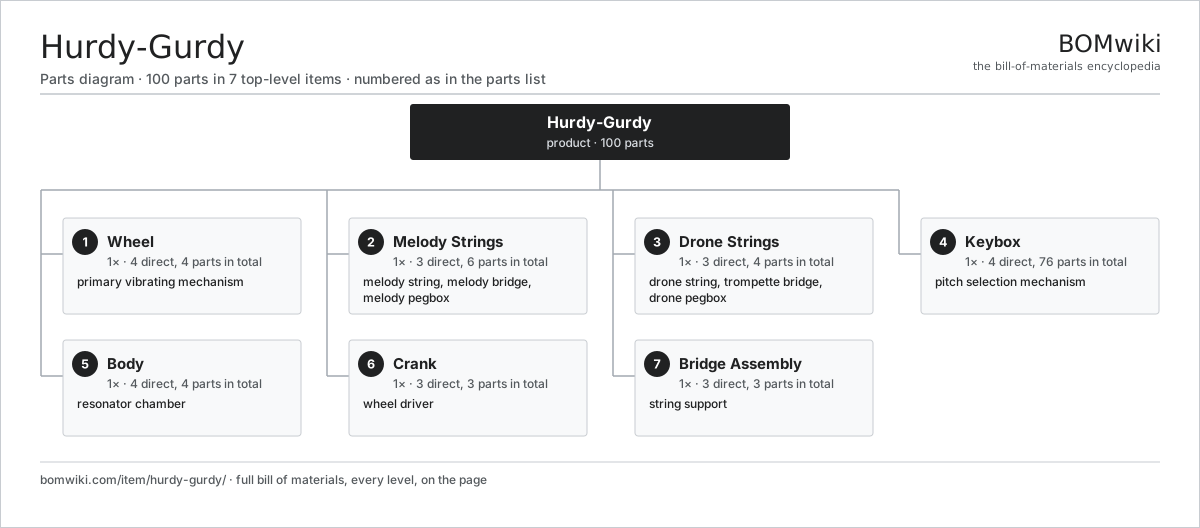
| # | Part | Qty | What it does |
|---|---|---|---|
| 1 | Wheel 4 parts | 1× | primary vibrating mechanism |
| 2 | Melody Strings 3 parts | 1× | Strings whose pitches are changed by the keyboard, carrying the primary melodic voice. |
| 3 | Drone Strings 3 parts | 1× | Constant-tone strings providing harmonic accompaniment to the melody. |
| 4 | Keybox 4 parts | 1× | pitch selection mechanism |
| 5 | Body 4 parts | 1× | resonator chamber |
| 6 | Crank 3 parts | 1× | wheel driver |
| 7 | Bridge Assembly 3 parts | 1× | string support |
3D model
No 3D model yet. Have a CAD file of this? Add a 3D model. STL renders right on this page; STEP, FreeCAD, and OpenSCAD sources are welcome too (openly licensed, like all 3D models on BOMwiki).
Build & assembly graph
expand / collapse · shared sub-assemblies converge · links to related products · est. labourTap an assembly to expand/collapse · tap a part to open it · use “Open page” for any node · drag to pan, scroll to zoom.
Bill of materials for Hurdy-Gurdy
7 top-level lines · 31 rows shown · 100 parts total · indented to 3 levels| # | Item / sub-assembly | Part no. | Qty/assy | Ext. qty | Parts | Type |
|---|---|---|---|---|---|---|
| 1 | Wheel 4 parts | hurdy-gurdy-wheel | 1× | 1 | 4 | assembly |
| 1.1 | Wheel Cylinder | hurdy-gurdy-wheel-cylinder | 1× | 1 | · | part |
| 1.2 | Wheel Rosin | hurdy-gurdy-wheel-rosin | 1× | 1 | · | part |
| 1.3 | Wheel Axle | hurdy-gurdy-wheel-axle | 1× | 1 | · | part |
| 1.4 | Wheel Tension | hurdy-gurdy-wheel-tension | 1× | 1 | · | part |
| 2 | Melody Strings 3 parts | hurdy-gurdy-melody-strings | 1× | 1 | 6 | assembly |
| 2.1 | Melody String | hurdy-gurdy-melody-string | 4× | 4 | · | part |
| 2.2 | Melody Bridge | hurdy-gurdy-melody-bridge | 1× | 1 | · | part |
| 2.3 | Melody Pegbox | hurdy-gurdy-melody-pegbox | 1× | 1 | · | part |
| 3 | Drone Strings 3 parts | hurdy-gurdy-drone-strings | 1× | 1 | 4 | assembly |
| 3.1 | Drone String | hurdy-gurdy-drone-string | 2× | 2 | · | part |
| 3.2 | Trompette Bridge | hurdy-gurdy-trompette-bridge | 1× | 1 | · | part |
| 3.3 | Drone Pegbox | hurdy-gurdy-drone-pegbox | 1× | 1 | · | part |
| 4 | Keybox 4 parts | hurdy-gurdy-keybox | 1× | 1 | 76 | assembly |
| 4.1 | Tangent | hurdy-gurdy-tangent | 25× | 25 | · | part |
| 4.2 | Key | hurdy-gurdy-key | 25× | 25 | · | part |
| 4.3 | Key Linkage | hurdy-gurdy-key-linkage | 1× | 1 | · | part |
| 4.4 | Key Spring | hurdy-gurdy-key-spring | 25× | 25 | · | part |
| 5 | Body 4 parts | hurdy-gurdy-body | 1× | 1 | 4 | assembly |
| 5.1 | Resonator Box | hurdy-gurdy-resonator-box | 1× | 1 | · | part |
| 5.2 | Sound Holes | hurdy-gurdy-sound-holes | 1× | 1 | · | part |
| 5.3 | Body Bracing | hurdy-gurdy-body-bracing | 1× | 1 | · | part |
| 5.4 | Wheel Opening | hurdy-gurdy-wheel-opening | 1× | 1 | · | part |
| 6 | Crank 3 parts | hurdy-gurdy-crank | 1× | 1 | 3 | assembly |
| 6.1 | Crank Handle | hurdy-gurdy-crank-handle | 1× | 1 | · | part |
| 6.2 | Crank Axle | hurdy-gurdy-crank-axle | 1× | 1 | · | part |
| 6.3 | Crank Gear | hurdy-gurdy-crank-gear | 1× | 1 | · | part |
| 7 | Bridge Assembly 3 parts | hurdy-gurdy-bridge-assembly | 1× | 1 | 3 | assembly |
| 7.1 | Melody Bridge | hurdy-gurdy-melody-bridge | 1× | 1 | · | part |
| 7.2 | Trompette Bridge | hurdy-gurdy-trompette-bridge | 1× | 1 | · | part |
| 7.3 | Bridge Calibration | hurdy-gurdy-bridge-calibration | 1× | 1 | · | part |
Something wrong in this list? Report a problem with this BOM.
Sourcing: possible vendors
Browse the supplier directory → Prices, MOQ, and lead times are algorithmic estimates, not quotes, and not claims about these companies. Company mappings are curated by keyword; est. price band $50–$5k. How estimates work| Vendor | HQ | Specialty | MOQ | Lead time |
|---|---|---|---|---|
| yamaha.com ↗ | Hamamatsu, JP | Audio & instruments | 200 units | 8–14 wks |
|
🇺🇸Fender
fender.com ↗
|
Los Angeles, US | Guitars & amps | 200 units | 8–14 wks |
|
🇺🇸Gibson
gibson.com ↗
|
Nashville, US | Guitars | 200 units | 8–14 wks |
|
🇯🇵Roland
roland.com ↗
|
Hamamatsu, JP | Electronic instruments | 200 units | 8–14 wks |
| steinway.com ↗ | New York, US | Pianos | 200 units | 8–14 wks |
1,269-word article