Hydrogen Tube Trailer
ProductOverview
A hydrogen tube trailer is a mobile storage and transport system comprising 8–12 high-pressure composite or steel tubes mounted on a road trailer chassis. Each tube stores hydrogen gas at 350 bar (SAE J2601 standard, ~25 kg H₂) or 700 bar (emerging ISO 14687, ~50 kg H₂). A typical full trailer carries 250–600 kg of hydrogen, sufficient to supply a hydrogen Hydrogen Dispenser fueling station for one shift, or to deliver hydrogen to distributed fuel cell Solid Oxide Fuel Cell Module installations or stationary PEM Electrolyzer Stack backup power systems.
The trailer is the industry-standard mode for point-to-point hydrogen logistics, offering capital efficiency (tubes are commodity items), scalability (add/remove tubes), and compatibility with existing trucking infrastructure.
How it works
Tube Selection and Storage Physics
The Composite Tube uses Type III (aluminum liner + fiberglass) or Type IV (plastic liner + carbon fiber) construction. Both are approved by DOT, TC, and Transport Canada for 350 bar hydrogen service. The composite overwrap hoop stress and axial stress are designed to withstand 350 bar with a safety factor of 3.6 (ASME Section VIII Div. 2).
Hydrogen stored at 350 bar and 20 °C occupies the tube volume according to real-gas corrections:
$$pV = nRT + Z(T, p) ext{ corrections}$$
At 350 bar, hydrogen density is ~25–28 kg/m³, so a 50 L tube holds:
$$m_{\text{H}_2} \approx 0.050 \text{ m}^3 \times 26 \text{ kg/m}^3 \approx 1.3 \text{ kg/tube}$$
A 10-tube trailer thus carries ~13 kg; fully loaded 12-tube trailer: ~16–20 kg at 350 bar (lower than direct liquefaction, but safer and more accessible than cryogenic systems).
Tube Bundle Assembly and Supports
The Tube Bundle arranges tubes in parallel rows (typically 4 tubes wide × 2–3 tubes high or 2 tubes wide × 6 tubes high) on the Frame Structure. Each tube sits in Tube Supports saddle mounts spaced ~1 m apart, with Vibration Isolators elastomer pads decoupling vibration from the frame.
Tubes are interconnected via a Tube Interconnect block or manifold, collecting all outlet ports into a single Manifold Block. This design allows fail-safe operation: if one tube ruptures (exceedingly rare for composite), the others remain isolated and operational via redundant isolation/check valves in the manifold.
Valve Panel and Manifold Integration
The Valve Panel houses critical safety and operational valves on the trailer frame:
- Isolation Valve: Manual or solenoid block valve closing off all tubes, required for safe storage and trailer disconnection.
- Relief Valve (primary): Pilot-operated poppet venting at 350–380 bar if pressure rises above setpoint (e.g., due to solar heating on a hot day).
- Secondary Relief: Independent backup relief (5% higher setpoint, 370–395 bar) as redundant overpressure protection per ASME.
- Check Valve: Prevents hydrogen backflow into tubes when the inlet supply is disconnected.
- Bleed-Down Valve: Manual vent for safe depressurization before maintenance.
The Manifold Block consolidates tube outlets, relief ports, and instrumentation ports into a compact aluminum or ductile iron block.
Coupling and Hydrogen Transfer
Hydrogen enters via the Inlet Coupler, a SAE J2601 quick-disconnect rated for 350/700 bar. This connects to a Hydrogen Dispenser or on-site generation system (e.g., PEM Electrolyzer Stack). Hydrogen exits via the Outlet Coupler for delivery to end users (Hydrogen Dispenser, stationary fuel cell plants, or Solid Oxide Fuel Cell Module).
The Coupler Connection Hose is EN 286 4SP rated hose with stainless steel swaged JIC fittings, capable of withstanding 700 bar service. The Breakaway Cartridge on the outlet prevents hydrogen release if the trailer is pulled away during connection (load-check mechanism).
Filling a trailer from a compressor typically takes 15–30 minutes at 350 bar. Outlet pressure management relies on a Pressure Sensor transducer feeding back to the supply compressor's regulator, maintaining steady outlet pressure.
Safety and Instrumentation
Multi-layer protection:
- Dual relief valves: Primary (350–380 bar) and secondary (370–395 bar) ensure no scenario can cause overpressure >5% above design.
- Rupture disk (optional): Single-use bursting membrane at 400 bar provides ultimate last-resort safety if both reliefs fail (extremely unlikely; installed for extra insurance in high-risk scenarios).
- Pressure monitoring: Pressure Sensor transducers at inlet and outlet inform the driver/operator of fill status. A Pressure Gauge mechanical dial gauge provides passive confirmation.
- Temperature sensing: Temperature Sensor on manifold outlet enables density correction for hydrogen quantity calculations (important for inventory tracking).
- Quantity system: Quantity System algorithm (using pressure, temperature, and previous calibration) estimates remaining hydrogen mass, alerting driver to refill needs.
Frame and Road Compliance
The Frame Structure is a welded carbon steel chassis certified to ASME Section VIII Div. 2 and DOT FMVSS 393 (cargo securement). Typical configurations:
- Standard 40-foot flatbed: Tubes mounted horizontally, 8–12 units, towed by a Class 8 tractor unit.
- Specialized hydrogen trailer: Custom chassis with integrated valve manifold, compliance labeling (DOT placard: Class 2.1 Flammable Gas), and road-safe cabling.
Lighting is DOT-compliant LED (brake, turn, clearance). Trailer Axles are air-suspended tandem or tri-axle rated for 20–35 tonne GVW, typical for hydrogen service.
Lashing: Lashing Straps (nylon or polyester web, ratchet-operated) secure tubes to frame with rated capacity exceeding 1.5× tube weight. Retention Brackets limit axial and rotational movement during cornering and braking.
Energy Density and Economics
Hydrogen mass-specific energy: 120 MJ/kg (~33 kWh/kg). A 350 bar trailer carrying 20 kg H₂ stores ~2400 MJ (~670 kWh), roughly equivalent to the chemical energy in 200 L of diesel. However, truck tractor + trailer fuel consumption to deliver that hydrogen can be 100–300 liters diesel per trip, so hydrogen logistics is best suited for high-utilization scenarios (frequent, short-haul routes) or situations where hydrogen cannot be produced on-site.
Capital cost: $100,000–300,000 USD per new composite tube trailer (tubes + frame + manifold + instrumentation). Refurbishment of older trailers: $30,000–50,000. Operational cost: minimal (just maintenance, occasional tube recertification per DOT/ASME). Lifespan: 20+ years for composite tubes if properly maintained.
Logistical Integration
Hydrogen tube trailers are the backbone of early-stage hydrogen supply chains, bridging PEM Electrolyzer Stack production sites (or Biomass Gasifier + cleanup) to distributed demand (automotive Hydrogen Dispenser networks, stationary power plants). As demand scales and hydrogen pipeline infrastructure emerges, tube trailers remain important for last-mile delivery and backup supply during peak demand.
Hydrogen Tube Trailer parts and their functions
8 top-level parts · 47 parts in total · full bill of materials below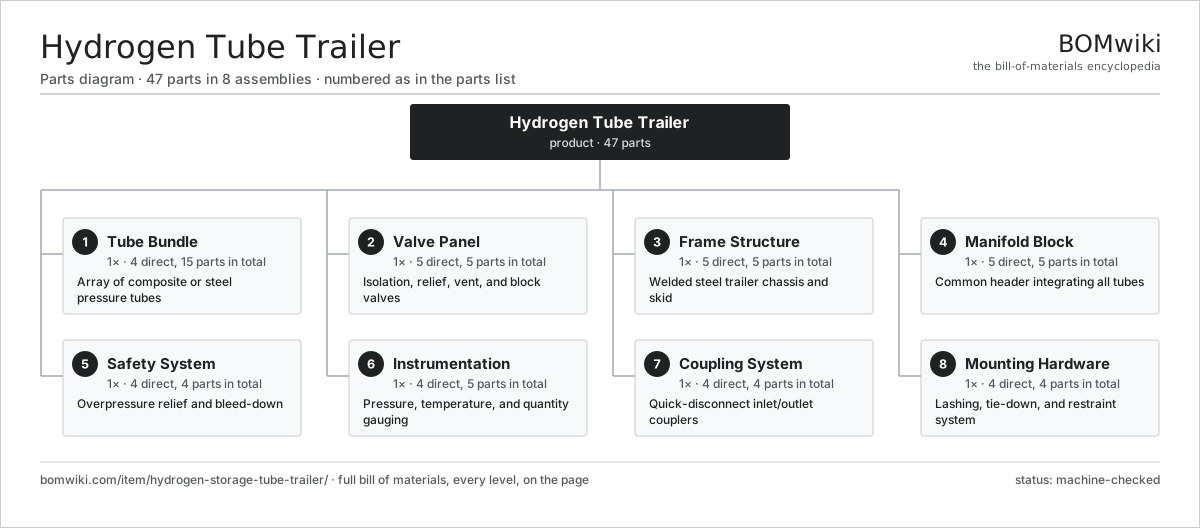
| # | Part | Qty | What it does |
|---|---|---|---|
| 1 | Tube Bundle 4 parts | 1× | Array of composite or steel pressure tubes |
| 2 | Valve Panel 5 parts | 1× | Isolation, relief, vent, and block valves |
| 3 | Frame Structure 5 parts | 1× | Welded steel trailer chassis and skid |
| 4 | Manifold Block 5 parts | 1× | Common header integrating all tubes |
| 5 | Safety System 4 parts | 1× | Overpressure relief and bleed-down |
| 6 | Instrumentation 4 parts | 1× | Pressure, temperature, and quantity gauging |
| 7 | Coupling System 4 parts | 1× | Quick-disconnect inlet/outlet couplers |
| 8 | Mounting Hardware 4 parts | 1× | Lashing, tie-down, and restraint system |
3D model
No 3D model yet. Have a CAD file of this? Add a 3D model — STL renders right on this page; STEP, FreeCAD, and OpenSCAD sources are welcome too (openly licensed, like all 3D models on BOMwiki).
Build & assembly graph
expand / collapse · shared sub-assemblies converge · links to related products · est. labourTap an assembly to expand/collapse · tap a part to open it · use “Open page” for any node · drag to pan, scroll to zoom.
Bill of materials for Hydrogen Tube Trailer
8 top-level lines · 43 rows shown · 47 parts total · indented to 3 levels| # | Item / sub-assembly | Part no. | Qty/assy | Ext. qty | Parts | Type |
|---|---|---|---|---|---|---|
| 1 | Tube Bundle 4 parts | hydrogen-storage-tube-trailer-tube-bundle | 1× | 1 | 15 | assembly |
| 1.1 | Composite Tube | hydrogen-storage-tube-trailer-composite-tube | 12× | 12 | · | part |
| 1.2 | Tube Supports | hydrogen-storage-tube-trailer-tube-supports | 1× | 1 | · | part |
| 1.3 | Tube Interconnect | hydrogen-storage-tube-trailer-tube-interconnect | 1× | 1 | · | part |
| 1.4 | Fastener Set | fastener-set | 1× | 1 | · | part |
| 2 | Valve Panel 5 parts | hydrogen-storage-tube-trailer-valve-panel | 1× | 1 | 5 | assembly |
| 2.1 | Isolation Valve | hydrogen-storage-tube-trailer-isolation-valve | 1× | 1 | · | part |
| 2.2 | Relief Valve | hydrogen-storage-tube-trailer-relief-valve | 1× | 1 | · | part |
| 2.3 | Bleed-Down Valve | hydrogen-storage-tube-trailer-bleed-down-valve | 1× | 1 | · | part |
| 2.4 | Check Valve | hydrogen-storage-tube-trailer-check-valve | 1× | 1 | · | part |
| 2.5 | Pressure Sensor | pressure-sensor | 1× | 1 | · | part |
| 3 | Frame Structure 5 parts | hydrogen-storage-tube-trailer-frame-structure | 1× | 1 | 5 | assembly |
| 3.1 | Frame Members | hydrogen-storage-tube-trailer-frame-members | 1× | 1 | · | part |
| 3.2 | Frame Welds | hydrogen-storage-tube-trailer-frame-welds | 1× | 1 | · | part |
| 3.3 | Trailer Axles | hydrogen-storage-tube-trailer-axles | 1× | 1 | · | part |
| 3.4 | Fifth Wheel | hydrogen-storage-tube-trailer-fifth-wheel | 1× | 1 | · | part |
| 3.5 | Lighting | hydrogen-storage-tube-trailer-lighting | 1× | 1 | · | part |
| 4 | Manifold Block 5 parts | hydrogen-storage-tube-trailer-manifold-block | 1× | 1 | 5 | assembly |
| 4.1 | Manifold Body | hydrogen-storage-tube-trailer-manifold-body | 1× | 1 | · | part |
| 4.2 | Manifold Check | hydrogen-storage-tube-trailer-manifold-check | 1× | 1 | · | part |
| 4.3 | Manifold Relief | hydrogen-storage-tube-trailer-manifold-relief | 1× | 1 | · | part |
| 4.4 | Manifold Ports | hydrogen-storage-tube-trailer-manifold-ports | 1× | 1 | · | part |
| 4.5 | O-Ring Set | oring-set | 1× | 1 | · | part |
| 5 | Safety System 4 parts | hydrogen-storage-tube-trailer-safety-system | 1× | 1 | 4 | assembly |
| 5.1 | Primary Relief | hydrogen-storage-tube-trailer-primary-relief | 1× | 1 | · | part |
| 5.2 | Secondary Relief | hydrogen-storage-tube-trailer-secondary-relief | 1× | 1 | · | part |
| 5.3 | Emergency Vent | hydrogen-storage-tube-trailer-emergency-vent | 1× | 1 | · | part |
| 5.4 | Rupture Disk | hydrogen-storage-tube-trailer-rupture-disk | 1× | 1 | · | part |
| 6 | Instrumentation 4 parts | hydrogen-storage-tube-trailer-instrumentation | 1× | 1 | 5 | assembly |
| 6.1 | Pressure Gauge | hydrogen-storage-tube-trailer-pressure-gauge | 1× | 1 | · | part |
| 6.2 | Pressure Sensor | pressure-sensor | 2× | 2 | · | part |
| 6.3 | Temperature Sensor | hydrogen-storage-tube-trailer-temperature-sensor | 1× | 1 | · | part |
| 6.4 | Quantity System | hydrogen-storage-tube-trailer-quantity-system | 1× | 1 | · | part |
| 7 | Coupling System 4 parts | hydrogen-storage-tube-trailer-coupling-system | 1× | 1 | 4 | assembly |
| 7.1 | Inlet Coupler | hydrogen-storage-tube-trailer-inlet-coupler | 1× | 1 | · | part |
| 7.2 | Outlet Coupler | hydrogen-storage-tube-trailer-outlet-coupler | 1× | 1 | · | part |
| 7.3 | Coupler Connection Hose | hydrogen-storage-tube-trailer-coupler-connection-hose | 1× | 1 | · | part |
| 7.4 | Breakaway Cartridge | hydrogen-storage-tube-trailer-breakaway-cartridge | 1× | 1 | · | part |
| 8 | Mounting Hardware 4 parts | hydrogen-storage-tube-trailer-mounting-hardware | 1× | 1 | 4 | assembly |
| 8.1 | Lashing Straps | hydrogen-storage-tube-trailer-lashing-straps | 1× | 1 | · | part |
| 8.2 | Vibration Isolators | hydrogen-storage-tube-trailer-vibration-isolators | 1× | 1 | · | part |
| 8.3 | Retention Brackets | hydrogen-storage-tube-trailer-retention-brackets | 1× | 1 | · | part |
| 8.4 | Fastener Set | fastener-set | 1× | 1 | · | part |
Related products
same domain, ranked by shared parts Autotransformer
7,784 parts · shares 2 with this page
Bottom Ash Handling System
1,782 parts · shares 2 with this page
Autotransformer
7,784 parts · shares 2 with this page
Bottom Ash Handling System
1,782 parts · shares 2 with this page
 Combined Heat and Power Unit
522 parts · shares 2 with this page
Containerized Diesel Genset
655 parts · shares 2 with this page
Combined Heat and Power Unit
522 parts · shares 2 with this page
Containerized Diesel Genset
655 parts · shares 2 with this page
 DEF Dispenser
35 parts · shares 2 with this page
DEF Dispenser
35 parts · shares 2 with this page
 Distribution Ring Main Unit
443 parts · shares 2 with this page
Distribution Ring Main Unit
443 parts · shares 2 with this page
Sourcing: possible vendors
Prices, MOQ, and lead times are algorithmic estimates, not quotes, and not claims about these companies. Company mappings are curated by keyword; est. price band $5k–$50M. How estimates work| Vendor | HQ | Specialty | MOQ | Lead time |
|---|---|---|---|---|
| gevernova.com ↗ | Cambridge, US | Power generation | made to order | 20–40 wks |
| siemens-energy.com ↗ | Munich, DE | Power & grid | made to order | 20–40 wks |
| hitachienergy.com ↗ | Zurich, CH | Grid & transformers | made to order | 20–40 wks |
|
🇨🇭ABB
abb.com ↗
|
Zurich, CH | Electrification & automation | made to order | 20–40 wks |
| se.com ↗ | Rueil-Malmaison, FR | Electrical & automation | made to order | 20–40 wks |
1,172-word article