Ice Fishing Shelter
ProductOverview
An ice fishing shelter (also called an ice shanty, ice shack, or pop-up shelter) is a portable insulated tent deployed on frozen lakes or rivers to provide weather protection during ice fishing. Modern designs use hub-and-pole collapsible frames with double-wall thermal fabric, allowing rapid setup in 5–10 minutes and breakdown in under 5 minutes. A sled base replaces traditional wooden skids, making shelters lighter and easier to tow by hand or snowmobile across ice.
Shelters are essential in northern climates where air temperatures drop to −20°C or lower and wind speeds routinely exceed 30 km/h. Unprotected ice fishing exposes anglers to hypothermia, frostbite, and whiteout conditions. A shelter retains body heat, blocks wind and precipitation, and provides safe venting for portable heaters used inside.
How It Works
The Frame and Hub Assembly consists of a central Central Hub and four or six Main Vertical Pole segments radiating outward. Each pole is 1.8–2.2 m long, typically aluminum 25–30 mm diameter. Diagonal Bracing Strut segments brace the frame diagonally, improving torsional rigidity. An internal Internal Shock Cord pre-tensions the frame, allowing rapid expansion during setup.
The Thermal Shell and Insulation is draped over this frame. It consists of three layers: an outer Outer Nylon Shell ripstop layer for wind and water resistance, a middle Thermal Padding of polyester batting or polycarbonate foam (50–100 mm thick, R-value 3–5), and an inner Inner Lining Fabric soft fabric facing the interior. Heat loss is minimized through this multi-layer construction; in still air, the shelter maintains an interior 15–25°C warmer than ambient when a small 1–2 kW heater is running.
The Sled Base Platform is a sled platform consisting of two plastic or aluminum Left Sled Ski and Right Sled Ski skis connected by Sled Cross Brace members. This sled base distributes shelter weight across ice, preventing sinking through weak sections. Unlike traditional wooden shanties (which stay on the lake year-round), sled-based shelters are portable and can be towed by hand across rough ice or by snowmobile.
The Entry Door Assembly is a double-zippered Door Fabric Panel panel with an outer zipper, inner zipper, and Door Wind Flap that overlaps above the entry point, reducing wind infiltration. The door is typically located on the lee side (downwind side) of the shelter during setup.
A Roof Vent with Damper near the apex vents combustion gases from portable heaters, crucial for safety. Without ventilation, carbon monoxide accumulates in the shelter to dangerous levels within 30 minutes. The Damper Control Cord allows operators to adjust vent opening; fully open provides maximum safety ventilation, while partially closed retains more heat. Two Side Vent Panel panels near the base provide intake air, establishing cross-ventilation circulation.
The Insulated Floor Layer is a closed-cell foam pad or XPE layer providing insulation from ice (which remains at 0°C) and absorbing meltwater. The Moisture Barrier Film underneath prevents water wicking back into the insulation.
Setup anchoring: shelters are secured to ice via Anchor Eyelet eyelets at the sled corners, using either Guy-Line Rope Kit guy-lines or Ice Anchor Screw spiral anchors twisted into the ice. This prevents shelter movement during wind gusts or towing.
Thermal Performance and Heating
Ice shelters typically operate with an interior heater, either a portable propane forced-air heater (10–15 kW), wood stove, or electric space heater (1–2 kW). Without active heating, the shelter acts as a passive insulation layer; with heating, interior temperature can reach 10–20°C above ambient.
The R-value 3–5 insulation is modest compared to building insulation (R-15 to R-30 walls), but adequate for intermittent use (4–8 hours per day). The Outer Nylon Shell ripstop offers minimal insulation (R<0.5); most warmth retention comes from the Thermal Padding.
Condensation is a persistent challenge in ice shelters. Warm, moist interior air contacts cold inner fabric, condensing as liquid water. Proper ventilation (keeping roof and side vents open) minimizes condensation by continuously exhausting humid air. Some modern designs add a second Inner Lining Fabric fabric treated with moisture-wicking coatings to reduce dripping.
Materials and Durability
The Outer Nylon Shell is 400 D ripstop, typically treated with DWR (durable water-repellent) coating. This resists wind-driven snow and rain. Under UV exposure (sunny winter days), DWR degrades; annual re-treatment with silicone or fluoropolymer spray extends life. Ripstop pattern (reinforced grid weave) distributes impact loads, preventing small tears from propagating.
The Thermal Padding is polyester batting (often recycled polyester) or polycarbonate foam. Polyester batting has a lifespan of 3–5 years before compressing. Polycarbonate foam (more expensive) resists compression better and lasts 5–8 years. Both materials are hydrophobic and shed water, though the Moisture Barrier Film prevents water from entering the insulation layer.
The Main Vertical Pole are typically 6061-T6 aluminum, chosen for strength-to-weight ratio. Aluminum corrodes slowly in salty air (near coastal ice) but resists rust. In freshwater ice-fishing regions, aluminum requires no coating. The Pole Connector sleeves are plastic (HDPE) or aluminum, plastic is cheaper and quieter during assembly; aluminum is more durable.
Assembly and Field Use
Hub-and-pole frames collapse into a compact bundle ~1.2 m × 0.3 m when disassembled, fitting in a car trunk or snowmobile cargo sled. The Internal Shock Cord keeps poles pre-tensioned; expansion takes 30–60 seconds of hand-spreading the main poles outward. Fabric draping takes another 3–5 minutes.
The Outer Door Zipper and Inner Door Zipper are heavy-duty YKK #8 or #10 metal sliders, rated for cold-temperature operation. Plastic zippers freeze and crack at −20°C. Even metal zippers require light silicone lubricant applied monthly to maintain smooth operation.
The Left Sled Ski and Right Sled Ski skis have a gentle rocker (curved upward at the ends), reducing drag as the shelter is towed. Polyethylene skis are lighter and quieter; aluminum skis are more durable on rough ice and handle multiple towing cycles without breaking.
Safety and Regulations
Portable heaters pose a carbon monoxide (CO) risk. All propane or gasoline heaters used inside ice shelters must be vented outside via the Roof Vent with Damper. Many jurisdictions mandate Damper Control Cord systems that lock the vent open to a minimum aperture, preventing accidental closure and CO accumulation.
Ice thickness must be confirmed before deployment. Standard ice-fishing guidance: minimum 10 cm (4") for walking, 15 cm for snowmobiles, 20+ cm for vehicles. Shelters with sled bases distribute weight, allowing safe operation on slightly thinner ice compared to traditional wooden shanties.
In high-wind regions (northern plains, Great Lakes), shelters must be Guy-Line Rope Kit anchored or Ice Anchor Screw pinned. An unanchored shelter can blow away or roll in gusts exceeding 40 km/h.
Ice Fishing Shelter parts and their functions
7 top-level parts · 45 parts in total · full bill of materials below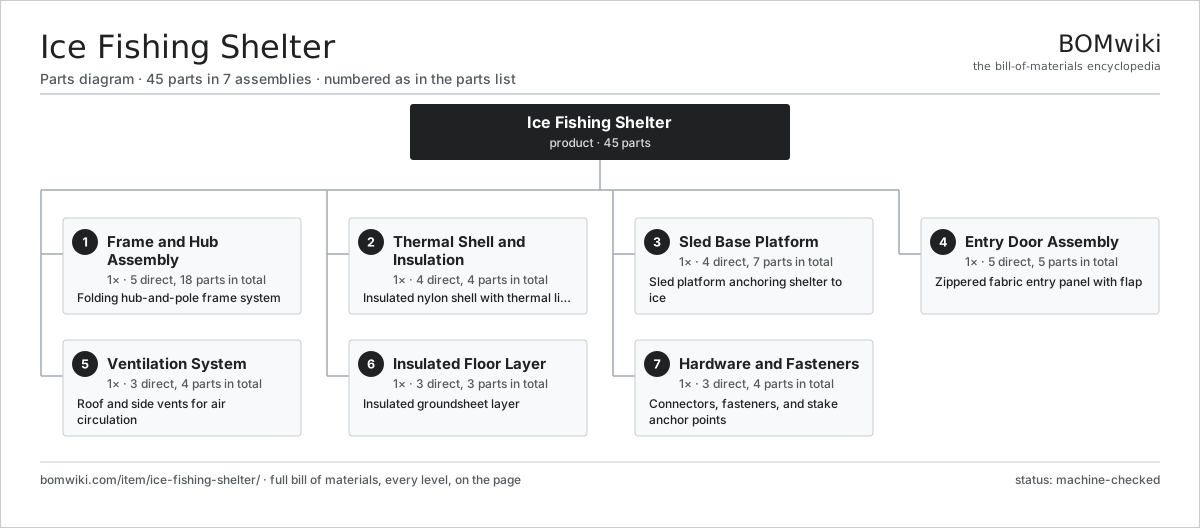
| # | Part | Qty | What it does |
|---|---|---|---|
| 1 | Frame and Hub Assembly 5 parts | 1× | Folding hub-and-pole frame system |
| 2 | Thermal Shell and Insulation 4 parts | 1× | Insulated nylon shell with thermal lining |
| 3 | Sled Base Platform 4 parts | 1× | Sled platform anchoring shelter to ice |
| 4 | Entry Door Assembly 5 parts | 1× | Zippered fabric entry panel with flap |
| 5 | Ventilation System 3 parts | 1× | Roof and side vents for air circulation |
| 6 | Insulated Floor Layer 3 parts | 1× | Insulated groundsheet layer |
| 7 | Hardware and Fasteners 3 parts | 1× | Connectors, fasteners, and stake anchor points |
3D model
No 3D model yet. Have a CAD file of this? Add a 3D model — STL renders right on this page; STEP, FreeCAD, and OpenSCAD sources are welcome too (openly licensed, like all 3D models on BOMwiki).
Build & assembly graph
expand / collapse · shared sub-assemblies converge · links to related products · est. labourTap an assembly to expand/collapse · tap a part to open it · use “Open page” for any node · drag to pan, scroll to zoom.
Bill of materials for Ice Fishing Shelter
7 top-level lines · 34 rows shown · 45 parts total · indented to 3 levels| # | Item / sub-assembly | Part no. | Qty/assy | Ext. qty | Parts | Type |
|---|---|---|---|---|---|---|
| 1 | Frame and Hub Assembly 5 parts | ice-fishing-shelter-frame | 1× | 1 | 18 | assembly |
| 1.1 | Central Hub | ice-fishing-shelter-hub-center | 1× | 1 | · | part |
| 1.2 | Main Vertical Pole | ice-fishing-shelter-main-pole | 4× | 4 | · | part |
| 1.3 | Diagonal Bracing Strut | ice-fishing-shelter-diagonal-strut | 4× | 4 | · | part |
| 1.4 | Pole Connector | ice-fishing-shelter-connector | 8× | 8 | · | part |
| 1.5 | Internal Shock Cord | ice-fishing-shelter-shock-cord | 1× | 1 | · | part |
| 2 | Thermal Shell and Insulation 4 parts | ice-fishing-shelter-fabric | 1× | 1 | 4 | assembly |
| 2.1 | Outer Nylon Shell | ice-fishing-shelter-outer-nylon | 1× | 1 | · | part |
| 2.2 | Thermal Padding | ice-fishing-shelter-insulation-layer | 1× | 1 | · | part |
| 2.3 | Inner Lining Fabric | ice-fishing-shelter-inner-lining | 1× | 1 | · | part |
| 2.4 | Seam Tape | ice-fishing-shelter-seam-tape | 1× | 1 | · | part |
| 3 | Sled Base Platform 4 parts | ice-fishing-shelter-base | 1× | 1 | 7 | assembly |
| 3.1 | Left Sled Ski | ice-fishing-shelter-sled-left | 1× | 1 | · | part |
| 3.2 | Right Sled Ski | ice-fishing-shelter-sled-right | 1× | 1 | · | part |
| 3.3 | Sled Cross Brace | ice-fishing-shelter-cross-brace | 2× | 2 | · | part |
| 3.4 | Anchor Eyelet | ice-fishing-shelter-anchor-point | 3× | 3 | · | part |
| 4 | Entry Door Assembly 5 parts | ice-fishing-shelter-door | 1× | 1 | 5 | assembly |
| 4.1 | Door Fabric Panel | ice-fishing-shelter-door-fabric | 1× | 1 | · | part |
| 4.2 | Outer Door Zipper | ice-fishing-shelter-door-zipper-outer | 1× | 1 | · | part |
| 4.3 | Inner Door Zipper | ice-fishing-shelter-door-zipper-inner | 1× | 1 | · | part |
| 4.4 | Door Frame Stiffener | ice-fishing-shelter-door-frame | 1× | 1 | · | part |
| 4.5 | Door Wind Flap | ice-fishing-shelter-door-flap | 1× | 1 | · | part |
| 5 | Ventilation System 3 parts | ice-fishing-shelter-vents | 1× | 1 | 4 | assembly |
| 5.1 | Roof Vent with Damper | ice-fishing-shelter-roof-vent | 1× | 1 | · | part |
| 5.2 | Side Vent Panel | ice-fishing-shelter-side-vent | 2× | 2 | · | part |
| 5.3 | Damper Control Cord | ice-fishing-shelter-damper-control | 1× | 1 | · | part |
| 6 | Insulated Floor Layer 3 parts | ice-fishing-shelter-floor | 1× | 1 | 3 | assembly |
| 6.1 | Closed-Cell Foam Pad | ice-fishing-shelter-foam-pad | 1× | 1 | · | part |
| 6.2 | Moisture Barrier Film | ice-fishing-shelter-moisture-barrier | 1× | 1 | · | part |
| 6.3 | Fastener Set | fastener-set | 1× | 1 | · | part |
| 7 | Hardware and Fasteners 3 parts | ice-fishing-shelter-hardware | 1× | 1 | 4 | assembly |
| 7.1 | Pole Connector | ice-fishing-shelter-connector | 1× | 1 | · | part |
| 7.2 | Guy-Line Rope Kit | ice-fishing-shelter-rope-anchor | 1× | 1 | · | part |
| 7.3 | Ice Anchor Screw | ice-fishing-shelter-ice-screw | 2× | 2 | · | part |
Related products
same domain, ranked by shared parts Avalanche Transceiver
35 parts · shares 1 with this page
Avalanche Transceiver
35 parts · shares 1 with this page
 Backpacking Stove
32 parts · shares 1 with this page
Backpacking Stove
32 parts · shares 1 with this page
 Baitcasting Reel
51 parts · shares 1 with this page
Bow Press
17 parts · shares 1 with this page
Bow Sight
72 parts · shares 1 with this page
Baitcasting Reel
51 parts · shares 1 with this page
Bow Press
17 parts · shares 1 with this page
Bow Sight
72 parts · shares 1 with this page
Sourcing: possible vendors
Prices, MOQ, and lead times are algorithmic estimates, not quotes, and not claims about these companies. Company mappings are curated by keyword; est. price band $20–$2k. How estimates work| Vendor | HQ | Specialty | MOQ | Lead time |
|---|---|---|---|---|
|
🇺🇸Coleman
coleman.com ↗
|
Chicago, US | Camping gear | 1,000 units | 6–10 wks |
| thenorthface.com ↗ | Denver, US | Outdoor apparel & gear | 1,000 units | 6–10 wks |
|
🇺🇸YETI
yeti.com ↗
|
Austin, US | Coolers & drinkware | 1,000 units | 6–10 wks |
| decathlon.com ↗ | Villeneuve-d'Ascq, FR | Sporting goods | 1,000 units | 6–10 wks |
|
🇺🇸Garmin
garmin.com ↗
|
Olathe, US | GPS & wearables | 1,000 units | 6–10 wks |
1,221-word article