Wireless In-Ear Monitor System
ProductOverview
A wireless in-ear monitor (IEM) system replaces floor wedge speakers with a personal mix delivered straight into a performer's ears. A rack Stereo Transmitter at the mix position radiates the monitor mix over a UHF FM link; each musician wears a Bodypack Receiver receiver feeding sealed In-Ear Earphones. Because the earphones isolate roughly 25 dB of stage noise, performers can monitor at moderate levels instead of competing with the backline, which protects hearing, removes wedge spill from the microphones, and makes the mix identical anywhere on stage.
Multi-channel rigs add an Antenna System that combines several transmitters onto one directional antenna, a Charging Dock dock for the pack batteries, and a Rack-Mount Kit that mounts the half-rack transmitters in a touring rack.
Transmission
The monitor mix arrives at the transmitter's balanced Input and Limiter Stage, where it is pre-emphasised, companded, and limited to prevent over-deviation. The Stereo MPX Encoder then builds a stereo multiplex signal, sum channel, 19 kHz pilot, and difference channel on a 38 kHz subcarrier, the same scheme broadcast FM has used since 1961, chosen because it degrades gracefully: a marginal signal loses stereo separation before it loses audio. The TX RF Board frequency-modulates this onto a PLL-synthesised UHF carrier, tunable in 25 kHz steps across a window of roughly 40 MHz, at 10 to 50 mW. Companding matters because FM's native dynamic range is well under a live mix's: the audio is compressed 2:1 before transmission and expanded 1:2 in the receiver, pushing the link's noise floor down by tens of decibels.
Frequency coordination is the operational discipline of IEM use. Each system needs a clear channel, but pairs of transmitters also generate intermodulation products at predictable frequencies; a 16-channel rig is calculated, not guessed. The Antenna Combiner exists for the same reason, it sums up to four transmitters onto a single Paddle Antenna while keeping their output stages isolated from each other, since two transmitter finals coupled through shared antennas would mix and radiate spurious products across the band.
Reception
The beltpack's Diversity RX Front End is a diversity design: two receive paths, and the pack continuously selects the stronger. This counters multipath fade, on a stage full of reflective surfaces, direct and reflected waves cancel at specific spots a few centimetres wide, and a moving performer walks through them constantly. With antenna diversity the odds of both paths fading simultaneously are small. The Stereo Decoder recovers left and right and expands the companded dynamics, and the Headphone Amplifier drives the earphones with around 100 mW, more than enough for sensitive in-ears, behind an output limiter that caps the level a fault can deliver into a sealed ear canal. The performer's only controls are the Volume Wheel and channel select; everything else is set at the rack and pushed to packs over an IR or RF sync link. Power comes from two AA cells in the Battery Tray or a Battery Sled with a fuel gauge, charged in the Charging Bay between shows.
Earphones
The earpieces do double duty as transducer and earplug. Universal-fit models seal with foam or silicone Ear Tips; custom models are printed from ear impressions for repeatable isolation. Inside each Earphone Shell, one or more Balanced-Armature Driver units generate the sound, balanced armatures, in which a magnetically pivoted reed drives a tiny diaphragm through a connecting rod. They trade the bass extension of a dynamic driver for very high sensitivity and a package small enough to stack several per ear, divided by a passive Passive Crossover. The Detachable Cable detaches at the shell, since cable failure from sweat and nightly coiling is the dominant field repair.
Practical limits
Range is typically quoted near 90 m line of sight but real stages are won or lost on antenna placement: the paddle goes up high with a clear view of the performance area, fed through short runs of low-loss Coaxial Feeder, with Antenna Bulkhead feed-throughs bringing connections to the rack front. The analog FM architecture described here still dominates touring because its latency is effectively zero; digital IEM links add a few milliseconds, which a singer hears as comb filtering against the bone-conducted sound of their own voice.
Wireless In-Ear Monitor System parts and their functions
6 top-level parts · 75 parts in total · full bill of materials below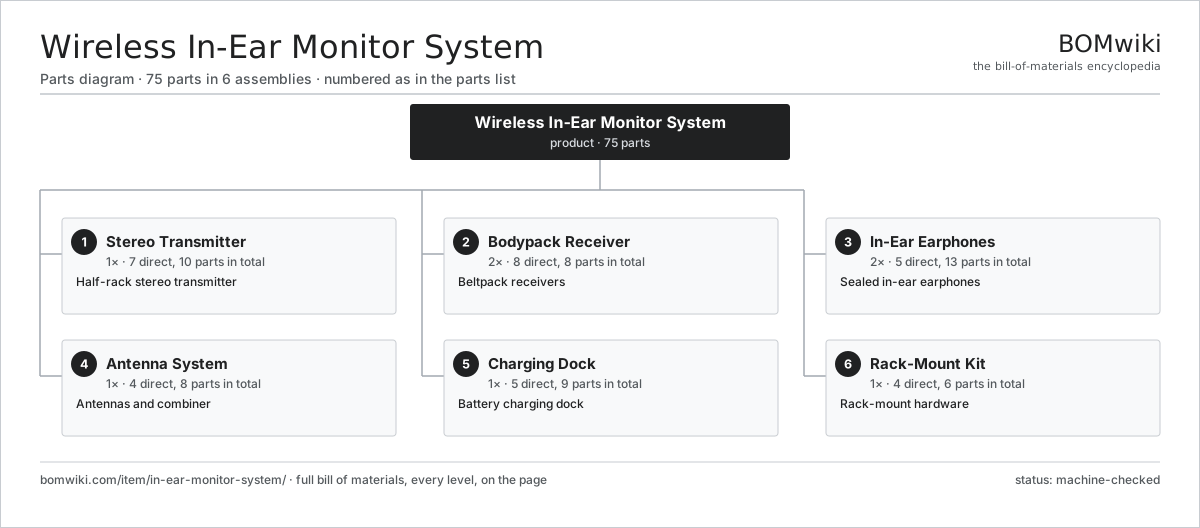
| # | Part | Qty | What it does |
|---|---|---|---|
| 1 | Stereo Transmitter 7 parts | 1× | Half-rack stereo transmitter |
| 2 | Bodypack Receiver 8 parts | 2× | Beltpack receivers |
| 3 | In-Ear Earphones 5 parts | 2× | Sealed in-ear earphones |
| 4 | Antenna System 4 parts | 1× | Antennas and combiner |
| 5 | Charging Dock 5 parts | 1× | Battery charging dock |
| 6 | Rack-Mount Kit 4 parts | 1× | Rack-mount hardware |
3D model
No 3D model yet. Have a CAD file of this? Add a 3D model — STL renders right on this page; STEP, FreeCAD, and OpenSCAD sources are welcome too (openly licensed, like all 3D models on BOMwiki).
Build & assembly graph
expand / collapse · shared sub-assemblies converge · links to related products · est. labourTap an assembly to expand/collapse · tap a part to open it · use “Open page” for any node · drag to pan, scroll to zoom.
Bill of materials for Wireless In-Ear Monitor System
6 top-level lines · 39 rows shown · 75 parts total · indented to 3 levels| # | Item / sub-assembly | Part no. | Qty/assy | Ext. qty | Parts | Type |
|---|---|---|---|---|---|---|
| 1 | Stereo Transmitter 7 parts | in-ear-monitor-system-transmitter | 1× | 1 | 10 | assembly |
| 1.1 | TX RF Board | in-ear-monitor-system-tx-rf-board | 1× | 1 | · | part |
| 1.2 | Stereo MPX Encoder | in-ear-monitor-system-mpx-encoder | 1× | 1 | · | part |
| 1.3 | Input and Limiter Stage | in-ear-monitor-system-tx-audio-in | 1× | 1 | · | part |
| 1.4 | LCD Panel | lcd-panel | 1× | 1 | · | part |
| 1.5 | Microcontroller | mcu | 1× | 1 | · | part |
| 1.6 | Connector | connector | 4× | 4 | · | part |
| 1.7 | Power Supply | power-supply | 1× | 1 | · | part |
| 2 | Bodypack Receiver 8 parts | in-ear-monitor-system-bodypack | 2× | 2 | 8 | assembly |
| 2.1 | Diversity RX Front End | in-ear-monitor-system-rx-front-end | 1× | 2 | · | part |
| 2.2 | Stereo Decoder | in-ear-monitor-system-mpx-decoder | 1× | 2 | · | part |
| 2.3 | Headphone Amplifier | in-ear-monitor-system-hp-amp | 1× | 2 | · | part |
| 2.4 | Whip Antenna | in-ear-monitor-system-rx-antenna | 1× | 2 | · | part |
| 2.5 | Volume Wheel | in-ear-monitor-system-volume-wheel | 1× | 2 | · | part |
| 2.6 | Beltpack Housing | in-ear-monitor-system-pack-case | 1× | 2 | · | part |
| 2.7 | Battery Tray | in-ear-monitor-system-aa-tray | 1× | 2 | · | part |
| 2.8 | LCD Panel | lcd-panel | 1× | 2 | · | part |
| 3 | In-Ear Earphones 5 parts | in-ear-monitor-system-earphones | 2× | 2 | 13 | assembly |
| 3.1 | Balanced-Armature Driver | in-ear-monitor-system-ba-driver | 2× | 4 | · | part |
| 3.2 | Earphone Shell | in-ear-monitor-system-ear-shell | 2× | 4 | · | part |
| 3.3 | Ear Tips | in-ear-monitor-system-ear-tips | 6× | 12 | · | part |
| 3.4 | Detachable Cable | in-ear-monitor-system-ear-cable | 1× | 2 | · | part |
| 3.5 | Passive Crossover | in-ear-monitor-system-ear-crossover | 2× | 4 | · | part |
| 4 | Antenna System 4 parts | in-ear-monitor-system-antenna-system | 1× | 1 | 8 | assembly |
| 4.1 | Paddle Antenna | in-ear-monitor-system-paddle-antenna | 1× | 1 | · | part |
| 4.2 | Antenna Combiner | in-ear-monitor-system-combiner | 1× | 1 | · | part |
| 4.3 | Coaxial Feeder | in-ear-monitor-system-coax | 2× | 2 | · | part |
| 4.4 | Connector | connector | 4× | 4 | · | part |
| 5 | Charging Dock 5 parts | in-ear-monitor-system-charging | 1× | 1 | 9 | assembly |
| 5.1 | Charging Bay | in-ear-monitor-system-charge-bay | 2× | 2 | · | part |
| 5.2 | Battery Sled | in-ear-monitor-system-battery-sled | 2× | 2 | · | part |
| 5.3 | Li-ion Cell, 18650 | li-cell-18650 | 2× | 2 | · | part |
| 5.4 | BMS Board | bms-board | 2× | 2 | · | part |
| 5.5 | Power Supply | power-supply | 1× | 1 | · | part |
| 6 | Rack-Mount Kit 4 parts | in-ear-monitor-system-rack-kit | 1× | 1 | 6 | assembly |
| 6.1 | Rack Ears | in-ear-monitor-system-rack-ears | 2× | 2 | · | part |
| 6.2 | Joining Plate | in-ear-monitor-system-joining-plate | 1× | 1 | · | part |
| 6.3 | Antenna Bulkhead | in-ear-monitor-system-antenna-bulkhead | 2× | 2 | · | part |
| 6.4 | Fastener Set | fastener-set | 1× | 1 | · | part |
Related products
same domain, ranked by shared parts Karaoke Machine
59 parts · shares 4 with this page
Karaoke Machine
59 parts · shares 4 with this page
 Portable Boombox
47 parts · shares 4 with this page
Portable Boombox
47 parts · shares 4 with this page
 Portable PA System
86 parts · shares 4 with this page
UHF Wireless Microphone System
291 parts · shares 3 with this page
Wireless Video TX/RX Kit
448 parts · shares 3 with this page
Intercom Beltpack
127 parts · shares 2 with this page
Portable PA System
86 parts · shares 4 with this page
UHF Wireless Microphone System
291 parts · shares 3 with this page
Wireless Video TX/RX Kit
448 parts · shares 3 with this page
Intercom Beltpack
127 parts · shares 2 with this page
Sourcing: possible vendors
Prices, MOQ, and lead times are algorithmic estimates, not quotes, and not claims about these companies. Company mappings are curated by keyword; est. price band $50–$3k. How estimates work| Vendor | HQ | Specialty | MOQ | Lead time |
|---|---|---|---|---|
|
🇯🇵Sony
sony.com ↗
|
Tokyo, JP | Consumer electronics | 1,000 units | 8–12 wks |
| samsung.com ↗ | Suwon, KR | Electronics & displays | 1,000 units | 8–12 wks |
|
🇺🇸Harman
harman.com ↗
|
Stamford, US | Audio (JBL, AKG) | 1,000 units | 8–12 wks |
|
🇺🇸Bose
bose.com ↗
|
Framingham, US | Audio | 1,000 units | 8–12 wks |
| yamaha.com ↗ | Hamamatsu, JP | Audio & instruments | 1,000 units | 8–12 wks |
809-word article