Induction Hardening System
ProductAlso known as: Induction Hardening Machine
Overview
An induction hardening system uses electromagnetic induction to rapidly heat localized areas of steel components to hardening temperature (typically 750–850 °C for carbon steel), followed immediately by rapid quenching to lock in the hard martensitic microstructure. This process, called induction hardening or induction surface hardening, produces a hardened surface layer (case) while the interior remains softer and tougher, ideal for wear and fatigue resistance in applications like gears, shafts, and bearings.
Induction heating is preferred over conventional furnace hardening because it is:
- Localized: Only the region in the coil is heated, sparing unnecessary heating of the entire workpiece.
- Rapid: Heating time is seconds to minutes, allowing fast throughput and minimal surface oxidation.
- Repeatable: Closed-loop temperature feedback ensures consistent hardness and case depth across a production run.
- Clean: No flame or combustion products; the process is environmentally benign and indoor-friendly.
Modern induction hardening systems integrate a solid-state RF or MF inverter power supply, a custom-shaped copper coil, real-time pyrometer feedback, and programmable quenching, all controlled by a PLC.
How it works
A workpiece (previously rough-machined) is placed in an indexing fixture. The induction coil, shaped to match the part geometry (e.g., a helical groove around a shaft), is positioned at a precise distance (typically 2–5 mm) from the part surface.
The RF or MF inverter generates high-frequency alternating current (1–400 kHz, depending on desired penetration depth and heating uniformity). This current flows through the coil, establishing a time-varying magnetic field. By Faraday's law, the metallic workpiece (which is essentially a secondary turn of a transformer) develops an induced current (eddy current) circulating within the conductive surface layer.
The electrical resistance of the metal converts this induced current into heat (I²R heating). Because eddy currents are concentrated in a thin layer near the surface, induction heating is inherently surface-focused; the depth of heated region depends on frequency, material conductivity, and coil design. Higher frequencies penetrate shallowly (10 mm or less); lower frequencies penetrate more deeply (up to 50 mm or more).
As the part surface temperature rises, an infrared pyrometer continuously measures it. The PLC reads the pyrometer signal and adjusts the inverter output power to maintain a target temperature setpoint (typically 800 °C for hardening, ±10 °C accuracy with modern feedback control). Once the pyrometer indicates the setpoint has been reached, the system dwells for 1–3 seconds to ensure uniform temperature through the case layer, then triggers the quenching system.
The quench fluid (water, oil-based polymer, or mineral oil) is suddenly sprayed or flooded onto the hot part surface via solenoid-controlled nozzles. The rapid cooling (rates often exceeding 50 °C/s at the surface) drives a solid-state phase transformation: austenite (the high-temperature face-centered cubic crystal structure of iron) transforms to martensite (body-centered tetragonal structure), a much harder phase.
The interior of the part, remaining at a lower temperature, does not achieve a high cooling rate; it stays austenitic or transforms to bainite, a softer, tougher phase. This dual-phase structure, hard surface, tough core, is the hallmark of induction-hardened parts.
After quenching, the part is transferred to a cooldown station where it air-cools to approximately 200 °C before being handled. Some applications include a low-temperature tempering step (150–350 °C in a convection oven) to relieve quenching stresses and optimize toughness. The cycle time from loading to part ejection is typically 5–20 minutes depending on part size and cooling requirements.
Coil Design and Tuning
The copper coil is perhaps the most critical custom component. For a cylindrical shaft, the coil is often helical (corkscrew-shaped), wrapping around the shaft and inducing a circumferential eddy current pattern. For a flat surface (like a gear tooth flank), the coil is a curved rectangular solenoid conforming to the geometry.
The coil is water-cooled (internal passages) to dissipate the intense heat generated by current flow and proximity heating from the workpiece. Water flow rates are typically 5–15 L/min at 40–50 °C.
The impedance of the coil-workpiece system varies with part geometry, material, and frequency. A frequency tuning network (variable capacitors and inductors) matches the inverter output impedance to the coil load, maximizing power transfer efficiency. This tuning must be recalibrated whenever part design or material changes significantly.
Frequency Selection
High frequency (100–400 kHz) penetrates 0.5–2 mm and is ideal for thin hardening of bearing races, cam lobes, or small gears. Heating is very rapid (10–30 seconds).
Medium frequency (1–10 kHz) penetrates 3–10 mm and suits larger components. Heating is slower (30–120 seconds) but more uniform through the case.
Low frequency (50–500 Hz) penetrates deeply (20–50 mm) and is used for through-hardening of large parts like crankshaft journals. These systems often employ large copper bars instead of windings.
Selection depends on case depth specification, heating uniformity, and cycle time targets.
Temperature Control and Feedback
A non-contact infrared pyrometer mounted on the coil or nearby continuously measures surface temperature. Modern pyrometers are sapphire-windowed to survive the forge environment (scale, dust, thermal cycling). They output 4–20 mA proportional to temperature.
The PLC reads this signal and executes a proportional-integral (PI) control loop, adjusting the inverter power output to track a target setpoint. When actual temperature lags the setpoint, power increases; when it exceeds the setpoint, power decreases. This closed-loop control is crucial: it accommodates variations in material properties, coil wear, and ambient conditions, ensuring consistent hardness part-to-part.
Most systems allow the operator to program a temperature profile: heat to 800 °C over 20 seconds, dwell at 800 °C for 3 seconds, then trigger quench. Different parts (different sizes, materials) have different profiles stored in the PLC, recalled via a job code.
Quenching Media
Oil (mineral oil or synthetic) offers moderate cooling rates (10–30 °C/s) and minimal distortion. Used for soft-steel or larger forgings.
Water-based polymer (polyethylene glycol solutions) offers faster cooling (30–50 °C/s) than oil, less hazardous than water, and controllable quench intensity via dilution. Most modern automotive plants use polymer.
Straight water cools fastest (100+ °C/s) but risks excessive distortion and cracking in complex geometries. Rarely used alone; instead, water is often used for initial rapid cooling, followed by oil or air cooling to slow the final phase.
The quench fluid must be continuously filtered (to remove scale particles) and cooled (to maintain consistent temperatures and quench intensity). A 20–50 kW cooling loop is typical.
Process Repeatability and Quality
Hardness uniformity across a production run is typically ±2–3 HRC with closed-loop control. Finer control (±1 HRC) is achievable with advanced systems using multi-zone heating or adaptive power profiles. Case depth is controlled by heating time and final temperature; repeatability is ±0.1–0.2 mm.
Critical parts (automotive steering, aerospace gears) are sampled and tested: hardness Rockwell C hardness measurement at multiple locations, case depth metallography, and fatigue or wear tests. Traceability records (temperature history, power levels, coil wear counter) are retained for each lot.
Coil Maintenance and Wear
Coil life depends on power level, frequency, and duty cycle. A coil can harden 5,000–50,000 parts before cracking or loss of cooling efficiency. Signs of wear include:
- Reduced heating efficiency (longer time to reach temperature)
- Temperature drift (widening spread of hardness)
- Water leakage indicating internal crack
Inspection (ultrasonic flaw detection) and replacement are routine maintenance. Coil replacement costs $5,000–$20,000 depending on complexity, but lasts 6–24 months in high-volume production.
Integration with Production Lines
Induction hardening is a natural fit for linked machining and heat-treat lines. A CNC turret lathe or grinding center may feed directly to an induction hardening station, then to a cooldown conveyor. PLC networking synchronizes all stations, enabling high throughput (30–200 parts/hour depending on size and cycle time) and automatic job selection based on part ID codes.
Modern automotive plants integrate induction hardening into a complete workflow: rough forge → CNC machine → induction harden → finish grind → wash → ship. One operator oversees multiple machines, with minimal manual handling.
Induction Hardening System parts and their functions
8 top-level parts · 34 parts in total · full bill of materials below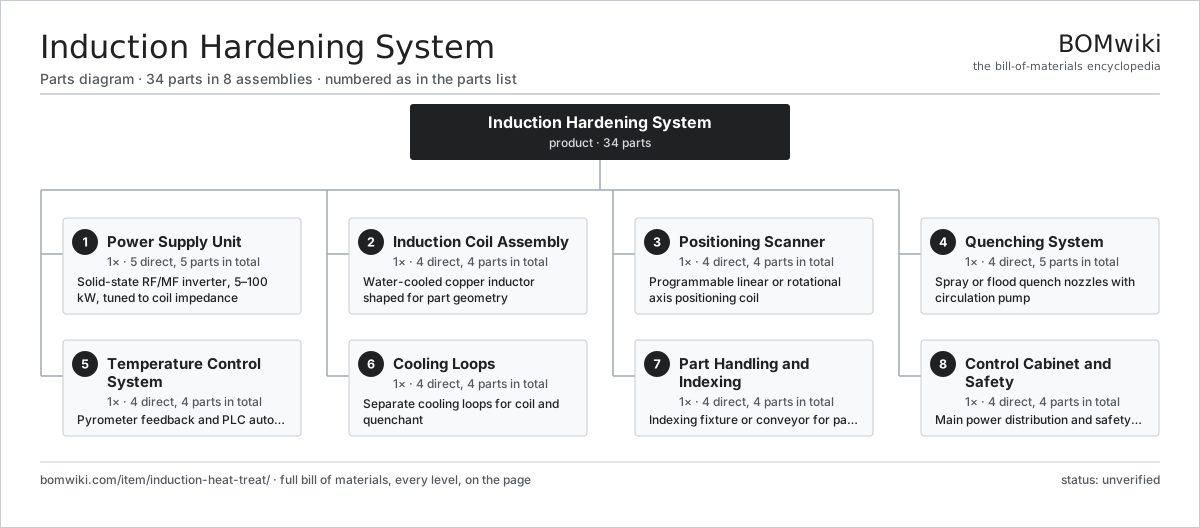
| # | Part | Qty | What it does |
|---|---|---|---|
| 1 | Power Supply Unit 5 parts | 1× | Solid-state RF/MF inverter, 5–100 kW, tuned to coil impedance |
| 2 | Induction Coil Assembly 4 parts | 1× | Water-cooled copper inductor shaped for part geometry |
| 3 | Positioning Scanner 4 parts | 1× | Programmable linear or rotational axis positioning coil |
| 4 | Quenching System 4 parts | 1× | Spray or flood quench nozzles with circulation pump |
| 5 | Temperature Control System 4 parts | 1× | Pyrometer feedback and PLC automation |
| 6 | Cooling Loops 4 parts | 1× | Separate cooling loops for coil and quenchant |
| 7 | Part Handling and Indexing 4 parts | 1× | Indexing fixture or conveyor for part positioning |
| 8 | Control Cabinet and Safety 4 parts | 1× | Main power distribution and safety relays |
3D model
No 3D model yet. Have a CAD file of this? Add a 3D model — STL renders right on this page; STEP, FreeCAD, and OpenSCAD sources are welcome too (openly licensed, like all 3D models on BOMwiki).
Build & assembly graph
expand / collapse · shared sub-assemblies converge · links to related products · est. labourTap an assembly to expand/collapse · tap a part to open it · use “Open page” for any node · drag to pan, scroll to zoom.
Bill of materials for Induction Hardening System
8 top-level lines · 41 rows shown · 34 parts total · indented to 3 levels| # | Item / sub-assembly | Part no. | Qty/assy | Ext. qty | Parts | Type |
|---|---|---|---|---|---|---|
| 1 | Power Supply Unit 5 parts | induction-heat-treat-power-supply | 1× | 1 | 5 | assembly |
| 1.1 | Main Inverter Module | induction-heat-treat-main-inverter | 1× | 1 | · | part |
| 1.2 | Capacitor Bank | induction-heat-treat-capacitor-bank | 1× | 1 | · | part |
| 1.3 | Output Transformer | induction-heat-treat-transformer | 1× | 1 | · | part |
| 1.4 | Inverter Cooling Fan | induction-heat-treat-cooling-fan | 1× | 1 | · | part |
| 1.5 | Current Transducer | induction-heat-treat-current-sensor | 1× | 1 | · | part |
| 2 | Induction Coil Assembly 4 parts | induction-heat-treat-coil | 1× | 1 | 4 | assembly |
| 2.1 | Copper Coil Tube | induction-heat-treat-coil-tubing | 1× | 1 | · | part |
| 2.2 | Coil Former | induction-heat-treat-coil-former | 1× | 1 | · | part |
| 2.3 | Coil Mounting Bracket | induction-heat-treat-coil-bracket | 1× | 1 | · | part |
| 2.4 | Coil Connector Lugs | induction-heat-treat-coil-connector | 1× | 1 | · | part |
| 3 | Positioning Scanner 4 parts | induction-heat-treat-scanner | 1× | 1 | 4 | assembly |
| 3.1 | Scanner Motor | induction-heat-treat-scanner-motor | 1× | 1 | · | part |
| 3.2 | Actuator (Lead Screw or Spindle) | induction-heat-treat-scanner-actuator | 1× | 1 | · | part |
| 3.3 | Scanner Bracket | induction-heat-treat-scanner-bracket | 1× | 1 | · | part |
| 3.4 | Position Sensor | induction-heat-treat-proximity-sensor | 1× | 1 | · | part |
| 4 | Quenching System 4 parts | induction-heat-treat-quench-system | 1× | 1 | 5 | assembly |
| 4.1 | Quench Pump | induction-heat-treat-quench-pump | 1× | 1 | · | part |
| 4.2 | Quench Nozzles | induction-heat-treat-quench-nozzles | 2× | 2 | · | part |
| 4.3 | Quench Flow Valve | induction-heat-treat-quench-manifold | 1× | 1 | · | part |
| 4.4 | Quench Fluid Filter | induction-heat-treat-quench-filter | 1× | 1 | · | part |
| 5 | Temperature Control System 4 parts | induction-heat-treat-temperature-control | 1× | 1 | 4 | assembly |
| 5.1 | Infrared Pyrometer | induction-heat-treat-pyrometer | 1× | 1 | · | part |
| 5.2 | Pyrometer Optics Assembly | induction-heat-treat-pyrometer-optics | 1× | 1 | · | part |
| 5.3 | Microcontroller | mcu | 1× | 1 | · | part |
| 5.4 | HMI Display Panel | induction-heat-treat-display | 1× | 1 | · | part |
| 6 | Cooling Loops 4 parts | induction-heat-treat-cooling-system | 1× | 1 | 4 | assembly |
| 6.1 | Coil Cooler | induction-heat-treat-coil-cooler | 1× | 1 | · | part |
| 6.2 | Coil Cooling Pump | induction-heat-treat-coil-pump | 1× | 1 | · | part |
| 6.3 | Quench Cooler | induction-heat-treat-quench-cooler | 1× | 1 | · | part |
| 6.4 | Thermostatic Control Valve | induction-heat-treat-thermostatic-valve | 1× | 1 | · | part |
| 7 | Part Handling and Indexing 4 parts | induction-heat-treat-part-handling | 1× | 1 | 4 | assembly |
| 7.1 | Indexing Fixture | induction-heat-treat-fixture-body | 1× | 1 | · | part |
| 7.2 | Part Clamp | induction-heat-treat-part-clamp | 1× | 1 | · | part |
| 7.3 | Index Cylinder | induction-heat-treat-index-cylinder | 1× | 1 | · | part |
| 7.4 | Cooldown Station | induction-heat-treat-cooldown-conveyor | 1× | 1 | · | part |
| 8 | Control Cabinet and Safety 4 parts | induction-heat-treat-control-cabinet | 1× | 1 | 4 | assembly |
| 8.1 | Main Contactor | induction-heat-treat-main-contactor | 1× | 1 | · | part |
| 8.2 | E-Stop Relay Module | induction-heat-treat-estop-relay | 1× | 1 | · | part |
| 8.3 | Soft-Start Unit | induction-heat-treat-soft-starter | 1× | 1 | · | part |
| 8.4 | Isolating Disconnector | induction-heat-treat-disconnector | 1× | 1 | · | part |
Sourcing: possible vendors
Prices, MOQ, and lead times are algorithmic estimates, not quotes, and not claims about these companies. Company mappings are curated by keyword; est. price band $10k–$1M. How estimates work| Vendor | HQ | Specialty | MOQ | Lead time |
|---|---|---|---|---|
|
🇩🇪DMG MORI
dmgmori.com ↗
|
Bielefeld, DE | Machine tools | 5 units | 12–20 wks |
|
🇯🇵Mazak
mazak.com ↗
|
Oguchi, JP | Machine tools | 5 units | 12–20 wks |
| haascnc.com ↗ | Oxnard, US | CNC machine tools | 5 units | 12–20 wks |
|
🇯🇵Okuma
okuma.com ↗
|
Niwa, JP | Machine tools | 5 units | 12–20 wks |
|
🇩🇪Trumpf
trumpf.com ↗
|
Ditzingen, DE | Laser & sheet-metal machines | 5 units | 12–20 wks |
1,362-word article